
Getting Back on Your Feet: Lumbar Radiculopathy Relief in Phoenix
When Your Lower Back Pain Shoots Down Your Leg: What Phoenix Residents Need to Know
If you’re searching for lumbar radiculopathy back pain relief in Phoenix, here is a quick summary of your best options:
| Treatment Step | What It Involves | Best For |
|---|---|---|
| Conservative care | Rest, NSAIDs, physical therapy | Mild to moderate symptoms |
| Interventional injections | Epidural steroid injections, nerve root blocks | Persistent nerve pain and inflammation |
| Minimally invasive procedures | MILD, microdiscectomy, radiofrequency ablation | Moderate to severe cases not responding to injections |
| Surgery | Open or endoscopic discectomy, spinal fusion | Progressive neurological deficits, failed conservative care |
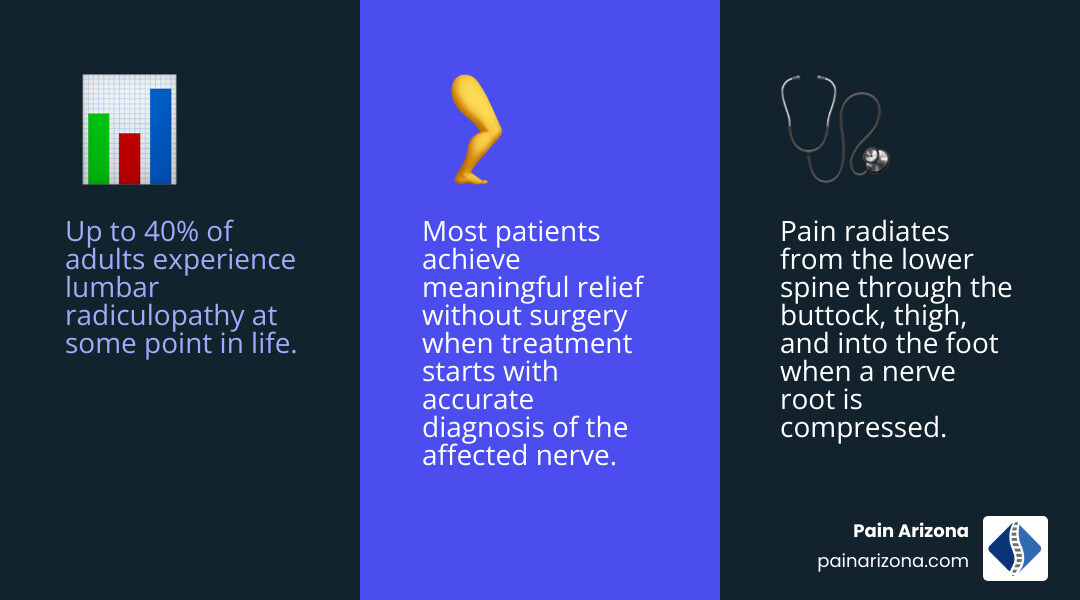
Most patients find meaningful relief without surgery. The right starting point depends on your specific diagnosis.
That sharp, burning pain that starts in your lower back and shoots down through your buttock, thigh, and into your foot — it has a name, and it has effective treatments. Lumbar radiculopathy back pain relief in Phoenix is more accessible than many patients realize, yet far too many people spend months — sometimes years — living with nerve pain that responds poorly to rest or over-the-counter medication alone.
Lumbar radiculopathy, commonly called sciatica, affects up to 40% of people at some point in their lives. It happens when a nerve root in the lower spine is compressed or irritated, sending pain signals far beyond the back itself. The condition is most common in adults between 30 and 50 — often the most active, productive years of life.
If you’ve been bouncing between treatments that don’t stick, or if the pain has started interfering with sleep, work, or simply getting through the day, you are not alone — and you don’t have to keep guessing.
I’m Dr. Nasser, a double board-certified physician in Physical Medicine and Rehabilitation and Pain Medicine, and I’ve spent my career performing thousands of minimally invasive procedures for patients dealing with exactly this kind of nerve-related spine pain. At Pain Arizona, I lead a multidisciplinary team dedicated to finding the root cause of your lumbar radiculopathy and building a personalized plan to get you real, lasting relief.
Glossary for lumbar radiculopathy back pain relief phoenix:
What is Lumbar Radiculopathy and Sciatica?
To understand how to find relief, we first need to look at the anatomy of your lower back. Your lumbar spine is made up of five vertebrae separated by shock-absorbing intervertebral discs. Branching off your spinal cord are nerve roots that exit through small openings in the bones.
When one of these nerve roots becomes pinched, compressed, or inflamed, it triggers a condition called lumbar radiculopathy. Because these nerve roots merge to form the massive sciatic nerve—the body’s largest nerve, which is roughly as thick as your pinky finger—the resulting radiating symptoms are frequently referred to as sciatica.
It is important to note that sciatica is a description of symptoms rather than an actual diagnosis. To achieve lasting lumbar radiculopathy back pain relief in Phoenix, we must identify the exact structural issue causing the nerve irritation. You can read more about this distinction in our guide, Is Your Lower Back Screaming? Understanding Lumbar Radiculopathy.
When a nerve is compressed, it behaves like a kinked garden hose. The normal flow of electrical signals is disrupted, resulting in a cascade of symptoms down the leg. If you are struggling to find answers, checking out our resource on finding the best lumbar radiculopathy and sciatica treatment in Phoenix is an excellent next step. You can also review general clinical insights regarding treatment for sciatica and sciatic nerve pain to learn more about the condition.
Common Causes and Symptoms of Nerve Compression
In our clinics across Phoenix, Mesa, Gilbert, Scottsdale, and Glendale, we see patients with lumbar radiculopathy caused by several common spinal issues:
- Herniated or Bulging Discs: The soft inner gel of a spinal disc can push through the tough outer layer, directly pressing against a nearby nerve root.
- Spinal Stenosis: Over time, the spinal canal can narrow due to wear and tear. This narrowing commonly occurs when ligaments, such as the ligamentum flavum, thicken and compress the nerve pathways.
- Bone Spurs (Osteophytes): Osteoarthritis can cause smooth bony growths to develop on the spinal joints, narrowing the space where nerves exit.
- Degenerative Disc Disease: As we age, discs lose their water content and shrink, reducing the space between vertebrae and pinching exiting nerves.
- Spondylolisthesis: This occurs when one vertebra slips forward over the one below it, pulling the nerve root out of alignment.
These conditions lead to a highly recognizable pattern of symptoms. While back pain may be present, the most disruptive symptoms usually travel down the leg. For a detailed breakdown, see our In-Depth Guide to Lumbar Radiculopathy Symptoms.
Common signs of nerve compression include:
- Sharp, shooting, or electric-shock-like pain that travels from the lower back through the buttock and down the leg.
- A persistent dull ache or burning heat in the calf or foot.
- Numbness or a “pins and needles” tingling sensation along a specific nerve pathway (dermatome).
- Muscle weakness in the leg or foot, which can sometimes lead to “foot drop” (difficulty lifting the front part of the foot).
- Muscle tightness, spasms, or cramping in the lower extremities.
For those dealing with bone spurs specifically, our guide on how to say goodbye to spine pain with top lumbar radiculopathy and bone spur treatments in Phoenix outlines specialized approaches. If you want to learn more about localized nerve irritation, understanding how a pinched nerve behaves is key to finding the right treatment.
How Specialists Diagnose Lumbar Radiculopathy Back Pain Relief Phoenix
Getting an accurate diagnosis is the most critical step toward recovery. Treating “back pain” as a generic symptom often leads to failed therapies and wasted time. When you visit a specialist, the diagnostic process is thorough and highly personalized.

At our offices, we begin with a comprehensive physical and neurological examination. We assess your reflexes, test your muscle strength, and perform specialized maneuvers like the straight leg raise test to see if moving your leg reproduces your nerve pain.
To confirm what is happening beneath the surface, we utilize advanced diagnostic tools:
- Magnetic Resonance Imaging (MRI): The gold standard for visualizing soft tissues, allowing us to see herniated discs, thickened ligaments, and compressed nerves clearly.
- Computed Tomography (CT) Scans: Useful for assessing the bony structures of the spine if an MRI is not an option.
- Electromyography (EMG) and Nerve Conduction Studies (NCS): These electrodiagnostic tests evaluate the electrical activity of your muscles and nerves, helping us pinpoint exactly which nerve root is damaged and how severely.
Partnering with an experienced back pain specialist Phoenix ensures that your treatment targets the exact structural issue. Choosing a dedicated pain management clinic Phoenix or looking into pain management advanced techniques can help you avoid unnecessary interventions and find a direct path to relief.
Non-Surgical and Interventional Treatments for Relief
The vast majority of patients with lumbar radiculopathy do not require major surgery. In fact, we always recommend starting with conservative and minimally invasive interventional treatments to calm the inflamed nerve root and allow the body to heal.

Conservative therapies include structured physical therapy to strengthen the core muscles supporting your spine, short-term use of anti-inflammatory medications, and activity modifications. To learn more about these foundational steps, read our guide on how to alleviate lower back pain and explore our comprehensive list of lower back pain treatments.
When conservative care alone isn’t enough to break the cycle of pain, interventional treatments offer a highly effective middle ground. These targeted procedures address the source of pain directly rather than masking it. You can read more about our philosophy in Don’t Let Your Back Hold You Back: Phoenix Pain Management Solutions.
To help you understand your options, here is a comparison of conservative care versus interventional injections:
| Feature | Conservative Care (PT, Medications) | Interventional Injections (Epidural, Blocks) |
|---|---|---|
| Primary Goal | Improve strength, flexibility, and support | Rapidly reduce local nerve inflammation |
| Target Area | Whole body/regional muscles and joints | Direct site of the compressed nerve root |
| Downtime | None (active participation required) | Minimal (usually 24 to 48 hours of light activity) |
| Time to Relief | Several weeks to months | 2 to 7 days as the medication takes effect |
| Role in Recovery | Long-term stability and prevention | Creates a pain-free window to perform physical therapy |
Our team also utilizes regenerative medicine and joint therapies where appropriate. For instance, you can learn everything you need to know about joint injections or read about PRP therapy Phoenix: is regenerative medicine right for you? to see how these cutting-edge therapies fit into a comprehensive plan. While we specialize in spine care, we also offer regional joint treatments, which you can read about in our knee injections Phoenix guide.
Interventional Injections for Lumbar Radiculopathy Back Pain Relief Phoenix
If nerve inflammation is keeping you from participating in physical therapy or enjoying your daily life, targeted injections can provide dramatic relief. These procedures are performed in an outpatient setting using fluoroscopy (real-time X-ray guidance) to ensure absolute precision.
The most common interventional injection for this condition is the lumbar epidural steroid injection (ESI). By delivering a powerful anti-inflammatory corticosteroid directly into the epidural space surrounding the irritated nerve, we can wash away inflammatory proteins and reduce swelling.
Depending on your anatomy, we may perform an interlaminar injection or a transforaminal epidural injection, which targets a single, specific nerve root as it exits the spine. For a detailed walk-through of what to expect, read Outpatient Lumbar Epidural Injections: A Smooth Procedure for Fast Relief and our detailed overview of the Transforaminal Epidural Injection.
If your back pain also stems from osteoarthritis in the spinal joints, we may combine these treatments with joint-specific therapies. Learn more in our Facet Joint Injection Complete Guide.
Minimally Invasive Procedures for Lumbar Radiculopathy Back Pain Relief Phoenix
When injections provide short-term relief but the structural compression remains, we can escalate care to outpatient, minimally invasive procedures. These advanced techniques require only tiny incisions, local anesthesia with light sedation, and minimal downtime.
- MILD® Procedure (Minimally Invasive Lumbar Decompression): Excellent for patients with spinal stenosis caused by a thickened ligament. Through an incision smaller than a baby aspirin, we can remove tiny portions of the excess ligament to restore space in the spinal canal.
- Radiofrequency Ablation (RFA): If your radiculopathy is accompanied by severe arthritic joint pain in the lower back, RFA uses gentle heat to temporarily turn off the sensory nerves sending pain signals from those joints. Read more about this in Phoenix’s Solution for Persistent Pain: Understanding Radiofrequency Ablation.
- Lumbar Microdiscectomy: If a large herniated disc fragment is pressing heavily on a nerve, a minimally invasive microdiscectomy can be performed using a microscope and muscle-sparing tubes to remove only the damaged portion of the disc, leaving the rest intact.
To explore these options further, check out our guides on minimally invasive back surgery, how to find the best minimally invasive spine doctors: what to look for, and your guide to cutting-edge pain and spine care.
Recovery Timeline and Preventing Recurrence
Recovery from lumbar radiculopathy is a journey, but with a structured plan, most patients return to their favorite activities quickly.
Following an interventional injection or a minimally invasive procedure, you can typically expect to resume light activities within 24 to 48 hours. The anti-inflammatory effects of an epidural injection usually begin to show within 2 to 7 days, providing a crucial window of relief.
To make sure your pain doesn’t return once you are feeling better, we emphasize long-term prevention strategies:
- Core Strengthening: Building strong abdominal and lower back muscles acts like a natural corset, taking the pressure off your lumbar discs.
- Smart Ergonomics: Whether you are driving in Valley traffic or sitting at a desk in Scottsdale, use a chair with proper lumbar support and take frequent standing breaks.
- Weight Management: Carrying extra weight puts additional mechanical stress on your lower spine.
- Safe Lifting Techniques: Always bend at your knees and hips, keeping heavy objects close to your body rather than bending at the waist.
Frequently Asked Questions about Sciatica and Pinched Nerves
What is the difference between sciatica and lumbar radiculopathy?
Sciatica is a broad term used to describe pain, numbness, or tingling that travels along the path of the sciatic nerve down the leg. Lumbar radiculopathy is the underlying medical condition—a compressed or irritated nerve root in the lower back—that actually causes those sciatic symptoms.
How long does it take to recover from an epidural steroid injection?
Most patients experience mild soreness at the injection site for a day or two, which responds well to ice. The pain-relieving effects of the steroid typically begin to kick in within 2 to 7 days and can last anywhere from several weeks to many months, giving you the comfort needed to progress through physical therapy.
When should I consider surgery for a pinched nerve?
Surgery is typically reserved for cases where conservative and interventional treatments have failed to provide relief after several weeks, or if you experience “red flag” symptoms. These include progressive muscle weakness (such as foot drop), difficulty walking, or a sudden loss of bowel or bladder control (which requires emergency medical attention).
Conclusion
Living with radiating lower back and leg pain can make even the simplest daily tasks feel like climbing Camelback Mountain in the middle of summer. But you don’t have to navigate this pain alone. At Pain Arizona, our double board-certified physicians specialize in identifying the exact source of your nerve compression and designing personalized, minimally invasive treatment plans to help you reclaim your life.
We accept most insurance plans. Check with our office manager to see if your plan is accepted.
If you are ready to take the first step toward lasting relief, schedule a comprehensive evaluation for lumbar radiculopathy treatment with our team today. Let’s get you back on your feet!