
Knee Injections Phoenix: 4 Best Relief
Why Phoenix Residents Are Exploring Knee Injection Options
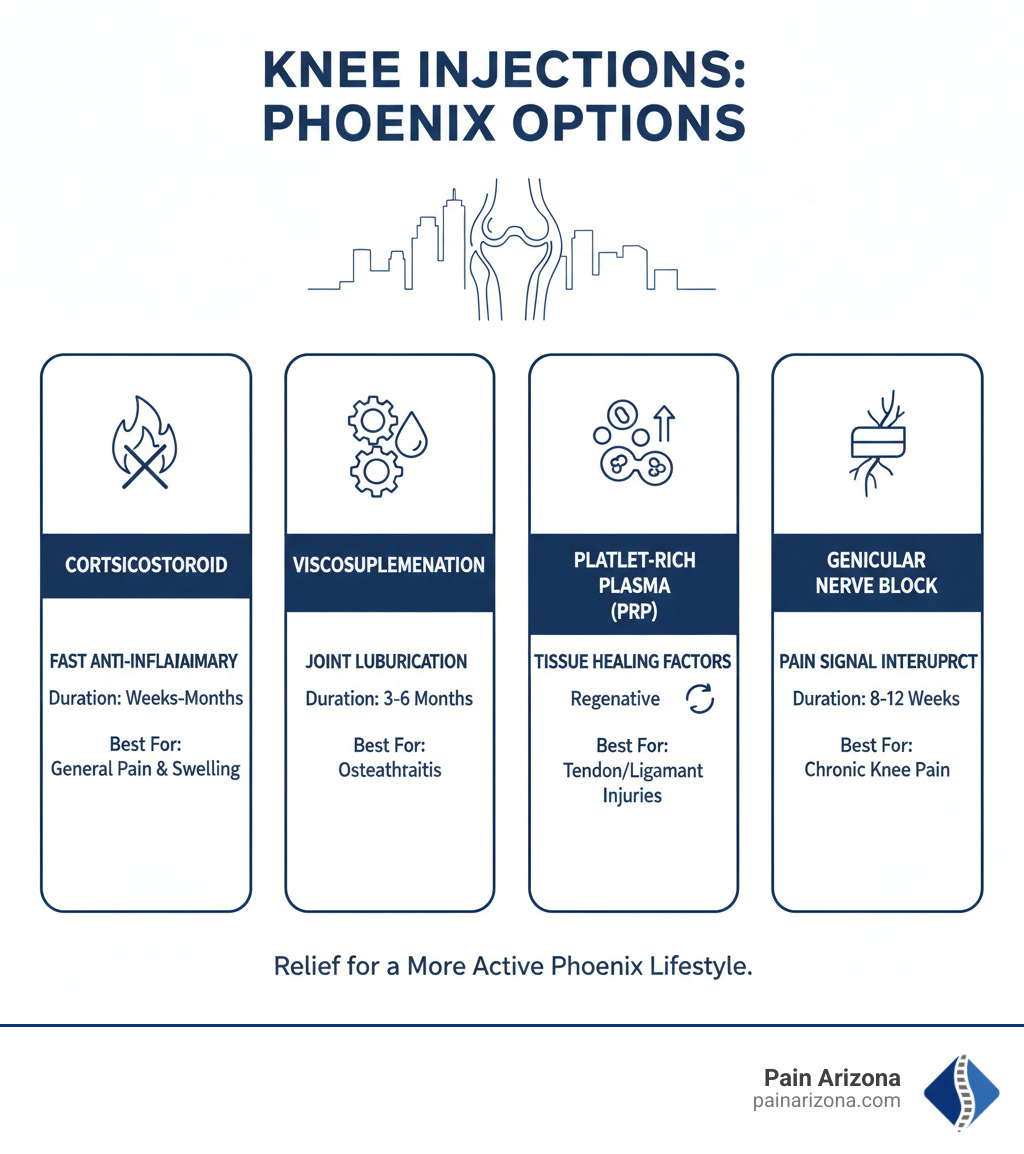
Knee injections phoenix offer minimally invasive treatments to reduce pain and restore function, helping you return to an active lifestyle. The main types available in the Greater Phoenix Area include:
Main Knee Injection Types:
- Corticosteroid Injections – Fast-acting anti-inflammatory relief, lasting weeks to months
- Viscosupplementation (Hyaluronic Acid) – Joint lubrication for osteoarthritis, lasting 3-6 months
- Platelet-Rich Plasma (PRP) – Regenerative therapy using your body’s own growth factors
- Genicular Nerve Blocks – Block pain signals, providing relief for 8-12 weeks
Knee pain from osteoarthritis, sports injuries, or chronic inflammation doesn’t have to control your life. Phoenix residents often consider knee injections when conservative treatments like rest, physical therapy, and over-the-counter medications fail to provide enough relief. These injections offer targeted relief by delivering medication directly to the pain source, without the need for surgery or long-term oral medications.
I’m Dr. Nasser, Chief Medical Officer and Medical Director at Pain Arizona, where I’ve performed tens of thousands of regenerative and minimally invasive procedures, including the advanced knee injections phoenix residents rely on for lasting relief. My goal is to help you understand your options so you can make an informed decision about your care.
This guide covers the types of knee injections available in Phoenix, what to expect during the procedure, and how to choose the right option for your specific condition.
Understanding Knee Pain and When to Consider Injections
An active Phoenix lifestylewhether hiking Camelback Mountain or golfing in Scottsdalerequires healthy knees. When pain slows you down, it’s crucial to understand the cause and your treatment options, including injections.
Common causes of knee pain we see at our Greater Phoenix Area clinics include:
Osteoarthritis is the leading cause of knee pain. This “wear and tear” arthritis involves the gradual breakdown of protective cartilage, leading to bone-on-bone friction, pain, and stiffness. The CDC reports that about 26% of all U.S. adults deal with some form of arthritis. You can find more info about Osteoarthritis on our website. For a general overview, see Osteoarthritis.
Rheumatoid arthritis is an autoimmune condition where the body attacks joint linings, causing inflammation, swelling, and pain.
Gout is caused by uric acid crystal buildup in a joint, leading to sudden, severe pain.
Sports injuries, common in our active community, include ligament tears (ACL/PCL), meniscus damage, or tendinitis from overuse or sudden impacts.

Consider knee injections phoenix when conservative treatments like physical therapy, rest, and medication no longer provide relief. These intra-articular injections deliver medication directly into the knee joint.
Who is a good candidate for knee injections? You may be a candidate if you have chronic knee pain that hasn’t responded to other treatments, want to delay or avoid surgery, or cannot tolerate oral anti-inflammatory medications. Injections work best for conditions like mild to moderate osteoarthritis, rheumatoid arthritis, and gout.
Who should be cautious? Injections may not be safe if you have an active infection near the knee, allergies to injection components (e.g., egg or poultry allergies for some HA injections), or severe bleeding disorders. Those who are pregnant, breastfeeding, or have uncontrolled diabetes should discuss the risks with their doctor, as corticosteroids can temporarily raise blood sugar levels.
The decision to pursue knee injections phoenix requires a consultation with a qualified pain specialist. At Pain Arizona, we provide evidence-based, minimally invasive treatments that target the root cause of your pain.
To learn more about the different types of arthritis and how they’re treated, check out our comprehensive guide on Arthritis Types and Treatments: Navigating Joint Pain.
A Guide to the Different Types of Knee Injections in Phoenix
Dealing with persistent knee pain in Phoenix can be overwhelming, but specialists offer several proven knee injections phoenix to target your pain. These intra-articular injections deliver medication directly into the knee joint. This targeted approach provides higher concentrations of medication at the pain source for more effective relief and fewer side effects than oral medications.
Successful treatment involves matching the right injection to your specific condition. Some reduce inflammation, others lubricate the joint, promote healing, or block pain signals.
Let’s walk through the most common types of knee injections phoenix residents rely on for relief.
Corticosteroid (Cortisone) Injections
Cortisone shots deliver powerful anti-inflammatory relief for swollen, painful knees. Corticosteroids are synthetic hormones that reduce inflammation by suppressing inflammatory cells, leading to less swelling and pain. We often add a local anesthetic for immediate, temporary relief, while the steroid itself takes a few days to become fully effective.
They are effective for arthritis (osteoarthritis, rheumatoid, gout) and other inflammatory conditions. Relief can last from a few weeks to several months. Risks are minimal but include a temporary “cortisone flare,” infection, and skin changes. To protect joint tissue, injections are typically limited to 3-4 per year per joint. Diabetics may see a temporary rise in blood sugar.
For more detailed information, check out our pages on Cortisone Shots: Fast Relief for Inflamed Joints and Details on Joint Steroid Injections.
Viscosupplementation (Hyaluronic Acid)
Often called “gel shots,” viscosupplementation is an option for osteoarthritis pain. This treatment involves injecting hyaluronic acid (HA), a natural substance in joint fluid that acts as a lubricant and shock absorber. In osteoarthritis, the amount and quality of HA decrease, causing more friction and pain. Viscosupplementation replenishes this fluid.
Unlike cortisone, which reduces inflammation, HA injections restore lubrication. Relief is not immediate, often taking 2-3 weeks, and these injections are approved specifically for knee osteoarthritis. Treatment often involves a series of 1-5 weekly injections, with relief lasting 3-6 months or more. Side effects are usually mild, like temporary localized pain or swelling.
To learn more about this treatment option, visit our comprehensive guide to Knee Pain.
Regenerative Medicine Injections
Regenerative medicine, like Platelet-Rich Plasma (PRP) therapy, aims to help the body heal damaged tissue rather than just manage pain. PRP therapy uses your own blood’s platelets, which are rich in growth factors that stimulate tissue repair and healing.
The process involves drawing your blood, concentrating the platelets in a centrifuge, and injecting the resulting PRP solution into your knee. The growth factors then work to repair damaged tissue, reduce inflammation, and activate healing, addressing the root cause of pain for improved function.
PRP is useful for osteoarthritis, tendon injuries, and ligament sprains. It can be combined with other therapies, like HA, for improved results.
To dive deeper into these cutting-edge solutions, Explore Regenerative Medicine on our site and learn more about What is Platelet-Rich Plasma (PRP) Therapy?
Genicular Nerve Blocks
When pain signals are the primary problem, genicular nerve blocks offer a unique solution. Genicular nerves transmit pain signals from your knee to your brain. A genicular nerve block injects an anesthetic around these nerves to interrupt those signals.
This block “turns off” pain signals, providing relief for chronic knee pain from osteoarthritis when other treatments have failed. These blocks are both diagnostic (to identify the pain source) and therapeutic (to provide relief). A successful block indicates you may be a candidate for a longer-lasting procedure like genicular nerve ablation, which uses radiofrequency energy to provide pain relief that can last for many months.
Studies show significant short-term pain relief for knee osteoarthritis, typically lasting 8-12 weeks, making them an excellent diagnostic tool for ablation.
To learn more about how we target knee pain at its source, visit our page on Knee Injections.
The Knee Injection Procedure: What to Expect
It’s natural to be nervous about a knee injection. At Pain Arizona, our double board-certified physicians have refined the process to be as comfortable as possible, using the latest techniques to ensure you’re in good hands.
Pre-injection consultation: Your journey starts with a comprehensive consultation. We will review your medical history, perform a physical exam, and look at any imaging (X-rays, MRIs) to determine the cause of your pain. This helps us decide if knee injections phoenix are right for you. We’ll explain the recommended injection type, its benefits, and risks, ensuring you feel confident in your decision.
The procedure step-by-step: The procedure is performed in our Phoenix, Mesa, or Scottsdale offices and takes less than an hour, with the injection itself lasting 10-20 minutes.
After positioning you comfortably, we clean the area and apply a local anesthetic to numb the skin. We use ultrasound or X-ray guidance to ensure the needle is precisely placed, delivering medication exactly where it’s needed. If there is excess fluid, we may perform arthrocentesis (fluid removal) first to relieve pressure. We then slowly inject the medication. You may feel pressure, but it shouldn’t be painful.

Post-injection care: After a brief observation period, you’ll receive clear home-care instructions. Most people can resume normal activities after a day of rest. We ask that you rest for the first 24-48 hours, avoiding strenuous activities like jogging or heavy lifting. We will provide specific guidance on when to resume your normal activities.
Potential Benefits and Risks of knee injections phoenix
Like any medical procedure, knee injections phoenix have both benefits and risks.
Benefits include significant pain relief, reduced inflammation, improved mobility, and the potential to delay or avoid knee surgery. Because the treatment is targeted directly at the joint, there are fewer systemic side effects than with oral medications.
Potential risks are generally mild and temporary. They can include pain or soreness at the injection site, a temporary “post-injection flare” of pain, minor bleeding or bruising, and in rare cases, infection or allergic reaction. With repeated corticosteroid use, there are risks of cartilage damage or temporary spikes in blood sugar. We will discuss all risks and benefits specific to your treatment during your consultation.
Specific Post-Injection Care Instructions
Following these post-injection guidelines will help you achieve the best results.
- Rest the joint for the first 24-48 hours. Avoid strenuous activities and high-impact exercise.
- Apply ice to the injection site for 15-20 minutes at a time to reduce any mild pain or swelling.
- Monitor for side effects. While mild soreness is normal, call our office immediately if you experience severe pain, excessive swelling, fever, or any signs of infection.
- Take over-the-counter pain relievers like acetaminophen if needed. Avoid anti-inflammatory medications (NSAIDs) after a PRP injection, as they can interfere with the healing process.
- Gradually return to activity. Ease back into your normal routine and consult your physical therapist or our office before resuming strenuous exercise.
For more general information about caring for your joints after injections, visit our page on Joint Injections.
Comparing Knee Injections to Other Treatments
When dealing with knee pain, it’s helpful to understand how knee injections phoenix compare to other common approaches.
Knee injections vs. Physical Therapy:
Knee injections and physical therapy are not competing treatments; they are complementary. Physical therapy is essential for strengthening muscles, improving flexibility, and correcting biomechanics. However, severe pain can hinder physical therapy. Injections provide pain relief, creating a window of opportunity to engage in therapy more effectively and achieve long-term recovery. It’s not about choosing one or the other—it’s about using both strategically. For more on this approach, visit our page on Physical Therapy: A Hands-On Approach to Pain Relief.
Knee injections vs. Oral Medications:
Oral medications like NSAIDs are a common first step but have drawbacks. They affect the entire body, potentially causing systemic side effects like stomach upset, and may not be strong enough for severe, localized pain. Knee injections phoenix offer a targeted approach, delivering medication directly to the pain source. This often results in faster, more effective relief with fewer side effects than daily oral medications.
Knee injections vs. Surgery:
Many patients wonder if injections can help them avoid surgery. For mild to moderate osteoarthritis, the answer is often yes. Knee injections can help delay or avoid a major procedure like knee replacement. As a minimally invasive option, injections are valuable for those who aren’t ready for surgery or are not good surgical candidates. A combination of injections, physical therapy, and lifestyle changes can provide years of relief without surgery.
To help you understand the differences between the main injection types, here’s a straightforward comparison:
| Feature | Cortisone Injections | Hyaluronic Acid (Viscosupplementation) | PRP Injections (Regenerative Medicine) |
|---|---|---|---|
| Primary Goal | Reduce inflammation, provide short-term pain relief | Lubricate joint, improve shock absorption, reduce pain | Promote tissue healing, regeneration, reduce pain |
| Mechanism | Powerful anti-inflammatory | Replenishes joint fluid, acts as lubricant/shock absorber | Concentrated growth factors stimulate healing |
| Onset of Relief | Hours to a few days | 2-3 weeks (not immediate) | Weeks to months (gradual improvement) |
| Duration | Weeks to a few months | 3-6 months (can be longer) | Variable, can be long-lasting with tissue repair |
| Conditions | Osteoarthritis, rheumatoid arthritis, gout, bursitis, tendinitis | Mild to moderate knee osteoarthritis | Osteoarthritis, tendon/ligament injuries, cartilage damage |
| Frequency | Limited (typically 3-4 per year per joint) | Often a series of 1-5 injections, repeated as needed | Often a series of 1-3 injections, repeated as needed |
How long do the effects of knee injections phoenix last?
The duration of relief varies depending on the injection type, your condition’s severity, and your body’s response.
-
Cortisone (Corticosteroid) Injections provide relief for weeks to a few months, with specific benefits for knee osteoarthritis lasting about 3-4 weeks. Repeat injections are possible but limited to 3-4 per year per joint.
-
Hyaluronic Acid (Viscosupplementation) relief is not immediate but typically begins in 2-3 weeks and lasts 3-6 months, sometimes longer. The series can be repeated when effects wear off.
-
Genicular Nerve Blocks provide short-term relief for about 8-12 weeks. They are also an important diagnostic tool to see if you are a candidate for a longer-lasting ablation procedure.
We will work with you to monitor your progress and determine the best time for any repeat treatments.
Cost and Insurance Coverage in the Phoenix Area
Understanding the cost of knee injections phoenix and insurance coverage is important. We aim for full transparency.
Cost is influenced by the injection type (cortisone is less expensive than PRP), the number of injections required, and the use of advanced guidance technology like ultrasound. Insurance coverage varies. Cortisone is usually covered. Viscosupplementation often requires prior authorization, proving other treatments failed. PRP is often considered investigational and may be an out-of-pocket expense.
Our staff can help you steer your insurance. We accept most plans and will assist with verifying benefits, estimating out-of-pocket costs, and handling prior authorizations so you know what to expect financially.
Frequently Asked Questions about Knee Injections
These are some of the most common questions we hear from our patients across Phoenix, Glendale, and Chandler.
Can knee injections help me avoid knee replacement surgery?
Yes, for many patients, knee injections can significantly delay or even help avoid knee replacement surgery. By reducing pain and improving function, especially with conditions like osteoarthritis, injections allow you to maintain an active lifestyle for months or years, postponing the need for more invasive procedures. While those with severe arthritis may eventually need surgery, injections can still provide significant comfort. We will create a personalized treatment plan based on your goals.
How do I know which type of knee injection is right for me?
Choosing the right knee injections phoenix is a personalized decision made with your pain specialist. The best option depends on the cause of your pain, symptom severity, overall health, and lifestyle goals. For example, corticosteroids are best for acute inflammation, while hyaluronic acid is better for osteoarthritis lubrication. PRP therapy aims to heal tissue, and genicular nerve blocks target nerve-related pain. A thorough evaluation with our specialists is the best way to determine the right treatment plan for you.
Are knee injections painful?
We take several steps to make knee injections phoenix as comfortable as possible, and most patients find the procedure very manageable. We use a local anesthetic to numb the skin, so the injection itself typically feels like pressure rather than sharp pain. Ultrasound or X-ray guidance ensures precise needle placement, improving effectiveness and comfort.
Afterward, mild soreness or a temporary “post-injection flare” is normal and can be managed with ice and rest. The anesthetic provides immediate relief, while the medication’s full effect may take a few days to weeks to develop. Our team is focused on making your experience as stress-free as possible.
Take the Next Step Towards Knee Pain Relief in Phoenix
You don’t have to live with knee pain. Whether it’s from osteoarthritis, a sports injury, or chronic inflammation, proven, minimally invasive solutions are available right here in the Greater Phoenix Area.
This guide has covered the main types of knee injections phoenix offers: corticosteroids, hyaluronic acid, PRP therapy, and genicular nerve blocks. The right choice depends on your specific condition and goals.
An accurate diagnosis from a specialist is key. At Pain Arizona, our double board-certified physicians use advanced imaging to perform precise, effective procedures. We create personalized treatment plans that address the root cause of your pain, not just the symptoms.
Our commitment is to minimally invasive treatments that help you avoid surgery, reduce reliance on oral medications, and return to your active Arizona lifestyle. Whether that means hiking, playing with your grandkids, or simply walking pain-free, we’re here to help you reach those goals.
Your journey to relief starts with a conversation. Our compassionate team is ready to answer your questions and help you take that first step toward a more comfortable, active life.
Find out more about our Knee Injections Phoenix services
Schedule your appointment today to find relief