
Whiplash Treatment Phoenix 2025: Expert Relief
Why Prompt Care for Whiplash Injuries Matters
Even minor car accidents can cause serious neck injuries like whiplash. This painful condition occurs when a sudden jerking motion stretches or tears the soft tissues in your neck. The pain may not appear immediately but can last for months or years if left untreated, which is why prompt whiplash treatment phoenix residents can access is so important.
Quick Answer: What to Know About Whiplash Treatment in Phoenix
- Common treatments include: Physical therapy, pain management, trigger point injections, cervical epidural steroid injections, and radiofrequency ablation
- When to seek care: As soon as possible after an accident, even if you feel fine initially—symptoms often appear hours or days later
- Recovery timeline: Most improve within weeks with treatment, but 25% have pain after three months without it
- Key fact: Whiplash can occur at speeds as low as 6 mph
- Insurance: Most major insurance plans are accepted; check with our office to confirm coverage
The numbers tell a sobering story. Research shows that 52-58% of whiplash injury patients still have pain and headaches 10 years after their accident. Studies estimate that one-third of all car accidents involve whiplash injuries, and as many as 90% of people involved in car accidents experience some type of neck pain afterward.
But here’s the good news: early diagnosis and treatment can dramatically change these outcomes. What you do in the first 90 days after your injury will largely determine how well you recover.
I’m Dr. Nasser, a double board-certified physical medicine and rehabilitation and pain medicine physician at Pain Arizona. I’ve performed tens of thousands of minimally invasive procedures, including the specialized whiplash treatment phoenix patients rely on for lasting relief. My approach combines advanced techniques with rehabilitation to address the root cause of your pain, not just mask symptoms.
Understanding Whiplash: Causes and Symptoms in the Valley
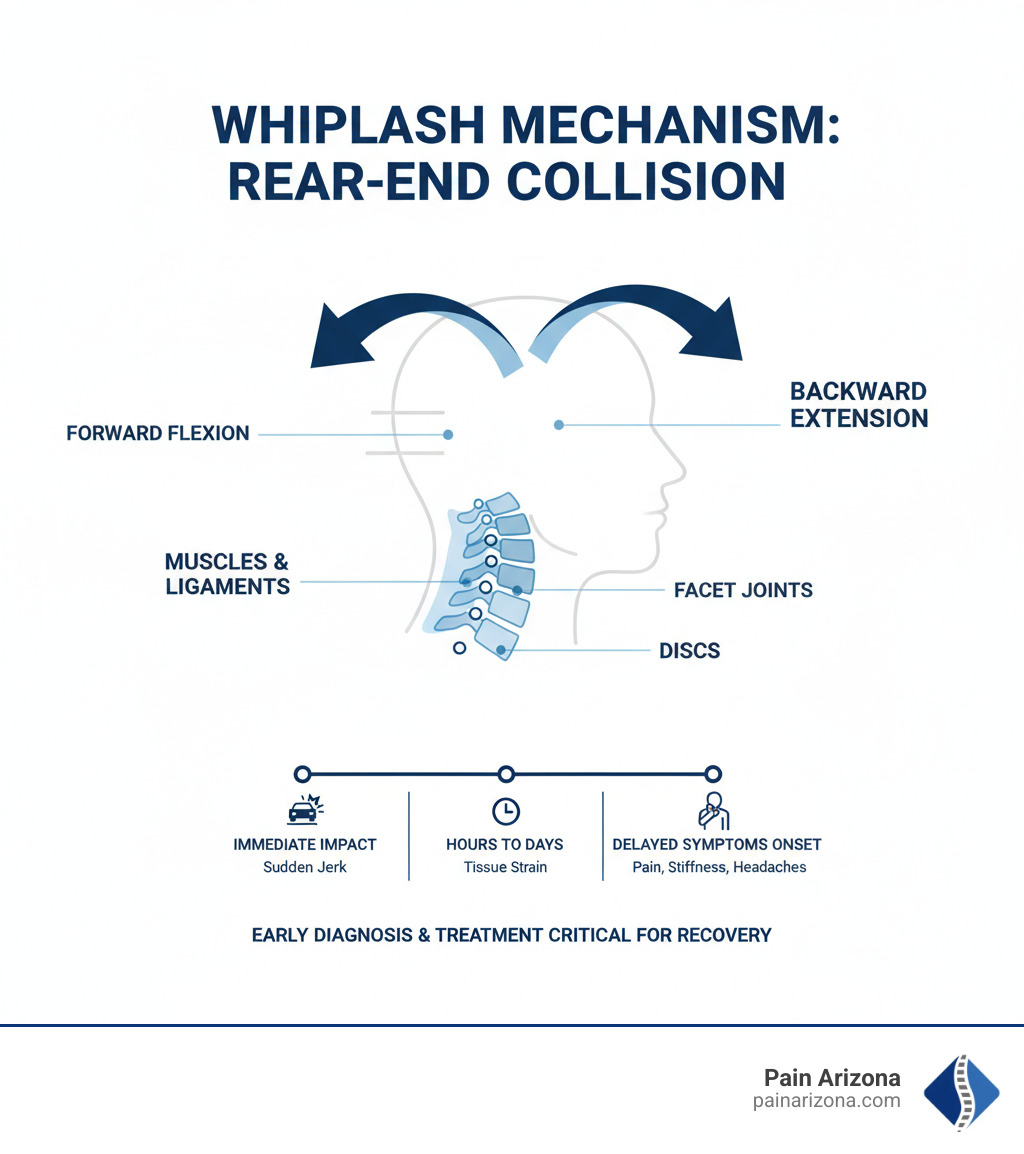
Whiplash is more than a simple stiff neck; it’s a complex injury medical professionals call Whiplash Associated Disorders (WAD). It happens when your head snaps forward and backward, overstretching the soft tissues in your neck—muscles, ligaments, and nerves. This neck strain or sprain can disrupt daily life for Phoenix residents, making driving, working, or even sleeping a painful struggle. If you’re dealing with persistent discomfort, our comprehensive guide on neck pain can help you understand what’s happening and why proper treatment matters.

Common Causes of Whiplash
Most people assume whiplash only happens in dramatic, high-speed collisions. The reality is far different.
Auto accidents are the leading cause. What surprises most people is that research shows that whiplash can occur at speeds as low as six miles per hour. Your vehicle might be fine, but your neck can experience significant trauma. We treat patients from across the Phoenix area for these injuries. Learn more on our auto accidents page.
Other common causes include:
- Sports injuries: From contact sports like football or activities with sudden impacts like mountain biking.
- Physical trauma: Such as an assault or being struck by an object.
- Slips and falls: Especially when the head strikes the ground or the neck hyperextends.
Recognizing the Symptoms
Here’s what makes whiplash particularly tricky: a delayed onset of symptoms is common. You might feel fine after an accident, only to wake up in pain hours or days later. This is why I always tell patients to get evaluated immediately. The most common symptoms include:
- Neck pain and stiffness that worsens with movement.
- Headaches, typically starting at the base of the skull.
- Dizziness or a feeling of being off-balance, and unexplained fatigue.
- Shoulder and back pain as the pain radiates from the neck.
- Numbness or tingling in your arms, which can indicate nerve involvement and requires prompt attention.
- Less common symptoms like jaw pain, blurred vision, ringing in your ears, or difficulty concentrating.
If you’re experiencing any of these symptoms after an injury, don’t wait. Early whiplash treatment phoenix specialists provide can prevent a chronic pain condition. For more detailed information, visit our page on whiplash symptoms.
The Diagnostic Process: How Phoenix Specialists Identify Whiplash
An accurate diagnosis is essential for effective whiplash treatment phoenix specialists provide. Whiplash often damages soft tissues that don’t show up on a standard X-ray, and its symptoms can mimic other neck conditions. Our goal is to pinpoint the exact source of your pain—be it facet joints, a herniated disc, or nerve compression—to create a targeted treatment plan for faster relief.
The process starts with a detailed conversation about your injury and symptoms. During the physical examination, I’ll gently check your neck, shoulders, and upper back for tenderness and muscle spasms. We’ll then perform range of motion testing to see which movements are painful or restricted, followed by a neurological assessment to check your reflexes, strength, and sensation. Weakness or numbness are red flags that we need to investigate further.

Advanced Imaging and Tests
While an exam provides many clues, advanced imaging helps us see the full picture.
- X-rays are our first step to rule out fractures, dislocations, or arthritis in your cervical spine.
- CT scans offer more detailed views of bone structures to spot subtle fractures.
- MRI scans are invaluable for showing soft tissues. An MRI can reveal a herniated disc, torn ligaments, or inflammation, often explaining the source of persistent pain.
- Electromyography (EMG) helps us evaluate nerve function if we suspect damage or compression.
Identifying the pain generator, such as the facet joints, is crucial. Chronic whiplash pain often stems from these small joints, and our diagnostic approach is designed to determine if they are the cause. This detailed diagnosis determines which whiplash treatment phoenix approach will work best for you.
A Comprehensive Guide to Whiplash Treatment in Phoenix
Once we’ve diagnosed the exact cause of your pain, we create a personalized treatment plan. At Pain Arizona, our philosophy for whiplash treatment phoenix patients is to address the underlying problem, not just mask symptoms. Our goals are to relieve your pain, restore your normal function, and prevent long-term complications. We offer a full spectrum of care, from conservative therapies to advanced interventional procedures. For a broader look, visit our page on available treatments.
Initial and Conservative Care
Most whiplash injuries respond well to early conservative treatment. These approaches form the foundation of recovery.
- Rest and activity modification: This means avoiding painful movements while keeping the neck gently mobile—not complete immobilization, which can weaken muscles.
- Ice and heat therapy: Use ice for the first 48 hours to reduce inflammation, then switch to heat to relax tight muscles.
- Over-the-counter medications: Medications like ibuprofen or naproxen can help reduce pain and inflammation.
- Gentle stretching: Once pain allows, slow, controlled movements help maintain mobility and prevent stiffness.
Understanding what triggers neck pain can make a real difference. We’ve put together helpful information on common triggers and remedies.
Professional Rehabilitative Therapies
As pain subsides, professional rehabilitation helps rebuild strength and restore proper movement.
- Physical therapy is the cornerstone of recovery. A therapist will guide you through strengthening exercises and teach you proper posture to protect your neck. Our hands-on approach gets results, which you can read about on our physical therapy page.
- Manual therapy involves specialized hands-on techniques to mobilize stiff joints and release tight tissues. This precision care targets your exact problem areas, as detailed on our manual therapy page.
- Massage therapy complements these approaches by reducing muscle spasms, improving circulation, and helping manage the stress that accompanies pain.
Advanced Medical Whiplash Treatment Phoenix Offers
When conservative care isn’t enough, we offer advanced medical interventions to target the specific source of your pain.
- Medication management: We may prescribe muscle relaxants for severe spasms or neuropathic medications for nerve pain to provide relief and allow you to participate in rehab.
- Trigger point injections: We inject a local anesthetic into tight muscle knots to release the spasm and provide immediate relief.
- Cervical epidural steroid injections: For inflammation around nerve roots, we deliver anti-inflammatory medication directly to the source to relieve radiating arm pain.
- Medial branch blocks: Since the majority of chronic whiplash pain occurs in the facet joints, we use these injections to diagnose facet joint pain. If an anesthetic injection near the joint’s nerves relieves your pain, we’ve confirmed the source.
- Radiofrequency ablation: For confirmed facet joint pain, this procedure offers long-lasting relief. Studies show it can relieve whiplash pain for six to nine months or longer by disabling the nerves that transmit pain signals.
I’m Dr. Nasser, and having performed tens of thousands of these procedures, I know the key is matching the right treatment to your specific injury through a thorough diagnosis and an individualized plan.
Why Timely Treatment is Crucial to Avoid Long-Term Pain
Here’s something I tell every patient who walks into my office after a car accident: the first 90 days matter more than you might think. What you do now can make the difference between a full recovery and a lifetime of managing pain.

Prompt whiplash treatment phoenix offers can reduce the inflammation that damages neck tissues and prevent scar tissue from forming in ways that limit movement. Early treatment means your pain is less likely to become severe or long-lasting, protecting your quality of life. Without it, you risk falling into the chronic pain cycle, where pain leads to inactivity, muscle weakness, and more pain—a difficult cycle to break.
The Risk of Chronic Whiplash
The statistics are sobering. While most people recover within weeks, about 25% of patients still have pain three months after their accident. Some research even shows that 52-58% of people may still experience pain and headaches a full decade after their initial injury.
When whiplash becomes chronic, it can lead to:
- Persistent headaches that originate from the neck.
- Decreased range of motion that makes simple tasks like driving a challenge.
- Ongoing numbness, tingling, or weakness in the arms and hands.
- Psychological effects like anxiety, depression, and sleep problems.
This is why we emphasize comprehensive whiplash treatment phoenix residents can access early. Our goal is to treat injuries properly from the start and help you avoid becoming a long-term statistic.
Frequently Asked Questions about Whiplash
After treating thousands of whiplash patients in Phoenix, I’ve heard just about every question you can imagine. Here are the most common concerns.
How long does recovery from whiplash take?
There’s no single answer, as recovery depends on the severity of your injury, your health, and most importantly, how quickly you seek treatment. Mild cases may resolve in a few weeks with prompt care, while severe injuries can take several months. The pattern I’ve seen is clear: early and consistent treatment dramatically improves your chances of a faster, more complete recovery. Patients who start whiplash treatment phoenix specialists provide within the first few weeks have significantly better outcomes.
Can I have whiplash even if my car wasn’t badly damaged?
Yes, absolutely. This is a critical point. Your body and your car absorb impact forces in completely different ways. A car is designed to crumple and distribute force, but your neck is not. Even in a low-speed collision, your head can whip back and forth violently, causing significant injury. In fact, whiplash injuries can occur at speeds as low as six miles per hour. The amount of vehicle damage does not correlate with the potential for physical injury. Always get evaluated after an accident, no matter how minor it seems.
Is surgery a common treatment for whiplash?
No, surgery is rarely necessary for whiplash injuries. We consider it a last resort option for severe complications, such as a herniated disc causing debilitating nerve compression that hasn’t responded to other treatments. Our philosophy at Pain Arizona is to help you avoid the operating room with evidence-based, minimally invasive treatments. Procedures like radiofrequency ablation, targeted injections, and physical therapy can provide lasting relief without the risks of surgery. With the right approach started early, most patients never need to consider it.
Your Path to Recovery in Phoenix
You don’t have to live with neck pain after an accident. If you’re in Phoenix, Mesa, Gilbert, Scottsdale, or Glendale, your recovery starts with an accurate diagnosis and a personalized treatment plan. At Pain Arizona, our approach to whiplash treatment phoenix residents trust is to find and address the root cause of your pain.
Our double board-certified physicians specialize in physical medicine, rehabilitation, and pain management, using compassionate, evidence-based, and minimally invasive solutions. We want to restore your ability to work, play, and enjoy the Arizona lifestyle you love.
We accept most insurance plans; please check with our office to confirm your coverage. For more information about our clinic and philosophy, visit our FAQs page.
Don’t let whiplash pain become a permanent part of your story. The sooner you take action, the better your chances of a full recovery. Contact us to start your recovery journey today—your path to feeling better begins now.