
Dorsal root ganglion stimulation: Achieve 80% Relief!
When Traditional Pain Treatments Stop Working
Dorsal root ganglion stimulation is a minimally invasive treatment that places a small device near specific nerve bundles in your spine to interrupt pain signals before they reach your brain, offering targeted relief for chronic pain in areas like the foot, knee, groin, or hip.
Key Facts About DRG Stimulation:
- What it treats: Complex Regional Pain Syndrome (CRPS), phantom limb pain, groin pain, pelvic pain, and other localized chronic pain
- How it works: Electrical pulses target the dorsal root ganglion—a cluster of sensory nerve cells—to block pain signals
- Success rate: 74% of patients achieved meaningful pain relief in clinical trials, with many experiencing 80%+ reduction
- Trial first: You test the system temporarily before permanent implantation
- Reversible: The device can be removed if needed without permanent nerve damage
If you’re living with chronic pain that hasn’t responded to medications, physical therapy, or surgery, you’re not alone. Many people suffer from chronic pain, and traditional treatments often fall short, especially for nerve-related pain in specific areas of your body.
I’m Dr. Nasser, Chief Medical Officer at Pain Arizona. I’ve spent my career helping patients with complex pain conditions find lasting relief through advanced interventional techniques like Dorsal root ganglion stimulation, helping them reclaim their lives from chronic pain.
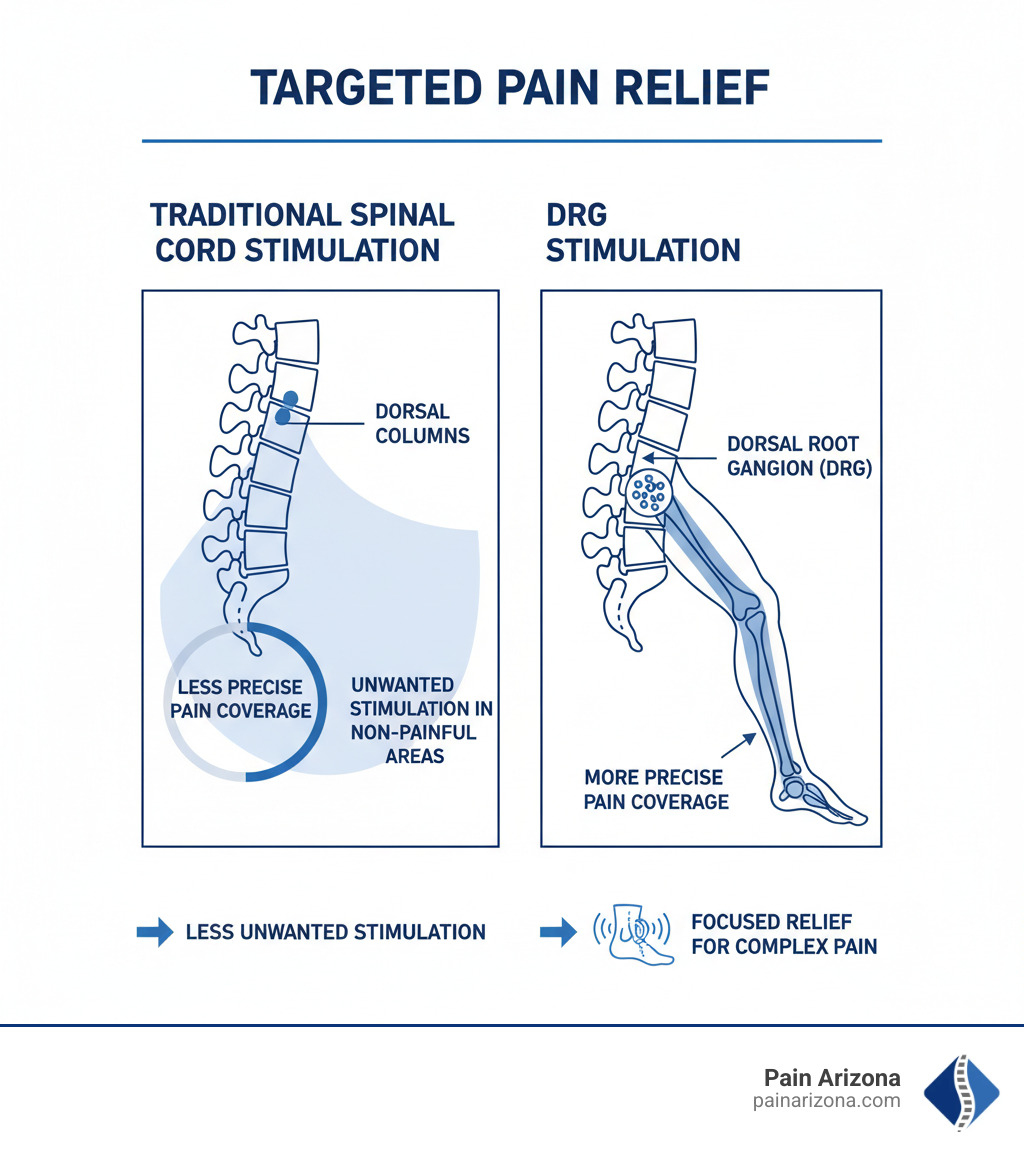
Dorsal root ganglion stimulation is a breakthrough in neuromodulation therapy. Unlike traditional spinal cord stimulation that casts a wide net, DRG stimulation targets the exact source of your pain with remarkable precision. It’s designed to treat pain in areas that were historically difficult to manage—your hand, chest, abdomen, foot, knee, or groin.
The results speak for themselves. At 12 months, patients reported less pain, improved mood, and better quality of life. This isn’t about masking symptoms—it’s about addressing pain at its source.
Understanding Dorsal Root Ganglion Stimulation: How It Works
Imagine your nervous system as a complex network of highways and traffic lights. The dorsal root ganglia (DRG) are like critical traffic lights for sensory nerves, located along the spinal column. These clusters of nerve cells are responsible for filtering and transmitting all sensory information—including pain signals—from your body to your brain.
When pain becomes chronic, these “traffic lights” can malfunction, sending constant, often exaggerated, pain signals. Dorsal root ganglion stimulation works by placing small, specialized leads (thin wires) near these specific DRGs. These leads deliver mild electrical pulses that essentially “reset” or “modulate” the faulty traffic light, interrupting the pain signals before they can reach the brain and cause discomfort. This targeted approach allows us to address the pain at its very origin, providing relief in a way that traditional treatments often cannot.
The DRG was once thought to have no connection to pain, but researchers now know that this nerve bundle plays a key role in nerve pain, especially for conditions like Complex Regional Pain Syndrome (CRPS). By directly stimulating the DRG, we can modulate all sensations from that area, offering a highly effective way to manage chronic neuropathic pain.
What is Dorsal Root Ganglion Stimulation Therapy?
Dorsal root ganglion stimulation therapy is a new type of neurostimulation designed to manage difficult-to-treat chronic pain in specific, localized areas. It’s a minimally invasive procedure that involves implanting a small medical device system to deliver mild electrical pulses directly to the dorsal root ganglia.
Unlike traditional Spinal Cord Stimulation, which stimulates the spinal cord itself, DRG stimulation focuses on these distinct nerve bundles. This allows for an incredibly precise approach, targeting only the nerves responsible for the pain in a specific body part—such as your foot, knee, hip, or groin—without affecting other areas. This targeted therapy has proven particularly beneficial for patients who experience isolated chronic pain following an injury or surgical procedure, and for whom other pain management strategies have provided little or no relief.
The Components of a DRG System
A Dorsal root ganglion stimulation system consists of three main parts that work together to provide pain relief:

- Implantable Pulse Generator (IPG): This is the “brain” of the system, a small, battery-powered device implanted just under your skin, typically in the upper buttock, low back, or abdominal wall. It generates the mild electrical pulses. Most DRG IPGs are non-rechargeable and designed to last for several years before needing replacement through a minor outpatient procedure.
- Thin Wires (Leads): These are flexible, insulated wires with small electrodes at their tips. During the implantation procedure, these leads are carefully threaded into the epidural space and positioned precisely over the dorsal root ganglia that correspond to your painful area. Each lead typically has four electrode contacts, allowing for highly specific stimulation.
- Patient Controller: This is a small, handheld remote control that you, the patient, use to manage your therapy. It allows you to turn the stimulation on or off, adjust the intensity, and switch between different pre-programmed settings to find the most comfortable and effective pain relief for your needs.
Who is an Ideal Candidate for DRG Stimulation?
If you’re reading this, chances are you’ve already been down a long road trying to find relief from your chronic pain. Maybe you’ve tried physical therapy, medications, injections, or even surgery—and you’re still hurting. I want you to know that you’re not out of options.
Dorsal root ganglion stimulation isn’t for everyone, but for the right patients, it can be truly life-changing. The key is that this therapy works best for very specific types of pain—the kind that’s concentrated in one particular area of your body rather than spread all over.
You might be an ideal candidate if your pain has been persistent for six months or longer, and conservative treatments like medications, physical therapy, or Nerve Blocks haven’t given you the relief you deserve. This is especially true if your pain is localized—meaning it’s focused in a specific spot like your foot, knee, hip, groin, or hand.
Many of our patients come to us after an injury or surgery that left them with ongoing nerve pain in one particular area. Others have tried traditional spinal cord stimulation but found that the relief wasn’t targeted enough, or that the stimulation changed when they moved their body—making it inconsistent and frustrating.
At Pain Arizona, we conduct a comprehensive evaluation to determine if DRG stimulation is right for you. This includes reviewing your medical history, examining your pain patterns, and sometimes conducting psychological screening to ensure you’re prepared for the trial period and long-term therapy management.
Specific Pain Conditions Treated
Complex Regional Pain Syndrome (CRPS) is one of the most challenging pain conditions we treat, and it’s also one of the areas where DRG stimulation truly shines. This condition—sometimes called Reflex Sympathetic Dystrophy or RSD—typically affects an arm or leg after an injury or surgery. The pain is often described as burning, and even the lightest touch can be unbearable. DRG stimulation received FDA approval specifically for CRPS in the lower extremities, and clinical studies have shown it provides superior pain relief compared to traditional spinal cord stimulation for both CRPS Type I and Type II.
Phantom limb pain is another condition where this therapy has brought hope to patients who thought they were out of options. After an amputation, many people continue to feel intense pain in the limb that’s no longer there. By targeting the specific dorsal root ganglia associated with that missing limb, we can interrupt those persistent pain signals.
Causalgia, a type of CRPS that results from direct nerve injury, responds particularly well to this targeted approach. Patients with causalgia often experience burning pain, increased sensitivity, and pain from things that shouldn’t hurt at all—like clothing touching their skin.
For those dealing with chronic pelvic pain or groin neuralgia, especially after surgeries like hernia repair, DRG stimulation offers relief where other treatments have failed. Studies have shown responder rates as high as 80% for groin pain. This is particularly encouraging for patients who’ve been told they just have to “live with it.”
Chronic pain in the foot, knee, hip, or hand—whether from injury, surgery, or other nerve-related causes—can also benefit significantly from this therapy. We’ve seen remarkable results with patients suffering from persistent foot pain or post-surgical knee pain after procedures like total knee replacement. The responder rate for foot pain has also reached 80% in clinical studies.
How DRG Stimulation Targets Specific Body Parts
Here’s what makes dorsal root ganglion stimulation so different from other pain treatments: precision. Each DRG along your spine is responsible for transmitting sensory information from a very specific area of your body—what we call a dermatome. Think of it like having individual dimmer switches for different rooms in your house, rather than one master switch that controls everything.
If you’re experiencing chronic foot pain, for example, we can target the specific DRGs in your lumbar or sacral spine that transmit signals from your foot—and only your foot. This focused approach means you get pain relief exactly where you need it, without affecting other areas.
This is a significant advantage over traditional Spinal Cord Stimulation. With spinal cord stimulation, the broader field of stimulation can sometimes create tingling sensations in areas that aren’t painful, or the relief can change when you bend, sit, or lie down. With DRG stimulation, patients consistently report more stable pain relief regardless of body position—whether they’re standing in line at the grocery store here in Phoenix, sitting at their desk in Mesa, or relaxing at home in Glendale.
The stability of the therapy means you can move through your day with confidence, knowing your pain relief will be consistent no matter what position your body is in.
The Patient Journey: From Trial to Permanent Implant
Starting Dorsal root ganglion stimulation therapy isn’t something we rush into. At Pain Arizona, we believe in a methodical approach to ensure this treatment is right for you. Think of it as a test drive before you commit—because your comfort and confidence matter.
Your journey begins with a comprehensive evaluation. We’ll review your medical history, look at imaging studies, and discuss your pain. Where is it? How intense is it? How does it affect your life in Phoenix? This helps us understand the full picture.
We may also include psychological screening. This isn’t because pain is “all in your head”—it’s absolutely not. But chronic pain affects mental health, and understanding this helps us provide better care.
Once we determine you’re a good candidate, we move to the trial period. During this minimally invasive procedure, we place temporary leads near your target dorsal root ganglia. These leads connect to an external pulse generator you’ll wear for five to seven days.
This trial is your chance to assess the pain relief in real-world conditions. Go about your normal daily activities. We’re looking for meaningful pain relief—ideally a 50% reduction or more—and improvements in your quality of life.
Your feedback during these days is invaluable. You’ll keep notes about your pain levels and activities. This trial gives us—and you—the information we need to make a confident decision about moving forward.
If your trial is successful, we’ll schedule the permanent implantation procedure. This is another minimally invasive surgery, performed with X-ray guidance. We’ll position the leads over the dorsal root ganglia and implant the small IPG (generator) under your skin, usually in your upper buttock, low back, or abdominal wall.
The procedure is performed under light sedation, and most patients return home the same day. Recovery is generally straightforward, though we’ll give you specific activity restrictions to follow while you heal.
One of the most reassuring aspects of Dorsal root ganglion stimulation is its reversibility. If the therapy stops working or if you experience complications, the entire system can be surgically removed without causing permanent damage to your nerves. This flexibility provides real peace of mind as you make this decision.
Throughout this journey, our team at Pain Arizona will be with you every step of the way. We’re not just placing a device—we’re partnering with you to reclaim your life from chronic pain.
Effectiveness, Benefits, and Risks of Dorsal Root Ganglion Stimulation
When you’re considering an advanced pain treatment, you naturally want to know two things: Does it actually work, and is it safe? With Dorsal root ganglion stimulation, the answer to both questions is encouraging. Clinical studies on DRG effectiveness have consistently demonstrated strong results, particularly when compared to traditional spinal cord stimulation.
The numbers tell a compelling story. In a landmark study published in Pain, 74.2% of patients achieved meaningful pain relief with DRG stimulation, compared to 53% with traditional spinal cord stimulation. Even more remarkable, one-third of patients experienced more than 80% pain relief—and many reported no tingling sensation at all, which is often an unwanted side effect of SCS. This superior pain relief translated directly into better quality of life for patients.
The evidence goes beyond a single study. A pooled analysis of DRG safety and effectiveness examined multiple clinical trials and found that 63% of patients reported at least 50% pain relief at 12 months. Patient-reported outcomes showed substantial improvements not just in pain levels, but in quality of life, mood, and physical function. The success rates were particularly impressive for specific areas: 80% responder rates for foot and groin pain, 75% for leg pain, and 70% for back pain.
What makes these results even more meaningful is their durability. Studies show that pain relief and improved quality of life are sustained at 12 months and beyond, giving patients long-term hope rather than just temporary relief.
Benefits of Dorsal Root Ganglion Stimulation
The advantages of Dorsal root ganglion stimulation go beyond just “it works.” The way it works makes a real difference in your daily life.
Targeted pain relief without unwanted stimulation is perhaps the most significant benefit. Because DRG stimulation directly targets the specific nerve bundles responsible for your pain, you get relief precisely where you need it. You won’t experience tingling in your thigh when you’re trying to treat foot pain, or sensations in areas that don’t hurt. Many patients achieve completely paresthesia-free relief, meaning they feel less pain without feeling the device working at all.
Lower energy requirements might sound technical, but it matters. The dorsal root ganglion sits in a tight space with minimal cerebrospinal fluid around it, which means electrical pulses reach their target very efficiently. In fact, DRG systems use about 10% of the energy that traditional SCS requires. For you, this translates to longer battery life—your implanted pulse generator can last several years before needing replacement.
Stable stimulation regardless of body position is a game-changer for staying active. With some traditional SCS systems, the sensation can change when you move from sitting to standing or bend over. With DRG stimulation, your relief remains consistent whether you’re walking around your Phoenix neighborhood, sitting at your desk, or lying down to rest. This stability means you can focus on living your life rather than constantly adjusting your device.
Significant pain reduction is what it all comes down to. When patients achieve 80% or more pain relief, they’re not just managing their pain—they’re reclaiming activities they thought were lost forever. They’re playing with their grandchildren, returning to work, and refinding hobbies that chronic pain had stolen from them.
Potential Risks and Complications
While Dorsal root ganglion stimulation is generally safe and effective, I believe in being completely transparent about potential risks. Like any medical procedure, especially one involving an implanted device, there are complications we need to discuss.
The most commonly reported issues are manageable and often treatable. Pain at the implant site where the pulse generator sits under your skin occurs in about 10% of cases. This is usually temporary and responds well to conservative care, though occasionally it may require repositioning the device.
Lead fracture or migration can happen in about 6% of cases each. The thin wires can sometimes break or shift from their optimal position. The good news is that the anatomical location of the DRG—tucked into a protected space along the spine—actually makes lead migration less common than with traditional SCS. If it does occur, a revision procedure can usually correct the problem.
Infection is a risk with any implanted device, occurring in about 5% of cases. Our team follows strict sterile protocols, and most infections respond to antibiotics. In rare cases, the device may need to be temporarily removed while the infection clears.
Sometimes, despite our best efforts and a successful trial, the permanent implant may not provide adequate long-term relief. About 6% of patients require explantation—removal of the device—because it’s not delivering the expected pain reduction. The therapy’s reversibility means we can remove the entire system without causing permanent damage to your nerves or spinal cord.
Here at Pain Arizona, our double board-certified physicians have extensive experience with these delicate procedures. Precise lead placement and meticulous surgical technique make all the difference in minimizing complications and maximizing your success. We’ve guided hundreds of patients through this journey, and that experience matters when it comes to your safety and outcomes.
Frequently Asked Questions about DRG Therapy
When you’re considering a new pain treatment, especially one involving an implanted device, it’s natural to have questions. I’ve been answering these questions for years with my patients in the Phoenix Area, and I’d like to address some of the most common concerns about Dorsal root ganglion stimulation.
Is DRG stimulation therapy reversible?
Yes, and this is one of the most reassuring aspects of the therapy for many patients I speak with. The entire DRG stimulation system—the leads, the pulse generator, everything—can be surgically removed if it’s no longer working for you or if complications arise.
This is different from some pain treatments that permanently alter your body. With DRG therapy, removal doesn’t cause permanent damage to your nerves or spinal cord. Your body returns to its pre-implant state. This reversibility gives many of my patients peace of mind when they’re making the decision to try this advanced treatment.
What are the long-term outcomes of DRG stimulation?
The research on Dorsal root ganglion stimulation shows encouraging results that extend well beyond the initial months. At 12 months and beyond, patients who responded to the therapy reported sustained pain relief and significant improvements in their quality of life. They also experienced better mood scores, which makes sense—when you’re not living with constant pain, everything improves.
One concern with any neuromodulation therapy is something called “therapy habituation,” where your body essentially gets used to the treatment and it becomes less effective over time. The good news is that DRG stimulation has shown less of this compared to traditional spinal cord stimulation for certain conditions like CRPS. This suggests the relief you experience can be durable and lasting.
Of course, every patient is different. Some people experience therapy habituation, while others maintain excellent relief for years. That’s why we continue monitoring your progress and adjusting your therapy as needed to ensure you’re getting the best possible outcomes.
How is DRG stimulation covered by insurance?
I know the insurance question is often at the top of everyone’s mind, and rightfully so. The good news is that Dorsal root ganglion stimulation is a well-established, FDA-approved treatment, and most major insurance carriers recognize its value.
Medicare and most major insurance plans typically cover DRG stimulation after you’ve completed a successful trial period and when the therapy is deemed medically necessary for your specific condition. Pre-authorization is almost always required before we can proceed with the procedure, but our team handles most of that paperwork for you.
At Pain Arizona, we accept most insurance plans. I always recommend checking with our office manager in Phoenix to verify that your specific plan is accepted and to understand the details of your coverage, including any out-of-pocket costs you might be responsible for. We’re here to help you steer the insurance process so you can focus on getting the relief you need.
Find Targeted Pain Relief in Arizona
Living with chronic, focal pain can feel like carrying an invisible weight that no one else can see. It affects everything—your ability to work, your relationships, even simple pleasures like walking through the Scottsdale Waterfront or playing with your grandchildren in Gilbert. When you’ve tried medication after medication, therapy after therapy, and nothing seems to work, it’s natural to feel like you’re running out of options.
But here’s the truth: Dorsal root ganglion stimulation represents a genuine breakthrough for people who thought they’d tried everything. This isn’t about masking your pain with another pill or learning to “just live with it.” It’s about targeting the specific nerve bundles causing your suffering and giving you real relief where other Treatments have fallen short.
At Pain Arizona, we’ve built our practice around one simple principle: finding the actual source of your pain and addressing it with the most advanced, evidence-based techniques available. Our double board-certified physicians don’t believe in one-size-fits-all solutions. Instead, we take the time to understand your unique situation and create a personalized treatment plan designed specifically for you.
If you’re dealing with Complex Regional Pain Syndrome, phantom limb pain, or persistent pain in your foot, knee, hip, or groin that just won’t quit, DRG stimulation might be the answer you’ve been searching for. We’ve seen patients who’d been suffering for years finally find relief through this targeted approach. The kind of relief that lets them get back to the activities and people they love.
You don’t have to keep living with constant pain. We accept most insurance plans, including Medicare coverage for DRG stimulation. Our office manager can verify your specific coverage and help you understand your options.
Ready to explore whether Dorsal root ganglion stimulation is right for you? Explore our minimally invasive spine procedures to learn more, or call our Phoenix Area office today. Let’s work together to help you reclaim your life from chronic pain.