
What causes sciatic nerve pain: Crucial Relief 2025
Why Understanding What Causes Sciatic Nerve Pain Matters
What causes sciatic nerve pain isn’t always obvious, but the answer matters more than you might think. That shooting pain, tingling, or numbness radiating from your lower back down through your leg isn’t a condition itself—it’s a symptom telling you that something is irritating or compressing your sciatic nerve, the longest and thickest nerve in your body.
Common causes of sciatic nerve pain include:
- Herniated or bulging discs – The most frequent culprit, accounting for most cases
- Spinal stenosis – Narrowing of the spinal canal that pinches nerve roots
- Degenerative disc disease – Age-related wear and tear on spinal discs
- Spondylolisthesis – When one vertebra slips forward over another
- Piriformis syndrome – Muscle spasm in the buttocks compressing the nerve
- Bone spurs – Bony overgrowths from arthritis
- Injury or trauma – Sports accidents, falls, or other impacts
The pain can feel like a burning sensation, an electric shock, or a dull ache that worsens when you sit, sneeze, or cough. You might also experience tingling, numbness, or muscle weakness in your leg or foot. For most people, sciatica affects only one side of the body, though it can occasionally impact both legs.
Why this matters: Sciatica isn’t just about managing pain—it’s about identifying the root cause. A herniated disc requires different treatment than spinal stenosis or piriformis syndrome. Without understanding why your sciatic nerve is angry, you might spend months on treatments that don’t address your specific problem.
I’m Dr. Nasser, Chief Medical Officer at Pain Arizona, and over my career I’ve performed tens of thousands of procedures to diagnose and treat what causes sciatic nerve pain in patients across the Greater Phoenix area. Understanding the specific source of your sciatica is the first step toward lasting relief, not just temporary symptom management.
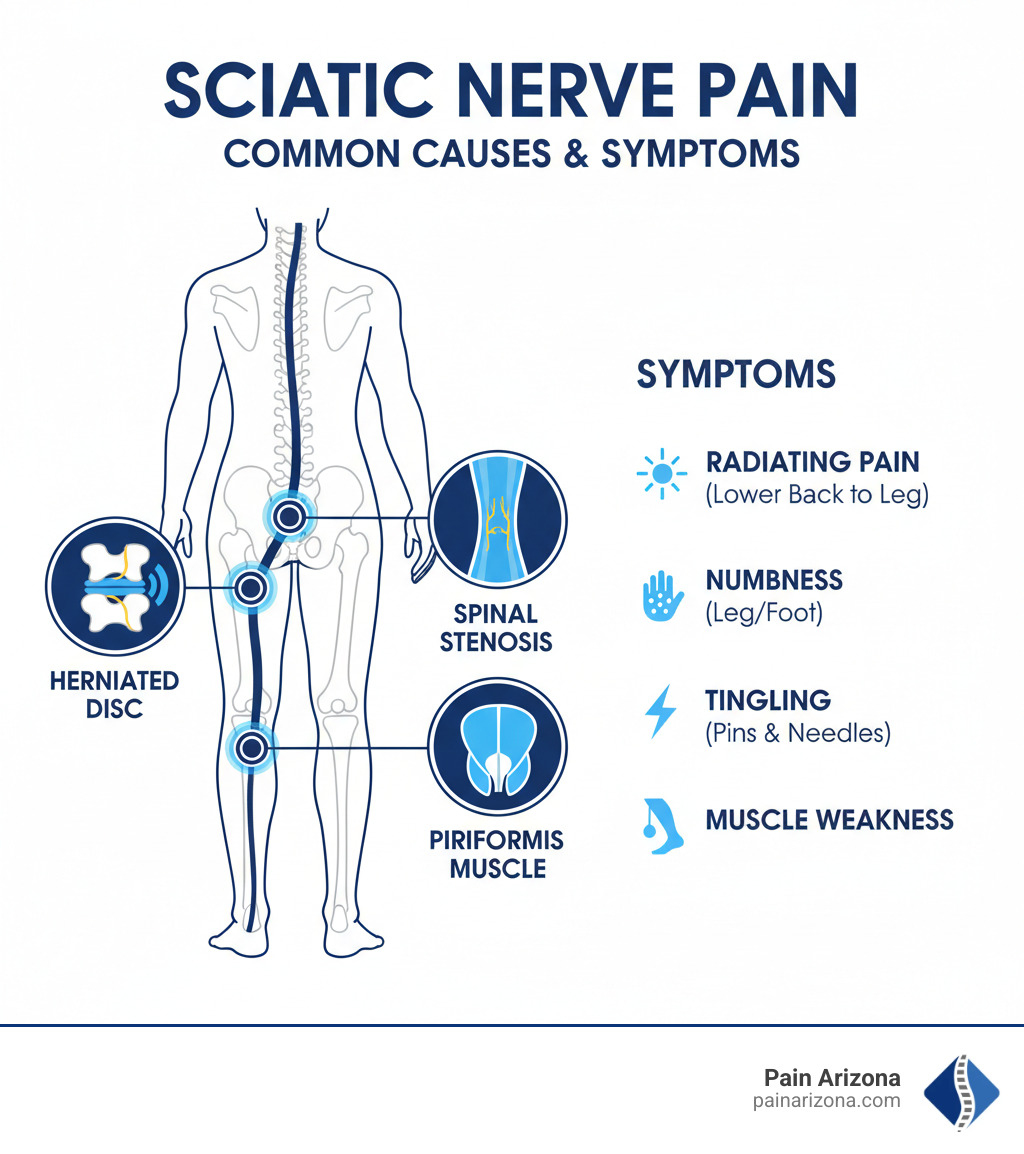
What Causes Sciatic Nerve Pain? Common Culprits Explained
When we ask what causes sciatic nerve pain, we’re looking for what is compressing, irritating, or inflaming the sciatic nerve. This long, thick nerve runs from your lower back down each leg, and any pressure along its path can cause the distinct symptoms of sciatica. Most problems originate in the lower lumbar spine, where the nerve roots exit the spinal column.
Herniated Discs: The Most Frequent Cause of What Causes Sciatic Nerve Pain
The most common answer to what causes sciatic nerve pain is a herniated disc. Your spinal discs act as cushions between vertebrae. A herniated disc (also called a “slipped” or “bulging” disc) occurs when the soft, gel-like center pushes through a tear in the tough outer layer. This material can press directly on a nerve root, causing pain, numbness, and tingling down the leg.
According to the Mayo Clinic’s detailed information on sciatica causes, herniated discs are the leading cause. This issue is most common in people between 20 and 50, an age where discs have undergone some wear but are still flexible enough to tear.
Spinal Stenosis and Degenerative Changes
Natural, age-related wear and tear can lead to spinal stenosis, another frequent cause of sciatica. Spinal stenosis is a narrowing of the spinal canal, which squeezes the spinal cord and nerve roots that pass through it.
This narrowing is often caused by:
- Bone spurs (osteophytes): Bony overgrowths that can pinch nerves.
- Degenerative disc disease: As discs lose fluid with age, they flatten and shrink, reducing the space between vertebrae.
- Osteoarthritis: Arthritis in the spine can contribute to these degenerative changes, further compressing nerve roots and triggering sciatica.
Spondylolisthesis
Spondylolisthesis occurs when one vertebra slips forward over the one below it. This misalignment can create spinal instability and pinch the nerve roots as they exit the spinal column, leading to classic sciatica symptoms. It can be a congenital condition or develop later in life due to degenerative changes or stress fractures.
Uncovering Other Causes and Key Risk Factors
While spinal issues are the primary culprits, understanding what causes sciatic nerve pain requires looking at other conditions and risk factors that can contribute to your symptoms.
Less Common Conditions: Other Reasons for What Causes Sciatic Nerve Pain
- Piriformis Syndrome: The piriformis muscle, located deep in the buttock, can spasm and compress the sciatic nerve, which runs nearby or even through it. This causes sciatica-like pain, sometimes called “pseudo-sciatica.”
- Pelvic Injury or Fracture: A significant fall, car accident, or sports injury can directly damage or put pressure on the sciatic nerve.
- Spinal Tumors: Though rare, growths near the spine can press on nerve roots and trigger sciatica symptoms.
- Cauda Equina Syndrome: This is a medical emergency. Severe compression of the nerve roots at the end of the spinal cord requires immediate medical attention to prevent permanent damage, such as paralysis or loss of bladder/bowel control.
Risk Factors That Increase Your Likelihood
Certain factors can make you more vulnerable to developing sciatica:
- Age: People aged 20-50 are more prone to herniated discs, while older adults are more likely to develop spinal stenosis and bone spurs.
- Obesity: Excess weight puts constant stress on your spine, increasing pressure on your discs.
- Occupation: Jobs involving heavy lifting, frequent twisting, or prolonged driving can accelerate wear and tear on the spine.
- Sedentary Lifestyle: Lack of activity weakens core support muscles, while prolonged sitting can directly compress the sciatic nerve. Maintaining good posture is crucial.
- Diabetes: This condition can increase the risk of nerve damage (neuropathy), making nerves more susceptible to compression.
- Improper Lifting Form: Bending at the waist or twisting while lifting puts immense pressure on your spinal discs. Learning safe weight lifting techniques is vital.
- Smoking: Nicotine restricts blood flow to spinal discs, accelerating their degeneration and weakening the spine.
Understanding these risk factors is the first step toward prevention. While you can’t change your age, you can modify many of these other factors to protect your back.
Diagnosis, Treatment, and When to See a Doctor
When you’re dealing with sciatica, an accurate diagnosis is the first step toward relief. At Pain Arizona, we focus on understanding exactly what causes sciatic nerve pain in your case to address the root problem.

How Sciatica is Diagnosed
The diagnostic process starts with a conversation. I’m Dr. Nasser, and I begin by taking a detailed medical history to understand your symptoms and any past injuries. This is followed by a physical exam where I’ll check your muscle strength, reflexes, and nerve function. A key diagnostic tool is the straight-leg raise test, where lifting your affected leg while you lie down can reveal nerve root irritation.
While a clinical exam is often sufficient, we may recommend imaging if symptoms are severe or persistent. An X-ray can show bone-related issues like fractures or spurs. For a detailed look at soft tissues, an MRI (Magnetic Resonance Imaging) is the gold standard, revealing herniated discs or spinal stenosis. An EMG (Electromyography) may also be used to measure nerve signals and confirm compression.
From Home Remedies to Medical Interventions
The good news is that 80-90% of people with sciatica improve without surgery. Our philosophy is to start with the least invasive treatments first.
- At-home care: For the first few days, ice packs can reduce inflammation, followed by heat to relax muscles. Gentle activity is better than prolonged bed rest. Over-the-counter anti-inflammatory drugs can also help.
- Physical therapy: This is a cornerstone of treatment. A therapist will guide you through exercises to strengthen your core, improve flexibility, and reduce nerve pressure.
- Prescription medications: If over-the-counter options aren’t enough, we may prescribe stronger anti-inflammatories, muscle relaxants, or nerve pain medications.
- Corticosteroid injections: For stubborn pain, these injections deliver powerful anti-inflammatory medication directly to the nerve root, providing a window for physical therapy to be more effective.
- Surgery: This is a last resort, reserved for cases with progressive nerve damage, severe pain unresponsive to other treatments, or emergencies like loss of bladder/bowel control. Procedures include diskectomy (removing part of a disc) or laminectomy (removing bone to create space).
We accept most insurance plans at Pain Arizona. Check with our office manager to confirm your coverage for these treatments.
When to Seek Immediate Medical Attention
While most sciatica is manageable, some symptoms are red flags. Seek emergency care if you experience:
- Sudden, severe pain in your lower back or leg
- Pain following a traumatic injury (e.g., car accident)
- Loss of bladder or bowel control
- Progressive leg weakness
- Numbness in the groin or rectal area (“saddle anesthesia”)
- Fever with back pain
These can signal a serious condition like Cauda Equina Syndrome, which requires urgent treatment to prevent permanent damage.
Prevention and Long-Term Outlook for Sciatica
Once you’ve had sciatica, preventing its return is key. Understanding what causes sciatic nerve pain empowers you to protect your back. The long-term outlook for most people is very positive.
How to Prevent Sciatica
Prevention focuses on building a strong, flexible body to handle daily stress.
- Regular exercise: Consistent movement is your best defense. Focus on strengthening your core (abdominal and lower back muscles) with activities like walking, swimming, or yoga.
- Maintain good posture: Proper posture while sitting, standing, and sleeping reduces strain on your spine. Use a chair with good lumbar support and keep your computer screen at eye level. The Cleveland Clinic has helpful resources on good posture.
- Use proper lifting techniques: Always bend at your knees, not your waist. Keep your back straight, hold objects close to your body, and avoid twisting while lifting.
- Maintain a healthy weight: Extra weight adds stress to your lower back and spinal discs. Even modest weight loss can significantly reduce your risk.
- Avoid prolonged sitting: If you have a desk job, take frequent breaks to stand, stretch, and walk. This relieves pressure on the sciatic nerve and keeps back muscles from becoming stiff.
Prognosis: What to Expect
The vast majority of people with sciatica recover fully. In my years treating patients across the Greater Phoenix area, I’ve seen countless individuals return to a pain-free life.
Typical recovery time for acute sciatica is often a few weeks, though more severe cases can take several months to resolve. Acute sciatica is a temporary flare-up, while chronic sciatica is less common but can persist long-term.
The most encouraging statistic is that 80 to 90% of people with sciatica improve without surgery. Conservative treatments like physical therapy and lifestyle changes are highly effective. Surgery is rarely needed.
However, recurrence is possible, especially if you revert to old habits. This is why prevention is not optional; it’s your insurance policy against future pain. At Pain Arizona, we equip you with the tools to maintain a healthy spine long-term, helping you live an active life with minimal risk of recurrence.
Frequently Asked Questions About Sciatica
Living with sciatica raises a lot of questions, and over my years treating patients across Mesa, Gilbert, and Scottsdale, I’ve heard them all. Let me address some of the most common concerns about what causes sciatic nerve pain and how it affects your daily life.
How long does sciatica typically last?
The duration depends on the underlying cause and its severity. Acute sciatica often improves within a few weeks with at-home care. However, if the cause is more complex, like severe spinal stenosis, or if the condition becomes chronic, symptoms can persist for months. Your overall health and adherence to a treatment plan also significantly impact recovery time.
Can sciatica affect both legs?
Usually, sciatica affects only one leg because the cause (like a herniated disc) typically compresses a nerve root on one side of the spine. Bilateral sciatica, affecting both legs, is rare but can occur. It may signal a more serious issue, such as a large central disc herniation or severe spinal stenosis compressing multiple nerve roots. If you have symptoms in both legs, it’s important to seek medical attention promptly.
Should I rest or stay active with sciatica?
While your first instinct may be to rest, prolonged bed rest can actually worsen sciatica and prolong recovery. After an initial day or two of rest for severe pain, gentle activity is encouraged. Movement reduces inflammation, promotes blood flow, and prevents muscle weakness. Low-impact activities like walking and gentle stretching are ideal. The key is to listen to your body and stay active within a comfortable range, avoiding movements that significantly increase pain. A physical therapist can help you find safe and effective exercises.
Conclusion: Taking the Next Step Towards Relief
You’ve learned a lot about what causes sciatic nerve pain – from herniated discs and spinal stenosis to the less common culprits like piriformis syndrome and even rare emergencies like Cauda Equina Syndrome. You’ve finded the risk factors that can make you more vulnerable, and you now understand that sciatica isn’t a condition in itself, but rather a symptom pointing to an underlying problem.
Here’s the thing: knowledge is power, but it’s only the beginning. The real game-changer is getting an accurate diagnosis that identifies your specific cause. A herniated disc needs different treatment than spinal stenosis. Piriformis syndrome requires a different approach than degenerative disc disease. Without pinpointing what’s actually irritating your sciatic nerve, you might spend months trying treatments that simply aren’t addressing your particular problem.
That’s where we come in. At Pain Arizona, we serve the Greater Phoenix Area – from Mesa and Gilbert to Scottsdale and Glendale – with one clear mission: to help you find lasting relief from chronic pain. Our team of double board-certified physicians specializes in getting to the root cause of your discomfort, not just masking symptoms temporarily.
We believe in compassionate, evidence-based care that starts with listening to you. We take the time to understand your unique situation, conduct thorough examinations, and use advanced diagnostic tools when needed. From there, we develop personalized treatment plans that emphasize minimally invasive options first, always keeping your quality of life at the forefront.
The good news? You don’t have to figure this out alone. We accept most insurance plans, so relief may be more accessible than you think. Just check with our office manager to confirm your specific plan is accepted.
Don’t let sciatic nerve pain keep controlling your daily life – whether that’s missing out on activities you love, struggling through your workday, or simply not sleeping well at night. You deserve to feel like yourself again.
Ready to take that next step? Learn more about our advanced sciatica treatments and find how we can help you move toward a life free from nagging nerve pain.