
Cervical radiculitis treatment: Proven 1st Relief
Understanding Cervical Radiculitis and Your Path to Relief
Cervical radiculitis treatment ranges from conservative care like physical therapy and medication to advanced interventions such as epidural steroid injections or surgery. Most patients—over 85%—recover within 8 to 12 weeks using non-surgical approaches. Here’s what you need to know:
Main Treatment Options:
- Conservative Care (first-line): Physical therapy, NSAIDs, activity modification, cervical traction
- Medications: Anti-inflammatory drugs, oral corticosteroids, nerve pain medications (gabapentin, pregabalin)
- Injections: Cervical epidural steroid injections, selective nerve root blocks, facet joint injections
- Surgery: Considered after 6-12 weeks of failed conservative treatment or for progressive neurological deficits
Expected Timeline:
- 88% improve within 4 weeks of non-operative management
- 90% achieve good to excellent outcomes without surgery
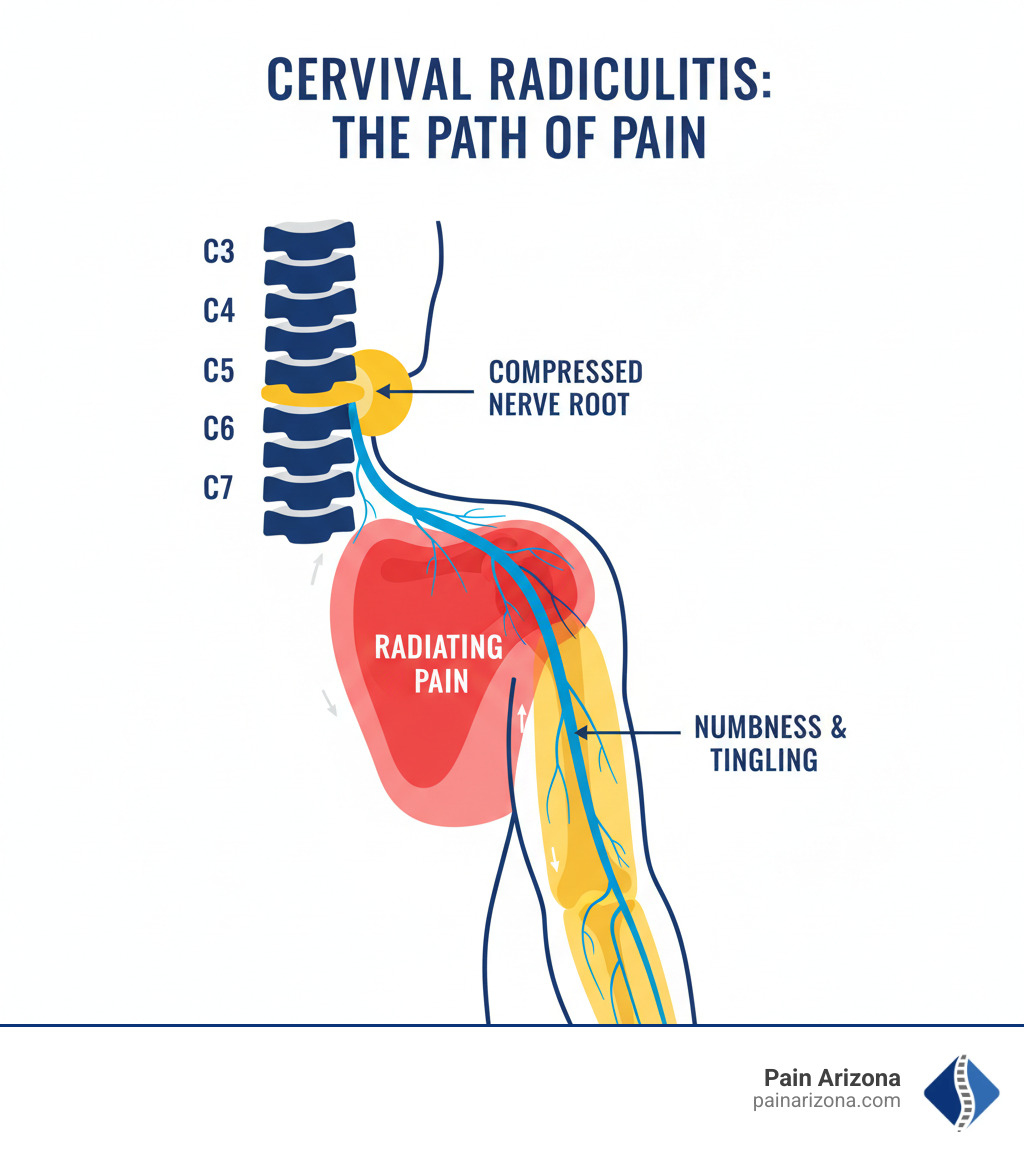
Cervical radiculitis—commonly called a pinched nerve in the neck—occurs when a nerve root in your cervical spine becomes compressed or irritated. This compression triggers pain that often radiates down your shoulder and arm, accompanied by tingling, numbness, or muscle weakness.
The condition typically stems from age-related changes in your spine or a herniated disk pressing against the nerve. While the symptoms can be alarming, the prognosis is remarkably favorable. Research shows that most cases resolve naturally, with the body healing itself given time and the right support.
Understanding your options is the first step toward relief. This guide covers the causes, diagnosis, and full spectrum of cervical radiculitis treatment to help you make informed decisions.
I’m Dr. Nasser, Chief Medical Officer at Pain Arizona. With over 15 years specializing in interventional pain management, I’ve helped thousands of patients find relief from cervical radiculitis by combining conservative therapies with targeted procedures to address the root cause of their pain.
Understanding the Root Causes and Symptoms
Your cervical spine consists of seven vertebrae (C1-C7) that protect your spinal cord while allowing head movement. Between each vertebra is a cushion-like intervertebral disk that absorbs shock and provides flexibility.
Think of these disks as tiny jelly doughnuts: a tough outer shell (the annulus fibrosus) surrounding a soft, gel-like center (the nucleus pulposus). These disks also create small openings called foramina—doorways through which nerve roots exit the spine and travel down your arm. When something compresses or irritates these nerve roots as they pass through the foramina, cervical radiculitis treatment becomes necessary.
The causes of a pinched nerve in the neck generally fall into two main categories: gradual degenerative changes and acute herniated disks. Both can trigger the same troubling symptoms.
If you’re dealing with cervical radiculitis, you’ll likely experience radiating arm pain—often sharp, burning, or aching—that starts in your neck and travels down one arm, sometimes all the way to your fingers. This pain typically follows the path of the affected nerve. You might also notice tingling or “pins and needles” in your hand or fingers, muscle weakness that makes gripping objects difficult, or numbness in parts of your arm or hand.
Interestingly, many patients find that placing their hand on top of their head provides temporary relief. This position, called arm abduction, reduces tension on the compressed nerve root and can ease symptoms momentarily.
For a broader look at neck discomfort and its various causes, visit our page on Neck Pain.
How Degenerative Changes Lead to a Pinched Nerve
As we age, the cushioning disks between vertebrae lose water and elasticity. This natural process causes disks to flatten and lose height, narrowing the spaces where nerve roots exit the spine.
This narrowing is called foraminal stenosis, and it’s one of the most common culprits behind cervical radiculitis in middle-aged and older adults. To stabilize the degenerating spine, your body may form bone spurs (also called osteophytes) along the vertebrae. Arthritis can also develop in the facet joints, which connect the vertebrae.
These bone spurs and arthritic changes can lead to nerve compression. The medical term for this age-related wear and tear is cervical spondylosis, and it’s incredibly common. Research shows that nearly half of middle-aged and older people have signs of worn disks and pinched nerves on imaging—even when they don’t have symptoms.
When these degenerative changes do cause nerve compression, they become a primary driver of cervical radiculitis. Scientific research on degenerative spinal disease has shown that factors like smoking and jobs requiring sustained neck flexion can accelerate this process.
For more information about related spinal conditions, explore our page on Facet Joint Syndrome.
Acute Injury and Herniated Disks
While degenerative changes tend to affect older individuals, younger patients often develop cervical radiculitis from a herniated disk—frequently following an injury or sudden trauma. A herniated disk occurs when that tough outer shell of the disk tears, allowing the soft, jelly-like center to squeeze out.
This extruded material can press on a nerve root and release inflammatory chemicals, causing both direct compression and chemical irritation. The result is significant pain, numbness, and weakness radiating down your arm.
Whether from a car accident, sports injury, or simply lifting something the wrong way, a herniated disk can create intense symptoms that demand immediate attention. The good news is that with proper cervical radiculitis treatment, most herniated disks heal naturally over time.
For more details on this specific condition, visit our page on a Pinched Nerve.
The Diagnostic Process: Pinpointing the Problem
Diagnosing the cause of your neck and arm pain requires a careful, step-by-step approach, as cervical radiculitis can mimic other conditions.
We start with a conversation—a detailed medical history review. I’ll ask you about when your symptoms started, what makes them better or worse, and how they’re affecting your daily life. Sometimes the pattern of your pain tells us as much as any test can.
Then comes the hands-on part: a comprehensive physical examination. I’ll watch how your neck moves, checking your range of motion and noting which positions trigger your symptoms. One test we often use is called Spurling’s test—I’ll gently extend and rotate your neck toward the affected side, then apply light pressure to your head. If this reproduces your arm pain, it’s a strong sign that a nerve root is being compressed.
We also check your reflexes with a reflex hammer, test sensation in different areas of your arm and hand, and assess muscle strength in specific movements. Each nerve root controls particular muscles and sensations, so these tests help us identify exactly which nerve is affected.

Here’s where it gets tricky: several other conditions can mimic cervical radiculitis. Carpal tunnel syndrome causes numbness and tingling in the hand, but the compression happens at the wrist, not the neck. Thoracic outlet syndrome occurs when nerves or blood vessels get squeezed between your collarbone and first rib. Even shoulder problems like rotator cuff tears or arthritis can send pain down your arm. In rare cases, we need to rule out heart disease, as cardiac issues can sometimes cause arm pain. Distinguishing between these conditions is essential for choosing the right cervical radiculitis treatment.
The Role of Imaging in Diagnosis
After the physical exam, imaging studies help us see inside your neck. It’s important to know that what a scan shows doesn’t always match your symptoms. Many people have abnormal findings on imaging without any pain.
X-rays give us a clear picture of your bone structure. We can spot bone spurs, narrowed disk spaces, or signs of instability. MRI scans are our preferred tool because they show soft tissues beautifully—the disks, nerves, and spinal cord all appear in detail. This is where we can see herniated disks or nerve root compression. CT scans provide even more detailed bone images and are especially helpful when we need a closer look at the foramina (the openings where nerves exit) or when someone can’t have an MRI.
The catch? Scientific research on abnormal MRIs in asymptomatic subjects shows many people without symptoms have disk herniations on imaging, especially as they age. That’s why we never diagnose based on images alone. We correlate scans with your symptoms and exam findings to ensure your cervical radiculitis treatment targets the true source of your pain, not an incidental finding.
Electrodiagnostic Testing: EMG and Nerve Conduction Studies
Sometimes we need more information to confirm nerve damage or rule out other conditions that can cause similar symptoms. That’s when electrodiagnostic testing—EMG (Electromyography) and nerve conduction studies—becomes incredibly valuable.
Nerve conduction studies measure how well electrical signals travel along your nerves. We place electrodes on your skin and send tiny electrical pulses to see how quickly and strongly your nerves respond. Slowed signals or reduced strength can point to nerve damage.
EMG involves inserting a very thin needle electrode into specific muscles to record their electrical activity. I know this sounds uncomfortable, but most patients tolerate it well. The patterns we see help us confirm which nerve root is affected and how severe the damage is.
These tests are particularly useful for differentiating cervical radiculitis from peripheral nerve problems like carpal tunnel syndrome or conditions like diabetic neuropathy. They give us objective evidence of nerve dysfunction, which helps us tailor your treatment plan more precisely.
Our experienced Practitioners in Phoenix use these diagnostic tools every day to ensure you get an accurate diagnosis—because the right cervical radiculitis treatment starts with knowing exactly what we’re treating.
Conservative Cervical Radiculitis Treatment: Your First Line of Defense
Here’s some good news about cervical radiculitis treatment: most people improve with conservative, non-surgical care. Over 85% feel better within about 8 to 12 weeks, and about 90% do well without surgery. Many notice relief within four weeks. At Pain Arizona, we start with the least invasive, most effective options.
Your first steps often include simple activity modifications—pause heavy lifting and limit prolonged looking down. A soft cervical collar can help briefly (typically 1–2 weeks). We’ll also review ergonomics and posture correction to reduce strain on your neck.

The Role of Physical Therapy in Managing Cervical Radiculitis
Think of physical therapy as a cornerstone of effective cervical radiculitis treatment. Our therapists create an individualized plan to reduce pain, restore motion, and prevent recurrence. Techniques may include heat/ice, gentle electrical stimulation, progressive strengthening for neck and shoulder muscles, stretching to improve range of motion, and cervical traction when appropriate. Manual therapy can help joints and soft tissues move better. Learn more on our pages for Physical Therapy and Exercise-Based Rehab.
Effective Medications for Pain and Inflammation
Medications can calm pain and inflammation, especially early on. We commonly use NSAIDs (ibuprofen, naproxen), short courses of oral corticosteroids for severe inflammation, and nerve pain medications such as gabapentin or pregabalin for tingling or burning symptoms. We reserve narcotic pain medications for brief, severe flares with a clear taper plan. Learn more on our Medication Management page.
Advanced Interventions for Persistent Pain
Most people with cervical radiculitis find relief through conservative care—physical therapy, medication, and lifestyle adjustments. But what happens when weeks of diligent treatment haven’t brought the improvement you were hoping for? Or when your symptoms are worsening despite your best efforts?
This is where advanced interventions come into the picture. These aren’t our first choice, but they’re powerful options when your body needs additional help to heal. At Pain Arizona, we consider moving beyond conservative cervical radiculitis treatment when you’ve given non-surgical approaches a fair trial—typically 6 to 12 weeks—without adequate relief.
We also act more quickly if you’re experiencing significant or progressive muscle weakness. This is a red flag that the compressed nerve may be sustaining damage that could become permanent if left untreated. Similarly, if your pain is so severe that it’s preventing you from sleeping, working, or performing basic daily activities—what we call intractable pain—waiting longer may not be in your best interest.
The most urgent scenario involves spinal cord compression, also known as myelopathy. This is different from a simple pinched nerve. When the spinal cord itself is being squeezed, you might notice changes in your walking pattern, clumsiness when buttoning shirts or handling small objects, or even bladder and bowel changes. Myelopathy requires prompt attention to prevent irreversible damage.
Minimally Invasive Injections for Targeted Relief
Think of injection therapy as delivering medication exactly where it’s needed most. While oral medications travel through your entire bloodstream, these targeted injections place powerful anti-inflammatory medicine directly at the source of your pain.
Cervical epidural steroid injections are among the most effective tools we have for treating persistent cervical radiculitis. During this procedure, we use real-time X-ray guidance (fluoroscopy) to carefully place a needle into the epidural space—the area surrounding your inflamed nerve roots. We then inject a combination of corticosteroid to reduce inflammation and local anesthetic for immediate pain relief. Research shows that between 40% and 84% of patients experience at least partial pain relief from these injections, and many find it’s enough to break the pain cycle and allow their body to heal naturally. For more details about this procedure, visit our page on Epidural Steroid Injections.
Selective nerve root blocks work similarly but target one specific nerve root. This precision makes them valuable not just for treatment, but also for diagnosis. If blocking a particular nerve eliminates your symptoms, we’ve confirmed which nerve is causing your trouble—information that’s invaluable if surgery becomes necessary down the road.
Sometimes the problem isn’t just the nerve root itself, but the facet joints—the small joints that connect your vertebrae. When these joints become inflamed or arthritic, they can contribute significantly to neck and arm pain. Facet joint injections deliver steroids directly into these joints to calm inflammation. If you get good but temporary relief from these injections, we might consider radiofrequency ablation. This innovative procedure uses heat energy to temporarily disable the tiny nerves that carry pain signals from the facet joints, potentially providing relief that lasts six months to a year or longer. Learn more about this option on our Radiofrequency Ablation page.
Are these procedures completely risk-free? No medical procedure is, but serious complications are rare. We always discuss potential risks—including infection, bleeding, or nerve injury—before proceeding. Our physicians in Phoenix, Scottsdale, and Mesa perform hundreds of these procedures each year with excellent safety records.
When is Surgery a Necessary Cervical Radiculitis Treatment?
Let me be direct: surgery is rarely the first answer for cervical radiculitis, but it’s an important option when other treatments haven’t worked or when your symptoms indicate a more serious problem.
The decision to recommend surgery isn’t made lightly. We typically consider it when you’ve completed 6 to 12 weeks of comprehensive conservative treatment—including physical therapy, medications, and possibly injections—without meaningful improvement. That’s usually enough time to know whether your body will heal on its own.
Progressive muscle weakness changes the timeline. If your grip is getting weaker, you’re having increasing difficulty lifting your arm, or you’re dropping things more frequently, we need to act more decisively. Nerve damage from prolonged compression can become permanent, and we don’t want to wait so long that you lose function you can’t get back.
The most urgent surgical indication is myelopathy—compression of the spinal cord itself. Unlike a pinched nerve root that affects one arm, spinal cord compression can affect your entire body. You might notice your walking becoming unsteady, difficulty with buttons or zippers, or changes in bladder control. These symptoms demand prompt evaluation and often surgical treatment to prevent permanent neurological damage.
When surgery is needed, several proven procedures can relieve nerve compression and restore function. Anterior cervical discectomy and fusion (ACDF) is the most common approach. The surgeon accesses your spine through a small incision in the front of your neck, removes the herniated disk or bone spur compressing your nerve, and then fuses the adjacent vertebrae together for stability. It sounds more dramatic than it is—most patients go home the same day or after one night in the hospital.
For younger, active patients, artificial disc replacement offers an alternative that preserves motion at the treated level rather than fusing the bones together. And in some cases, a posterior cervical foraminotomy—removing a small amount of bone from the back of the vertebra to widen the nerve exit—can relieve pressure without fusion.
Surgery for cervical radiculitis has high success rates, with most patients experiencing significant pain relief and functional improvement. Recovery varies depending on the procedure, but many people return to desk work within a few weeks and more strenuous activities within a few months.
The key is having a thorough conversation with your surgeon about what to expect. What are the realistic outcomes? What does recovery look like? What are the risks? At Pain Arizona, our goal is always to match you with the most appropriate and effective cervical radiculitis treatment—whether that’s continued conservative care, a targeted injection, or surgical intervention when it’s truly needed.
Prevention, Prognosis, and Living a Pain-Free Life
Your long-term outlook is excellent. About 88% of patients show significant improvement within four weeks of starting treatment, and most recover fully with conservative care or targeted interventions. Symptoms can recur in roughly one-third of patients, so ongoing neck protection matters.
Common triggers include heavy lifting (especially with poor technique), repetitive neck movements and extended device use, and poor posture. Smoking accelerates disc degeneration and slows healing—quitting is one of the most impactful steps you can take.
Preventative Measures to Protect Your Neck
Maintain a healthy weight to reduce spinal load. Exercise regularly (even daily walking) to keep muscles strong and joints flexible. Do simple neck strengthening and flexibility exercises as guided by your therapist. Use proper lifting techniques: bend at the knees, keep loads close, and avoid twisting. Make ergonomic adjustments at work and home—monitor at eye level, supportive chair, feet flat, breaks every 30–45 minutes, and consider a headset for frequent calls. For more strategies, visit Neck Pain Woes: Common Triggers and Remedies.
Your Path to Recovery in Arizona
Recovery is gradual—most patients feel better within weeks, with steady gains over the following months. A comprehensive, individualized cervical radiculitis treatment plan works best because every patient’s needs differ.
At Pain Arizona, our double board-certified physicians provide evidence-based, minimally invasive care at convenient locations across the Greater Phoenix Area, including Phoenix, Mesa, Gilbert, Scottsdale, and Glendale. We accept most insurance plans. Please check with our office manager to see if your plan is accepted.
If you’re experiencing radiating arm pain, tingling, numbness, or weakness, early evaluation can speed and improve recovery. We’re here to help you return to the activities and people you love. Learn more about Radiculopathy treatments and how we can support your journey to a pain-free life in Arizona.