
Regenerative Medicine Phoenix: Guide to 3 Healing Options
Why Regenerative Medicine Phoenix Matters for Chronic Pain Sufferers
Regenerative medicine phoenix offers a breakthrough for the millions of Americans living with chronic pain. Instead of masking symptoms with medication or resorting to invasive surgery, it harnesses your body’s natural healing abilities to repair damaged tissues, reduce inflammation, and target the root cause of pain.
What regenerative medicine in Phoenix can do for you:
- Stimulates natural healing using your own biological materials
- Treats the source of pain in joints, tendons, and ligaments
- Minimally invasive procedures with shorter recovery times
- Reduces reliance on pain medications and helps you avoid surgery
- Addresses conditions like arthritis, sports injuries, and chronic back pain
I’m Dr. Nasser, Chief Medical Officer at Pain Arizona. I’ve performed thousands of regenerative procedures to help patients across the Phoenix area reclaim their lives from chronic pain. My work combines advanced techniques like PRP, stem cell therapy, and prolotherapy with a whole-person approach that prioritizes safety, transparency, and lasting results.
This guide will cover the regenerative medicine options in Phoenix, what to expect, how to find a qualified provider, and if these therapies are right for you. If you’re dealing with persistent knee pain, a limiting shoulder injury, or arthritis, understanding these options is your first step toward lasting relief.

Understanding Regenerative Medicine Treatments and the Conditions They Address
Traditional options for chronic pain, like medication or invasive surgery, can be limiting. Regenerative medicine offers another way, stimulating your body’s own repair mechanisms. At Pain Arizona, we focus on biological therapies that work with your body to restore function and target the root cause of your pain, not just cover up symptoms.
The Power of Platelet-Rich Plasma (PRP) Therapy
Platelet-Rich Plasma (PRP) therapy harnesses and amplifies your body’s natural healing ability. We draw a small blood sample and use a centrifuge to concentrate the platelets, which are rich in growth factors. When we inject this solution into your injured area, these growth factors signal your body to repair tissue, calm inflammation, and promote new cell growth.

PRP is versatile, treating joint pain (knees, hips, shoulders), tendon injuries (tennis elbow, rotator cuff), ligament sprains, muscle strains, plantar fasciitis, and some forms of arthritis. Most patients notice improvement within four to six weeks, with continued healing over three months. It’s a great option to avoid surgery or long-term medication.
For more in-depth information, explore our page on Platelet-Rich Plasma (PRP) Therapy.
The Role of Stem Cell Therapy
Stem cells are your body’s internal repair system, with the ability to develop into specialized cells like muscle, cartilage, or bone. At Pain Arizona, we use autologous treatments, meaning we use your own cells—harvested from your bone marrow (BMAC) or fat tissue—which eliminates any risk of rejection. We concentrate these cells and inject them into the damaged area to regenerate tissue.
While allogeneic treatments (from a donor) exist, we focus on autologous methods for their superior safety profile in treating the orthopedic and pain conditions we see in Phoenix. Stem cell therapy is highly effective for joint pain (knees, hips, shoulders), arthritis, bursitis, meniscus tears, and tendon/ligament injuries. It is also showing promise for certain lung and autoimmune conditions.
To learn more, visit our Stem Cell Therapy page.
What is Prolotherapy?
Prolotherapy, or “proliferative therapy,” is a time-tested technique that stimulates your body’s healing process. It involves injecting a mild irritant solution (often dextrose) into injured ligaments and tendons. This triggers a localized healing response, leading to the growth of new, stronger collagen tissue. The process strengthens and tightens weakened areas, improving stability and reducing pain.
Prolotherapy is particularly beneficial for joint instability in the spine, knees, and shoulders, as well as for chronic back and neck pain and sacroiliac joint pain.
Explore our page on Prolotherapy for more details.
Common Conditions Treated with Regenerative Medicine in Phoenix
The beauty of regenerative medicine phoenix is its broad application across many painful conditions. At our Phoenix, Mesa, Gilbert, Scottsdale, and Glendale locations, we successfully treat:
- Joint pain in the knees, hips, shoulders, elbows, and ankles
- Arthritis, particularly osteoarthritis
- Sports injuries like tendonitis, ligament sprains, and meniscus tears
- Chronic back and neck pain from disc degeneration or ligament instability
- Foot and ankle conditions such as plantar fasciitis
Our goal is to speed up healing by promoting the growth of new tissue, helping you avoid surgery and long-term medication.
The Patient Journey: What to Expect from Regenerative Medicine Phoenix
Understanding the process from start to finish can ease concerns and set you on the path to recovery. At Pain Arizona, we believe in transparency and will walk you through each step.
Your Initial Consultation and Evaluation
Your journey begins with a comprehensive consultation where we listen to your pain story. We’ll review your medical history, discuss your symptoms, and perform a thorough physical exam to find the source of your pain. We will also review any existing imaging (like MRIs or X-rays) or provide a script for new ones if needed.

Determining candidacy is a crucial step; we are always honest about whether regenerative medicine can help you. If you are a good candidate, we will create a personalized treatment plan custom to your specific goals.
The Procedure: During and Immediately After
The procedure is straightforward and designed for your comfort. We use minimally invasive injections, guided by ultrasound or fluoroscopy for precision, to deliver the treatment. A local anesthetic is used to numb the area. The procedure typically takes less than an hour, and you’ll go home the same day.
Post-procedure discomfort is usually mild and temporary. Some soreness at the injection site for 24 to 72 hours is normal and a sign that your body’s healing response has begun. A brief rest period of a couple of days is typically recommended.
Recovery and Long-Term Outcomes
Recovery is a journey, not a race, as your body needs time to rebuild. We’ll provide clear post-procedure guidelines, and physical therapy is often part of the plan to help restore full function as your tissues heal.
Many patients start noticing improvements within a few weeks to a few months, with continued healing often occurring for over three months. This isn’t an immediate fix like a pain pill; you’re growing new, healthy tissue.
Our goal is to restore function and help you get back to living your life fully. A major benefit our patients report is reducing their reliance on medication and avoiding surgery. Regenerative medicine offers a path to address the root cause of pain, leading to lasting relief and improved well-being.
Benefits, Risks, and Costs of Regenerative Therapies
Weighing the pros and cons is a crucial step in making an informed decision about your health. We want you to feel confident and fully informed about your choices.
Key Benefits Compared to Traditional Treatments
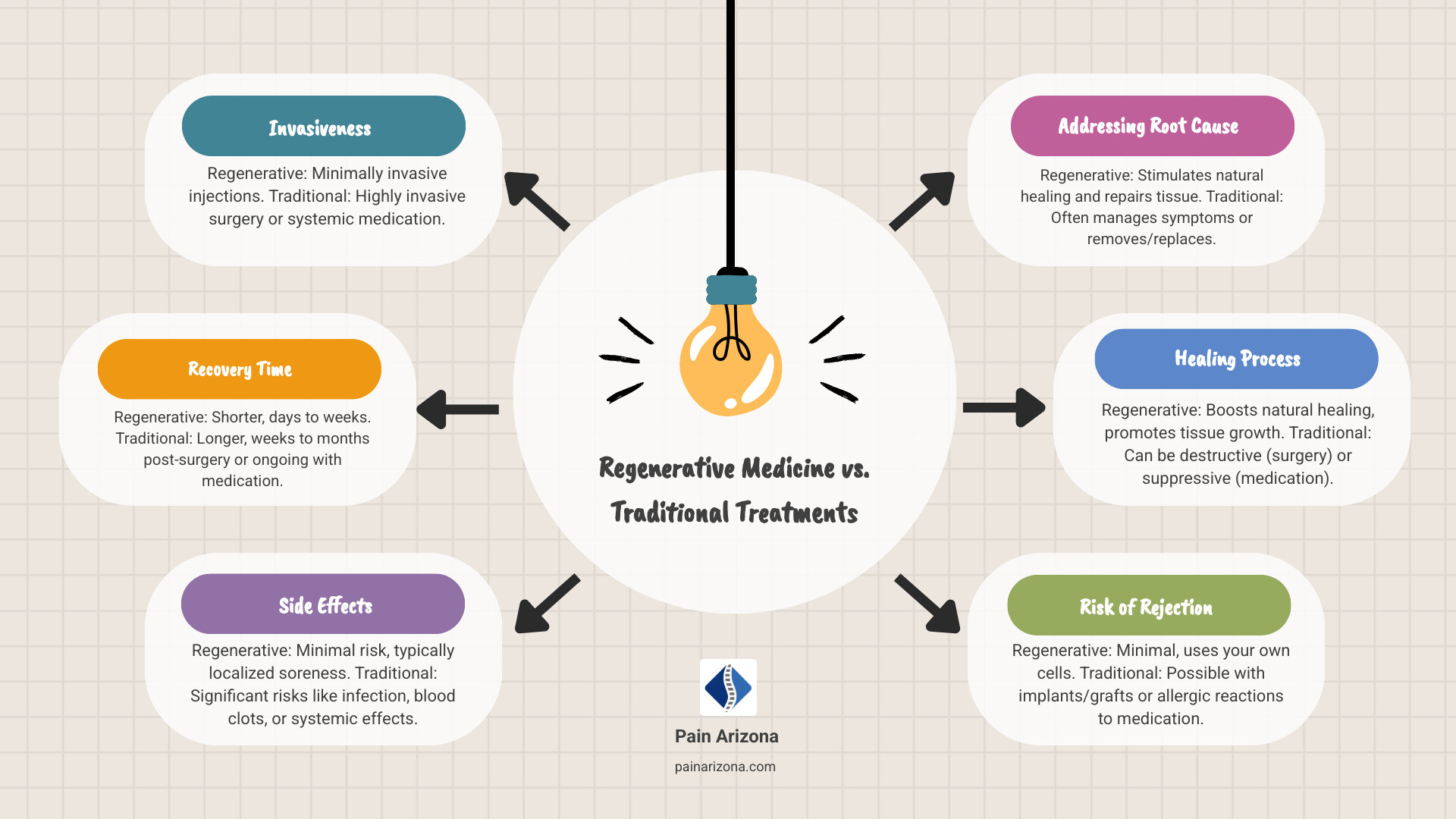
If you’re exploring regenerative medicine phoenix, you’ve likely found traditional pain management approaches lacking. Here’s how regenerative medicine is different:
- Minimally Invasive: It uses simple injections rather than large incisions. Procedures are quick (often under an hour), and patients go home the same day.
- Shorter Recovery: While surgery can sideline you for months, most patients return to light activities within days or weeks.
- Fewer Side Effects: The most common side effect is temporary soreness at the injection site. This avoids the significant risks of surgery (infection, blood clots) and long-term medication use (dependency, organ stress).
- Addresses the Root Cause: Instead of masking symptoms, it stimulates your body’s natural healing process to grow new, healthy tissue.
- Minimal Rejection Risk: Because we use your own biological materials, your body accepts the treatment.
The long-term outlook is actual healing and functional improvement, allowing many patients to reduce or eliminate pain medications and avoid surgery altogether.
Potential Risks and Complications
While regenerative medicine is generally safe when performed by a qualified physician, it is a medical treatment with some potential risks. The good news is that these risks are rare, and we take every precaution to minimize them.
Risks can include infection, bleeding, or swelling at the injection site. There’s also a slight risk of damage to nearby blood vessels or nerves, which is why we use advanced imaging technology—like C-Arm/Fluoroscopy and Ultrasound guidance—for precision. This dramatically reduces risks.
The importance of choosing a qualified provider cannot be overstated. At Pain Arizona, our double board-certified physicians have performed thousands of regenerative procedures, and your safety is always our top priority. We will review all risks with you during your consultation.
Understanding the Cost of Regenerative Medicine Treatments in Phoenix
Let’s address the cost. The price of regenerative medicine varies based on the condition being treated, the type of therapy (PRP, stem cell, etc.), and the number of sessions needed.
Your initial consultation is typically covered by your insurance. However, the regenerative procedures themselves are often considered investigational by insurance companies and may be an out-of-pocket expense.
We promise complete transparency. Before any treatment, we will explain all costs clearly. Our team will help you understand your options, verify any potential coverage, and discuss financing if needed. We believe cost shouldn’t be a barrier to getting the care you need.
Finding a Qualified Provider and the Future of Healing in Phoenix
The Phoenix area is a growing hub for medical innovation, making it essential to choose the right expert for your care. With regenerative medicine becoming more popular, you deserve a provider who combines expertise with compassion and transparency.
How to Find a Qualified Regenerative Medicine Provider in Phoenix
Choosing the right clinic for your regenerative medicine phoenix journey is crucial for your outcome. Here’s what to look for:
- Credentials and Specialization: Seek a physician who is double board-certified and specializes in pain management, with specific training and experience in regenerative medicine.
- Physician-Led Care: Ensure the physician is directly involved in every step, from evaluation to the procedure and follow-up.
- Advanced Technology: The clinic should use guidance technology like ultrasound or fluoroscopy for precision and safety.
- Transparent Communication: A good provider will clearly explain benefits, risks, and realistic expectations.
- Evidence-Informed Approach: Your treatment should be based on current scientific research, not hype.
- High-Quality Facilities: Onsite facilities, like a state-licensed Operating Room, demonstrate a commitment to safety and quality.

Latest Advancements in the Phoenix Area
Phoenix is rapidly becoming a significant center for advancements in regenerative medicine, giving you access to cutting-edge treatments. Our city hosts major conferences like The Cell & Gene Meeting on the Mesa, attracting global leaders and showcasing the latest breakthroughs.
Ongoing clinical research and regulatory progress by organizations like the Alliance for Regenerative Medicine are making these therapies safer and more accessible. The future of pain management is moving away from masking symptoms toward therapies that repair damaged cells to durably treat conditions. At Pain Arizona, we are committed to incorporating the latest evidence-based advancements into our practice. It’s an exciting time to be pursuing regenerative medicine, and there’s no better place to do it than right here in the Phoenix area.
Frequently Asked Questions about Regenerative Medicine
We understand you have questions about regenerative medicine phoenix. Here are clear, straightforward answers to the most common ones.
Is regenerative medicine covered by insurance?
Your initial consultation is typically covered by insurance, as we accept most major plans. However, most regenerative procedures themselves—like PRP and stem cell therapy—are often considered “investigational” by insurance companies and may require out-of-pocket payment.
Every plan is different, so it’s crucial to verify your specific coverage with our office. We are committed to price transparency and will discuss all costs and payment options with you beforehand so there are no surprises.
How long does it take to see results?
Results are not immediate because the goal is to actually heal damaged tissue, not just mask pain. This biological process of repair and regeneration takes time. Many patients report feeling gradual improvement within a few weeks to a few months after their procedure. Encouragingly, continued improvement can occur for over three months as your body completes the healing process.
Is regenerative medicine safe?
Yes, when performed by a qualified physician, regenerative medicine is a relatively safe procedure. A major safety advantage is that we use your body’s own biological materials, which dramatically reduces the risk of rejection or adverse reactions.
As with any injection, minor risks include temporary soreness or swelling at the injection site. We minimize more significant (but rare) risks like infection or nerve damage by using strict sterile techniques and advanced imaging guidance for precision. We will discuss all potential risks and benefits with you during your consultation to ensure you feel confident in your decision.
Your Path to a Pain-Free Life Starts Here
Living with chronic pain is exhausting, physically and emotionally. Regenerative medicine phoenix represents a genuine paradigm shift, moving beyond masking symptoms to actively healing damaged tissues from within. For those in Phoenix, Mesa, Gilbert, Scottsdale, and Glendale dealing with joint pain, arthritis, or sports injuries, these minimally invasive treatments offer real hope by using your body’s own restorative power.
At Pain Arizona, we are dedicated to helping you find lasting relief through thoughtful, physician-guided care. We combine regenerative therapies like PRP, stem cell therapy, and prolotherapy with integrative services. Your treatment plan is co-created around your specific goals and grounded in safety, transparency, and clinical rigor—no hype, just compassionate care.
You deserve to regain your mobility, reduce your pain, and reclaim the quality of life you’ve been missing. You deserve to get back to the activities you love without pain holding you back.
Don’t let chronic pain dictate your life any longer. Take that first step toward healing.
Learn more about our approach to Regenerative Medicine