
Sacroiliac Joint Pain: Your #1 Ultimate Relief Guide
Understanding the Hidden Source of Your Lower Back Pain
Sacroiliac joint pain is inflammation or dysfunction in the joints connecting your spine to your pelvis, causing discomfort in your lower back, buttocks, and sometimes legs.
Quick Facts About SI Joint Pain:
- Location: Two joints where the sacrum (base of spine) meets the iliac bones of your pelvis.
- Prevalence: Up to 25% of chronic low back pain originates from the SI joint.
- Common Symptoms: Pain in the lower back and buttocks that worsens with sitting, standing, or climbing stairs.
- Main Causes: Arthritis, injury, pregnancy, uneven gait, or previous spine surgery.
- Treatment: Physical therapy, medications, injections, and in severe cases, minimally invasive surgery.
- Prognosis: Most cases improve with conservative treatment in 2-4 weeks.
Many people with persistent lower back pain don’t realize the culprit might be their sacroiliac (SI) joint. This large, weight-bearing joint acts as a shock absorber between your upper body and legs. When it moves improperly—either too much (hypermobility) or too little (hypomobility)—it can cause significant pain often mistaken for a herniated disc.
The SI joint has minimal natural motion but bears tremendous force. Studies suggest that approximately one-quarter of people with chronic low back pain actually have sacroiliac joint dysfunction rather than a spinal problem.
I’m Dr. Nasser, Chief Medical Officer at Pain Arizona, and I’ve treated thousands of patients with sacroiliac joint pain. Through advanced diagnostics and personalized treatment plans, we help patients in the Greater Phoenix area identify and address the true source of their discomfort.

What is SI Joint Dysfunction and What Causes It?
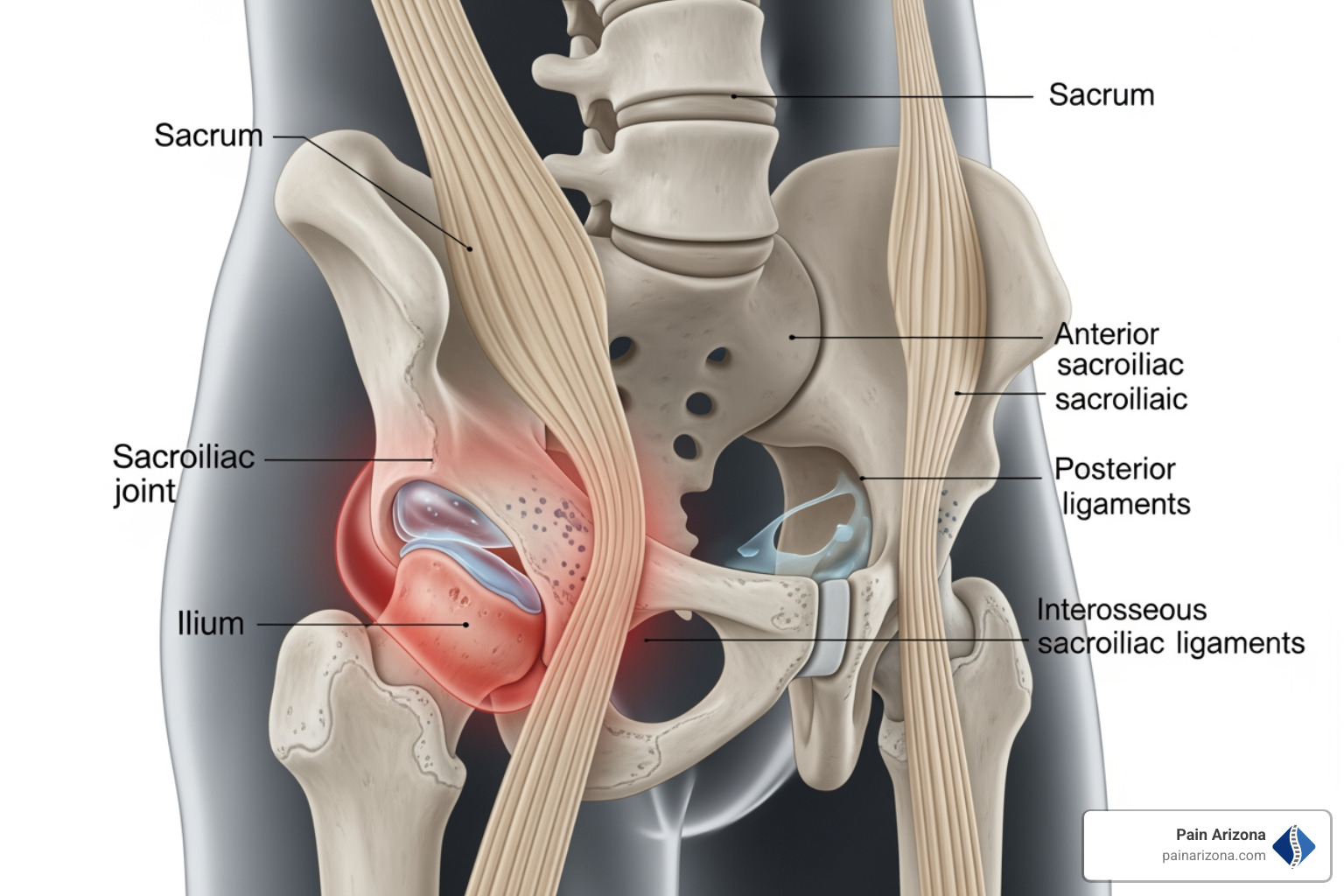
Your sacroiliac joint is where your sacrum—the triangular bone at the base of your spine—connects to your ilium, the large bone of your pelvis. You have two of these strong joints, reinforced by tough ligaments. Their critical job is to transfer your upper body’s weight to your legs while absorbing shock. Despite their strength, they only move 2 to 4 millimeters, but when this small movement goes wrong, it causes pain.
SI joint dysfunction occurs when these joints don’t function correctly. The problem is typically one of two types: hypermobility (too loose), where stretched ligaments allow excessive movement, or hypomobility (too stiff), where the joint gets “stuck” and doesn’t move enough.
Sacroiliitis vs. SI Joint Pain
Sacroiliac joint pain is a general term for any discomfort from the SI joint. Sacroiliitis is more specific, meaning there is active inflammation within one or both joints. While inflammation is common in SI joint pain, sacroiliitis is a distinct diagnosis and can be an early sign of inflammatory arthritis, like ankylosing spondylitis. The pain can feel sharp and stabbing or like a dull ache in your lower back, buttocks, or groin, sometimes radiating down the leg.
Common Causes of Sacroiliac Joint Pain
Understanding the trigger helps determine the best treatment.
Traumatic injury from a fall, car accident, or heavy lifting can damage the SI joint or its ligaments.
Repetitive stress from activities like golf, bowling, or jobs involving constant twisting can gradually wear down the joint.
Arthritis affects the SI joint like any other. Osteoarthritis is “wear and tear” arthritis, while ankylosing spondylitis, a chronic inflammatory condition, often presents first with sacroiliitis.
Pregnancy and childbirth make women vulnerable. Hormones loosen ligaments to prepare for delivery, and the extra weight and altered gait stress the SI joints. For most, the pain resolves after delivery, but for some, it lingers.
Previous lumbar fusion surgery can alter how forces move through your back. Studies show that after a fusion, the SI joint experiences increased stress and abnormal motion as it compensates for the fused segment above, potentially leading to new sacroiliac joint pain. Learn more on our page about Herniated Disc: How Spinal Issues Can Disrupt Your Life.
Less common causes include bacterial infection (septic sacroiliitis) and inflammatory bowel diseases like Crohn’s disease.
Risk Factors and Complications
Certain factors increase your risk for sacroiliac joint pain. A leg length discrepancy or scoliosis can create an uneven gait that loads SI joints asymmetrically. Any gait abnormality, even from unsupportive shoes, can put you at risk. Women are generally more susceptible due to anatomy and pregnancy, and degenerative changes become more common with age.
Ignoring sacroiliac joint pain can lead to serious complications, including limited mobility, sleep disruption, and an increased risk of depression and anxiety. Early diagnosis and treatment can prevent these issues. For a comprehensive overview, see this publication: PubMed: Sacroiliac Joint Pain: A Comprehensive Review of Anatomy, Diagnosis, and Treatment.
Recognizing the Symptoms and Getting an Accurate Diagnosis
SI joint dysfunction has distinctive characteristics that can help you and your doctor pinpoint the problem.
Common Symptoms of Sacroiliac Joint Dysfunction
The hallmark of sacroiliac joint pain is a deep, aching discomfort in your lower back and buttocks, usually on one side. The pain is often located just below the two “dimples” at the base of your spine.
The pain often radiates into the hip, groin, or upper thigh. About half of people with SI joint dysfunction experience pain traveling down the back or side of their thigh, which can be confused with sciatica. The pain itself can feel sharp and stabbing or like a dull, persistent ache.
What sets SI joint pain apart is what makes it worse. You’ll likely notice increased discomfort when:
- Climbing stairs
- Prolonged sitting or standing
- Transitional movements like getting up from a chair or rolling over in bed
- Lying on the affected side
- Twisting, bending forward, or running
Some people feel their leg might buckle or give way. Unlike many back conditions, sacroiliac joint pain sometimes improves with gentle movement. You might also notice morning stiffness.
How We Diagnose Sacroiliac Joint Pain
Diagnosing sacroiliac joint pain can be tricky because symptoms overlap with other conditions like lumbar radiculopathy or hip arthritis. At Pain Arizona, we use a comprehensive approach to ensure an accurate diagnosis.
We start with your medical history and a physical examination, where we assess your gait, posture, and range of motion. We then use provocation tests—specific maneuvers designed to stress your SI joint and reproduce your pain. If three or more of these tests are positive, it’s a strong indicator your SI joint is the source. These tests include the Fortin Finger Test, Thigh Thrust, Distraction, Compression, and Gaenslen’s Test.
Imaging tests like X-rays, CT scans, and MRIs help rule out other problems and reveal structural changes or inflammation. However, imaging alone is often not enough to confirm the diagnosis.
The gold standard for diagnosis is a diagnostic injection. An image-guided Sacroiliac Joint Injection involves placing a local anesthetic into the SI joint. If your pain decreases by more than 75%, we’ve confirmed the diagnosis. This procedure is both diagnostic and therapeutic.
By combining these methods, we can confidently identify the source of your pain and create an effective treatment plan.
Your Guide to Treating Sacroiliac Joint Pain
Once we confirm an SI joint diagnosis, the good news is that most people improve significantly with a personalized treatment plan. We start with conservative options and only move to more advanced interventions if needed. Many patients see substantial improvement within 2 to 4 weeks with a consistent, multimodal approach.
Non-Surgical Treatment Options
The foundation of treatment involves non-surgical approaches to reduce inflammation, restore joint mechanics, and strengthen supporting muscles.
Physical therapy is crucial. A therapist will design exercises for your specific condition, whether it’s hypermobility (too loose) or hypomobility (too stiff). This may involve strengthening exercises for your core and glutes or stretching tight muscles like the piriformis and hamstrings. Manual therapy can also help realign the joint. Learn more about Exercise-Based Rehab.
Medications like over-the-counter NSAIDs (ibuprofen, naproxen) can reduce pain and inflammation for short-term use. Muscle relaxants can help with associated muscle spasms.
When other methods aren’t enough, we offer interventional procedures. Corticosteroid injections deliver a powerful anti-inflammatory directly into the SI joint under fluoroscopic guidance, providing concentrated relief. Learn how Cortisone Shots offer fast relief.
For recurring pain, radiofrequency ablation (RFA) may be an option. This procedure uses heat to interrupt pain signals from the joint, offering relief that can last for months or even over a year. Read more on our Radiofrequency Ablation page.
Lifestyle modifications are also key. Maintaining a healthy weight, using good posture, and regular low-impact exercise can provide lasting relief. Small changes can make a big impact, as detailed in our guide to Lifestyle Modifications for Pain Management.
The prognosis is generally favorable, with most people returning to normal activities with consistent conservative treatment.
When Is Surgery Considered?
Surgery is reserved for the small percentage of patients with chronic, severe pain who have not found relief after months of comprehensive conservative care.
SI joint fusion is the primary surgical option. The goal is to permanently stabilize the joint, eliminating the painful, abnormal motion. Modern SI joint fusion is performed using minimally invasive techniques. Small titanium implants and bone graft material are used to hold the bones in place and encourage them to fuse over time. This approach typically means less tissue damage and faster recovery. Learn more about our Minimally Invasive Spine Procedures.
Fusion surgery is a major decision. We will have an in-depth conversation about the realistic outcomes, benefits, and risks. At Pain Arizona, we serve patients throughout the Greater Phoenix area—including Mesa, Scottsdale, Glendale, and Chandler—and are committed to helping you make an informed decision.
Frequently Asked Questions about SI Joint Pain
Here are answers to the questions I hear most often from patients experiencing sacroiliac joint pain.
Can sacroiliitis be prevented?
While not all cases of sacroiliitis are preventable, especially those linked to genetics, you can take steps to protect your SI joints and reduce your risk.
- Reduce arthritis risk: Lifestyle choices like avoiding tobacco are crucial, as smoking accelerates joint degeneration.
- Use proper lifting technique: Squat and lift with your legs, not your back, to avoid stressing your SI joints.
- Maintain good posture: Avoid slouching or standing with your weight shifted to one leg.
- Engage in regular low-impact exercise: Activities like swimming, walking, and cycling strengthen the muscles that stabilize your SI joint.
- Maintain a healthy weight: This reduces the constant compressive forces on your joints.
- Address biomechanical issues: Correcting a leg length discrepancy or gait issues, sometimes with a simple shoe insert, can prevent long-term strain.
What is the difference between sacroiliitis and sciatica?
These conditions are often confused because both can cause pain in the lower back and legs. The key difference is their origin:
- Sacroiliitis is joint inflammation. The pain comes directly from an irritated or abnormally moving sacroiliac joint.
- Sciatica is nerve pain. It occurs when the sciatic nerve is compressed or irritated, often by a herniated disc.
While both can cause radiating leg pain, sacroiliac joint pain typically stays in the buttock, hip, and upper thigh. Sciatica often travels down to the foot and may cause numbness, tingling, or weakness. SI joint pain is often worsened by climbing stairs or standing up from a seated position, while sciatica can be triggered by coughing or sneezing. Accurate diagnosis is critical, as treatment for each condition is different.
Is SI joint pain permanent?
For most people, sacroiliac joint pain is not permanent. The prognosis depends on the cause.
- Pregnancy-related pain is often temporary and typically resolves within a few months postpartum as hormones and ligaments return to normal.
- Pain from trauma or biomechanical issues also has a very positive outlook, usually responding well to physical therapy and other conservative treatments.
- If your pain stems from arthritis-related damage, such as ankylosing spondylitis, the structural changes may be permanent. However, this does not mean permanent suffering. Effective management with medications, physical therapy, and interventional procedures can control pain and maintain function.
Recurrence can happen, but it is often preventable. Patients who stick with their exercise programs and practice good body mechanics tend to have better long-term outcomes. At Pain Arizona, we focus on strategies to keep you active and pain-free for years to come.
Take Control of Your Low Back Pain
If you’ve made it this far, you now understand that sacroiliac joint pain is a real, identifiable condition that may be the true culprit behind your chronic lower back pain.
The encouraging news is that you are not stuck with this pain. Whether your discomfort stems from an injury, arthritis, or a previous surgery, effective treatments are available. From physical therapy and lifestyle adjustments to targeted injections and minimally invasive procedures, there is a path to relief.
At Pain Arizona, we understand the frustration of living with chronic pain. Our approach begins with a thorough diagnostic evaluation to identify the exact source of your discomfort. Our double board-certified physicians use a combination of expertise and compassion to create personalized treatment plans for your unique situation.
I’m Dr. Nasser, Chief Medical Officer at Pain Arizona. Our team serves patients throughout the Greater Phoenix area, including Chandler, Mesa, Gilbert, Scottsdale, and Glendale. We accept most insurance plans and encourage you to check with our office to confirm yours is accepted.
You don’t have to keep wondering why your back hurts. If you’re experiencing persistent lower back or buttock pain that worsens with sitting, standing, or climbing stairs, your SI joint might be telling you something important. Find comprehensive care for your low back pain at our locations across the Phoenix area: Low Back Pain Chandler, Mesa, Scottsdale, Phoenix, Glendale.
Let’s work together to get you back to living your life without pain holding you back.
