
Outpatient Lumbar Epidural Injections: A Smooth Procedure for Fast Relief
Chronic Back Pain Doesn’t Have to Control Your Life
A lumbar epidural injection outpatient procedure is one of the most common and effective non-surgical options for relieving chronic low back pain and leg pain — and it’s done the same day, with no hospital stay required.
Here’s what to expect at a glance:
| Step | What Happens |
|---|---|
| Preparation | Change into a gown, review medications, discuss your history |
| During | Fluoroscopy-guided needle placement, contrast dye, steroid injection |
| Duration | 15 to 30 minutes total |
| After | Monitored for 15–20 minutes, then discharged home |
| Relief | Begins within 1–3 days; may last several months |
Back pain is the fifth most common reason Americans seek medical care. For the many people who experience pain that radiates down the leg — a condition called radicular pain — it can feel impossible to get through a normal day. Simple tasks become a struggle. Treatments that once helped stop working. And the idea of surgery feels overwhelming.
That’s where a lumbar epidural steroid injection (ESI) comes in. It delivers powerful anti-inflammatory medicine directly to the source of nerve irritation in the lower spine — without surgery, without a hospital admission, and often with meaningful relief within days.
Epidural steroid injections are among the most common therapies used for radicular pain today. Research shows that up to 70% of patients with pain caused by a herniated disk report feeling at least 50% better within one to two months of receiving one.
I’m Dr. Nasser, a double board-certified physician in Physical Medicine and Rehabilitation and Pain Medicine, and I’ve performed tens of thousands of minimally invasive procedures — including the lumbar epidural injection outpatient procedure — helping patients across the Greater Phoenix Area reclaim their lives from chronic pain. In this guide, I’ll walk you through everything you need to know, from how the procedure works to what recovery looks like.
Understanding the Lumbar Epidural Injection Outpatient Procedure
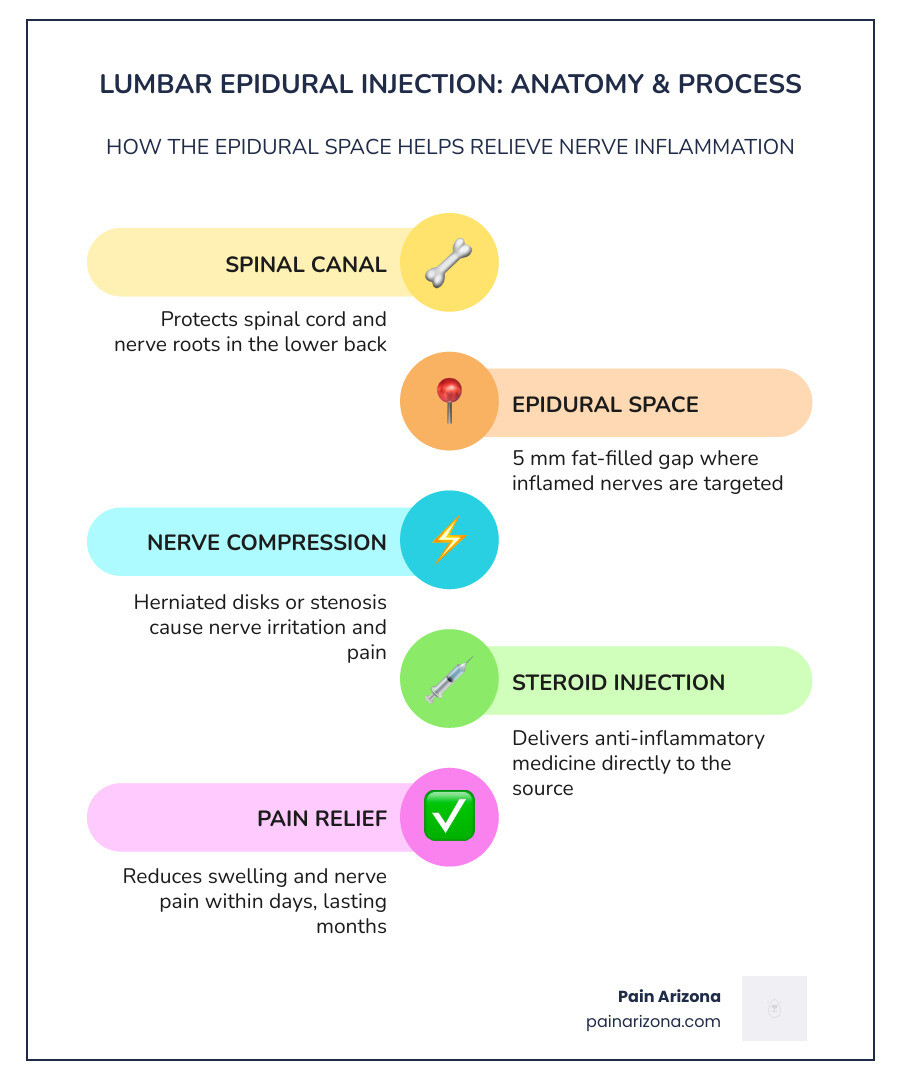
To understand why this procedure is so effective, we first need to look at the anatomy of your lower back. Your spinal cord and the nerves that branch out from it are protected by a “sleeve” called the dural sac. Between this sac and the bony walls of your spinal canal lies a small, fat-filled area known as the epidural space.
This space is only about 5 millimeters wide, but it is incredibly important. It contains the nerve roots that travel from your spine down into your legs. When a disk herniates or the spinal canal narrows (stenosis), these nerves can become compressed and, more importantly, inflamed. This inflammation is the primary driver of that sharp, shooting “electric” pain you might feel in your buttocks or legs.
A lumbar epidural injection outpatient procedure works by delivering a concentrated dose of corticosteroids directly into this space. Think of corticosteroids as high-powered “fire extinguishers” for inflammation. By bathing the irritated nerve roots in this medicine, we can reduce swelling, “flush out” inflammatory chemicals, and allow the nerve to heal.
As noted in Epidural Steroid Injections – StatPearls, these injections have been a staple of pain management since 1952. While they don’t “fix” a herniated disk in the way surgery might, they often provide enough relief to allow you to participate in physical therapy and other non-surgical back treatment options that can lead to long-term recovery.
Choosing a lower back pain medical procedure that doesn’t require a hospital stay means you get back to your life in Mesa or Scottsdale much faster than you would with traditional surgery.
Different Approaches to the Lumbar Epidural Injection Outpatient Procedure
Not all epidural injections are the same. Depending on where your pain is located and what is causing it, we may choose one of three primary “routes” to reach the epidural space.
- Interlaminar: This is the most traditional approach. The needle enters from the back of the spine, passing between the “laminae” (the flat plates of bone on the back of your vertebrae). This is excellent for delivering medication over a wide area or if you have pain on both sides of your body.
- Transforaminal: Often called a “nerve block” approach, this technique enters from the side of the spine where the specific nerve root exits. This allows us to place the medication exactly where the inflammation is most intense. It is highly effective for one-sided leg pain. You can learn more about the specifics of the transforaminal epidural injection here.
- Caudal: This approach uses the “sacral hiatus” — a small opening near your tailbone. It is a very safe and often easier way to reach the lowest nerves in the spine, especially if you have had previous back surgery that created scar tissue higher up.
| Approach | Best For | Precision |
|---|---|---|
| Interlaminar | Multi-level pain, bilateral symptoms | Moderate |
| Transforaminal | Specific nerve root irritation (Sciatica) | High |
| Caudal | Lower sacral nerves, post-surgical pain | Moderate |
Why Choose an Outpatient Setting for Spinal Injections?
In May 2026, the shift toward outpatient care has only accelerated. Patients in the Phoenix Area consistently choose our outpatient clinics for several reasons:
- Convenience: You aren’t dealing with the bureaucracy of a massive hospital system. You arrive, have your procedure, and are back in your own bed within a few hours.
- Safety: Outpatient centers often have lower infection rates compared to large hospitals.
- Cost-Effectiveness: Outpatient procedures are generally more affordable for both patients and insurance providers. We accept most insurance plans at our locations in Gilbert and Glendale; just check with our office manager to see if your plan is accepted.
- Recovery: There is no “hospital fog.” You recover in a comfortable, specialized environment designed specifically for lower back pain treatments.
Conditions Treated and Expected Benefits
We primarily use the lumbar epidural injection outpatient procedure to treat “radicular” pain — pain that starts in the back and travels down into the leg. Common culprits include:
- Herniated Disks: When the soft center of a spinal disk leaks out, it can chemically irritate the nearby nerve.
- Spinal Stenosis: A narrowing of the spaces within your spine, which can put pressure on the nerves.
- Degenerative Disk Disease: Wear and tear on the disks that leads to inflammation.
- Sciatica: A general term for irritation of the sciatic nerve. If you’re struggling with this, we offer specialized sciatica treatment and targeted injections for sciatica.
The benefits are significant. According to the Cleveland Clinic, up to 70% of patients with disk-related pain experience a 50% reduction in pain for several months. For many, this relief “breaks the cycle” of chronic pain, allowing them to strengthen their core and back muscles, which provides the real long-term solution.
Preparing for Your Lumbar Epidural Injection Outpatient Procedure
Preparation is straightforward, but following these steps ensures the procedure goes smoothly.

- Medication Review: We need to know everything you are taking. Most importantly, we will likely ask you to stop taking blood thinners (like aspirin, Plavix, or Coumadin) for several days before the procedure to prevent bleeding near the spine.
- Fasting: Generally, we ask that you do not eat for six hours before your appointment. You can usually have clear liquids (water, black coffee) up to two hours before.
- The “Buddy System”: Because we use local anesthetics (and sometimes a mild sedative to help you relax), you cannot drive yourself home. You must arrange for a responsible adult to stay at the clinic and drive you back to your home in Mesa or Scottsdale.
- Health Update: If you have a fever, an active infection, or if there’s any chance you are pregnant, please let us know immediately. We use X-ray guidance, which is not recommended during pregnancy.
For more detailed prep tips, check out our guide on everything you need to know about joint injections.
Step-by-Step: What Happens During the Injection
When you arrive at our Phoenix Area clinic, we’ll make sure you’re comfortable. The entire lumbar epidural injection outpatient procedure usually takes about 15 to 30 minutes.

Step 1: Positioning You will lie face down on a specialized X-ray table. We may place a small pillow under your abdomen to help open up the spaces between your vertebrae.
Step 2: Numbing the Skin We clean the area thoroughly with an antiseptic solution. Then, we use a very fine needle to numb the skin and deeper tissues with a local anesthetic. This might sting for a few seconds, but it makes the rest of the procedure much more comfortable.
Step 3: Fluoroscopy (The “Eye in the Sky”) We never “guess” where the needle is going. We use live X-ray imaging called fluoroscopy. This allows us to watch the needle in real-time as it moves toward the epidural space.
Step 4: Contrast Dye Once the needle is in position, we inject a small amount of contrast dye. This dye shows up clearly on the X-ray, confirming that the medication will spread exactly where it’s needed and ensuring the needle isn’t in a blood vessel.
Step 5: The Injection Finally, we inject the mixture of corticosteroid and anesthetic. You might feel a sensation of pressure or a temporary “tingling” down your leg—this is actually a good sign that the medicine is reaching the right spot! For a deeper dive into how these medicines work, see our post demystifying cortisone injections.
As MedlinePlus explains, the numbing medicine often provides immediate relief, but this only lasts a few hours. The steroid is the “long-term” player, taking a few days to fully kick in.
Recovery and Aftercare Following Your Procedure
After the injection, we will move you to a recovery area for about 15 to 20 minutes. We check your blood pressure and make sure you can walk steadily.
- The First 24 Hours: Go home and take it easy. No heavy lifting, strenuous exercise, or long drives. You can resume a normal diet immediately.
- Pain Management: It is normal to have some soreness at the injection site. You can use an ice pack for 15-20 minutes at a time to help. Some patients experience a “steroid flare”—a temporary increase in pain for a day or two before the relief begins.
- The Pain Diary: We often give patients a pain diary. This helps you track your relief over the next two weeks, which is vital information for us to determine if we need to repeat the injection or try a different approach, like facet joint injections.
- Activity Progression: The goal isn’t just to sit on the couch! Once the pain starts to subside (usually day 3 or 4), we want you to start moving gently. Walking is great. This is the perfect time to start physical therapy.
Frequently Asked Questions
How long does pain relief last after the procedure?
While every patient is different, studies show that a lumbar epidural injection outpatient procedure can provide reliable pain relief for up to six months. Some of our patients in the Phoenix Area experience relief for a full year, while others may need a follow-up injection sooner. The injection is a “window of opportunity” to perform the exercises that keep your back healthy.
What are the risks of a lumbar epidural injection outpatient procedure?
This is considered a very safe procedure, but no medical intervention is without risk.
- Spinal Headache: Occurs in less than 1% of cases if the needle accidentally punctures the dural sac. It usually resolves with rest and fluids.
- Infection/Bleeding: Extremely rare due to our sterile techniques and pre-procedure screening.
- Steroid Side Effects: Some people may feel “flushed,” have trouble sleeping for a night, or notice a temporary rise in blood sugar (important for our diabetic patients to monitor).
How many injections can I receive in one year?
Most healthcare providers, including us at our pain management clinic Phoenix, limit patients to two or three injections per year. Excessive use of steroids can potentially weaken the local bones or muscles, so we use them judiciously as part of a broader treatment plan.
Conclusion
At Pain Arizona, we believe that you shouldn’t have to choose between living in pain and undergoing major surgery. The lumbar epidural injection outpatient procedure offers a middle ground—a sophisticated, minimally invasive way to target the root cause of your pain and get you back to the activities you love in the Greater Phoenix Area.
Our team, led by double board-certified physicians, is dedicated to providing compassionate, evidence-based care. Whether you are in Mesa, Gilbert, Scottsdale, or Glendale, we are here to help you navigate your journey to recovery.
Don’t let back pain dictate your future. Schedule your outpatient lumbar epidural steroid injection with us today and take the first step toward a pain-free life.