
Beat Sciatica: 12 Quick Ways to Soothe Your Symptoms
Understanding Sciatic Nerve Pain and Your Path to Relief
How to treat sciatica starts with understanding that most cases improve within 4-6 weeks using conservative approaches. Here’s what works:
| Treatment Approach | Time to Relief | Effectiveness |
|---|---|---|
| Ice/heat therapy | Minutes to hours | Quick symptom relief |
| Gentle stretching | Days to weeks | Reduces nerve pressure |
| Walking and movement | 1-2 weeks | Prevents stiffness |
| Physical therapy | 4-6 weeks | Addresses root cause |
| Anti-inflammatory meds | Hours to days | Reduces inflammation |
| Epidural injections | Days to weeks | For severe cases |
If you’ve ever felt that sharp, shooting pain radiating from your lower back down through your leg, you know exactly how debilitating sciatica can be. Sciatica isn’t actually a condition itself—it’s a type of pain that happens when your sciatic nerve, the longest nerve in your body, becomes compressed, irritated, or inflamed. This nerve runs from your lower back through your hips and buttocks and down each leg, which is why the pain can travel such a long distance.
The good news? Research shows that 80-90% of people with sciatica recover without surgery, and about half improve within just six weeks. For some, relief comes even faster with the right combination of treatments.
I’m Dr. Nasser, Chief Medical Officer at Pain Arizona, where I’ve spent over 15 years helping patients understand how to treat sciatica through evidence-based interventions and minimally invasive procedures. Having performed tens of thousands of procedures for nerve-related pain, I’ve seen that addressing the root cause—not just masking symptoms—leads to lasting relief.
Most sciatica cases stem from a herniated or bulging disc pressing on the nerve root, though spinal stenosis, piriformis syndrome, and other conditions can also trigger symptoms. The key is identifying what’s causing your pain and building a treatment plan that moves you from managing symptoms to resolving the underlying problem.
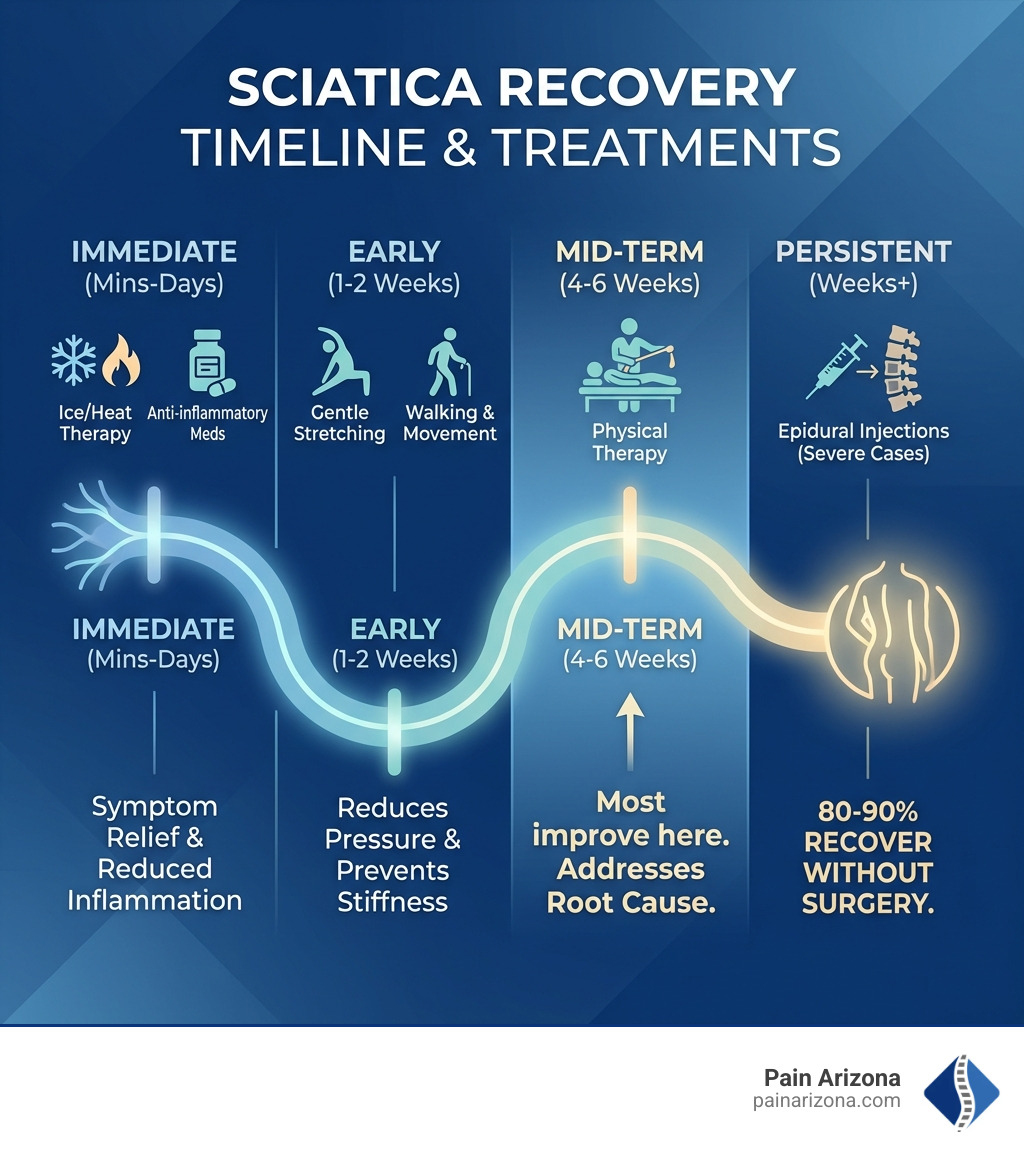
How to treat sciatica terms at a glance:
Understanding the Root Causes of Nerve Pain
To effectively learn how to treat sciatica, we first have to look at what is actually happening in your spine. Your sciatic nerve is the body’s biggest, thickest, and longest nerve. It starts at segments L4 through S3 of your spinal cord and travels all the way to your toes. Because it covers so much ground, there are many places where things can go wrong.
Sciatica is essentially a symptom of an underlying issue. According to scientific evidence on sciatica causes, the most frequent culprit is a herniated disc. This occurs when the soft, jelly-like center of a spinal disc pushes through a tear in the tougher exterior, putting direct pressure on the nerve. Similarly, a bulging disc happens when the disc protrudes without actually tearing, but the result—nerve compression—is often the same.
Other common causes we see at our Phoenix and Mesa clinics include:
- Spinal Stenosis: A narrowing of the spaces within your spine, which puts pressure on the nerves.
- Piriformis Syndrome: A condition where the piriformis muscle, located in the buttock region, spasms and irritates the sciatic nerve.
- Spondylolisthesis: This happens when one vertebra slips forward over the one below it, pinching the nerve root.
- Nerve Inflammation: Sometimes the nerve isn’t physically “pinched” by a bone or disc, but is chemically irritated by inflammatory proteins released from a nearby injury.
Understanding these causes is vital because how to treat sciatica caused by a tight muscle (piriformis) is very different from treating pain caused by a structural bone issue (stenosis).
12 Quick Ways for How to Treat Sciatica at Home
When a flare-up hits, you want relief now. While long-term recovery takes time, these twelve strategies can help soothe symptoms quickly.

1. Ice Therapy
For the first 72 hours of a flare-up, ice is your best friend. It helps reduce the acute inflammation around the nerve. Apply an ice pack (wrapped in a thin towel) for 15-20 minutes every few hours.
2. Heat Application
After the initial three days, switching to heat can help relax the muscles that may be spasming in response to the pain. Heat increases blood flow to the area, which promotes healing.
3. Comparing Ice vs. Heat
| Feature | Cold Therapy (Ice) | Heat Therapy |
|---|---|---|
| Best Used | First 48-72 hours | After 72 hours |
| Primary Goal | Reduce swelling/numb pain | Relax muscles/stiffness |
| Duration | 15-20 minutes | 15-20 minutes |
| Caution | Don’t apply directly to skin | Avoid if area is “hot” or red |
4. Exercise-Based Rehab
It might feel counterintuitive to move when you’re in pain, but movement is medicine. Exercise-based rehab focuses on strengthening the core muscles that support your spine, taking the load off your discs.
5. Walking
Avoid the temptation to stay in bed. Walking is a low-impact way to keep your spine mobile. Start with short, 5-minute walks around your home in Gilbert or Scottsdale and gradually increase as tolerated.
6. Swimming and Hydrotherapy
Water provides buoyancy, which unloads the spine. Research on swimming for nerve regeneration suggests that the rhythmic movement and lack of gravity can significantly aid recovery.
7. OTC Anti-inflammatories
Over-the-counter medications like Ibuprofen (Advil/Motrin) or Naproxen (Aleve) can reduce the inflammation that triggers the nerve pain. Always consult with a professional regarding medication management to ensure these are safe for your specific health profile.
8. Massage Therapy
Targeted massage can release tension in the lower back and glutes. While it may not “cure” a herniated disc, it can certainly reduce the secondary muscle guarding that makes sciatica feel worse.
9. Acupuncture
Many of our patients find relief through acupuncture. Acupuncture efficacy for sciatica has been supported by several studies, showing it can be more effective than certain medications for some individuals.
10. Short-Term Rest
While we advocate for movement, a “little bit” of rest can help during a severe flare-up. Harvard research suggests that limited bed rest (1-2 days max) can be helpful, but any longer can actually weaken your muscles and delay recovery.
11. Nerve Gliding
Nerve glides (or “flossing”) are gentle movements that help the nerve slide through its surrounding tissues more easily, reducing irritation.
12. Topical Gels
Menthol-based or lidocaine creams can provide a temporary “distraction” for the nerves, offering short-term relief while you work on other therapies.
Effective Stretches for How to Treat Sciatica
Stretching is a cornerstone of how to treat sciatica. The goal is to create space for the nerve and reduce muscle tension.
- Cat-Cow Pose: On all fours, gently arch your back toward the ceiling (cow) and then round it (cat). This mobilizes the spine.
- Bird-Dog: This builds core stability. Extend your right arm and left leg simultaneously while maintaining a flat back.
- Reclining Pigeon Pose: Lie on your back, cross one leg over the other so your ankle rests on the opposite knee, and gently pull the bottom leg toward your chest.
- Knee-to-Opposite-Shoulder: This helps stretch the glutes and lower back without putting excessive pressure on the discs.
If you are unsure about these movements, seeking professional Physical Therapy is the safest way to ensure you aren’t accidentally making the compression worse.
Lifestyle Adjustments and How to Treat Sciatica Naturally
Often, how to treat sciatica successfully involves changing the habits that caused the problem in the first place.
- Ergonomics: If you work in an office in Phoenix, ensure your chair supports your lower back’s natural curve. Small lifestyle modifications like using a standing desk or a lumbar roll can make a massive difference.
- Posture Correction: Avoid “slumping” when sitting. Your ears should be over your shoulders, and your shoulders over your hips.
- Avoiding Prolonged Sitting: Sitting puts more pressure on your spinal discs than standing or lying down. Set a timer to stand and stretch every 30 minutes.
- Stress Management and Biofeedback: Chronic pain is stressful, and stress makes us tighten our muscles, which increases pain. Techniques like biofeedback can help you learn to relax the muscles surrounding the sciatic nerve.
When to Seek Professional Medical Attention
While many cases of sciatica resolve on their own, we want you to know when it’s time to visit us at Pain Arizona. If your pain hasn’t improved after four weeks, or if it’s getting worse despite home care, a professional evaluation is necessary.
There are “red flag” symptoms that require immediate medical attention:
- Cauda Equina Syndrome: This is a rare but serious condition where the nerve roots at the bottom of the spinal cord are compressed.
- Bladder or Bowel Incontinence: Any loss of control over your bathroom habits is an emergency.
- Numbness in the “Saddle Area”: Numbness around your genitals or inner thighs.
- Progressive Weakness: If you find you can’t lift your foot (foot drop) or your leg feels like it’s “giving out.”
These symptoms may indicate Lumbar Radiculopathy or a severe Pinched Nerve that could lead to permanent damage if not treated promptly.
Advanced Medical Options for Persistent Pain
If conservative methods haven’t provided the relief you need, we offer several minimally invasive treatments in our Glendale and Mesa offices.
- Lumbar Epidural Steroid Injection: We inject a potent anti-inflammatory directly into the space around the irritated nerve. This can provide relief for 3-4 months, often giving you the “window” you need to participate in physical therapy.
- Nerve Root Block: A more targeted injection used both for diagnosis and treatment of a specific nerve.
- Radiofrequency Ablation: This procedure uses heat to “turn off” the pain signals from specific nerves.
- Spinal Decompression Therapy: A non-surgical way to gently stretch the spine and take pressure off the discs.
- Spinal Cord Stimulation: For chronic, persistent sciatica, we can use an implantable device that sends mild electrical pulses to the spinal cord to mask pain signals.
- Minimally Invasive Spine Surgery: In cases where structural issues like a large herniation don’t respond to other treatments, we utilize endoscopic procedures to remove the pressure with minimal downtime.
Long-term Outlook and How to Treat Sciatica Recurrence
The long-term outlook for sciatica is excellent. Most people return to their normal activities within a few months. However, once you’ve had a flare-up, you are at a higher risk for recurrence.
Preventing future pain involves:
- Core Strengthening: Think of your core as a natural “back brace.”
- Weight Management: Every extra pound adds pressure to your lower spinal discs.
- Smoking Cessation: Smoking reduces blood flow to the spinal discs, accelerating Degenerative Disc Disease.
- Proper Lifting: Always bend at the knees, not the waist.
If you deal with lingering numbness, our team provides specialized neuropathy care to help restore nerve function.
Frequently Asked Questions about Sciatica
How long does sciatica typically last?
For most people, symptoms improve significantly within 4 to 6 weeks. However, it can take up to 12 weeks for the inflammation to fully subside. In chronic cases, pain may fluctuate for a year or more without proper intervention.
Is walking good for sciatic nerve pain?
Yes! Walking is generally recommended because it increases blood flow and helps maintain spinal mobility. However, you should avoid “power walking” or long strides that might overstretch the nerve. If walking increases your pain, stop and consult a specialist.
Can sciatica go away on its own?
Yes, in many cases, the body can actually reabsorb the herniated disc material over time. However, “waiting it out” without doing corrective exercises often leads to the pain returning later.
Conclusion
At Pain Arizona, we believe that no one should have to live with the “lightning bolt” pain of sciatica. Our team of double board-certified physicians is dedicated to providing the Greater Phoenix Area with compassionate, evidence-based care. Whether you are in Mesa, Gilbert, or Phoenix, we are here to help you move from pain to power.
We accept most insurance plans to ensure our treatments are accessible. Check with our office manager to see if your plan is accepted.
Don’t let nerve pain dictate your life. How to treat sciatica effectively means taking the first step toward a diagnosis. Beat Sciatica Today by scheduling a consultation with our specialists. We look forward to helping you return to the activities you love.