
Don’t Let Your Back Hold You Back: Phoenix Pain Management Solutions
Why Lower Back Pain Phoenix Care Matters for Your Quality of Life
Lower back pain Phoenix residents experience can be debilitating, but effective treatment is closer than you think. If you’re searching for relief, here’s what you need to know:
Quick Guide to Finding Lower Back Pain Treatment in Phoenix:
- Identify your symptoms – Dull ache, sharp pain, or radiating discomfort down your legs
- Understand the severity – Acute (days to weeks) vs. chronic (3+ months)
- Seek expert diagnosis – Physical exam, imaging, and functional assessment
- Explore treatment options – From physical therapy to minimally invasive procedures
- Find specialized care – Board-certified pain physicians with interventional expertise
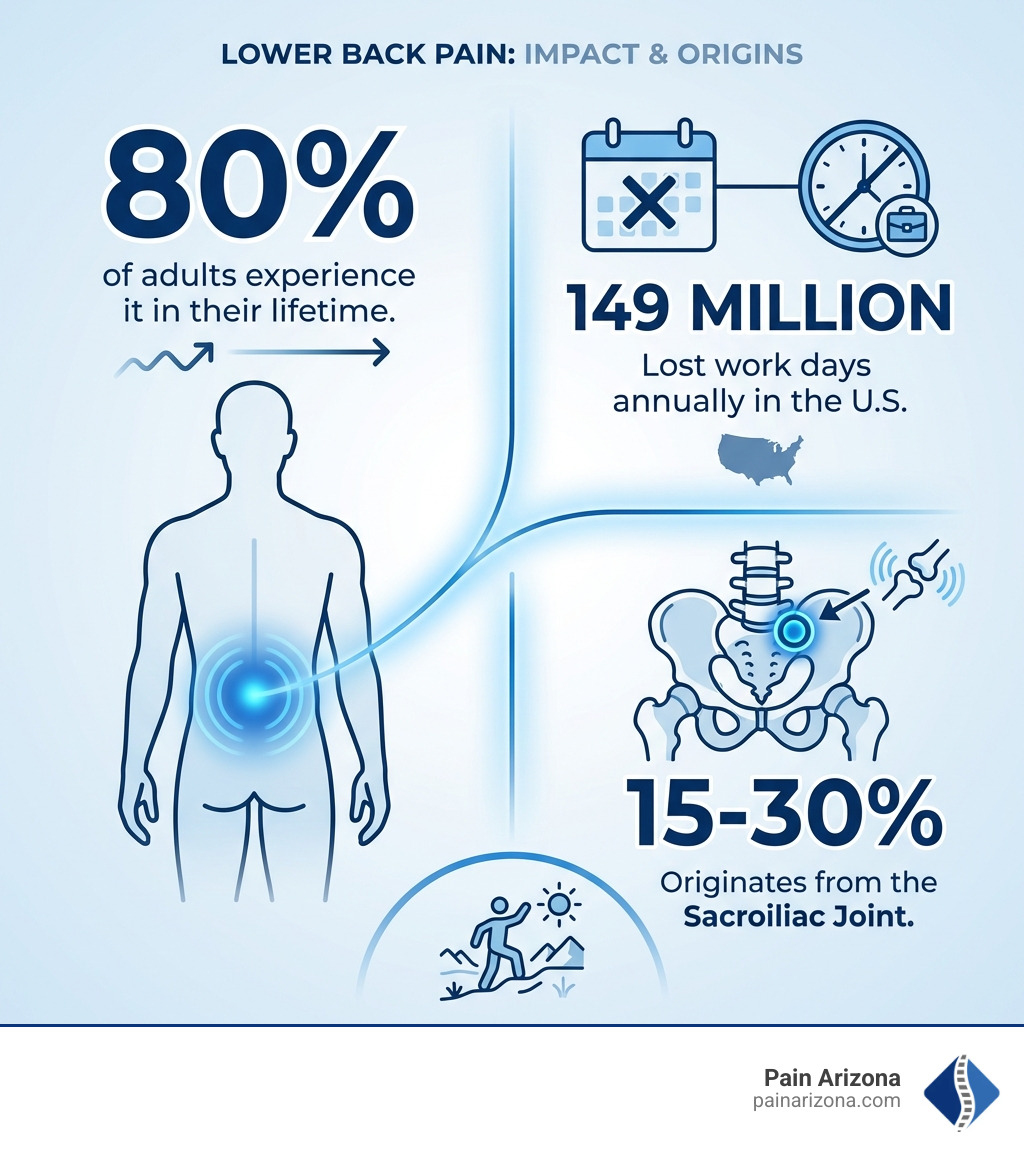
Nearly 80 percent of adults will experience lower back pain at some point in their lives, making it one of the most common reasons people seek medical care. In Phoenix, where an active outdoor lifestyle is part of the culture, back pain can feel like losing a piece of yourself—whether it’s missing out on hiking Camelback Mountain, struggling through your work commute, or simply finding it difficult to play with your kids.
The good news? Modern pain management has evolved far beyond temporary fixes and prescription dependency. Today’s evidence-based treatments address the root cause of your pain, not just the symptoms, offering real hope for lasting relief without major surgery.
I’m Dr. Nasser, Chief Medical Officer at Pain Arizona, and I’ve spent over 15 years specializing in physical medicine, rehabilitation, and interventional pain management, helping thousands of Phoenix-area patients overcome lower back pain Phoenix specialists can effectively treat through comprehensive, minimally invasive approaches. My mission is simple: help you understand why you hurt and guide you toward the most effective treatment for your specific condition.
Lower back pain Phoenix basics:
- Failed back surgery syndrome
- Dorsal root ganglion stimulation
- minimally invasive spine surgery near me
Understanding Lower Back Pain Phoenix: Causes and Symptoms
The lumbar spine is a marvel of engineering, designed to support the weight of your entire upper body while providing the flexibility to twist, bend, and lift. However, this high-demand role makes it susceptible to wear and tear. When we talk about lower back pain Phoenix residents often describe anything from a dull, persistent ache to sharp, stabbing sensations that make movement impossible.

Statistically, 80 percent of our population experiences back pain at some point. This isn’t just a minor inconvenience; in the United States, low back pain is the second most common cause of disability among adults and is responsible for an estimated 149 million lost work days every year. Whether it’s a sudden muscle strain from lifting a heavy box or more complex disc problems, understanding the “why” behind the pain is the first step toward recovery.
Common Causes for Phoenix Residents
In our beautiful Valley of the Sun, lifestyle factors play a significant role in spinal health. We see several recurring themes among our patients:
- Active Lifestyle Injuries: While hiking Piestewa Peak or golfing in Scottsdale is great for your heart, repetitive movements or sudden slips can lead to sacroiliac joint dysfunction or ligament sprains.
- Heat-Related Muscle Issues: The intense Phoenix heat can lead to dehydration, which contributes to muscle cramping and spasms in the lower back.
- The “Commuter Spine”: With the sprawling nature of the Phoenix metro area, many residents spend hours each week commuting from Gilbert or Surprise to downtown. Prolonged sitting puts immense pressure on the lumbar discs.
- Degenerative Conditions: As we age, conditions like spondylolisthesis (where one vertebra slips over another) or osteoarthritis become more prevalent.
When to Seek Medical Attention for Lower Back Pain Phoenix
Most people hope their back pain will simply go away with a few days of rest. While acute strains often do resolve, there are “red flag” symptoms that require immediate evaluation by a specialist.
If your pain is accompanied by lumbar radiculopathy—often described as electric shocks or “pins and needles” traveling down the leg—you may be dealing with nerve compression. This is commonly known as sciatica. You should seek medical attention promptly if you experience:
- Pain that persists for more than a few weeks despite rest.
- Numbness or tingling in the “saddle area” or legs.
- Noticeable weakness in your feet (such as “foot drop”).
- Pain that worsens at night or interferes with sleep.
- Any loss of bowel or bladder control (this is a medical emergency).
Diagnostic Excellence and Non-Surgical Relief
At Pain Arizona, we believe that an accurate diagnosis is the foundation of any successful treatment plan. We don’t just treat the “spot” that hurts; we look at the entire kinetic chain to understand how your body is moving.
| Characteristic | Acute Back Pain | Chronic Back Pain |
|---|---|---|
| Duration | Days to 4-6 weeks | 3 months or longer |
| Common Cause | Sudden injury or strain | Nerve issues, disc decay, arthritis |
| Treatment Goal | Symptom relief & healing | Restoring function & pain management |
| Approach | Rest, ice, PT | Interventional procedures, long-term PT |
Our diagnostic process typically begins with a comprehensive physical examination and a review of your medical history. We use advanced chronic back pain insights to guide our testing. If necessary, we utilize high-resolution imaging such as MRI or CT scans to visualize the discs and nerves. In cases where nerve damage is suspected, we may perform Electromyography (EMG) and Nerve Conduction Studies to pinpoint exactly where a nerve is being pinched.
The Role of Physical Therapy and the Phoenix Stretch
We often say that movement is medicine. Physical therapy is a cornerstone of our approach, focusing on core stabilization and flexibility. Strengthening the “natural corset” of muscles around your spine can take significant pressure off your vertebrae.
One specific technique that has gained attention is the “Phoenix Stretch.” Rooted in traditional martial arts and Nei Gong routines, this exercise emphasizes deep breathing (Tu Na) and coordination to open up the lower back and hamstrings. While we always recommend performing new exercises under professional guidance, the principle is sound: using breath and controlled movement to release tight muscles.
For those requiring more intensive physical intervention, spinal decompression therapy can be highly effective at easing the pressure on compressed discs without the need for surgery.
Conservative Management and Lifestyle Changes
Before jumping to procedures, we explore all conservative avenues. This includes:
- Ergonomic Adjustments: Whether you work in a high-rise in Phoenix or a home office in Mesa, your desk setup matters.
- Weight Management: Every extra pound carried in the midsection adds strain to the lumbar spine.
- Anti-inflammatory Strategies: Using heat/ice therapy and oral medications to manage bulging disc treatments and reduce swelling.
Advanced Interventional Treatments for Chronic Lower Back Pain Phoenix
When conservative measures aren’t enough, we move into the realm of interventional pain management. These are minimally invasive procedures designed to stop pain at the source, often performed right here in our Phoenix-area clinics.
One of our most common and effective tools is the lumbar epidural steroid injection. By delivering powerful anti-inflammatory medication directly into the epidural space near the inflamed nerves, we can provide significant relief for herniated discs and sciatica.
If your pain originates from the small joints between your vertebrae, facet joint injections or medial branch blocks can both diagnose and treat the source of the discomfort.
Minimally Invasive Procedures and Biologics
We are proud to offer some of the most advanced treatments available in Arizona. For patients with long-term mechanical back pain, radiofrequency neurotomy/ablation uses heat to “turn off” the pain signals from specific nerves, providing relief that can last for months or even years.
We also utilize biologics-based therapies like Platelet-Rich Plasma (PRP) therapy. This involves using your body’s own healing cells to repair damaged tissues. For those with chronic, intractable pain that hasn’t responded to other treatments, Spinal Cord Stimulation (SCS) acts like a “pacemaker for pain,” using mild electrical pulses to mask pain signals before they reach the brain. These therapeutic epidural injections and neuromodulation techniques represent the cutting edge of pain medicine.
Innovative Solutions for Spinal Stenosis
Spinal stenosis—the narrowing of the spinal canal—is a frequent cause of lower back pain Phoenix seniors face. It often leads to “neurogenic claudication,” where standing or walking causes cramping and pain that is only relieved by sitting or leaning forward.
We offer innovative, minimally invasive solutions like the MILD (Minimally Invasive Lumbar Decompression) procedure and Vertiflex. These treatments are designed to create more space for the nerves without the extensive recovery time associated with traditional laminectomies. Our goal is to provide spinal stenosis care and herniated disc relief that gets you back to your favorite activities as quickly as possible.
Frequently Asked Questions about Lower Back Pain Phoenix
How is chronic back pain different from a typical muscle strain?
A muscle strain is usually a “soft tissue” injury that heals within a few weeks with rest and ice. Chronic back pain lasts longer than three months and is often related to structural issues like disc decay, nerve compression, or joint arthritis. If your pain doesn’t improve after two weeks, it’s time to see a specialist.
What should I expect during a Phoenix pain management consultation?
During your first visit, we will do a deep dive into your symptoms. I’ll ask about when the pain started, what makes it better or worse, and how it’s impacting your life. We will perform a physical exam to check your reflexes, strength, and range of motion. We want to hear your story so we can build a plan that fits your lifestyle.
Are minimally invasive treatments covered by insurance in Arizona?
Yes, most interventional treatments and diagnostic tests are covered by major insurance providers. We accept most insurance plans at Pain Arizona. Because every plan is different, we recommend checking with our office manager to see if your specific plan is accepted and what your coverage looks like for specific procedures.
Conclusion
Living with lower back pain Phoenix doesn’t have to be your “new normal.” Whether you are a weekend warrior in Scottsdale or a busy professional in Glendale, you deserve a life that isn’t defined by discomfort. Our team at Pain Arizona is dedicated to providing personalized, evidence-based care that looks beyond the symptoms to find lasting solutions.
From the latest in regenerative medicine to advanced minimally invasive spine surgery, we have the tools and the expertise to help you reclaim your mobility. Don’t wait for the pain to become unbearable—early intervention is often the key to avoiding more complex problems down the road.
If you’re ready to take the first step toward a pain-free life, we are here to help. Reach out to us today to schedule your consultation and let’s get you back to enjoying everything the Valley has to offer.