
Spine and Pain Management: How to Choose Your Specialist
Is Your Spine Pain Getting the Right Care?
Spine and pain management covers a wide range of treatments — from simple lifestyle changes to advanced procedures like spinal cord stimulation. Here’s a quick breakdown to help you compare your options:
| Approach | Best For | Examples |
|---|---|---|
| Conservative care | Mild to moderate, new pain | NSAIDs, physical therapy, activity changes |
| Interventional procedures | Persistent or nerve-related pain | Epidural injections, radiofrequency ablation |
| Regenerative medicine | Tissue damage, joint degeneration | Platelet-rich plasma (PRP), biologic therapies |
| Surgical consultation | Severe structural problems, failed conservative care | Discectomy, spinal fusion |
Most people start with conservative care. But if pain lasts more than 6 weeks, radiates into your arms or legs, or comes with numbness or weakness, it’s time to see a specialist.
Chronic back pain affects up to 84% of adults at some point in their lives. It’s the leading cause of disability worldwide — responsible for 60.1 million years of lost function globally. Yet most people spend months, sometimes years, cycling through treatments that never address the root cause.
That cycle is frustrating. And it’s exactly what good spine and pain management is designed to break.
I’m Dr. Nasser — a double board-certified physician in Physical Medicine & Rehabilitation and Pain Medicine, with over a decade of experience performing tens of thousands of minimally invasive and regenerative procedures for spine and pain management. At Pain Arizona, I work with each patient to find the actual source of their pain and build a treatment plan around their life, not just their symptoms.
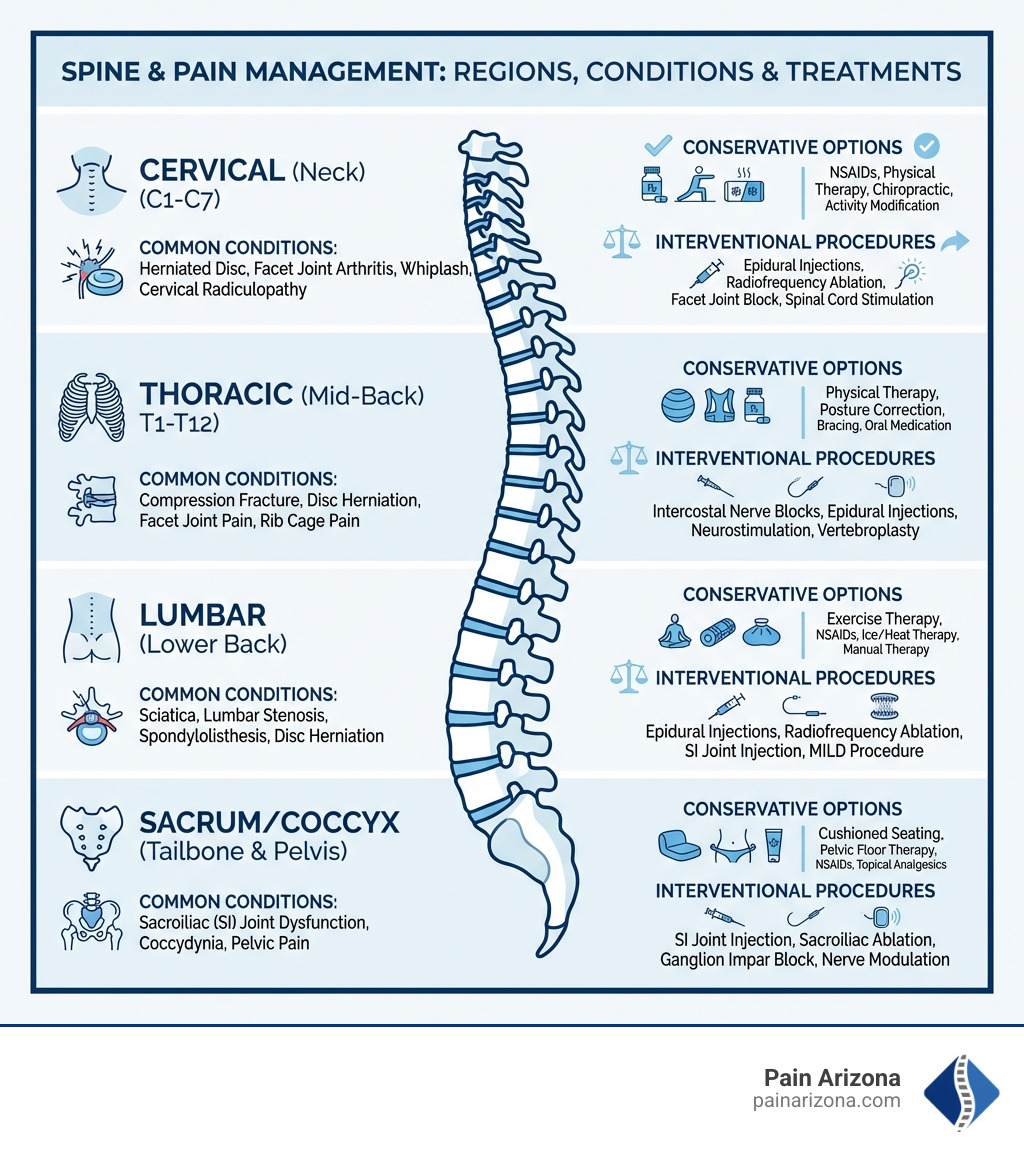
Easy spine and pain management glossary:
Understanding Common Causes and Red Flags in Spine and Pain Management
When we talk about spine and pain management, we first have to understand why the back is so prone to trouble. Your spine is a marvel of engineering, consisting of 26 vertebrae that protect your spinal cord while allowing you to twist, bend, and walk. However, because it is so complex, many things can go wrong.

Mechanical vs. Structural Pain
Roughly 90% of back pain cases are classified as “mechanical.” This means the pain isn’t caused by a scary disease or a major fracture, but rather by the way the parts of your back move together. Common culprits include:
- Muscle Strains and Sprains: Often the result of heavy lifting or sudden movements.
- Osteoarthritis: This is the most common joint disorder. In the US, one-third of people over age 65 have osteoarthritis, which causes the protective cartilage in the spine to wear down.
- Degenerative Disc Disease: Believe it or not, disc degeneration occurs in more than 80% of adults older than 50. These discs act as shock absorbers, and when they wear out, it’s literally “bone on bone.”
- Herniated Discs: This happens when the soft jelly-like center of a spinal disc pushes through a tear in the tougher exterior. This can irritate nearby nerves, leading to pain, numbness, or weakness in an arm or leg.
Don’t Ignore the Red Flags
While most back pain resolves with time and conservative care, certain “red flags” indicate a serious underlying condition that requires immediate medical attention. According to research on back pain etiology, you should seek help immediately if you experience:
- Cauda Equina Syndrome: This is a surgical emergency. Symptoms include new urinary retention, bowel dysfunction, and “saddle anesthesia” (numbness in the areas that would touch a saddle).
- Neurologic Deficits: Sudden, severe weakness in your legs or feet (like being unable to tiptoe or heel walk).
- Unexplained Weight Loss or Fever: These can be signs of infection or malignancy.
- Trauma: Pain following a significant fall or accident, especially if you have osteoporosis.
How Specialists Diagnose Complex Spinal Conditions
At Pain Arizona, we don’t just guess where the pain is coming from. A proper diagnosis is the foundation of effective spine and pain management. We use a combination of old-school physical exams and high-tech diagnostic tools to map out your spine.
The Physical Examination
We start by looking at how you move. We might use the Straight Leg Raise (SLR) test, where we lift your leg while you’re lying down. If this causes pain below the knee at a certain angle, it’s a strong indicator of a herniated disc. We also look for “centralization”—if certain movements make the pain move from your leg back toward your spine, that’s actually a good sign that conservative therapy will work!
Advanced Diagnostic Tools
Sometimes, we need to see what’s happening under the skin. However, we follow strict scientific research guidelines on spine MRI and imaging. Routine imaging for uncomplicated back pain is often unnecessary and can lead to “incidentalomas”—findings that look scary on a screen but aren’t actually causing your pain.
| Diagnostic Tool | What It Sees Best | Why We Use It |
|---|---|---|
| X-Ray | Bony structures, alignment | Checking for fractures, tumors, or severe arthritis. |
| MRI | Soft tissues, nerves, discs | The “gold standard” for diagnosing herniated discs and nerve compression. |
| CT Scan | Detailed bone anatomy | Excellent for complex fractures or when an MRI isn’t possible. |
| EMG/NCS | Nerve and muscle function | Testing the electrical activity of nerves to find exactly where a “pinched nerve” is located. |
| Discography | Internal disc pressure | A specialized test used to determine if a specific disc is the source of your chronic pain. |
Comparing Nonsurgical and Interventional Treatment Options
The goal of spine and pain management is to get you back to your life with the least invasive method possible. We generally divide treatments into two categories: First-line conservative care and advanced interventional procedures.
First-Line Conservative Spine and Pain Management
Most acute back pain (pain lasting less than 6 weeks) gets better with simple steps. We often recommend:
- Activity Modification: We said modification, not bed rest! Bed rest should be kept to a minimum (1-3 days) to avoid muscle stiffness.
- Physical Therapy: We utilize evidence-based approaches like the McKenzie Method (Mechanical Diagnosis and Therapy). This system helps patients identify specific movements that “centralize” and abolish their pain.
- Medications: NSAIDs like ibuprofen or naproxen are often the first choice for inflammation. For short-term muscle spasms, muscle relaxants may be used.
- Lifestyle Changes: Weight management and smoking cessation are critical. Smoking actually reduces blood flow to your spinal discs, accelerating degenerative disc disease.
Advanced Interventional Spine and Pain Management Procedures
If conservative care doesn’t cut it, we move to interventional options. These are minimally invasive procedures performed right here in our Arizona clinics (serving Phoenix, Mesa, Gilbert, Scottsdale, and Glendale).
- Epidural Steroid Injections (ESI): We inject anti-inflammatory medicine directly into the epidural space around the irritated nerves. This is highly effective for treating sciatica and radiculopathy.
- Radiofrequency Ablation (RFA): If your pain comes from the small “facet joints” in your spine (common in arthritis), we can use heat to “turn off” the tiny nerves sending pain signals. This can provide relief for 6 to 12 months.
- Spinal Cord Stimulation (SCS): For chronic pain that hasn’t responded to other treatments, we can use a device that sends mild electrical impulses to the spinal cord. This interrupts pain signals before they reach the brain, replacing them with a gentle tingling sensation.
- Facet Joint Injections: These serve both as a diagnostic tool (to confirm the source of pain) and a therapeutic one (to reduce inflammation).
When to Consider Surgical Consultation
As a spine and pain management specialist, one of my most important jobs is knowing when not to treat a patient in my office and when to refer them to a surgeon. While fewer than 5% to 10% of low back pain cases require surgery, it is sometimes the best path forward.
Indicators for Surgery
Surgery is usually considered when there is a clear structural problem that matches your symptoms and hasn’t improved with months of conservative care. Common conditions include:
- Severe Spinal Stenosis: When the spinal canal narrows so much that it compresses the spinal cord or nerves, making it difficult to walk even short distances. Learn more about spinal stenosis treatments here.
- Spondylolisthesis: When one vertebra slips forward over another, causing instability.
- Failed Back Surgery Syndrome (FBSS): Ironically, some patients need a “revision” surgery if a previous procedure didn’t provide relief or caused new issues.
- Progressive Nerve Damage: If you are losing strength in your legs or have loss of bowel/bladder control.
Our role at Pain Arizona is to act as your “quarterback.” We provide all the necessary non-surgical care, and if we determine that surgery is necessary, we help you find the right surgeon and coordinate your post-operative rehabilitation. You can find more scientific research on when back surgery is a good idea to help guide your decision.
Frequently Asked Questions about Spine Health
How can I prevent spine pain recurrence?
Prevention is the best form of spine and pain management. Once you’ve recovered, we focus on:
- Core Strengthening: Your abdominal muscles are the “internal brace” for your spine.
- Posture Improvement: Whether you’re sitting at a desk in Scottsdale or lifting boxes in Mesa, proper ergonomics matter.
- Weight Management: Every extra pound adds strain to your lower back.
- Smoking Cessation: Quitting smoking is one of the best things you can do for your spinal discs. Even conditions like scoliosis in adults are easier to manage when the body is healthy.
What are the risks and success rates of interventional treatments?
Most interventional procedures are very safe because they are minimally invasive and performed under live X-ray (fluoroscopy) guidance.
- Risks: While rare, risks include infection, bleeding, or temporary nerve irritation.
- Success Rates: Procedures like facet joint injections or RFAs have high success rates for the right candidates, often reducing pain by 50% to 80% for significant periods.
What is the role of emerging therapies in spine care?
The field of spine and pain management is constantly evolving. We are now using regenerative medicine—like Platelet-Rich Plasma (PRP)—to help the body heal itself. Instead of just masking pain, these therapies aim for tissue regeneration. Additionally, advanced neuromodulation (Spinal Cord Stimulation) is becoming more targeted and effective every year.
Conclusion
Living with chronic pain can make you feel like your world is shrinking. But at Pain Arizona, we believe that “manageable” isn’t good enough—we want you to rediscover your life. Our team of double board-certified physicians provides the highest level of spine and pain management care in the Greater Phoenix Area, including Mesa, Gilbert, Scottsdale, and Glendale.
We accept most insurance plans, and our office manager can help you verify your coverage. Whether you are dealing with a new injury or have been suffering for years, we are here to provide a personalized, evidence-based plan that addresses the root cause of your pain.
Book an appointment today to rediscover life beyond pain with Pain Arizona.