
Why Joint Injections in Phoenix are the Real Deal for Relief
Joint Pain in Phoenix Doesn’t Have to Be Your New Normal
Joint injections Phoenix residents are turning to offer a minimally invasive, non-surgical path to real, lasting relief — and they’re worth understanding before you decide on your next step.
Quick answers for Phoenix residents researching joint injections:
| Question | Short Answer |
|---|---|
| What are they? | Injections of medication (steroid, hyaluronic acid, PRP, or stem cells) directly into a painful joint |
| Who are they for? | People with chronic joint pain from arthritis, bursitis, tendonitis, or injuries that haven’t improved with rest or oral meds |
| How fast do they work? | Some relief within hours; full effect in days to 2 weeks |
| How long does relief last? | Weeks to several months, depending on injection type |
| Are they covered by insurance? | Most major plans accepted — check with our office to confirm yours |
| Where in Phoenix? | Pain Arizona serves the Greater Phoenix area across multiple locations |
An estimated 15 million Americans live with chronic joint pain caused by arthritis alone. If you’re one of them — waking up stiff, struggling to walk, or giving up activities you love — you already know how exhausting it is to chase relief that never quite arrives.
The problem isn’t just the pain. It’s the feeling that nothing works. Rest helps a little. Pills take the edge off. But the pain comes back, and the cycle continues.
Joint injections change that equation. They deliver medication directly to the source of the problem, bypassing the limitations of oral treatments and offering targeted relief that can make a real difference in how you feel and move.
I’m Dr. Nasser — a double board-certified PM&R and pain medicine physician, and Chief Medical Officer at Pain Arizona — and I’ve performed tens of thousands of minimally invasive procedures, including joint injections Phoenix patients rely on to get back to the life they love. In this guide, I’ll walk you through everything you need to know to make a confident, informed decision about your care.
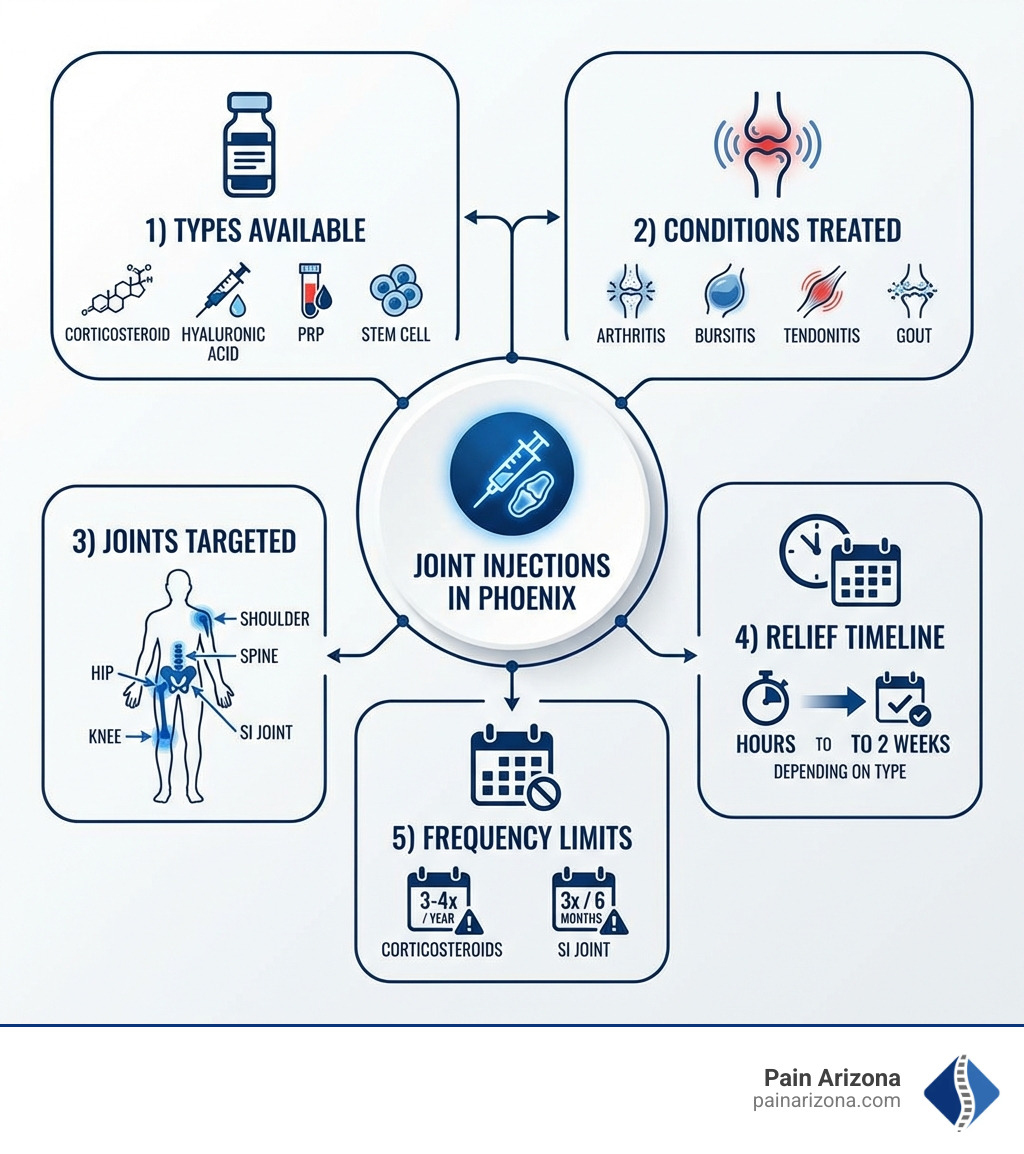
Simple guide to joint injections Phoenix:
Understanding Joint Injections Phoenix: How They Work
When we talk about joint injections, we are describing a targeted medical procedure where therapeutic substances are delivered directly into the “intra-articular” space—the gap between the bones that form a joint.
Think of your joint like a hinge on a door. If that hinge is rusty and screaming every time you move it, spraying lubricant on the outside of the door frame won’t do much. You need to get the oil inside the mechanism. That is exactly what we do with joint injections Phoenix.
Inflammation Reduction at the Source
Most chronic joint pain is driven by inflammation. When a joint is inflamed, the tissue swells, and the nerves in the area become hypersensitive. By using a corticosteroid injection to relieve pain and inflammation, we can “turn off” the fire at the source. This is far more efficient than taking an oral anti-inflammatory pill, which has to travel through your digestive system and bloodstream, losing potency before a tiny fraction finally reaches your aching knee or hip.
Diagnostic vs. Therapeutic Uses
At Pain Arizona, we often use injections for two reasons:
- Therapeutic: To provide long-term relief from pain.
- Diagnostic: To confirm exactly where the pain is coming from. If we inject a local anesthetic into a specific joint and your pain vanishes for a few hours, we’ve found our “smoking gun.” This ensures that any future treatments are perfectly targeted.
Common Types of Joint Injections in Phoenix
Not all joints require the same “fuel.” Depending on your diagnosis, we might recommend one of several different substances.
- Corticosteroids: These are the “gold standard” for rapid relief. Often called cortisone shots, these provide fast relief for inflamed joints by suppressing the immune response in the area.
- Hyaluronic Acid: Often referred to as “gel shots” or viscosupplementation, this mimics the natural fluid in your joints to provide lubrication.
- Platelet-Rich Plasma (PRP): A form of regenerative medicine that uses your own blood’s healing factors to repair tissue.
- Stem Cell Therapy: Advanced biologics aimed at long-term tissue regeneration.
- Aspiration: Sometimes, the problem isn’t what’s missing, but what’s extra. Aspiration involves removing excess fluid (effusion) from a swollen joint to reduce pressure and pain.
Corticosteroid and Hyaluronic Acid Joint Injections Phoenix
For many of our patients in the Phoenix area, the choice comes down to steroids versus “gel.”
Corticosteroids are incredibly effective for conditions like flexor tenosynovitis (trigger finger), where they have been shown to be 90% effective in relieving symptoms. They work quickly, often within a few days, and are excellent for “flares” of arthritis.
On the other hand, injections of hyaluronic acid are specifically designed for knee osteoarthritis. In a healthy joint, hyaluronan acts as a shock absorber. In an arthritic joint, this fluid thins out. By performing intra-articula joint injections of this gel, we essentially “grease the gears,” allowing the cartilage to glide more smoothly.
Regenerative Medicine Options
If you are looking for more than just a temporary “band-aid,” regenerative options like PRP might be the answer. These treatments don’t just mask pain; they aim to accelerate the body’s natural healing process. While corticosteroids work in days, regenerative treatments may take weeks or months to show full results as they work to repair the underlying tissue.
Conditions and Joints Treated with Injection Therapy
We treat a wide variety of conditions across the body using joint injections Phoenix. Whether it’s an injury from hiking Camelback Mountain or the wear-and-tear of decades of hard work, we can help.
- Osteoarthritis: The “wear and tear” arthritis that commonly hits knees and hips.
- Rheumatoid Arthritis: An autoimmune condition where the body attacks the joint lining.
- Bursitis: Inflammation of the small, fluid-filled sacs that cushion the joints (common in the shoulder and hip).
- Tendonitis: Inflammation of the tendons (like “tennis elbow” or rotator cuff issues).
- Gout: Painful crystal deposits in the joints, most commonly the big toe.
We frequently perform shoulder injections for rotator cuff syndrome, knee injections for meniscus tears or arthritis, and hip injections for bursitis or labral tears.
Targeted Relief for Spine and SI Joint Injections Phoenix
Back pain often stems from the small joints in your spine or the base of your back. We specialize in:
- Sacroiliac joint injections: The SI joints connect your spine to your pelvis. When these become inflamed, they cause significant lower back and buttock pain.
- Facet joint injections: These treat arthritis in the small joints of the spine that allow you to twist and bend.
- Lumbar facet joint injection: Specifically for the lower back.
- Cervical facet joint injection: For neck pain that often radiates into the shoulders.
The Procedure: What to Expect During and After
Many patients are nervous about needles. We get it! However, modern joint injections Phoenix are far more comfortable than you might imagine.
Precision Guidance
We don’t “guess” where the needle goes. At Pain Arizona, we use advanced imaging like ultrasound guidance or fluoroscopy (live X-ray). This allows us to see the needle in real-time, ensuring the medication is delivered to the exact millimeter where it will do the most good. Ultrasound is particularly great for soft tissues like tendons, while fluoroscopy is the gold standard for deep joints like the hip or spine.
The Timeline
The entire procedure usually takes about 10 to 20 minutes. We start by cleaning the skin with an antiseptic and numbing the area with a local anesthetic (like what you get at the dentist). You might feel a brief “pinch and sting,” but most patients describe the sensation as “pressure” rather than sharp pain.
Recovery Comparison Table:
| Feature | Corticosteroid Injection | Hyaluronic Acid (Gel) |
|---|---|---|
| Procedure Time | 10-15 minutes | 10-20 minutes |
| Immediate Feel | Numb (from anesthetic) | Fullness in the joint |
| Soreness | 24-48 hours | 24-48 hours |
| Activity Level | Rest for 24 hours | Light activity for 48 hours |
| Icing | Recommended (20 mins on/off) | Recommended |
After the procedure, we recommend resting the joint for the remainder of the day. You can use ice to manage any localized soreness at the injection site. Most patients drive themselves home and return to normal, non-strenuous activities the following day.
Frequently Asked Questions about Joint Injections
How quickly do joint injections provide pain relief?
The timeline depends on what we inject. If we include a local anesthetic, you might feel better almost immediately, though this wears off after a few hours.
- Corticosteroids: You’ll typically notice a significant reduction in pain within 3 to 7 days. The cortisone injection usually reaches its peak effect at about the 2-week mark.
- Hyaluronic Acid: These can take a bit longer, often requiring a series of shots over several weeks, with relief building gradually.
- Regenerative Med: These take the longest (weeks to months) because they are actually rebuilding tissue.
Are joint injections covered by insurance in Phoenix?
Yes, most major insurance plans, including Medicare and private PPO/HMO plans, cover medically necessary joint injections. Some treatments, like “gel shots,” may require “prior authorization” or proof that you’ve tried other conservative treatments (like physical therapy or oral meds) first.
At Pain Arizona, we accept most insurance plans. We recommend checking with our office manager to see if your specific plan is accepted and what your out-of-pocket costs might be.
How often can I safely receive these injections?
Safety is our top priority. We generally follow these industry-standard guidelines:
- Corticosteroids: We typically limit these to 3 or 4 times per year in the same joint. Overusing steroids can eventually lead to the thinning of skin or weakening of tendons, so we use them judiciously.
- SI Joints: Patients can often undergo up to three sacroiliac joint injections within a six-month period if they are providing significant relief.
- Facet Joints: A facet joint injection can be repeated if the relief is substantial but wears off over time.
If an injection provides only very short-term relief, we may discuss other options, such as radiofrequency ablation, which “turns off” the pain nerves for a longer duration (often 6 to 12 months).
Conclusion
If you’ve been living with the frustration of chronic joint pain, it’s time to stop managing the symptoms and start treating the source. Joint injections Phoenix are a proven, evidence-based way to reduce inflammation, improve mobility, and—in many cases—delay or even avoid the need for invasive surgery.
At Pain Arizona, we don’t believe in a “one-size-fits-all” approach. I’m Dr. Nasser, and our team of board-certified specialists is dedicated to creating a personalized treatment plan that fits your life and your goals. Whether you want to get back on the golf course in Scottsdale, hike the trails in Glendale, or simply walk through the grocery store in Mesa without pain, we are here to help.
Don’t let your joint pain define your life any longer. We have locations across the Phoenix area ready to serve you.
Ready to find relief? Request an appointment at Pain Arizona today