
Is Your Lower Back Screaming? Understanding Lumbar Radiculopathy
What is Radiculopathy in the Lumbar Region?
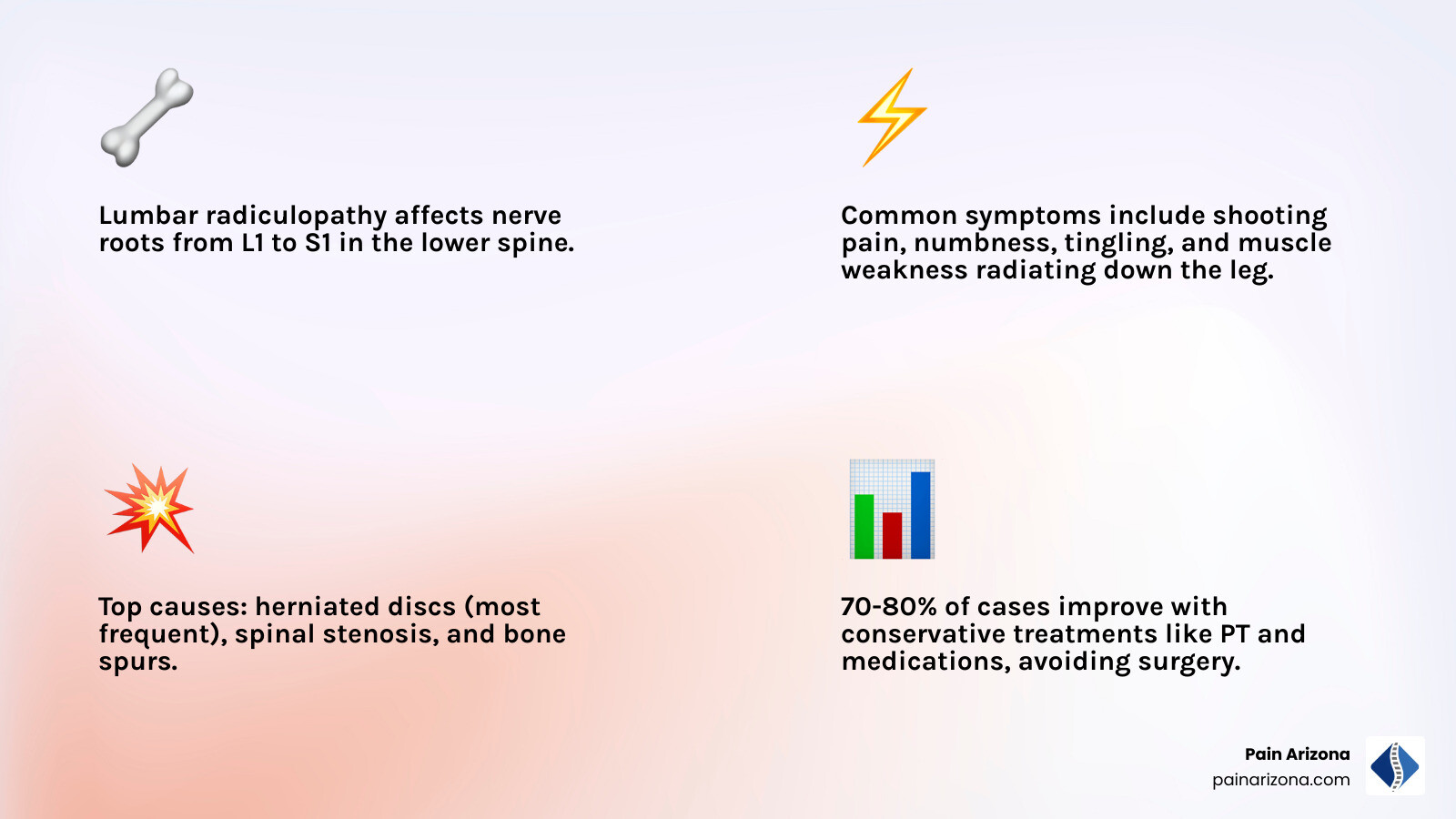
Radiculopathy lumbar region refers to irritation or compression of one or more nerve roots in the lower spine — causing pain, numbness, tingling, or weakness that can radiate from your back down into your legs.
If you’re looking for a quick answer, here’s what you need to know:
| Question | Quick Answer |
|---|---|
| What is it? | A pinched or irritated nerve root in the lower (lumbar) spine |
| Common symptoms | Shooting leg pain, numbness, tingling, muscle weakness |
| Most common causes | Herniated discs, spinal stenosis, bone spurs |
| How common? | Affects 3-5% of the population; up to 10% of low back pain sufferers |
| Does it need surgery? | Usually no — 70-80% improve with conservative treatment |
| When is it urgent? | New bowel/bladder loss or sudden severe weakness = go to the ER |
If your lower back pain has started radiating down your leg, you’re not alone — and you’re not stuck.
Lumbar radiculopathy is one of the leading causes of disability in adults under 45. Around 65 million Americans report recent back pain, and for millions of them, the real problem isn’t the back itself — it’s a compressed nerve root sending pain signals down the leg.
The good news? Most cases don’t require surgery. But understanding what’s actually happening in your spine is the first step toward real, lasting relief.
I’m Dr. Nasser, a double board-certified PM&R and pain medicine physician with decades of experience diagnosing and treating radiculopathy lumbar region conditions using minimally invasive, evidence-based approaches. As Chief Medical Officer at Pain Arizona, I’ve helped thousands of patients across the Greater Phoenix Area move from chronic pain back to the activities that matter most to them.
Radiculopathy lumbar region glossary:
When we talk about radiculopathy lumbar region, we are specifically referring to a condition where a nerve root in your lower back is being “pinched,” irritated, or compressed. Your spine is a marvel of engineering, but it’s also a very crowded neighborhood. The lumbar spine consists of five large vertebrae (labeled L1 through L5) sitting just above your tailbone (the sacrum, where the S1 nerve root resides).
Between these bones are discs that act as shock absorbers. When something—a disc, a bone spur, or inflammation—encroaches on the space where the nerve exits the spinal column, the nerve sends out a distress signal. According to the National Institutes of Health, lumbar radiculopathy affects approximately 3% to 5% of the general population. While back pain itself is incredibly common (affecting 60% to 90% of people at some point), only about 5% to 10% of those cases involve true radiculopathy.
Most people start to notice these symptoms later in life; men often see them in their 40s, while women typically notice them in their 50s. However, because it is a leading cause of disability for those under 45, it’s a condition that doesn’t strictly respect age. Whether it’s a pinched nerve from a sports injury or age-related wear and tear, the result is the same: a nerve that is very, very unhappy.
Primary Causes and Risk Factors
Why does this happen? Usually, it’s not just one thing, but a combination of “life happening” to your spine.

The Usual Suspects
- Herniated Discs: This is the most common cause. Think of your spinal disc like a jelly donut. If the outer layer tears, the “jelly” (nucleus pulposus) leaks out and presses directly on the nerve. You can learn more about how this happens in our guide to herniated discs.
- Spinal Stenosis: This is a fancy term for “narrowing.” Over time, the canal where your nerves live can get smaller due to arthritis or ligament thickening, leaving the nerves with no room to breathe. Check out our deep dive into spinal stenosis for more details.
- Bone Spurs (Osteophytes): As we age, our bodies sometimes grow extra bits of bone near joints to try and stabilize them. Unfortunately, these spurs can poke into the nerve pathways.
- Spondylolisthesis: This occurs when one vertebra slips forward over the one below it, which can snag or stretch the nerve roots in the process.
Are You at Risk?
The American Academy of Physical Medicine and Rehabilitation identifies several risk factors that make you more likely to develop a radiculopathy lumbar region issue:
- Genetics: If your parents had “bad backs” or early disc problems, you might be predisposed to similar issues.
- Occupational Hazards: Jobs that involve frequent heavy lifting, especially with twisting motions, or long hours of driving (which subjects the spine to constant vibration) are high-risk.
- Obesity: Extra body weight puts constant mechanical stress on the lumbar discs.
- Smoking: This is a big one people often miss. Smoking reduces blood flow to the spinal discs, causing them to dehydrate and fail faster.
- Sedentary Lifestyle: Weak core muscles mean your spine has to do all the work of supporting your body weight without any help from your “natural brace.”
Typical Symptoms and Critical Red Flags
The hallmark of radiculopathy lumbar region is that the pain doesn’t stay in the back. Because the nerves in your lower back travel all the way down to your toes, the symptoms follow that same path.
Common Symptoms
- Sciatica: This is the most famous symptom. It’s a sharp, shooting pain that starts in the buttock and travels down the back or side of the leg. Read more about sciatica here.
- Paresthesia: This is the medical term for “pins and needles.” You might feel tingling or a “foot falling asleep” sensation even when you aren’t sitting awkwardly.
- Muscle Weakness: You might find your leg buckles occasionally, or you have trouble lifting the front of your foot (foot drop).
- Reflex Loss: During an exam, we might find that your knee-jerk or ankle-jerk reflex is diminished.
The “Red Flags” (Don’t Ignore These!)
While most radiculopathy is manageable, there is a rare but severe condition called Cauda Equina Syndrome. This happens when the bundle of nerve roots at the very end of the spinal cord is severely compressed. Research on Cauda Equina Syndrome emphasizes that this is a surgical emergency.
Seek immediate ER care if you experience:
- Bowel or Bladder Incontinence: If you suddenly lose control of your bathroom habits or cannot go at all.
- Saddle Anesthesia: Numbness in the areas that would touch a horse’s saddle (groin, buttocks, inner thighs).
- Sudden, Progressive Weakness: If you can no longer stand or walk due to rapidly failing leg strength.
Diagnosis and Treatment for Radiculopathy Lumbar Region
When you visit us at Pain Arizona, our first goal is to figure out exactly which nerve is being grumpy and why. We don’t just treat the back pain; we treat the person attached to it.
Diagnosing Radiculopathy Lumbar Region
Diagnosis starts with a clinical history and a thorough physical examination. I often perform the Lasègue test (also known as the Straight Leg Raise). If lifting your straight leg while you’re lying down reproduces that familiar shooting pain, it’s a strong indicator of disc-related nerve irritation. A Cochrane review on physical exams confirms that these maneuvers are vital for an accurate clinical picture.
To confirm the diagnosis and plan treatment, we may use:
- MRI Imaging: The gold standard for seeing discs and nerves.
- CT Scans: Better for looking at the bony architecture if we suspect stenosis or spurs.
- Electromyography (EMG) and Nerve Conduction Studies (NCS): These tests measure the electrical activity of your muscles and nerves to see exactly where the signal is being blocked.
Treatment Options for Radiculopathy Lumbar Region
The good news is that 70-80% of patients experience significant improvement within 4 to 6 weeks with conservative management. We usually start with the least invasive options:
- Activity Modification: This doesn’t mean bed rest! In fact, long-term bed rest can make things worse. We suggest “relative rest”—avoiding heavy lifting and twisting while staying mobile.
- Medications: NSAIDs (like ibuprofen) to reduce inflammation, and sometimes nerve-specific medications like gabapentin.
- Physical Therapy: This is the cornerstone of recovery. We focus on core stabilization and “McKenzie” exercises to help move the disc pressure away from the nerve.
| Treatment Phase | Approach | Goal |
|---|---|---|
| Phase 1: Acute | NSAIDs, Ice/Heat, Activity Modification | Reduce inflammation and “calm” the nerve |
| Phase 2: Sub-Acute | Physical Therapy, Nerve Root Blocks | Restore mobility and break the pain cycle |
| Phase 3: Interventional | Lumbar Epidural Steroid Injections | Direct delivery of anti-inflammatories to the nerve |
| Phase 4: Surgical | Minimally Invasive Discectomy | Physical removal of the compression (rarely needed) |
If conservative measures aren’t enough, we offer interventional treatments. Research on surgical discectomy shows high success rates for those who truly need it, but we always aim to help you avoid the operating room whenever possible through advanced pain management.
Differentiating Lumbar Radiculopathy from Related Conditions
Not all leg pain is radiculopathy. It’s important to distinguish radiculopathy lumbar region from other conditions that “mimic” it.
- General Lower Back Pain: This is usually muscular or joint-related. It stays in the back and doesn’t cause weakness or shooting leg pain. A Georgetown University back pain study found that while 65 million Americans have back pain, only a fraction have true nerve involvement.
- Myelopathy: This is compression of the spinal cord itself, rather than the nerve roots. This is more common in the neck and can cause balance issues and coordination problems in both legs.
- Peripheral Neuropathy: Common in diabetics, this usually causes a “stocking-glove” pattern of numbness (both feet equally) rather than a single line of pain down one leg.
- Piriformis Syndrome: Sometimes a tight muscle in your buttock (the piriformis) can squeeze the sciatic nerve. It feels like radiculopathy, but the problem is in the hip, not the spine.
- Bulging Discs: A bulging disc is like a tire with low pressure—it sags but hasn’t “popped” yet. It can cause pain, but often isn’t as severe as a full herniation.
Frequently Asked Questions about Lumbar Radiculopathy
Is lumbar radiculopathy a serious condition?
Yes, it should be taken seriously. Because it involves a compressed nerve, ignoring it can lead to permanent nerve damage. Over time, an untreated compressed nerve can lead to muscle wasting (atrophy), permanent numbness, and in extreme cases, paralysis or loss of bladder control. Early intervention is the best way to ensure the nerve can fully recover. You can read more about how spinal issues disrupt life to understand the long-term stakes.
What is the most effective treatment for radiculopathy?
There is no “one size fits all” answer, but the most effective approach is a tailored plan. For many, the combination of physical therapy and therapeutic epidural steroid injections provides the “reset” the body needs to heal itself. We focus on the root cause—whether that’s inflammation, mechanical pressure, or lifestyle factors.
How does radiculopathy differ from standard lower back pain?
Standard lower back pain is often “axial”—it stays in the center of your back and is usually caused by muscles, ligaments, or the small joints of the spine (facet joints). Radiculopathy is “radicular”—it travels. If your pain feels like an electric shock going down your leg, or if you have weakness in your foot, it’s likely radiculopathy rather than a simple muscle strain.
Conclusion
The prognosis for radiculopathy lumbar region is actually very bright. Most people—about 90%—will see their symptoms resolve or become highly manageable within three months of starting the right treatment. The key is not to wait until the “screaming” in your lower back becomes a permanent whisper of numbness or weakness.
At Pain Arizona, we specialize in helping the residents of Phoenix, Mesa, Gilbert, Scottsdale, and Glendale find relief without jumping straight to major surgery. We use evidence-based care to get you back on your feet. We accept most insurance plans; just check with our office manager to see if your specific plan is accepted.
If you’re tired of the shooting pain and want to understand your options, schedule a consultation for radiculopathy with us today. Let’s get you moving again.