
Cervical Spine Surgery: Essential Relief 2025
Understanding Your Options for Neck Surgery
Cervical spine surgery refers to surgical procedures performed on the neck region of the spine to relieve pain, decompress nerves, or stabilize vertebrae affected by injury, degeneration, or disease.
Quick Answer: When You Might Need Cervical Spine Surgery
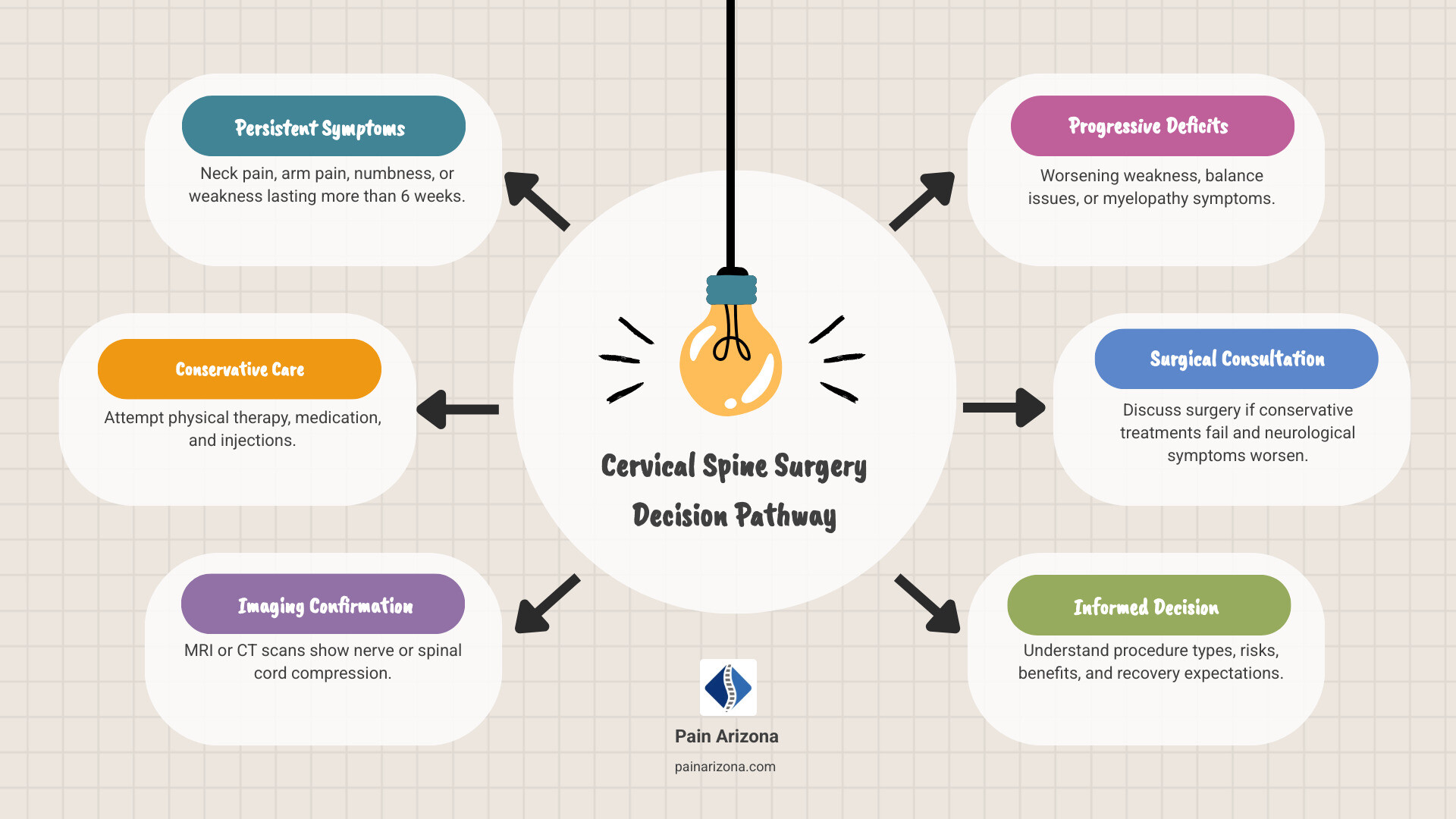
- Persistent arm pain or numbness lasting more than 6 weeks despite conservative treatment
- Progressive weakness in your hands, arms, or legs
- Spinal cord compression (myelopathy) causing balance problems or difficulty walking
- Failed conservative treatments including physical therapy, medications, and injections
- Imaging confirmation (MRI or CT) showing nerve or spinal cord compression
If you’re experiencing severe neck pain radiating down your arms or weakness in your hands, you’re not alone. Approximately 132,000 people in the U.S. undergo anterior cervical spine surgery annually, with success rates of 85% to 95% for pain reduction and functional restoration.
The decision for surgery often follows months of conservative treatments. When non-surgical care fails to provide relief from debilitating pain that affects daily life, understanding your surgical options becomes crucial. This guide explains the conditions leading to surgery, the types of procedures, the recovery process, and how to determine if surgery is right for you. Our goal is to provide clear information to help you make an informed decision.
I’m Dr. Nasser, Chief Medical Officer at Pain Arizona, and I’ve performed tens of thousands of minimally invasive and regenerative procedures throughout my career, including advanced cervical spine surgery techniques. My focus is helping patients understand the root causes of their pain and exploring all treatment options—from conservative care to advanced surgical interventions—to find lasting relief.
Relevant articles related to cervical spine surgery:
- cervical radiculitis treatment
- is there a most effective treatment protocol for lumbosacral radiculopathies
- radiculitis
Why Surgery? Understanding the Conditions and Indications
Cervical spine surgery is typically considered when conservative treatments fail to relieve debilitating neck or arm pain. The primary goals are to alleviate pain, decompress nerves or the spinal cord, and stabilize the cervical spine to restore function and prevent further neurological damage.
For many patients, the journey to surgery begins with conservative treatments like Physical Therapy: A Hands-On Approach to Pain Relief and Epidural Steroid Injections, which can reduce inflammation. We believe in exploring all non-surgical avenues first.
The conditions that most often necessitate cervical spine surgery include:
- Cervical Radiculopathy: Also known as a “pinched nerve,” this involves a compressed nerve root in the neck, causing pain, numbness, or weakness radiating into the arm or hand. It’s often caused by a Herniated Disc or bone spurs.
- Cervical Myelopathy: A more severe condition involving spinal cord compression. Symptoms include numbness, weakness, balance problems, and difficulty with fine motor skills. Untreated myelopathy can lead to serious health risks, making timely intervention crucial.
- Herniated Discs: Occurs when the soft center of a cervical disc pushes through its outer layer, pressing on nerves or the spinal cord.
- Degenerative Disc Disease: Age-related wear on cervical discs, causing them to thin and lose water content. This can lead to instability, bone spurs, and nerve compression.
- Spinal Stenosis: A narrowing of the spinal canal in the neck that puts pressure on the spinal cord and nerve roots, often caused by bone spurs, thickened ligaments, or disc bulges.
When is Cervical Spine Surgery Recommended?
We recommend cervical spine surgery after a thorough evaluation confirms it’s the best option, typically when:
- Conservative therapy fails: Non-surgical treatments have not provided significant relief after at least six weeks.
- Progressive neurological deficits: Worsening weakness, numbness, or declining balance signal a need to prevent irreversible nerve damage.
- Motor weakness: Significant or progressive motor weakness in your limbs is a strong indicator for surgery.
- Severe, debilitating pain: Pain is so intense that it impacts your quality of life and does not respond to other treatments (e.g., a persistent pain score of 4/10 or higher).
- Pinched Nerve symptoms: Persistent pain, numbness, or weakness from a pinched nerve that correlates with imaging findings.
- Imaging confirmation: MRI or CT scans clearly show nerve or spinal cord compression that matches your symptoms.
- Acute conditions: Traumatic injury, spinal tumors, or acute spinal cord injury may require immediate surgery.
It’s important not to delay surgery if neurological symptoms progress, as pre-existing nerve damage might limit the extent of recovery.
Exploring Non-Surgical Alternatives
Before recommending surgery, our team at Pain Arizona explores all non-surgical options. These treatments are often effective and can help many patients avoid surgery.
Common non-surgical options include:
- Physical Therapy: A cornerstone of conservative care, using targeted exercises to strengthen neck muscles, improve posture, and increase flexibility. We offer custom Exercise-Based Rehab and Manual Therapy: Precision Care for Pain Reduction.
- Medications: Over-the-counter pain relievers, NSAIDs, muscle relaxants, and neuropathic pain medications to manage symptoms.
- Chiropractic Adjustments: Can help restore proper alignment and reduce pressure on spinal nerves for some conditions.
- Injections: Targeted injections deliver medication directly to the source of pain. These include Cervical Facet Joint Injection, Nerve Blocks, and Cervical Selective Nerve Root Blocks.
- Spinal Decompression Therapy: A non-invasive treatment that uses traction to gently stretch the spine, relieving pressure on discs and nerves.
- Lifestyle Modifications: Improving posture, making ergonomic adjustments, engaging in low-impact exercise, and avoiding aggravating activities can make a significant difference.
A Guide to Common Cervical Spine Surgery Procedures
When non-surgical options are exhausted, cervical spine surgery can offer profound relief. Procedures generally fall into categories of decompression (relieving pressure), fusion (stabilizing), or disc replacement (preserving motion).
Decompression surgery removes structures like herniated discs or bone spurs. Fusion surgery permanently joins two or more vertebrae. Disc replacement uses an artificial implant to replace a damaged disc and preserve motion.
Common Types of Cervical Spine Surgery
The most common types of cervical spine surgery include:
- Anterior Cervical Discectomy and Fusion (ACDF): This is the most common neck surgery. The surgeon accesses the spine from the front to remove the damaged disc and any bone spurs. The space is filled with a bone graft or a synthetic cage, and a metal plate and screws stabilize the vertebrae while they fuse. ACDF surgery is highly successful, with success rates of 85% to 95%. Approximately 132,000 ACDF procedures are performed in the U.S. each year. You can learn More on ACDF here.
- Cervical Disc Replacement (Arthroplasty): As an alternative to fusion, this procedure replaces the damaged disc with an artificial one to preserve motion. This motion preservation may reduce the risk of degeneration in adjacent spinal segments. It avoids bone grafting and the risk of failed fusion, often resulting in less post-operative pain and a shorter recovery. In the U.S., it’s typically approved for single-level disease. Success rates can be as high as 87%. Our Cervical Disc Replacement info provides a detailed overview.
- Posterior Cervical Laminectomy/Laminoplasty: Performed from the back of the neck, these procedures are often used to treat Spinal Stenosis or myelopathy.
- Laminectomy involves removing a portion of the vertebral bone (lamina) to create more space for the spinal cord and nerves.
- Laminoplasty reshapes the lamina by creating a “hinge” to expand the spinal canal (by up to 30%). This “open door” technique preserves more natural neck motion and often avoids the need for fusion.
The Rise of Minimally Invasive Techniques
Technological advancements have led to a significant increase in minimally invasive cervical spine surgery. These approaches offer numerous benefits:
- Smaller incisions: Leading to less scarring.
- Less muscle damage: Minimizing trauma to surrounding tissues for less post-operative pain.
- Faster recovery: Patients typically experience shorter hospital stays and a quicker return to daily activities.
- Endoscopic and Laser Surgery: For many procedures, an endoscope (a thin tube with a camera) or laser can be used to precisely remove problematic tissue. Our Pain Arizona Minimally Invasive Spine Surgery Endoscopic Spine Procedures are designed to offer these benefits.
Beyond the surgical tools, advancements like improved imaging, navigation systems, 3D-printed implants, and robotics have made surgery more precise and safe. For example, robotics can improve the accuracy of screw placement during fusion procedures, making the process quicker and more efficient.
The Surgical Process: Anterior vs. Posterior Approaches
Choosing the right surgical approach for cervical spine surgery is critical and depends on the specific condition, the location of the compression, and your overall health. We consider two main approaches: anterior (from the front of the neck) and posterior (from the back of the neck).
| Feature | Anterior Approach | Posterior Approach |
|---|---|---|
| Incision Location | Front of the neck, usually along a skin crease | Back of the neck, along the midline |
| Access to Spine | Direct access to the front of the vertebral bodies and discs | Direct access to the back of the vertebral bodies (lamina) and spinal canal |
| Muscle Impact | Minimal muscle dissection, often retracting structures | More muscle dissection initially, though MIS reduces this |
| Common Procedures | ACDF, Cervical Disc Replacement, Anterior Corpectomy | Laminectomy, Laminoplasty, Foraminotomy |
| Conditions Treated | Herniated discs, degenerative disc disease, radiculopathy, myelopathy (anterior pathology) | Spinal stenosis, ossification of posterior longitudinal ligament (OPLL), myelopathy (posterior pathology, multi-level) |
| Specific Risks | Difficulty swallowing (dysphagia), hoarseness, recurrent laryngeal nerve injury, esophageal injury | Higher (though still small) infection risk, C5 root palsy, spinal fluid leak |
The Anterior Approach Explained
The anterior approach is commonly used for procedures like ACDF and cervical disc replacement because it offers direct access to the front of the cervical spine where many disc and bone spur issues originate.
Here’s a general overview of the steps involved:
- Anesthesia: You will receive general anesthesia.
- Incision: A small incision, typically 1 to 2 inches long, is made in a skin crease on the front of your neck, usually on the right or left side. This approach minimizes visible scarring.
- Access: The surgeon carefully separates and retracts the muscles, trachea (windpipe), esophagus, and major blood vessels to expose the front of the cervical spine. This allows for direct visualization of the problematic disc or bone spurs.
- Decompression: The damaged disc (or portion of the vertebral body in a corpectomy) and any compressing bone spurs are precisely removed. This relieves pressure on the spinal cord and nerve roots.
- Stabilization (for ACDF): For fusion procedures, a bone graft or synthetic cage is inserted into the empty disc space. This restores disc height and provides a scaffold for the vertebrae to fuse. A small metal plate and screws are often used to secure the graft and provide immediate stability, promoting a solid fusion over several months.
- Motion Preservation (for Arthroplasty): For disc replacement, an artificial disc implant is carefully inserted into the disc space, designed to mimic the natural movement of a healthy disc.
- Closure: The retracted tissues are returned to their normal positions, and the incision is closed with sutures.
The anterior approach is favored for its direct access to anterior cervical pathology with minimal damage to neck muscles. However, it carries risks of injuring delicate structures like the recurrent laryngeal nerve, esophagus, and major blood vessels. For a deeper understanding, you can review this Scientific review of anterior surgery.
Understanding the Posterior Approach
The posterior approach for cervical spine surgery involves accessing the spine from the back of the neck. This method is typically chosen when the compression is primarily from the posterior elements of the spine, such as thickened ligaments, bone spurs on the lamina, or when multiple levels need decompression, especially in cases of extensive Spinal Stenosis.
Here’s a general overview of the steps for procedures like laminectomy or laminoplasty:
- Anesthesia: You will receive general anesthesia.
- Incision: An incision, generally between 1 to 3 inches, is made down the midline of the back of your neck.
- Access: The neck muscles are carefully dissected and moved aside to expose the posterior bony structures (lamina) of the cervical vertebrae.
- Decompression:
- For a Laminectomy, the surgeon removes all or part of the lamina from one or more vertebrae to create more space for the spinal cord and nerve roots.
- For a Laminoplasty, the surgeon reshapes the lamina. This often involves cutting one side of the lamina and creating a hinge on the other, then gently “opening” the bone to widen the spinal canal. The bone is then secured in its new position with small plates and screws or bone graft. This technique expands the canal by up to 30% while preserving spinal motion.
- Closure: The muscles and skin are carefully closed.
The posterior approach allows direct visualization of the spinal canal and posterior disc herniation. It is particularly suited for posterior lesions, pathology extending beyond three vertebral levels, extensive spinal stenosis, and conditions like OPLL where an anterior approach might be technically difficult. However, posterior surgeries can sometimes be more uncomfortable initially than anterior procedures due to muscle dissection. For more insights into this approach, you can refer to Research on posterior approaches. A specific complication unique to cervical spine surgery, often associated with posterior approaches, is C5 root palsy, which involves temporary weakness in the shoulder and biceps muscles.
Navigating Recovery After Cervical Spine Surgery
Recovery after cervical spine surgery requires patience and adherence to your surgeon’s instructions. While every patient’s experience is unique, here is a general roadmap of what to expect.
Most patients spend one or two nights in the hospital, though some minimally invasive procedures may allow for same-day discharge. Our medical team will monitor you, manage your pain, and help you start moving gently shortly after surgery.
- Pain Management: Pain and soreness are normal after surgery, especially in the first three to five days. We provide pain medication to keep you comfortable and manage your Post-Surgical Pain so you can begin healing.
- Neck Brace/Collar: Depending on the surgery (especially fusion), you may need to wear a soft cervical collar for a few weeks to provide support. For disc replacement, immobilization time is usually much shorter.
- Activity Restrictions: You will have specific instructions to avoid strenuous activities, lifting anything heavier than 10 pounds, and excessive neck movement for several weeks.
- Fusion Timeline: For fusion procedures, the bone can take six months to a year to fully solidify. You will feel better much sooner, but complete healing is a longer process.
Risks, Benefits, and Long-Term Outlook
Understanding the potential outcomes of cervical spine surgery is essential.
Benefits:
The primary benefit is significant pain relief, often reducing the need for pain medications. Patients frequently report improved function, restored strength, and a better quality of life. For those with myelopathy, surgery can halt the progression of neurological symptoms.
Success Rates:
- ACDF surgery boasts success rates of 85% to 95%.
- Cervical artificial disc replacement shows success rates up to 87%.
- Studies indicate that the positive results of ACDF surgery can last for more than 10 years.
Risks:
While generally safe, cervical spine surgery carries potential risks, including:
- General Risks: Infection, bleeding, reaction to anesthesia, blood clots, or failure to relieve symptoms.
- Specific to Anterior Approach: Difficulty swallowing (dysphagia), hoarseness, or, rarely, damage to the esophagus.
- Specific to Fusion: Non-union (failed fusion) or adjacent segment disease (accelerated degeneration of nearby discs).
- Specific to Posterior Approach: C5 root palsy (temporary shoulder/biceps weakness) or a slightly higher infection risk.
- Rare but Serious: Spinal cord or nerve root injury, cerebrospinal fluid leak.
Despite these risks, long-term outcomes are generally positive. Comparing Clinical outcomes of different approaches helps tailor the best option for you.
The Crucial Role of Physical Therapy
Physical therapy is indispensable for a successful recovery. It helps you regain strength, flexibility, and proper movement patterns to optimize long-term outcomes.
- When to Start: Formal physical therapy typically starts four to six weeks post-operation, though it may be as early as two weeks for disc replacement patients.
- Goals of Therapy:
- Strengthening neck muscles to support the spine.
- Improving range of motion to prevent stiffness.
- Posture correction to prevent future strain.
- Pain reduction using techniques like Manual Therapy: Precision Care for Pain Reduction.
Our Exercise-Based Rehab programs are customized to your needs. Adhering to your physical therapist’s guidance is crucial for returning to your daily activities safely.
Frequently Asked Questions about Cervical Spine Surgery
We understand you likely have many questions when considering cervical spine surgery. Here are answers to some of the most common inquiries we receive:
How painful is recovery after ACDF surgery?
It’s natural to be concerned about pain after surgery. While you will experience some initial soreness and discomfort, especially during the first three to five days, this is typically well-managed with prescribed pain medications. Many patients report that the post-surgical pain is significantly less than the debilitating pain they experienced before the operation. As you progress through recovery, this discomfort will gradually improve. Our team at Pain Arizona will work closely with you to ensure your pain is controlled, allowing you to focus on healing.
Will I have permanent restrictions after a cervical fusion?
After a cervical fusion, the fused vertebrae will no longer move independently. This means there will be a permanent reduction in motion at that specific level of your neck. However, most patients don’t notice a significant change in their overall neck flexibility because the other cervical levels compensate. You may need to avoid certain high-impact sports or activities that put excessive strain on your neck, but for the most part, you can expect to return to your regular activities. With disc replacement surgery, the goal is to preserve motion, so these restrictions are typically minimized.
Is cervical spine surgery considered major surgery?
Yes, cervical spine surgery is considered a major surgery. It involves working on delicate structures like the spinal cord and nerve roots. However, it’s also a very common and safe procedure, especially with modern advancements and experienced surgeons. While it’s major, the hospital stay is often short (many patients go home the next day, and some even the same day for minimally invasive procedures), and the success rates are high. We carefully evaluate each patient to ensure the benefits outweigh the risks.
Conclusion: Taking the Next Step Towards Relief
Deciding on cervical spine surgery is a significant step, one that we typically recommend only after careful consideration and when conservative treatments have not provided sufficient relief. As we’ve explored, different procedures are designed to address specific problems—whether it’s decompressing nerves, stabilizing the spine through fusion, or preserving motion with disc replacement. While the recovery process requires patience and dedication, the benefits of pain relief and improved function can be life-changing.
At Pain Arizona, we focus on a comprehensive approach to diagnose and treat the source of your neck pain. Our double board-certified physicians specialize in evidence-based, minimally invasive treatments, prioritizing your well-being every step of the way. If you’re struggling with debilitating neck or arm pain in the Phoenix, Mesa, Gilbert, Scottsdale, or Glendale areas, understanding your options is the first step towards finding lasting relief. We accept most insurance plans; please check with our office manager to see if your plan is accepted.
Learn more about how we diagnose and treat conditions like radiculopathy and how we can help you steer your path to a pain-free life.