
Phoenix’s Solution for Persistent Pain: Understanding Radiofrequency Ablation
Living with Chronic Pain? Here’s What You Need to Know About Relief
Radiofrequency ablation Phoenix is a minimally invasive procedure that uses heat to disrupt nerve signals and provide long-lasting relief from chronic pain—typically lasting 9-24 months without surgery.
Quick Facts About Radiofrequency Ablation in Phoenix:
- What it treats: Chronic neck pain, lower back pain, facet joint pain, arthritis-related spine pain, knee osteoarthritis, and nerve pain from injury
- How long it takes: 15-45 minutes as an outpatient procedure
- Recovery time: Most patients resume normal activities within 1-3 days
- Pain relief begins: Usually around 10 days after treatment
- Results last: 9-24 months on average, with some patients experiencing relief up to 2 years
- Who performs it: Board-certified pain management specialists trained in interventional procedures
- Insurance: Most plans cover RFA when medically necessary—we accept most insurance plans and can verify your coverage
If you’ve tried physical therapy, medications, and injections without lasting relief, you’re not alone. Thousands of people in the Greater Phoenix area live with persistent pain that disrupts their sleep, limits their activities, and affects their relationships. The good news? Radiofrequency ablation offers a proven path forward when other treatments haven’t worked.
I’m Dr. Nasser, Chief Medical Officer at Pain Arizona, where I’ve performed thousands of radiofrequency ablation procedures helping Phoenix-area patients find lasting relief from chronic pain. My double board certification in Physical Medicine and Rehabilitation and Pain Medicine allows me to take a comprehensive approach to understanding and treating the root causes of your pain.
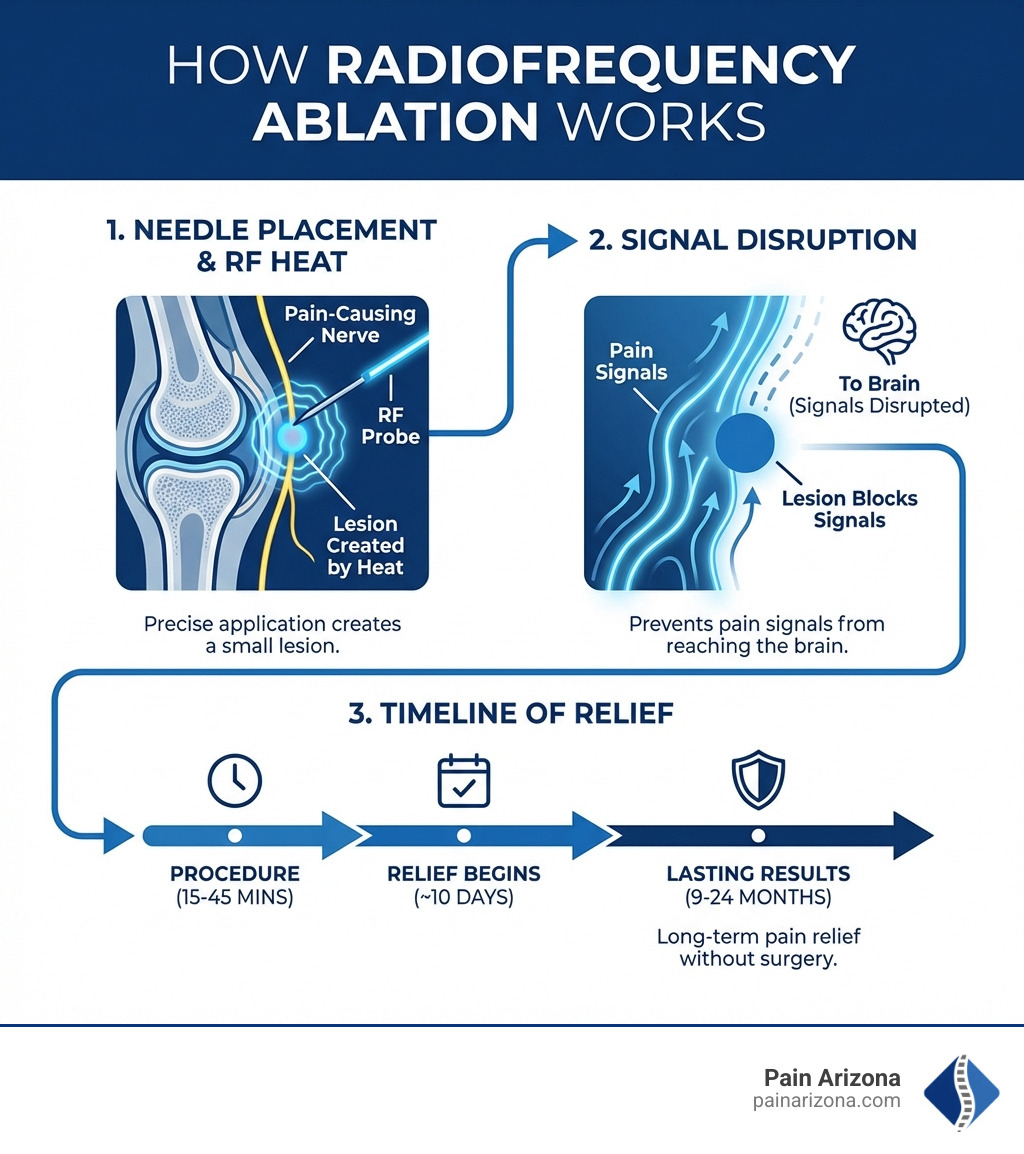
Radiofrequency ablation Phoenix terms you need:
What is Radiofrequency Ablation and How Does it Work?
Radiofrequency ablation (RFA), also known as a rhizotomy or neurotomy, is a sophisticated, non-surgical technique used to treat chronic pain. But don’t let the technical names intimidate you; the concept is actually quite straightforward.
Think of your nerves as telephone wires that carry “pain messages” from your joints to your brain. When you have a condition like spinal arthritis, those wires are constantly sending “busy signals” of pain. Radiofrequency ablation essentially creates a tiny break in that wire, stopping the signal from reaching the brain.
During the procedure, we use a specialized device that generates thermal energy (heat) via an electrical current. By precisely targeting the medial branch nerves—the specific nerves that transmit pain from the facet joints in your spine—we can cauterize a small area of nerve tissue. This “stuns” the nerve, preventing it from communicating pain. Because the treatment is so targeted, it doesn’t affect your ability to feel normal touch or move your muscles; it simply mutes the specific pain signal that has been making your life difficult.
At Pain Arizona, we often perform Radiofrequency Neurotomy Ablation to help patients who have found only temporary relief with other methods. It is one of the most effective tools in modern interventional pain management because it addresses the source of the pain rather than just masking the symptoms.
Conditions Treated with Radiofrequency Ablation Phoenix
Many of our patients in Mesa, Gilbert, and Scottsdale come to us after years of “just dealing with it.” Radiofrequency ablation Phoenix is particularly effective for pain originating from the spine and major joints.
The most common conditions we treat include:
- Spinal Arthritis (Spondylosis): Wear and tear on the vertebrae and discs.
- Facet Joint Syndrome: Inflammation or degeneration of the small joints between the bones of your spine. Facet Joint Syndrome is a leading cause of chronic back and neck stiffness.
- Sacroiliitis: Inflammation of the sacroiliac (SI) joints, where your lower spine connects to your pelvis.
- Chronic Neck Pain from Whiplash: Long-term nerve irritation following a car accident or injury.
- Sciatica: Persistent leg pain caused by nerve root irritation in the lower back.
- Knee Osteoarthritis: Targeting the genicular nerves to provide relief for those who aren’t ready for or cannot undergo knee replacement surgery.
To help you understand why RFA is often the “next step” in care, look at how it compares to standard diagnostic treatments:
| Treatment Type | Typical Duration of Relief | Primary Purpose |
|---|---|---|
| Diagnostic Nerve Block | 4 – 24 Hours | Confirming the pain source |
| Cortisone/Steroid Injection | 1 – 3 Months | Reducing temporary inflammation |
| Radiofrequency Ablation | 9 – 24 Months | Long-term pain signal disruption |
Who is a Candidate for Radiofrequency Ablation Phoenix?
Not everyone with a backache is a candidate for RFA. We follow a very specific, evidence-based protocol to ensure the highest chance of success for our patients.
First, you must have chronic pain that has not responded to conservative treatments like physical therapy or anti-inflammatory medications. Second, we perform a “test run” using a diagnostic injection. This is often a nerve block or facet joint injection.
If you experience significant pain relief (usually 50-80% improvement) during the few hours that the diagnostic numbing agent is active, it confirms that we have found the correct “wire” to target. This successful test is the “golden ticket” indicating that radiofrequency ablation Phoenix will likely provide you with months or even years of relief.
Types of Radiofrequency Ablation Phoenix Procedures
We tailor the type of ablation to the specific area of your body that is hurting:
- Lumbar Radiofrequency Neurotomy: Targets the lower back, often for patients with degenerative disc disease or lumbar arthritis.
- Cervical Facet Neurotomy: For chronic neck pain and cervicogenic headaches (headaches that start in the neck).
- Genicular Nerve Ablation: A specialized procedure for chronic knee pain. We use knee injections to test the nerves around the knee capsule before performing the ablation.
- SI Joint Ablation: Specifically for pain in the buttocks and lower back caused by the sacroiliac joint.
- Joint-Specific RFA: We also offer Radiofrequency Ablation Targeting Chronic Joint Pain for other areas, including the hip and shoulder.
The Procedure: What to Expect at Phoenix Clinics
If you’re nervous about the word “ablation,” let us put your mind at ease. This is an outpatient procedure, meaning you’ll be back in the comfort of your own home the same day.
The entire process at our Phoenix or Glendale clinics usually takes between 15 and 45 minutes. Here is the step-by-step breakdown:
- Preparation: You will lie on your stomach on a specialized procedure table. We prioritize your comfort, so while you stay awake, we provide a local anesthetic to numb the skin at the treatment site.
- Guidance: We use fluoroscopy (live X-ray guidance) to see the structures of your spine in real-time. This ensures the needle is placed with sub-millimeter accuracy.
- Testing: Once the needle is near the nerve, we may use a tiny amount of electrical current to “tickle” the nerve. You might feel a slight pressure or a muscle twitch, which confirms we are in the exact right spot.
- Ablation: After confirming the location and injecting more numbing medication, the radiofrequency energy is activated. This heats the nerve for about 90 seconds. You shouldn’t feel pain during this part—just perhaps a sensation of warmth.
- Completion: We may treat multiple levels of the spine during one session (for example, Lateral Branch Radio Frequency Neurotomy for the SI joint). We then apply a small bandage, and you’re off to the recovery room for a few minutes of observation.
For those who want to see the technology in action, you can often find an expert video on RFA techniques to help visualize the precision involved.
Recovery and Results: Life After Your Procedure
One of the best things about radiofrequency ablation Phoenix is the minimal “downtime.” Most of our patients resume their usual light activities within 1 to 3 days.
However, it’s important to manage expectations regarding the timeline of relief:
- Days 1-3: You might feel some localized soreness at the injection site, similar to a sunburn or a bruised feeling.
- Days 4-10: The “stunned” nerve is settling down. You might not feel full relief yet.
- Day 10 and beyond: Most patients notice a significant improvement in their chronic pain around the 10-day mark.
- Full Effect: It can take up to 4-6 weeks for the full benefits to manifest as the inflammation from the procedure subsides.
Once the relief kicks in, it typically lasts between 9 and 24 months. During this time, we strongly encourage our patients to engage in physical therapy. Why? Because when you aren’t in pain, you can finally strengthen the muscles around your joints, which helps prevent the pain from returning as aggressively if the nerve eventually regenerates.
For more specific questions about post-procedure care, you can visit our Pain Arizona FAQs or follow RFA success stories from patients who have reclaimed their mobility.
Benefits of Choosing RFA for Chronic Pain
Why choose RFA over other options? In our experience at Pain Arizona, the benefits are clear:
- Non-Surgical: No large incisions, no hospital stays, and no general anesthesia.
- Reduced Medication Reliance: Many of our patients are able to significantly decrease their use of oral pain medications, including opioids and NSAIDs, which can have harsh side effects over time.
- Improved Mobility: Chronic pain often leads to a sedentary lifestyle. RFA allows you to get back to hiking the Phoenix Mountain Preserve or playing with your grandkids.
- Evidence-Based: Numerous clinical studies support RFA. In fact, one study showed that over 80% of patients treated with pulsed RFA reported excellent relief that lasted at least a year.
- Repeatable: Nerves do eventually grow back (usually at a rate of about one millimeter per month). The great news is that RFA can be safely repeated once the pain returns.
If you want to explore how RFA fits into a larger plan, check out our full range of treatments and the conditions we specialize in.
Frequently Asked Questions about Radiofrequency Ablation
How much does RFA cost and is it covered by insurance?
This is one of the most common questions we hear. Because RFA is a well-established medical procedure, it is covered by most major insurance plans, including Medicare, when it is deemed medically necessary. “Medically necessary” usually means you have tried other treatments first and had a successful diagnostic block.
We accept most insurance plans. To get a clear picture of your specific benefits, we recommend you check with our office manager to see if your plan is accepted. You can also contact us directly for a preliminary insurance verification.
What kind of doctor performs RFA in Phoenix?
You want a specialist who understands the intricate “map” of the human nervous system. RFA is typically performed by double board-certified pain management specialists or interventional radiologists.
At Pain Arizona, our physicians are experts in using image guidance to perform these precision procedures safely. Choosing a doctor with specific fellowship training in pain medicine ensures that you are receiving the highest standard of care available in the Greater Phoenix area.
How long do the results of RFA last?
On average, relief lasts 6 to 12 months, but many of our patients enjoy relief for up to 2 years. The variation depends on how quickly your specific nerves regenerate. Think of it like mowing a lawn; eventually, the grass grows back, but you get a long period of “clean” results in the meantime. Because RFA doesn’t involve surgery, it is a repeatable procedure that can be performed again once the nerve regrows and pain signals resume.
Conclusion
Chronic pain doesn’t have to be your “forever.” Whether you are dealing with spinal arthritis in Mesa or knee pain in Glendale, radiofrequency ablation Phoenix offers a sophisticated, minimally invasive solution to help you get back to the life you love.
At Pain Arizona, we pride ourselves on providing compassionate, evidence-based care. I’m Dr. Nasser, and our team is dedicated to finding the root cause of your discomfort rather than just treating the symptoms. We invite you to take the first step toward a pain-free life.
Ready to stop the pain signals? Schedule a consultation for pain relief in Phoenix today and see if radiofrequency ablation is the right solution for you.