
Sciatica Diagnosis Tests: 3 Essential Steps
Your Guide to Understanding Sciatica Diagnosis
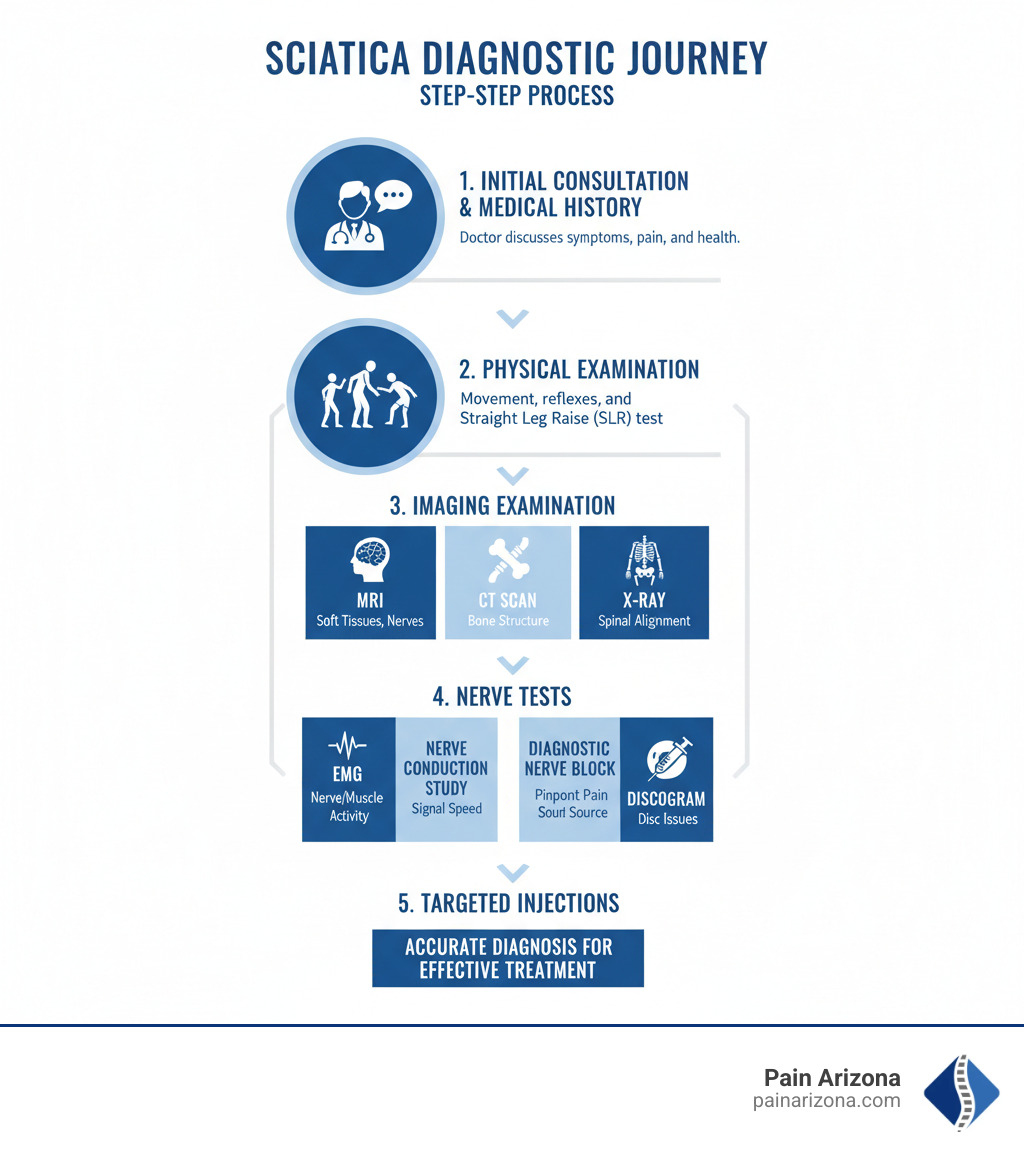
A common way doctors identify sciatica diagnosis tests involves a mix of methods. Here’s what you can expect:
- Medical History: Your doctor will ask about your pain and overall health.
- Physical Exam: This includes specific movements like the Straight Leg Raise (SLR) to check nerve response.
- Imaging Tests:
- MRI: To get clear pictures of soft tissues like discs and nerves.
- CT Scan: Provides detailed views of bone and spinal structures.
- X-ray: Checks for bone changes or issues.
- Nerve Tests:
- Electromyography (EMG): Measures electrical activity in your nerves and muscles.
- Nerve Conduction Studies: Checks how fast electrical signals travel through nerves.
- Targeted Injections:
- Diagnostic Nerve Blocks: Injections used to pinpoint the exact source of your pain.
- Discogram: Helps find disc issues, especially those causing chemical irritation.
Sciatica is more than general back pain; it’s a specific discomfort that travels along your sciatic nerve, from your lower back down your leg. The pain can be mild or severe, and it’s often caused by something pressing on the nerve. Finding out why you have sciatica is key to getting the right treatment, and that’s where sciatica diagnosis tests come in. These tests help doctors understand the root cause of your pain.
I’m Dr. Nasser, a double board-certified physical medicine and rehabilitation, and pain medicine physician. My career is dedicated to helping people understand and overcome chronic pain, with a deep focus on accurate sciatica diagnosis tests to ensure effective treatment. My expertise in diagnosing and treating complex pain conditions, including those requiring advanced interventions, stems from years of specialized training and clinical practice.
Sciatica refers to radiating pain along the sciatic nerve, the longest nerve in your body, which runs from your lower back down each leg. When this nerve or its roots are compressed or irritated, it can cause symptoms ranging from a dull ache to a sharp, shooting pain, often with numbness, tingling, or muscle weakness in the leg or foot.
The most common causes include:
- Herniated Discs: The primary cause, where a spinal disc bulges and presses on a sciatic nerve root.
- Spinal Stenosis: A narrowing of the spinal canal, often due to age-related changes like bone spurs, which puts pressure on the nerves.
- Piriformis Syndrome: When the piriformis muscle in the buttock tightens or spasms, it can compress the nearby sciatic nerve.
Understanding these potential causes is the first step toward an effective diagnosis. At Pain Arizona, our goal is to accurately identify the source of your pain to create a personalized treatment plan for lasting relief.
The First Step: Clinical History and Physical Examination
Our diagnostic journey begins with a detailed conversation and a physical examination. These initial steps are crucial for gathering clues and narrowing down the potential causes of your sciatica.

During your visit to our Phoenix Area clinic, this medical history review helps us understand:
- Pain Details: When did it start? What does it feel like (sharp, dull, burning)? Where does it travel?
- Triggers: What makes the pain better or worse (e.g., sitting, standing, coughing)?
- Associated Symptoms: Are you experiencing numbness, tingling, or muscle weakness? We’ll also ask about any changes in bowel or bladder function, which can be a sign of a serious condition.
- Past Medical and Lifestyle History: We’ll discuss previous back injuries, surgeries, and other conditions like diabetes, as well as your activity level and job.
Next, a comprehensive physical examination allows us to see your body in action. We’ll observe your posture and gait, and ask you to perform simple movements like walking on your toes or heels. We will specifically check your muscle strength and reflexes, as weakness or diminished reflexes can indicate nerve compression. If you’re curious to learn even more about sciatica, visit our dedicated page: More info about Sciatica
Common physical sciatica diagnosis tests
We use several hands-on sciatica diagnosis tests to gain crucial insights:
- The Straight Leg Raise (SLR) test is one of the most common. While you lie on your back, we gently lift your affected leg. If this reproduces your sciatic pain, it strongly suggests nerve root irritation. This is also known as Lasègue’s test. The SLR test is very sensitive (good at identifying who might have the condition) but has lower specificity (a positive result isn’t definitive). You can dive deeper into the science behind sciatica diagnosis and treatment in this study: A study on the diagnosis and treatment of sciatica.
- The Slump Test involves you sitting, ‘slumping’ forward, and extending your leg. If this brings on your sciatic pain, it points to nerve tension.
- The Piriformis Test helps determine if the piriformis muscle in your buttock is the culprit. We look for pain in the buttock or down the leg as you cross one leg over the other, which suggests the muscle is compressing the sciatic nerve.
- The Flip Test, where you extend your leg while seated, was once common but is now considered less reliable for confirming nerve compression, as shown in research. This highlights why we use a combination of tests for an accurate diagnosis.
We use terms like sensitivity (how well a test finds those with a condition) and specificity (how well it rules out those without it) to evaluate tests. By combining findings from your history and multiple physical tests, we build the clearest picture of your condition.
Differentiating Sciatica from Other Conditions
Not all leg pain is sciatica. A precise diagnosis is critical for effective treatment. We must differentiate sciatica from:
- General Low Back Pain: Usually stays in the back and doesn’t radiate down the leg.
- Pinched Nerve: Sciatica is a type of pinched nerve, but other nerves can be pinched, causing different pain patterns. Learn more here: Pinched Nerve
- Hip Problems: Arthritis or bursitis in the hip can mimic sciatica pain in the buttock or thigh.
- Sacroiliac (SI) Joint Dysfunction: Pain from the SI joint can also refer pain to the buttock and thigh.
- Vascular Issues: Poor blood circulation can cause leg pain, especially with activity.
We also watch for Serious Conditions (Red Flags). While rare, these require immediate attention:
- Cauda Equina Syndrome: Severe compression of nerve roots at the end of the spinal cord. Symptoms include new bowel/bladder control issues, major weakness in both legs, or numbness in the groin/saddle area. This is a medical emergency.
- Spinal Infection, Fracture, or Tumor: May cause sciatic-like pain along with fever, night sweats, or unexplained weight loss.
An accurate diagnosis is everything. Misdiagnosis can lead to ineffective treatments and prolonged suffering. At Pain Arizona, we carefully sort through all possibilities to ensure your treatment plan addresses the true cause of your pain.
The Role of Advanced Sciatica Diagnosis Tests
When a physical exam suggests sciatica, or if symptoms are severe or persistent, we may recommend advanced sciatica diagnosis tests like medical imaging. These tests provide a direct look inside your spine to pinpoint the exact cause of your pain.
Medical imaging acts as a window into your body, revealing what a physical exam cannot. These tools give us detailed pictures of your soft tissues, bones, and nerves, which is crucial for identifying issues like herniated discs that may be compressing the sciatic nerve. You can find more information about herniated discs here: More info about Herniated Discs.
These techniques help us understand the full picture, allowing us to create a treatment plan that addresses the root cause of your pain.
How do medical imaging tests help diagnose sciatica?
We choose the best imaging test based on your specific symptoms and clinical findings.
Magnetic Resonance Imaging (MRI) is the gold standard for diagnosing sciatica caused by soft tissue problems. Using magnets and radio waves, it creates detailed images of your spine. An MRI is my first choice for sciatica diagnosis tests because it excels at soft tissue visualization. It clearly shows herniated discs, nerve compression, spinal stenosis (narrowing of the spinal canal), and less common issues like tumors or infections.
Computed Tomography (CT) scans use X-rays to create cross-sectional images that are excellent for showing bone structures. A CT scan is ideal if I suspect bone spurs, fractures, or spinal alignment issues like spondylolisthesis (a slipped vertebra).
A CT Myelogram is a specialized CT scan where we inject contrast dye into the spinal fluid. The dye highlights the spinal cord and nerves, making compression much more visible. This is useful when an MRI isn’t possible or when more detail is needed.
X-rays are often a first step. While they primarily show bones, they are valuable for identifying bone spurs, fractures, and assessing overall spinal alignment. Many age-related changes seen on X-rays are also present in people without pain, so we always interpret these findings in the context of your symptoms.
These advanced imaging techniques allow us to precisely locate the source of nerve compression, which is critical for formulating an effective, targeted treatment plan.
When are advanced sciatica diagnosis tests necessary?
While many cases of sciatica improve with conservative care, advanced sciatica diagnosis tests are needed in certain situations:
- Severe or persistent pain that doesn’t improve after 6-8 weeks of conservative treatment.
- Progressive weakness or numbness in the leg or foot, which suggests ongoing nerve damage.
- Loss of bladder or bowel control, which is a medical emergency. If you have these symptoms, along with saddle numbness or significant leg weakness, seek immediate medical attention as it could be Cauda Equina Syndrome.
- Failure of conservative treatment to provide relief, prompting a need to understand why.
- Suspicion of serious underlying conditions like a tumor, infection, or fracture, based on “red flags” in your medical history.
- Planning for surgery, as detailed imaging is essential to pinpoint the problem area and guide the procedure.
In these cases, advanced imaging helps confirm the diagnosis, assess the severity, and rule out serious conditions, ensuring you get the right treatment at the right time.
Specialized Diagnostic Procedures
Sometimes, even after physical exams and imaging, we need to investigate further to pinpoint the source of your sciatica. Specialized diagnostic procedures help us confirm which nerve is the problem, assess its function, and guide us toward the most effective treatment.
Think of these specialized sciatica diagnosis tests as detective work for complex cases. They are valuable when symptoms don’t perfectly match imaging findings or when we need to understand the extent of nerve involvement. Learn more about how nerve blocks can provide relief: More info about Nerve Blocks.
Electromyography (EMG) and Nerve Conduction Studies
When we need to understand how your nerves and muscles are communicating, we often use Electromyography (EMG) and Nerve Conduction Studies (NCS). These tests work together to evaluate your nerve function.
- Nerve Conduction Studies (NCS) are performed first. We place small electrodes on your skin over a nerve and deliver a mild electrical impulse. We then measure the speed and strength of the signal as it travels along the nerve. A slow or weak signal can indicate nerve damage or compression.
- Electromyography (EMG) follows, looking at the electrical activity within your muscles. We insert a very thin needle electrode into specific muscles to record their electrical signals at rest and during contraction. Abnormal patterns help us determine if the problem is a pinched nerve or a muscle issue.
Together, these sciatica diagnosis tests help us measure nerve impulses, assess the severity of nerve damage, and differentiate between nerve and muscle problems. This information is crucial for clarifying which nerve root is affected, especially in chronic cases or when considering surgery.
Diagnostic Nerve Block Injections and Discograms
When the precise source of pain remains a puzzle, diagnostic injections are incredibly valuable tools.
Diagnostic nerve block injections are one of the most targeted sciatica diagnosis tests. Using live X-ray imaging (fluoroscopy) for precision, we inject a local anesthetic around a suspected nerve root. If your pain significantly decreases after the injection, it strongly confirms that the blocked nerve is the source of your sciatica. This not only provides a diagnosis but also guides future treatments, such as therapeutic injections or surgery, to that specific area.
While there are small risks like bleeding or infection, we take every precaution to minimize them. For most, the benefit of a definitive diagnosis outweighs these minimal risks.
Discograms are a more specialized procedure used less frequently. They are helpful when we suspect a specific spinal disc is causing pain, particularly if it’s from chemical irritation that doesn’t show up on an MRI. During a discogram, we inject contrast dye into a disc. If this injection reproduces your typical pain, it provides powerful diagnostic information. While MRI is our go-to, discograms can be invaluable in certain situations, especially when planning surgery, to ensure we target the correct disc.
Frequently Asked Questions about Sciatica Diagnosis
We understand that dealing with sciatic pain brings up many questions. Here are answers to some of the most common concerns we hear in our Phoenix Area clinics.
What’s the difference between sciatica and lumbar radiculopathy?
This is simpler than it sounds. Think of it this way: sciatica is the symptom you feel, while lumbar radiculopathy is the medical diagnosis explaining why.
- Sciatica is the term for pain that radiates along the sciatic nerve pathway down your leg.
- Lumbar radiculopathy is the clinical term for a nerve root in your lower back (lumbar spine) being pinched, irritated, or compressed.
Essentially, sciatica is the most common symptom of lumbar radiculopathy. Our sciatica diagnosis tests aim to confirm the radiculopathy and identify what’s causing it.
Can sciatica affect both legs?
In most cases, sciatica affects only one leg (unilateral) because it’s typically caused by a herniated disc or bone spur compressing a nerve root on one side of the spine.
However, bilateral sciatica—affecting both legs—can occur. When it does, it often signals a more serious condition requiring prompt evaluation. Causes of bilateral sciatica include a large central disc herniation that presses on nerves on both sides, severe spinal stenosis, or Cauda Equina Syndrome.
If you experience sciatica symptoms in both legs, especially with bowel or bladder changes, contact us immediately or go to the emergency room. This is not a symptom to ignore.
What happens if sciatica is not diagnosed and treated properly?
While mild sciatica can resolve on its own, ignoring persistent symptoms or getting an incorrect diagnosis can lead to serious, long-term complications. Prolonged nerve compression doesn’t just cause pain; it can lead to permanent damage.
Without proper diagnosis and treatment, you risk developing issues that significantly impact your quality of life. This is why accurate sciatica diagnosis tests are so important. Early and correct diagnosis allows us to intervene before these complications arise, helping you get back to your life without pain.
The potential complications include:
- Chronic, unrelenting pain
- Permanent nerve damage and dysfunction
- Foot drop and significant leg weakness
- Complete or partial loss of sensation in the leg or foot
- Muscle wasting (atrophy) from disuse
- Severe limitations in daily activities and mobility
- Psychological impacts like anxiety and depression
- Risk of permanent paralysis if cauda equina syndrome develops
From Diagnosis to Treatment in Arizona
At Pain Arizona, we believe an accurate diagnosis is the critical first step toward lasting pain relief. Our thorough approach to sciatica diagnosis tests allows us to pinpoint the exact cause of your discomfort, so we can create a treatment plan that’s right for you.
Treating just the pain without knowing the cause is like fixing a leaky roof without finding the hole. By understanding if your sciatica stems from a herniated disc, spinal stenosis, or piriformis syndrome, we can choose the most effective path to recovery.
Here in the Greater Phoenix Area, our philosophy is to provide compassionate, evidence-based, and minimally invasive care. We typically begin with conservative treatments, which are often very effective:
- Physical Therapy: A cornerstone of treatment to strengthen core muscles, improve flexibility, and relieve nerve pressure. You can learn more here: Physical Therapy: A Hands-On Approach to Pain Relief
- Medication Management: Anti-inflammatories, muscle relaxers, or nerve pain medications to manage symptoms.
- Heat and Cold Therapy: Simple home remedies to provide comfort and reduce inflammation.
- Lifestyle Modifications: Advice on proper body mechanics, ergonomics, and gentle exercises.
If conservative methods don’t provide enough relief, or if your condition is more severe, we may consider more advanced options. Surgery is generally reserved for cases where:
- Conservative treatments have failed after 6 to 8 weeks.
- You have progressive muscle weakness or numbness.
- You develop “red flag” symptoms like loss of bladder or bowel control (Cauda Equina Syndrome).
Our double board-certified physicians in Arizona are skilled in a range of minimally invasive procedures that can offer significant relief without major surgery. These options, such as epidural steroid injections, radiofrequency ablation, or spinal cord stimulation, are designed to target your pain precisely at its source.
We are dedicated to helping you find lasting relief from sciatica. If you’re struggling with sciatic pain in Phoenix, Mesa, Gilbert, Scottsdale, or Glendale, please reach out to us. We accept most insurance plans, and you can always check with our office manager to see if your plan is accepted. Let us guide you through the diagnostic process and create a personalized treatment plan so you can get back to living your life to the fullest.
Learn more about our approach to Sciatica