
Failed back surgery syndrome: Expert Hope 2025
When Surgery Doesn’t End the Pain
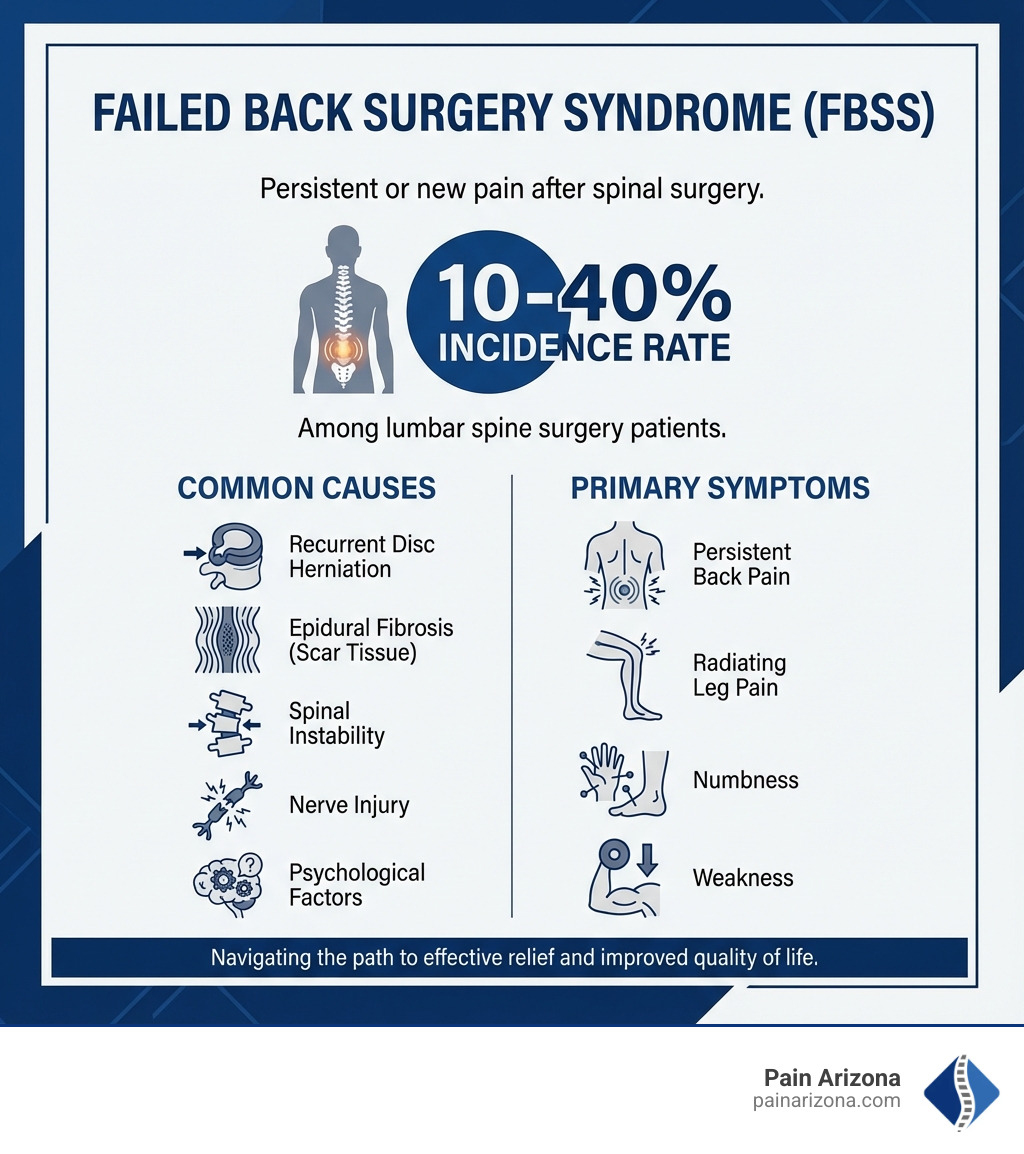
Failed back surgery syndrome is a condition where lower back pain, with or without leg pain, persists or develops after spinal surgery. It affects between 10% and 40% of patients who undergo lumbar spine surgery.
What You Need to Know About Failed Back Surgery Syndrome:
- Definition: Chronic pain that continues or appears after one or more spine surgeries in the same area
- Symptoms: Persistent back pain, radiating leg pain (sciatica), numbness, weakness, or sharp stabbing sensations
- Causes: Recurrent disc herniation, scar tissue (epidural fibrosis), nerve injury, spinal instability, or psychological factors
- Incidence: 10-40% of patients experience FBSS after lumbar spine surgery
- Treatment Options: Physical therapy, medications, nerve blocks, spinal cord stimulation, or in rare cases, revision surgery
The term itself can feel discouraging, but it simply means the surgical outcome didn’t meet expectations and a different approach is needed. The pain is real, the frustration is valid, and importantly, there are effective treatment options available.
Factors can range from pre-existing conditions to post-procedure issues like scar tissue. Understanding these causes is the first step toward relief.
I’m Dr. Nasser, Chief Medical Officer at Pain Arizona. I’ve spent my career helping patients with complex pain like Failed back surgery syndrome. Our team identifies the root cause of your pain to create personalized treatment plans that prioritize function and quality of life.
The good news is that comprehensive pain management, including physical therapy, targeted interventions, and advanced treatments, can significantly improve outcomes. You don’t have to accept chronic pain as your new normal.
Learn more about Failed back surgery syndrome:
Understanding the Causes and Symptoms of Failed Back Surgery Syndrome
When debilitating back pain continues or new pain develops after spinal surgery, it’s known as Failed back surgery syndrome (FBSS), or post-laminectomy syndrome. This complex condition has varied causes, and understanding them is crucial for effective treatment at our clinics in Phoenix, Mesa, Gilbert, Scottsdale, and Glendale.

Common causes we encounter include:
- Recurrent Disc Herniation: A disc can re-herniate at the same or an adjacent level, renewing pressure on nerve roots. Recurrence rates can be 5%-36% two years post-discectomy.
- Epidural Fibrosis (Scar Tissue): Excessive scar tissue can form around the surgical site, entrapping nerve roots and causing pain. This accounts for 20-36% of FBSS cases.
- Spinal Instability: The surgery may fail to stabilize the spine or inadvertently cause instability, leading to pain.
- Adjacent Segment Disease: Spinal fusion can increase stress on adjacent spinal levels, accelerating wear and tear and causing new problems like herniation or stenosis.
- Nerve Injury: Nerves can be damaged during surgery, leading to chronic neuropathic pain.
- Infection: Though rare, post-operative infections can cause significant pain.
- Arachnoiditis: Inflammation and scarring of the membrane surrounding the spinal cord can cause severe, burning pain.
- Improper Patient Selection/Diagnosis: The surgery may fail if the initial diagnosis was inaccurate or if the patient was not an ideal candidate due to comorbidities or significant psychosocial factors.
- Psychological Factors: Depression and anxiety can amplify pain perception and hinder recovery. They are strong predictors for developing FBSS, with one survey showing 67 of 78 FBSS patients had pre-existing depression.
What are the Symptoms of FBSS?
Symptoms of Failed back surgery syndrome are varied and can appear immediately after surgery or develop over time, sometimes after a period of initial improvement. This variability can make diagnosis challenging.
Common symptoms we look for include:
- Persistent Back Pain: The hallmark of FBSS, often a dull ache in the lower back that worsens with activity.
- Neuropathic Pain: Nerve-related pain described as burning, tingling, electrical, or shooting sensations.
- Radicular Pain (Radiating): Pain that radiates from the back down the leg, often called Sciatica.
- Numbness or Weakness: Nerve compression can cause numbness, tingling, or muscle weakness in the legs or feet, sometimes leading to “foot drop.”
- Dull Ache: A constant, deep ache in the back or legs.
- Sharp or Stabbing Pain: Sudden, intense, sharp pains, especially in the extremities.
- Pain Worse Than Before Surgery: In some cases, pain is the same or more severe than before the operation.
These symptoms can significantly reduce mobility and quality of life.
The Diagnostic Journey: Identifying the Root of Persistent Pain
Diagnosing Failed back surgery syndrome is a meticulous process focused on pinpointing the exact “pain generator.” An accurate diagnosis is essential for effective treatment. At Pain Arizona, we use a comprehensive diagnostic approach to understand why the previous surgery failed to provide relief.

Our diagnostic journey typically involves several key steps:
- Comprehensive Patient History: We listen to your story, including details about your initial symptoms, previous surgeries, and the progression of your current pain. We also discuss lifestyle and psychosocial factors.
- Detailed Physical Examination: A physical exam helps us assess your range of motion, muscle strength, reflexes, and identify neurological deficits or tenderness at the surgical site.
- Diagnostic Imaging: Expert interpretation of post-surgical imaging is crucial.
- X-rays: Show spinal alignment, hardware integrity, and signs of instability.
- MRI: The gold standard for FBSS evaluation. An MRI with contrast helps distinguish recurrent disc herniation from scar tissue.
- CT Scans/Myelogram: A CT scan, sometimes with contrast dye (myelogram), provides detailed anatomical information, especially for patients with implants that interfere with MRI.
- Diagnostic Nerve Blocks: Targeted injections of local anesthetic, like Facet Joint Injections or Nerve Blocks, help confirm the pain source. If the injection provides significant temporary relief, it identifies the targeted structure as the pain generator.
- Discography: In some cases, injecting contrast into a suspected disc to see if it reproduces your pain can help confirm the source.
Accurate diagnosis is critical. Our multidisciplinary approach includes reviewing surgical reports and psychosocial assessments to understand your full medical journey. For more information, see this Scientific research on FBSS diagnosis.
Potential Risks and Complications
Living with Failed back surgery syndrome presents challenges beyond physical pain, profoundly impacting your life. The potential risks and complications include:
- Chronic Pain Cycle: FBSS can trap individuals in a cycle of pain, reduced activity, deconditioning, and worsening pain.
- Decreased Quality of Life: Patients often report lower quality of life, affecting relationships, work, and hobbies.
- Increased Disability: Pain and functional limits often lead to disability, making daily tasks difficult.
- High Opioid Use: Reliance on opioids is common, carrying risks of dependence and addiction. One study found opioid overdose was the most common cause of death following lumbar fusion surgery.
- Unemployment: Severe pain and disability contribute to higher unemployment rates and financial strain.
- Psychological Distress: Constant pain and frustration often lead to depression, anxiety, and hopelessness.
For a deeper dive, see this comprehensive review of FBSS perspectives. We empower our patients in Scottsdale and the wider Phoenix Area with knowledge, assuring them that help is available.
Charting a New Course: A Guide to FBSS Treatment Options
A diagnosis of Failed back surgery syndrome doesn’t mean there’s no hope. At Pain Arizona, we use a robust, multimodal approach to create a custom treatment plan for each patient. Our goal is to alleviate pain, improve function, and improve your quality of life.
Our treatment for FBSS typically begins with conservative management before progressing to more advanced interventions if needed.
- Conservative Management:
- Physical Therapy: A cornerstone of recovery, our physical therapy programs focus on conditioning, core strengthening, and stretching to retrain the body and improve function.
- Medications: We may use NSAIDs for inflammation, anticonvulsants for nerve pain, and antidepressants for chronic pain and co-existing depression. Opioids are used with extreme caution, and our goal is to reduce reliance on them.
- Interventional Pain Management: When conservative measures aren’t enough, we turn to targeted interventions.
- Epidural Steroid Injections: These deliver anti-inflammatory medication to the epidural space to relieve nerve root irritation, providing significant, often temporary, relief.
- Nerve Blocks: These provide longer-lasting relief by numbing specific pain-transmitting nerves.
- Radiofrequency Ablation: If facet joints are the pain source, this procedure uses heat to disable the pain-signaling nerves for longer-term relief.
- Percutaneous Epidural Adhesiolysis: This procedure uses a catheter to break up scar tissue (epidural fibrosis) and deliver medication to free entrapped nerves.
The Role of Spinal Cord Stimulation in Managing FBSS
For patients with persistent FBSS pain unresponsive to other treatments, Spinal Cord Stimulation (SCS) offers significant hope and is a cornerstone of our advanced pain management.
- What is Spinal Cord Stimulation (SCS)?: SCS is a minimally invasive therapy that uses a small implanted device to send mild electrical impulses to the spinal cord, interrupting pain signals before they reach the brain.
- How SCS Works: SCS masks pain signals, often replacing them with a mild tingling sensation (paresthesia). Newer systems also offer paresthesia-free options.
- Trial Period: A key feature is the trial period. You’ll wear an external version of the device for 5-7 days to “test-drive” the therapy and see if it effectively reduces your pain before committing to a permanent implant.
- Long-Term Pain Relief: Research shows SCS is highly effective for FBSS, often superior to conservative care or repeat surgery, with many patients achieving 50% or more pain relief. Research supporting SCS for FBSS highlights these benefits.
- Improved Function: A primary goal of SCS is improving your ability to perform daily activities and return to a more active lifestyle.
- Reduced Opioid Dependence: By managing pain effectively, SCS can significantly reduce or eliminate the need for opioid medications.
While not a panacea, SCS is a life-changing option for many. For appropriately selected patients in the Greater Phoenix Area, it is a highly effective treatment. Learn more about Spinal Cord Stimulation on our site.
When Should You Consider Further Surgical Evaluation?
Deciding on another surgery is a difficult choice that we approach with extreme caution and thorough evaluation at Pain Arizona. Reoperation for FBSS has a lower success rate than initial surgeries.
- Diminishing Success Rates with Repeat Surgeries:
- Up to 50% success for a first surgery.
- Up to 30% success for a second surgery.
- Up to 15% success for a third surgery.
- As low as 5% success for a fourth surgery.
- When to Consider It: Revision surgery is only considered if there is a clear, correctable structural problem, such as a new disc herniation, significant Spinal Stenosis, or hardware failure.
- Importance of Expert Evaluation: An expert, multidisciplinary evaluation is required to weigh the potential benefits against the risks. For most, we recommend exhausting all non-operative and minimally invasive treatments before considering another surgery. Our Phoenix team at Pain Arizona provides compassionate, evidence-based guidance through this complex decision.
Prevention and Prognosis: Looking to the Future
Preventing Failed back surgery syndrome starts long before the first incision. While we can’t turn back time for those already with FBSS, understanding prevention is key for anyone considering back surgery. The prognosis for FBSS varies, but our focus is always on improving function and quality of life, even if complete pain eradication isn’t possible.
How Can the Probability of Developing FBSS Be Minimized?
Minimizing the risk of Failed back surgery syndrome involves a proactive approach from both the patient and the healthcare team.
- Comprehensive Pre-Surgical Evaluation: A clear, accurate diagnosis is essential. Diagnostic findings must match your symptoms, and psychological factors like depression must be addressed before surgery. For conditions like Herniated Discs or Spinal Stenosis, we ensure surgery is the best option.
- Proper Patient and Procedure Selection: Choosing an experienced surgeon and the right, least invasive procedure is vital. Sometimes, conservative management for Degenerative Disc Disease is better than surgery. Setting realistic expectations is also crucial.
- Managing Health Factors: Addressing comorbidities like obesity and diabetes before surgery is important. Smoking cessation is strongly advised, as smoking impairs healing and increases risks.
- Post-Operative Adherence: Strictly following post-operative restrictions and a dedicated Physical Therapy program are crucial for proper recovery.
By taking these steps, the chances of a successful outcome can be significantly improved.
Conclusion: Finding Hope and a Path Forward in Phoenix
Failed back surgery syndrome is a challenging and complex condition, but it is not a personal failure, and it is treatable.
At Pain Arizona, serving Phoenix, Mesa, Gilbert, Scottsdale, and Glendale, our compassionate, multidisciplinary approach is key to finding relief. We focus on improving your overall function and enhancing your quality of life.
From custom Physical Therapy and targeted Epidural Steroid Injections to advanced treatments like Spinal Cord Stimulation, we offer a spectrum of options to address the root cause of your persistent pain. We are committed to helping you steer the challenges of chronic back pain.
If you’re struggling with Failed back surgery syndrome in the Greater Phoenix Area, you are not alone. Pain Arizona specializes in creating personalized, evidence-based treatment plans that can offer new hope. We accept most insurance plans; please check with our office manager to confirm your coverage.
Find how our minimally invasive approaches can help you regain control over your life. Explore our services at Pain Arizona Minimally Invasive Spine Surgery.