
PRP Therapy Phoenix: Is Regenerative Medicine Right for You?
Is PRP Therapy Phoenix AZ the Right Treatment for Your Chronic Pain?
PRP therapy Phoenix AZ offers a natural, minimally invasive option for people dealing with chronic joint pain, tendon injuries, hair loss, and more — using concentrated healing factors drawn from your own blood.
Here’s a quick overview of what you need to know:
| Question | Quick Answer |
|---|---|
| What is PRP? | A concentration of your own platelets, injected to stimulate healing |
| What does it treat? | Joint pain, tendonitis, ligament injuries, hair loss, skin rejuvenation |
| How long is the procedure? | About 1 hour, same day |
| When do results show? | 2–3 months, with peak results around 6 months |
| Is it safe? | Yes — very low risk, uses your own blood |
| Does insurance cover it? | Coverage varies; check with our office manager |
If you’re living with chronic pain in Phoenix and feel like nothing has worked — the cortisone shots wore off, physical therapy only helped so much, and surgery feels like too big a step — you’re not alone. Many patients feel stuck between treatments that mask pain and procedures that feel too drastic. PRP therapy offers a middle path: harnessing your body’s own biology to address the root cause of tissue damage, not just the symptoms.
I’m Dr. Nasser, a double board-certified physical medicine, rehabilitation, and pain medicine physician with decades of experience performing regenerative procedures — including PRP therapy Phoenix AZ — for patients across the Greater Phoenix area. As Chief Medical Officer at Pain Arizona, I’ve helped thousands of patients find lasting relief through evidence-based, minimally invasive care.
Common PRP therapy Phoenix AZ vocab:
Understanding PRP Therapy Phoenix AZ
To understand why PRP therapy Phoenix AZ is so effective, we first have to look at what’s inside your own veins. Your blood is made of four main components: red blood cells, white blood cells, plasma, and platelets. While we usually think of platelets as the “clotting” cells that stop a scrape from bleeding, they are actually tiny powerhouses of regeneration.

In a normal blood sample, platelets make up only about 6% of the volume. However, through a specialized process we perform right here in our Phoenix area clinics, we can create Platelet-Rich Plasma that contains up to a 94% concentration of platelets. This “liquid gold” houses 5 to 10 times the concentration of growth factors found in regular blood.
These growth factors are bioactive proteins that act as a biological “SOS” signal. When injected into an injured area, they:
- Trigger tissue repair and cell proliferation.
- Act as a scaffold for new tissue growth.
- Attract the body’s own stem cells to the site of the injury.
- Reduce chronic inflammation that prevents healing.
By using platelet-rich plasma therapy, we aren’t just masking your pain with a chemical; we are concentrating your body’s natural resources and placing them exactly where they are needed most. Scientific research on PRP for musculoskeletal healing has shown that this high concentration of platelets can significantly improve outcomes for patients who haven’t found relief through traditional means.
How the Biological Healing Process Works
Once the PRP is injected, it initiates a complex three-stage healing response. First, there is an inflammatory phase where the concentrated platelets release cytokines—signaling molecules that kickstart the repair process. You might feel a little extra soreness during this time, but don’t worry! That’s just the sound of the “construction crew” arriving.
Next comes the proliferation phase. This is where the magic happens. The growth factors stimulate collagen production (the building block of tendons and ligaments) and angiogenesis (the growth of new blood vessels). Improved blood flow is crucial because many areas, like the “white zone” of a tendon or the cartilage in a joint, naturally have poor blood supply.
Finally, the remodeling phase occurs over several months. The new tissue matures and strengthens, leading to long-term functional improvement. This is truly healing with your own blood, a process that works with your biology rather than against it.
What Conditions Can PRP Injections Treat?
One of the reasons we are so passionate about PRP therapy Phoenix AZ at Pain Arizona is its versatility. Whether you are a weekend warrior with a sports injury or someone dealing with the daily grind of osteoarthritis, PRP can likely help.
We frequently use PRP to treat:
- Chronic Tendon Injuries: Including tennis elbow, golfer’s elbow, and Achilles tendinopathy.
- Ligament Sprains: Such as partial tears in the knee or ankle.
- Muscle Tears: Helping athletes return to the field faster.
- Spine Pain: Addressing issues like prolotherapy: regenerative medicine for joint pain in the facet joints or sacroiliac joint.
For more information on how we use these techniques, you can explore our overview of regenerative medicine.
Is PRP Therapy Phoenix AZ Right for Your Joint Pain?
If you’ve been told you need a joint replacement but aren’t ready for major surgery, PRP might be the alternative you’ve been looking for.
Knee Osteoarthritis: This is perhaps the most well-studied application of PRP. In fact, 10 out of 12 Level 1 clinical studies showed extremely favorable results for hip and knee arthritis pain relief. Research involving 1,400 patients found that PRP knee injections were superior to steroid injections, ozone, and hyaluronic acid.
Hip and Shoulder Pain: Research on hip osteoarthritis treatments indicates that PRP can significantly improve mobility. We also see great success with subacromial impingement and rotator cuff tears. While a full, retracted tear may still require surgery, PRP is an excellent option for partial tears and chronic inflammation that hasn’t responded to rest or physical therapy.
The Procedure: What to Expect During Your PRP Therapy Phoenix AZ Visit
We know that “injections” can sound intimidating, but the PRP process is straightforward, relatively quick, and performed entirely in our comfortable Phoenix area offices.
Step-by-Step Clinical Process
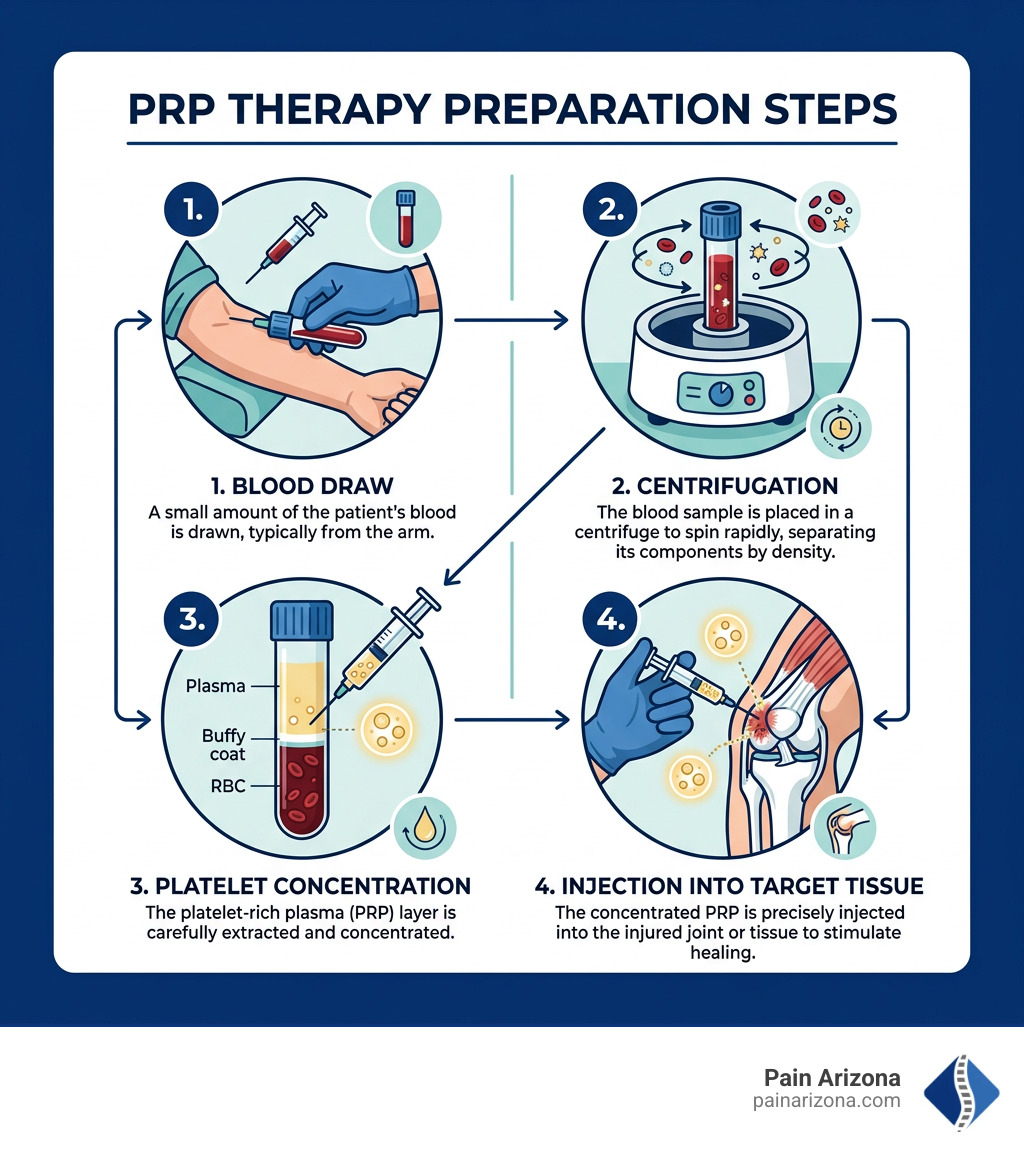
- The Blood Draw: We start by drawing a small amount of your blood (usually between 10cc to 60cc, depending on the area being treated). It’s just like a standard blood test at your annual physical.
- Centrifugation: We place your blood into a high-tech centrifuge. This machine spins at high speeds for about 10 to 15 minutes to separate the blood into layers: the red blood cells, the platelet-poor plasma, and the “buffy coat”—which is the concentrated PRP.
- Preparation: We carefully extract that “liquid gold” PRP layer. During this time, we often apply a local anesthetic to the injection site to ensure you are as comfortable as possible.
- Precision Injection: Using ultrasound guidance, I or one of our other expert physicians will inject the PRP directly into the damaged tissue. Using imaging ensures we are hitting the exact “sweet spot” of the injury for maximum effectiveness.
- Recovery: You’ll rest for about 10 minutes, and then you’re free to go! The entire visit usually takes about an hour.
Comparing PRP to Traditional Pain Treatments
When we talk to patients about PRP therapy Phoenix AZ, they often ask how it compares to the “old school” treatments they’ve tried before.
Why Patients Choose Regenerative Medicine
- PRP vs. Corticosteroids: Steroid shots are great for immediate, short-term pain relief because they are powerful anti-inflammatories. However, they can actually weaken tendons and cartilage over time if used repeatedly. PRP, on the other hand, encourages the tissue to heal and get stronger. Research comparing PRP to steroid injections consistently shows that while steroids might win in the first week, PRP is the clear winner for long-term relief at the 6-month and 1-year marks.
- PRP vs. Hyaluronic Acid (Gel Shots): Hyaluronic acid acts as a lubricant for the joint. While helpful, it doesn’t provide the same regenerative growth factors that PRP does. Many studies have shown PRP to be superior for reducing pain and increasing activity levels in arthritic joints.
- PRP vs. Surgery: Surgery involves anesthesia, incisions, and often a long, painful recovery. PRP is minimally invasive, has a very low risk of infection (since it’s your own blood!), and requires significantly less downtime.
By choosing regenerative medicine, you are opting for a “root cause” treatment. Instead of just turning off the pain alarm, we are trying to fix the fire. You may also want to read about stem cell therapy: cutting-edge solutions for pain recovery to see how different regenerative options compare.
Recovery, Results, and The Cost of PRP Therapy Phoenix AZ
The recovery from PRP therapy Phoenix AZ is generally very mild. Because we are intentionally triggering a healing response, it is normal to feel some increased soreness or “fullness” in the joint for 2 to 3 days after the procedure.
Post-Procedure Care Tips:
- Avoid NSAIDs: Do not take anti-inflammatory medications like Ibuprofen (Advil/Motrin) or Naproxen (Aleve) for at least one week after the injection. These drugs can block the very inflammatory response we are trying to create!
- Ice is Your Friend: Use cold compresses for discomfort during the first 48 hours.
- Listen to Your Body: We usually recommend resting the area for 24–48 hours, followed by a gradual return to light activity. Most patients are back to light sports by day 10 and full exercise within 30 days.
While some patients feel better within a few weeks, the real “magic” happens around the 6-to-8-week mark. Scientific research on long-term PRP efficacy shows that improvements can continue for up to 6 to 12 months as the tissue continues to remodel.
Investment and Insurance Considerations
One of the most common questions we get is about cost. Because PRP is considered “investigational” by many big insurance companies, coverage can vary.
At Pain Arizona, we believe in transparency. We accept most insurance plans, and while the PRP injection itself may be an out-of-pocket cost, many of the associated costs (like the initial consultation and follow-up visits) are often covered. We also offer package pricing for those who need a series of injections (which is often more effective for chronic conditions). We recommend checking with our office manager to see if your specific plan is accepted or if you can use your HSA/FSA funds for the procedure.
Frequently Asked Questions about PRP
Is PRP therapy safe?
Absolutely. Because PRP is autologous (meaning it comes from your own body), there is virtually zero risk of an allergic reaction or rejection. The risks are the same as any needle injection—slight bruising, a small risk of infection, or temporary nerve irritation—but because we use sterile techniques and ultrasound guidance, these risks are extremely low.
How many sessions will I need?
Every patient is unique. For a mild, acute injury, one injection might be enough. For chronic conditions like knee osteoarthritis, research shows that a series of 2 to 3 injections spaced about 4 weeks apart is significantly more effective than a single shot. We will create a personalized plan for you during your consultation.
When will I see results from PRP?
Patience is key! You aren’t getting a temporary numbing agent; you’re growing new tissue. Most patients notice a decrease in pain and improved function at 4 to 6 weeks, with the peak benefits appearing at 3 to 6 months.
Conclusion
At Pain Arizona, our goal isn’t just to help you manage your pain—it’s to help you get your life back. Whether you want to get back on the golf courses in Scottsdale, hike the trails in Phoenix, or just walk through the grocery store without wincing, PRP therapy Phoenix AZ could be the key.
With our team of double board-certified physicians, we provide the highest level of evidence-based regenerative care in the Valley. We don’t just “poke and hope”; we use precision imaging and the latest centrifugation technology to ensure you get the best possible results.
Don’t let chronic pain dictate your future. If you’re ready to see if regenerative medicine is right for you, schedule your consultation for PRP therapy in Phoenix today. We have convenient locations in Phoenix, Mesa, Gilbert, Scottsdale, and Glendale to serve you. Let’s start your healing journey together.