
Lower Back Pain Medical Procedures That Don’t Require a Hospital Stay
When Back Pain Won’t Quit: Outpatient Procedures That Can Actually Help
Lower back pain medical procedure options have come a long way — and most of the best ones today don’t require a hospital stay, general anesthesia, or weeks of bed rest.
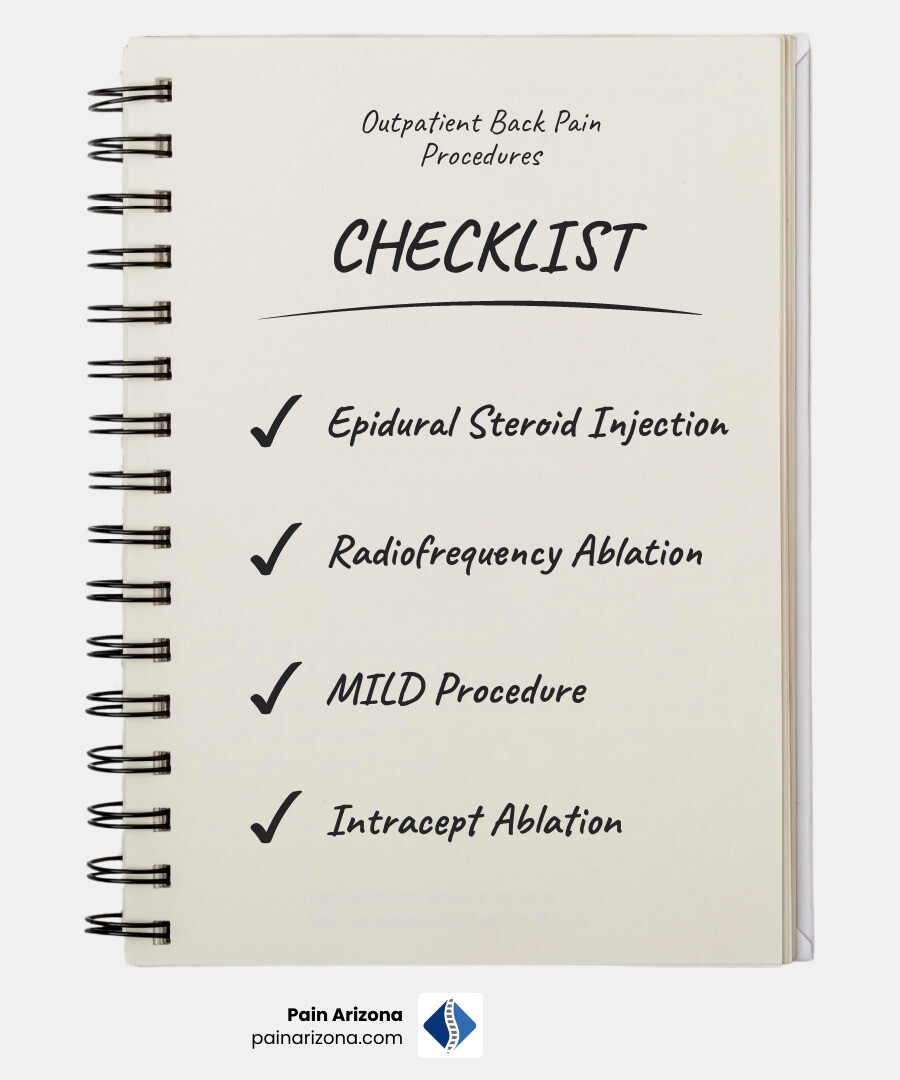
Here’s a quick look at the most common outpatient procedures for lower back pain:
| Procedure | Best For | Typical Setting |
|---|---|---|
| Epidural Steroid Injection | Herniated disc, sciatica | Outpatient clinic |
| Radiofrequency Ablation | Facet joint pain, vertebrogenic pain | Outpatient clinic |
| MILD (Minimally Invasive Lumbar Decompression) | Spinal stenosis | Same-day procedure |
| Intracept (Basivertebral Nerve Ablation) | Vertebrogenic chronic low back pain | Outpatient clinic |
| Kyphoplasty / Vertebroplasty | Vertebral compression fractures | Outpatient clinic |
| Microdiscectomy | Herniated disc with nerve compression | Outpatient surgery center |
About 80% of adults will experience lower back pain at some point. For most, it fades within three months. But for the roughly 16 million Americans whose pain becomes chronic and limiting, that’s cold comfort.
The good news: you don’t have to choose between suffering and major surgery. A growing range of minimally invasive, same-day procedures can address the root cause of your pain — not just mask it.
I’m Dr. Azmi N. Nasser, a double board-certified PM&R and pain medicine physician with fellowship training in interventional pain and tens of thousands of minimally invasive procedures performed, including advanced lower back pain medical procedures ranging from nerve ablation to endoscopic spine techniques. In the sections below, I’ll walk you through the procedures most likely to help — and how to know which one fits your situation.
Lower back pain medical procedure vocab to learn:
Common Causes and When to Consider a Lower Back Pain Medical Procedure

Understanding why your back hurts is the first step toward fixing it. In the Greater Phoenix Area, we see patients every day who have been told “it’s just old age,” but the reality is often more specific. Common culprits include herniated discs, where the inner gel of a spinal disc leaks out and irritates nearby nerves, and spinal stenosis, a narrowing of the spaces within your spine that puts pressure on the nerves.
Another frequent cause is degenerative disc disease, which isn’t actually a “disease” but the natural wear and tear of spinal cushions as we age. Interestingly, research shows that discs can begin to show signs of wear as early as our teenage years, with 60% of 70-year-olds showing severe degeneration. We also look closely for Modic changes on MRIs—these are specific signals in the vertebral bone that indicate inflammation and “vertebrogenic” pain.
So, when is back surgery a good idea? Generally, we follow a “12-week rule.” Most back pain resolves on its own within three months. However, if you have tried conservative treatments like physical therapy, anti-inflammatories, and activity modification for 6 to 12 weeks without relief, it may be time to consider a lower back pain medical procedure.
We especially recommend intervention if you experience:
- Pain that radiates down the leg (sciatica).
- Numbness or weakness in the legs or feet.
- Pain that prevents you from performing daily activities or working.
- Confirmed structural issues like herniated discs that are compressing a nerve root.
Minimally Invasive Decompression and Nerve Ablation
If you find that you can only walk a short distance before your legs feel heavy, weak, or painful, you might be dealing with neurogenic claudication caused by spinal stenosis. In the past, the only fix was a major “open” surgery. Today, we offer the mild® (Minimally Invasive Lumbar Decompression) procedure.
This procedure is a game-changer for mobility. Statistics show that after the mild® procedure, patients saw their average walking distance increase from a mere 246 feet to a staggering 3,956 feet over one year. It works by removing tiny pieces of thickened ligament (the ligamentum flavum) through an incision no larger than a baby aspirin, restoring space in the spinal canal without the need for implants or stitches.
For those dealing with arthritis in the spine, radiofrequency ablation (RFA) is a highly effective lower back pain medical procedure. RFA uses heat to “turn off” the pain signals from the small nerves attached to your facet joints.
Benefits of Minimally Invasive Spine Care:
- No Hospital Stay: Most patients go home within two hours.
- Reduced Risk: Lower infection rates and less blood loss compared to traditional surgery.
- Faster Recovery: Many patients return to light activity within days.
- Local Anesthesia: Avoid the risks associated with being “put under” completely.
The Intracept Lower Back Pain Medical Procedure for Vertebrogenic Pain
For years, many patients with chronic low back pain were told their pain was “discogenic,” yet disc treatments didn’t help. We now know that the source is often the vertebral endplates—the areas where the disc meets the bone. This is called vertebrogenic pain.
The Intracept procedure is a revolutionary, FDA-cleared treatment that targets the basivertebral nerve inside the bone. By using a specialized radiofrequency probe, we stop this nerve from sending pain signals to the brain.
- Proven Results: 72% of patients reported at least 50% improvement in pain scores two years after the procedure.
- Long-Term Relief: Clinical data shows relief can last more than five years from a single treatment.
- Preservation: It is completely implant-free and preserves the overall structure of the spine, which is crucial for preventing lumbar radiculopathy in adjacent segments.
MILD and Other Decompression Lower Back Pain Medical Procedure Options
Beyond the mild® procedure, we utilize other advanced decompression techniques to treat sciatica and nerve impingement. One such option is an outpatient microdiscectomy. Unlike traditional “open” surgery, we use tubular retraction. This involves inserting a series of small tubes to create a tunnel to the spine, allowing us to remove the herniated disc fragment without cutting through major muscle groups.
According to scientific research on injection techniques and surgery, these targeted interventions are often superior for relieving leg pain compared to traditional, more invasive methods. Because these techniques are so refined, they allow for same-day discharge from our Phoenix or Mesa facilities, getting you back to the comfort of your own bed by dinner time.
Advanced Injection Therapies and Vertebral Augmentation
When pain is acute or acting as a barrier to physical therapy, lumbar epidural steroid injections (ESIs) are a primary tool. We use live X-ray (fluoroscopy) to ensure the medication—a mix of anesthetic and anti-inflammatory steroid—is delivered exactly where the nerve is irritated.
For pain originating at the very base of the spine, caudal blocks can be effective, while facet joint pain is often addressed with direct joint injections. These aren’t just “shots”; they are precise medical procedures designed to break the cycle of inflammation.
For patients with vertebral compression fractures (VCFs)—often caused by osteoporosis—we perform vertebral augmentation. This is a life-saving intervention; statistics indicate that for every 15 patients treated with vertebral augmentation, one life is saved due to improved mobility and reduced complications.
Comparing Vertebral Augmentation Options:
| Procedure | Technique | Best For |
|---|---|---|
| Vertebroplasty | Direct injection of bone cement into the fracture. | Immediate stabilization of painful fractures. |
| Kyphoplasty | A balloon is inflated to create space before cement is added. | Restoring lost vertebral height and alignment. |
| SpineJack® | A mechanical implant expands the bone before cementing. | Maximum height restoration and protection of adjacent vertebrae. |
Frequently Asked Questions about Outpatient Back Procedures
How long is the recovery for a lower back pain medical procedure?
Because these are outpatient procedures, the timeline is significantly shorter than traditional surgery. Most patients require about 24 hours of initial rest. While you might feel some soreness at the injection or incision site, most people resume light walking the same day. We often recommend manual therapy or specialized physical therapy starting 1-2 weeks post-procedure to strengthen the supporting muscles and ensure long-term success.
Are these minimally invasive procedures covered by insurance?
Yes, most of these procedures, including MILD and Intracept, are covered by Medicare and many PPO insurance plans. Our team at Pain Arizona is experienced in the authorization process to ensure you get the care you need. We also frequently use diagnostic tools like sacroiliac joint injections to prove the source of pain to insurance providers, helping secure coverage for more advanced treatments. We accept most insurance plans; please check with our office manager to see if your specific plan is accepted.
What is the success rate of nerve ablation compared to traditional surgery?
Nerve ablation, particularly for vertebrogenic pain, boasts impressive success rates. About 64% of Intracept patients reported more than 50% pain relief within 12 months, and 30% reported complete pain relief. Unlike spinal fusion, these procedures are “motion-preserving,” meaning they don’t put extra stress on the rest of your back. We often use medial branch blocks as a “test drive” to predict how successful a permanent ablation will be.
Conclusion
I’m Dr. Nasser, and at Pain Arizona, our double board-certified team specializes in identifying the root cause of your discomfort using advanced diagnostics. Whether you are dealing with vertebrogenic pain, a herniated disc, or spinal stenosis, we provide Greater Phoenix Area patients—from Scottsdale to Gilbert and Glendale—with evidence-based, same-day solutions to reclaim their mobility.
You don’t have to live with a “bad back” forever. Modern medicine in 2026 allows us to treat the spine with incredible precision, minimal downtime, and high success rates. If you’re ready to explore a minimally invasive spine surgery or outpatient procedure that fits your life, we are here to help you take that first step.