
The Truth About Double Board Certification and Your Care
What “Double Board Certified” Really Means for Your Care
Double board certified means a physician has completed specialized training and passed rigorous certification exams in two separate medical specialties — not just one.
Here’s a quick breakdown:
| Term | What It Means |
|---|---|
| Board certified | Passed exams and met training standards in one specialty |
| Double board certified | Did the same in two distinct specialties |
| Fellowship trained | Completed advanced subspecialty training beyond residency |
This dual credential signals a higher level of expertise — especially valuable when your condition doesn’t fit neatly into one category.
If you’re living with chronic or complex pain in the Greater Phoenix Area, the credentials of your physician matter more than most people realize. A doctor’s training shapes how they diagnose, how they think, and how they treat. And for conditions that involve overlapping systems — like spine pain, nerve damage, or musculoskeletal disorders — a physician with expertise in two complementary fields can see what a single-specialty doctor might miss.
I’m Dr. Nasser, and as a double board certified specialist in Physical Medicine & Rehabilitation and over 20 years of experience in Pain Medicine, I’ve spent my career treating exactly the kinds of complex, persistent pain cases that benefit most from dual-specialty thinking. That experience is the foundation of everything we do at Pain Arizona.
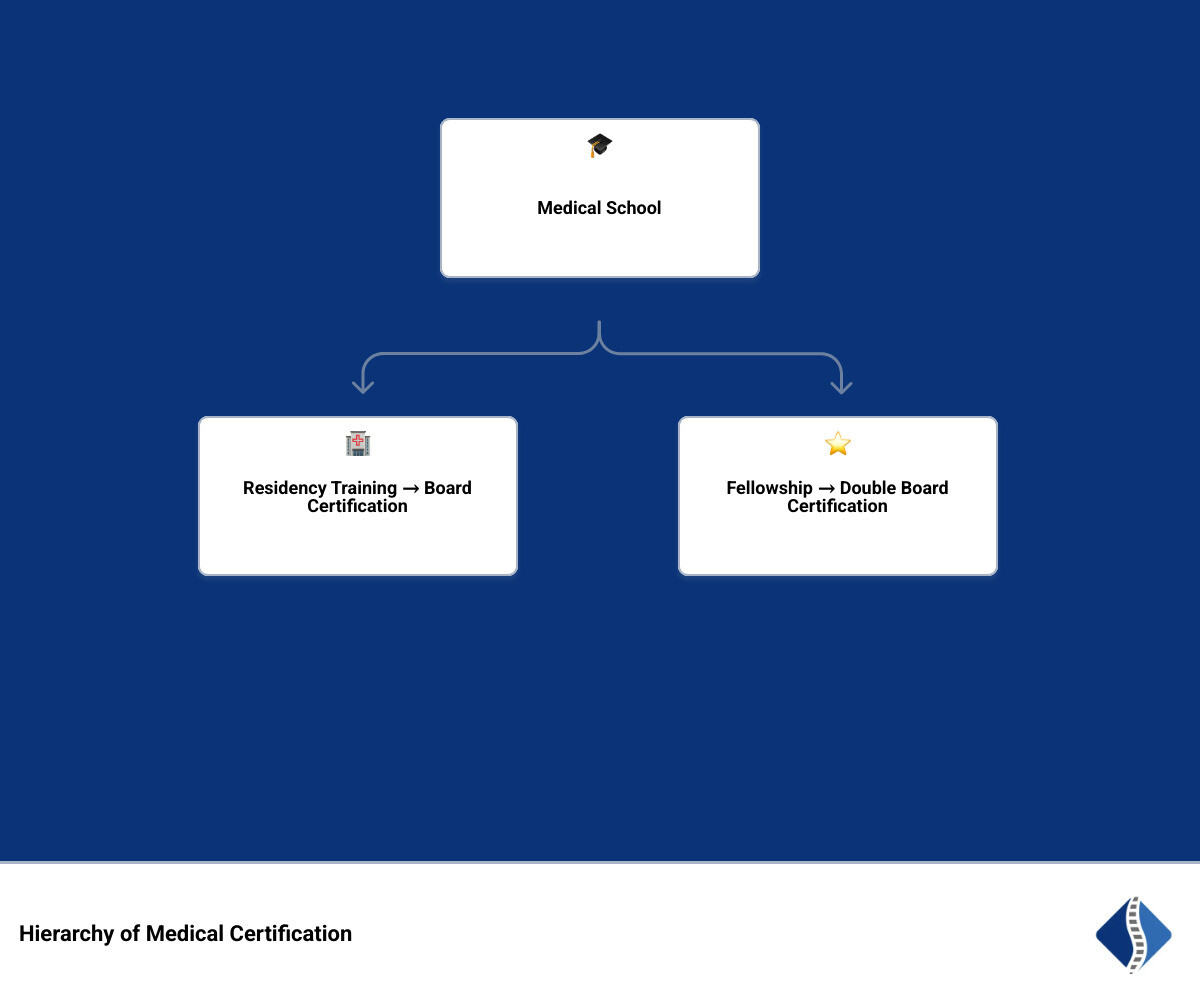
Double board certified terms you need:
What Does It Mean to Be Double Board Certified?

When you hear the term double boarded, it isn’t just a fancy title to hang on a wall. It represents a physician who has voluntarily met the highest standards of two different medical specialty boards. In the United States, most physicians are certified by boards under the American Board of Medical Specialties (ABMS) or the American Board of Physician Specialties (ABPS).
To be a Double Board Certified Doctor, a physician must first complete their primary residency and pass those initial board exams. But they don’t stop there. They then pursue a second residency or, more commonly, a specialized fellowship in a different but often complementary field.
For example, many of our practitioners at Pain Arizona hold certifications in both Anesthesiology and Pain Medicine, or Physical Medicine and Rehabilitation (PM&R) and Pain Medicine. This dual certification ensures that the physician has a massive “toolbox” of knowledge. One specialty might focus on the mechanics of how you move, while the other focuses on the neurological pathways of pain. When these two perspectives combine, the patient receives a much more comprehensive level of care.
This professional distinction is a marker of healthcare excellence. It shows that the doctor has gone through double the testing, double the peer review, and double the clinical hours to prove their competency. In an era where medical knowledge is expanding faster than ever (it’s April 2026, and the pace of new treatments is staggering!), having a doctor who has mastered two fields provides an extra layer of security for the patient.
The Rigorous Path to Achieving Double Board Certification
Becoming double board certified is not for the faint of heart. It is a marathon that often takes over a decade of post-graduate education. The journey begins with four years of medical school, followed by a residency program that can last anywhere from three to five years. During residency, doctors are immersed in a specific field—like Internal Medicine, Anesthesiology, or Pediatrics—under the strict guidance of ACGME-accredited programs.
What it means to be double board-certified is that after that first residency, the doctor chooses to dive back into the books and the clinic. They must pass grueling written and oral examinations for their first board. Then, they enter a second training period.
Take Dr James Adkins, for example. Achieving this level of mastery requires not just time, but a specific type of clinical fellowship. These fellowships are highly competitive. In fields like Pain Medicine, only the top tier of residents are typically accepted into these one-to-two-year programs where they master subspecialty skills like interventional spine procedures and advanced diagnostics.
Extensive Training and Fellowship Requirements
The fellowship is where the “magic” happens for a double board certified specialist. While a primary residency provides a broad foundation, the fellowship provides surgical precision and subspecialty mastery.
In the context of pain management, this means a doctor doesn’t just know that your back hurts; they have the specialized skills to use live X-ray (fluoroscopy) or ultrasound to place a needle within millimeters of a compressed nerve. This level of double board certified training translates directly to safer procedures and more effective results for our patients in Phoenix and Scottsdale.
Maintenance of Certification (MOC) in 2026
In 2026, being board certified isn’t a “one-and-done” achievement. To stay a Board Certified Pain Specialist, doctors must participate in what is known as Maintenance of Certification (MOC). This involves:
- Continuous Medical Education (CME): Earning hundreds of credits by staying updated on the latest research and treatments.
- Periodic Exams: Taking “check-in” exams every few years to ensure their medical knowledge hasn’t become stagnant.
- Practice Improvement: Demonstrating that they are actively using the latest evidence-based protocols in their daily practice.
- Professional Ethics: Maintaining an unblemished medical license and adhering to strict ethical codes.
When a doctor is double board certified, they have to do this for both boards. It’s twice the work, but it ensures that we are always at the cutting edge of what is possible in modern medicine.
Why Patients Seek a Double Board Certified Specialist
Why do patients drive from all over the Gilbert and Mesa areas to see a double board certified specialist? It usually comes down to one word: perspective.
When you have a complex condition, you don’t want a doctor who only has one way of looking at the problem. If all you have is a hammer, everything looks like a nail. But if you have a hammer and a high-tech laser, you have options. More info about our practitioners will show you that our team, including Azmi N Nasser D O, approaches pain from multiple angles.
A double board certified specialist offers:
- Diagnostic Accuracy: They can distinguish between pain coming from a joint versus pain coming from a nerve.
- Care Coordination: They speak the “language” of multiple specialties, making it easier to work with your primary care doctor, your surgeon, or your physical therapist.
- Treatment Innovation: They are often the first to adopt minimally invasive techniques that reduce recovery time.
Advanced Diagnostics for Complex Pain
One of the biggest advantages of dual certification is the ability to perform and interpret advanced diagnostics. For instance, a doctor certified in both Neurology and Pain Medicine (or PM&R and Pain) is uniquely qualified to perform EMG (electromyography) and nerve conduction studies.
As David Warkentin and our other providers can attest, these tests are vital for “root cause analysis.” Instead of guessing why your leg is numb, a double board certified expert can pinpoint the exact nerve root that is being pinched in your spine. This precision medicine is the difference between a treatment that works and one that just masks the symptoms.
Multidisciplinary Treatment Perspectives
At Pain Arizona, we believe in functional restoration. We don’t just want to lower your pain score; we want to get you back to playing golf in Scottsdale or hiking in Phoenix. This requires a multidisciplinary perspective.
A doctor like Bogdan Anghel Md uses his background to look at the “whole person.” This might mean combining interventional procedures with specific rehabilitation exercises.
| Benefit | Single Board Certified | Double Board Certified |
|---|---|---|
| Specialty Knowledge | Deep in one area | Expert in two distinct areas |
| Diagnostic Range | Focused on one system | Cross-system analysis |
| Treatment Options | Limited to primary field | Broad, multidisciplinary toolkit |
| Professional Rigor | High | Exceptional (Double the exams) |
Common Specialty Combinations in Modern Medicine
While we focus on pain management, double board certified physicians exist across the entire medical spectrum. Some of the most common and beneficial combinations include:
- Anesthesiology and Pain Medicine: This is the “gold standard” for interventional pain. These doctors, like Paul Lynch, have a deep understanding of pharmacology and procedural safety.
- Physical Medicine & Rehabilitation (PM&R) and Pain Medicine: These specialists focus on the mechanics of the body and how to restore function after an injury.
- Internal Medicine and Cardiology: These doctors are experts in how systemic health affects the heart.
- Otolaryngology (ENT) and Facial Plastic Surgery: This combination is vital for surgeons who must understand both the function of the nose and throat and the aesthetics of the face.
- Neurology and Psychiatry: Often referred to as “behavioral neurologists,” these experts treat conditions where the brain and the mind overlap.
Whether it’s Arash Ghaffari M D or any other specialist, these combinations allow for a more holistic approach to patient care.
Frequently Asked Questions about Double Board Certification
Is a double board-certified doctor always better?
Not necessarily “better” in a moral sense, but they do have more formal training. Clinical experience and the patient-provider relationship are also incredibly important. However, for complex cases, that extra layer of specialty focus can be a game-changer. You can find more specific answers in our Pain Arizona Faqs.
How can I verify a physician’s board status?
You should always do your homework! You can verify a doctor’s status through the ABMS (American Board of Medical Specialties) directory or your state’s medical board. At our practice, we are transparent about the credentials of everyone from our MDs to our specialized PAs like Avi Mallin Mspas Pa C.
Does insurance cover visits to double board-certified specialists?
Yes! Board certification is a standard credential recognized by insurance companies. While some “super-specialists” might be in different coverage tiers, the certification itself is a mark of quality that insurers value. We accept most insurance plans. Check with our office manager to see if your plan is accepted. For more tips on navigating this, see our guide to choosing an advanced pain doctor.
Conclusion
Choosing the right doctor is one of the most important decisions you can make for your health. When you choose a double board certified physician, you aren’t just getting a doctor; you’re getting a specialist who has committed their life to mastering the complexities of the human body from multiple perspectives.
At Pain Arizona, we are proud to serve the Greater Phoenix Area, including Mesa, Gilbert, Scottsdale, and Glendale. Our mission is to provide compassionate, evidence-based, and minimally invasive treatments that address the root cause of your pain. Whether you are seeking advanced treatment for sciatica or help with a complex spine condition, our team is here to help you get back to the life you love.
If you have more questions, browse our Pain Arizona Faqs or schedule a consultation with one of our experts today. You don’t have to suffer in silence—let our dual-specialty expertise work for you.