
Double board certified doctor: 2x Expert Advantage
Why Understanding Your Doctor’s Credentials Matters
When you’re searching for relief from chronic pain, understanding what a Double board certified doctor is can help you make better choices about your care. Here’s what you need to know:
A double board-certified doctor is a physician who has:
- Completed extensive training in two separate medical specialties
- Passed rigorous board examinations for both fields
- Demonstrated exceptional expertise and commitment to patient care
- Maintained continuing education requirements for multiple specialties
This distinction is rare—less than 20% of doctors pursue more than one board certification in their lifetime.
In the complex world of healthcare, the letters and titles after your doctor’s name tell an important story. Board certification shows that a physician has gone beyond the basic requirements to practice medicine. They’ve completed years of additional training and proven their expertise through comprehensive exams. Double board certification takes this commitment even further, signaling a physician who has mastered two distinct areas of medicine.
I’m Dr. Nasser, and I’m double board-certified in Physical Medicine and Rehabilitation (PM&R) and Pain Medicine, which allows me to address both the functional restoration and pain relief aspects of your condition. This dual expertise means I can offer you a more complete approach to understanding and treating complex pain conditions.
The Foundation: Understanding Board Certification
When we talk about a doctor’s qualifications, “board-certified” is a term that often comes up, and for good reason. It represents a significant achievement and a voluntary commitment to excellence in a specific medical field. For us, and for you, it symbolizes that a physician has reached the highest level of accreditation within their chosen specialty.
Board certification is a voluntary distinction, meaning doctors are not legally required to obtain it to practice medicine. However, it is widely recognized as a gold standard in the medical community. The American Board of Medical Specialties (ABMS) is a well-known and respected organization that commonly sets the standard for physician specialty in the United States. Through their rigorous processes, board certification assures patients that their physician meets the highest standards of medical practice and patient care. It’s not about physician prestige; it’s fundamentally about patient assurance.
This commitment to excellence doesn’t stop after the initial certification. Board-certified physicians are dedicated to lifelong learning, continuously assessing and improving their medical practice, acquiring new skills, and adapting to changing patient needs. This ongoing process, known as Maintenance of Certification (MOC) or continuing certification, ensures that doctors remain current with the latest medical advances and evidence-based practices. In fact, over 90% of physicians in the U.S. are board-certified, reflecting the widespread dedication to these high standards.
To learn more about these standards and the organizations that uphold them, you can visit the ABMS website.
What is the difference between medical licensure and board certification?
It’s easy to confuse medical licensure with board certification, but they serve distinct purposes in a physician’s career and in safeguarding patient health.
Medical licensure is a mandatory requirement to practice medicine in any state. It is granted by state medical boards, such as those in Arizona, and ensures that a physician meets basic qualifications to provide medical care. To obtain a license, a doctor must complete medical school, fulfill specific postgraduate training requirements, and pass standardized national examinations, such as the United States Medical Licensing Examination (USMLE). Without a valid state license, a doctor cannot legally treat patients.
Board certification, on the other hand, is a specialty credential granted by private, non-governmental organizations like the ABMS or the American Board of Physician Specialties (ABPS). Unlike licensure, it is voluntary. Board certification indicates that a doctor has undergone extensive, specialized training and passed rigorous exams in a particular medical specialty, demonstrating expertise beyond the general requirements for licensure. It signifies a deeper level of knowledge, skill, and commitment to a specific area of medicine. A medical license permits general practice, while board certification denotes specialized expertise.
What are the requirements to become board-certified?
The journey to becoming board-certified is a long and demanding one, reflecting the depth of knowledge and skill required to achieve this distinction. It typically involves several key stages:
-
Medical School (MD or DO): The first step is completing a four-year medical degree from an accredited institution. This foundational education provides a broad understanding of human anatomy, physiology, disease processes, and treatment principles.
-
Residency Training: After medical school, physicians enter a residency program, which provides intensive, supervised training in a chosen medical specialty. These programs typically last between three to seven years, depending on the specialty. For example, a residency in Anesthesiology, a primary specialty for many pain management doctors, usually lasts four years. During residency, doctors gain hands-on experience in patient care, diagnosis, and treatment within their specific field.
-
Specialty-Specific Exams: Upon successful completion of residency and meeting all program requirements, a physician becomes “board-eligible.” To achieve board certification, they must then pass comprehensive, specialty-specific examinations administered by their respective board (e.g., the American Board of Anesthesiology for anesthesiologists). These exams often include both written and oral components, testing both theoretical knowledge and clinical judgment.
-
Ongoing Assessment and Maintenance of Certification (MOC): Board certification is not a one-time achievement. To maintain their certification, physicians must participate in ongoing assessment and continuing certification programs. This includes continuous medical education (CME), periodic assessments, and demonstrating ongoing competence in their field. This commitment to lifelong learning ensures that board-certified doctors remain at the forefront of medical knowledge and practice.
These stringent requirements ensure that board-certified physicians possess the advanced knowledge and skills necessary to provide high-quality, specialized care. You can find more information about the process of becoming board-certified on the ABMS website.
The Next Level: What is a Double Board-Certified Doctor?

If a single board certification demonstrates a high level of expertise, then a Double board certified doctor signifies an even deeper and broader commitment to specialized medical knowledge. This credential means a physician has gone through the rigorous process of becoming certified in two distinct medical specialties.
For us, a Double board certified doctor represents an liftd level of education, training, and expertise. It shows that a physician has not only mastered one area of medicine but has dedicated years to achieving proficiency and passing comprehensive examinations in a second, often related, field. This extensive training and commitment to rigorous examinations in two specialties is quite rare; statistics show that less than 20% of doctors choose to undertake more than one board certification in their lifetime. This rarity underscores the significant commitment to expertise and professional reputation that such physicians possess.
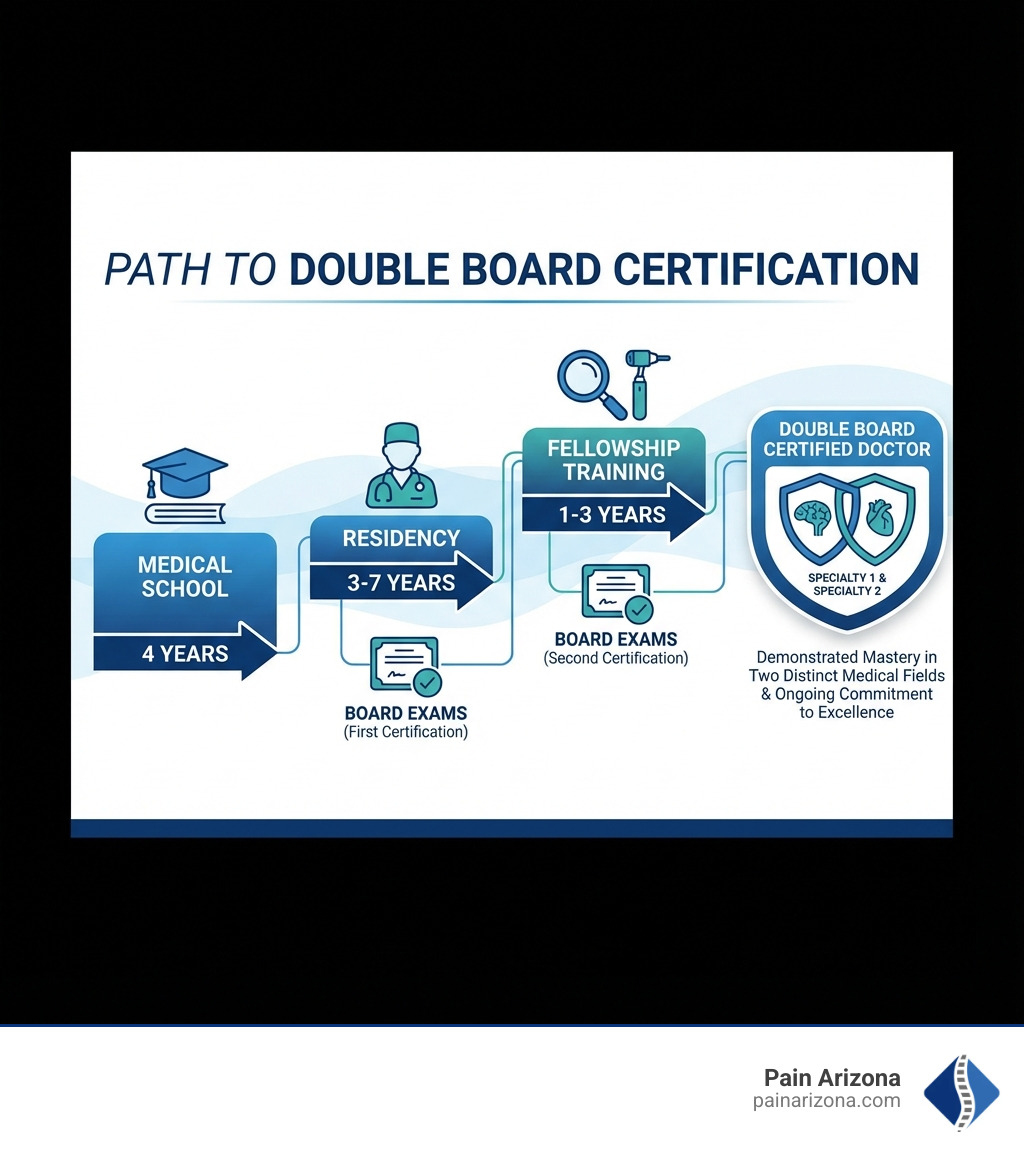
The Path to Becoming a Double Board-Certified Doctor
The journey to becoming a Double board certified doctor is even more demanding than achieving a single certification, requiring an extraordinary level of dedication and time. It’s a path few physicians choose, but one that yields unique benefits in patient care.
The process typically involves:
-
Primary Residency: As with any board certification, the physician first completes a residency program in their initial chosen specialty. This provides foundational expertise in one area.
-
Fellowship Training or Second Residency: After completing their first residency, the physician then pursues further specialized training. This can involve:
- Fellowship Training: An additional one to three years of highly focused training within a subspecialty of their primary field or a closely related area. For example, an Anesthesiologist might complete a fellowship in Pain Medicine.
- Second Residency: In some cases, a physician might complete an entirely separate, full residency program in a second distinct medical specialty. This is a much longer and more intensive pathway.
-
Passing Two Separate Board Exams: After fulfilling the training requirements for both specialties, the physician must then pass two separate sets of rigorous board examinations—one for each specialty. These exams, which often include both written and oral components, are designed to test the physician’s comprehensive knowledge and clinical judgment in both fields.
-
Substantial Time Commitment: This entire process, from medical school through two certifications, can easily take over a decade, often extending to 12-15 years or more of post-graduate education and training.
-
Continuous Medical Education (CME) for Both Specialties: Once certified, the Double board certified doctor must then maintain both certifications through ongoing continuing medical education and maintenance of certification activities for each specialty. This means they are constantly staying current with advancements across two fields.
This arduous path demonstrates an unparalleled commitment to mastering multiple areas of medicine, ultimately benefiting patients with a broader range of expertise. You can explore more about this demanding journey on resources like ABPSUS.org and Rosh Review.
What are the benefits for the physician?
For the physician, becoming a Double board certified doctor offers a multitude of professional advantages that extend beyond the satisfaction of academic achievement. This advanced credential can significantly impact a doctor’s career trajectory and opportunities.
-
Improved Professional Reputation: Being double board-certified immediately improves a physician’s standing among peers, patients, and the wider medical community. It signals an exceptional dedication to their craft and a profound depth of knowledge, leading to greater respect and trust.
-
Increased Job Opportunities and Career Stability: In today’s competitive healthcare landscape, physicians with dual specialties are often in high demand, particularly in urban healthcare systems like those in the Phoenix area. This unique skill set can lead to better job opportunities, increased career stability, and the flexibility to work in diverse settings, from clinical practice to administration or research.
-
Higher Earning Potential: Due to their specialized skills and ability to offer a wider range of services, Double board certified doctors often command higher earning potential. Their unique expertise is valuable to healthcare institutions and patients alike.
-
Academic and Research Roles: Physicians with dual expertise are exceptionally well-positioned for academic roles, teaching positions, and research opportunities. Their broad and deep understanding of two specialties allows them to contribute significantly to medical advancements and education.
-
Career Flexibility and Adaptability: Dual certification provides physicians with greater flexibility to adapt to changing healthcare demands and trends. They can transition between different roles or focus areas, ensuring long-term career viability and satisfaction.
-
Leadership Positions: An additional board certification can demonstrate a physician’s role as a leader in fields related to their specialty. It can validate efforts for healthcare executive roles and open doors to leadership positions where multidisciplinary expertise is highly valued. The American Board of Physician Specialties (ABPS) explicitly highlights how multiple certifications can clarify purpose, secure practice growth, and expand into leadership.
This extensive commitment to training and certification not only benefits the physician’s career but ultimately translates into a higher level of expertise and care for their patients.
The Patient Advantage: Why Choose a Double Board-Certified Physician?
When it comes to your health, especially managing complex conditions like chronic pain, choosing the right physician is paramount. Opting for a Double board certified doctor offers distinct advantages that can significantly impact your care, bringing comprehensive care, a unique skill set, and a broader perspective to your treatment journey. This level of expertise can instill greater confidence in your care and provide you with much-needed peace of mind.
For us at Pain Arizona, our double board-certified physicians exemplify this commitment to advanced patient care. They have dedicated years to mastering two distinct fields, allowing them to approach your condition with a depth of understanding that is truly exceptional.
Benefits for Patients of a Double Board-Certified Doctor
Choosing a Double board certified doctor can provide several tangible benefits for patients, particularly those with complex or intersecting health issues:
-
Holistic and Comprehensive Approach: A Double board certified doctor can integrate knowledge from two specialties, offering a more holistic view of your health. This means they can diagnose and treat conditions with a broader understanding of how different bodily systems interact, leading to more integrated and effective treatment plans. For instance, our double board-certified pain specialists can address both the neurological and physical aspects of your pain, considering the whole patient.
-
Ability to Treat Complex Conditions: Patients with chronic pain often present with multifaceted issues that cross traditional medical boundaries. A doctor with dual expertise is better equipped to handle these complex conditions, understanding the nuances from multiple angles. This leads to a more nuanced and effective treatment strategy.
-
Reduced Need for Multiple Specialists: With a Double board certified doctor, you might find that you need to consult fewer individual specialists. Their combined expertise means they can manage aspects of your care that might otherwise require referrals to different doctors, streamlining your treatment process and reducing the burden of coordinating multiple appointments.
-
Two Expert Perspectives in One Physician: This is perhaps one of the most significant advantages. A Double board certified doctor can approach your problem with two expert perspectives rather than just one. This dual insight allows for more innovative solutions and a more well-rounded understanding of your condition, ensuring that all relevant factors are considered in your diagnosis and treatment plan. This level of expertise helps us provide grounded advice and ensure you achieve the best possible outcomes.
Our team at Pain Arizona prides itself on having expert practitioners who embody these benefits. You can meet our expert practitioners to learn more about their qualifications and dedication.
Common Fields for Double Board Certification
While double board certification is relatively rare, certain medical fields see it more commonly due to the synergistic nature of the specialties. These combinations often provide significant benefits for both the physician and their patients.
In the field of pain management, for example, it is highly beneficial for a physician to be Double board certified in Anesthesiology and Pain Medicine. Anesthesiology provides a deep understanding of pharmacology, physiology, and procedural skills essential for interventional pain techniques, while Pain Medicine offers specialized knowledge in chronic pain diagnosis and treatment. This dual certification allows for a comprehensive approach to managing complex pain conditions. Our own Dr. Azmi N. Nasser, D.O., and Dr. Arash Ghaffari, M.D., are excellent examples, both being double board-certified in Physical Medicine & Rehabilitation and Pain Medicine. This dual expertise is invaluable in assessing and treating the intricate causes of pain.
Other common and beneficial combinations include:
- Facial Plastic Surgery: Often, surgeons in this field are double board-certified in Otolaryngology – Head and Neck Surgery and Facial Plastic and Reconstructive Surgery. Otolaryngology provides a deep understanding of the anatomy and function of the head and neck, crucial for complex facial procedures, while the second certification focuses specifically on aesthetic and reconstructive techniques of the face. This ensures comprehensive expertise in both the functional and cosmetic aspects of facial procedures.
- Cardiology: A cardiologist might be double board-certified in Internal Medicine and Cardiology. Internal Medicine provides a broad foundation in adult general medicine, allowing the physician to understand systemic conditions that impact the heart, while Cardiology focuses specifically on heart and vascular diseases. This allows for a holistic approach to cardiovascular health.
- Endocrinology: Similarly, an endocrinologist might be certified in Internal Medicine and Endocrinology, enabling them to manage complex hormonal disorders with a comprehensive understanding of the patient’s overall health.
These examples highlight how dual certification can equip physicians with a unique and powerful combination of skills, making them exceptionally qualified to handle intricate medical challenges.
How to Verify Your Doctor’s Board Certification
In our commitment to transparency and empowering you to make informed healthcare decisions, we believe it’s crucial for you to be able to verify your doctor’s credentials. Verifying board certification is a simple yet powerful step in ensuring you receive quality care from a qualified professional. This process, often referred to as Primary Source Verification (PSV), confirms that the information about a physician’s training and certification comes directly from the issuing authority, providing you with reliable assurance.
The American Board of Medical Specialties (ABMS) plays a vital role in this process by maintaining a comprehensive database of information on nearly a million physicians. This database is recognized by major healthcare organizations like The Joint Commission, the National Committee for Quality Assurance (NCQA), and URAC as satisfying the requirements for PSV. It’s a testament to the fact that patients see board certification as a higher standard and a source of peace of mind.
Step-by-Step Verification Process
Verifying your doctor’s board certification is straightforward, thanks to online resources provided by official medical boards. Here’s how you can do it:
- Visit an Official Verification Website: The primary and most reliable resource is the ABMS’s “Certification Matters” website. This platform is specifically designed for patients to check physician credentials.
- Search by Doctor’s Name and State: On the website, you’ll typically enter your doctor’s last name (at least the first two letters), and optionally their first name, the state they practice in (such as Arizona), and their specialty. Including more details can help refine your search.
- Review the Listed Specialties and Certification Status: The search results will display the physician’s board certification status, including the specific specialties in which they are certified and the dates of their certification. This will clearly indicate if a doctor is a Double board certified doctor and in which fields. If a doctor is double board-certified, both certifications will be listed.
For example, if you’re looking for a physician in Phoenix, Arizona, you would input “Nasser” and “Arizona” to find Dr. Azmi Nasser’s certifications.
It’s a quick and easy way to gain confidence in your healthcare provider’s qualifications. You can verify your doctor’s credentials directly on the Certification Matters website.
Frequently Asked Questions about Doctor Certifications
We understand that medical credentials can be complex, and you likely have questions beyond the basics. Here, we address some common inquiries about doctor certifications, particularly regarding the distinction of a Double board certified doctor.
What is the difference between “board-eligible” and “board-certified”?
This is an important distinction that often causes confusion.
- Board-eligible means that a doctor has successfully completed an accredited residency training program in a specific medical specialty. They have fulfilled all the educational and training requirements to take their board certification examination. However, they have not yet passed the actual board exams. Being board-eligible indicates that they are on the path to certification and have the necessary training, but have not yet demonstrated their knowledge through the rigorous testing process.
- Board-certified means the doctor has not only completed their residency training but has also successfully passed the comprehensive written and often oral examinations administered by their specialty’s certifying board. This status confirms that they have demonstrated a high level of knowledge, skill, and expertise in their specialty, meeting the highest standards set by their peers. Choosing a board-certified physician ensures they have proven their proficiency through a challenging assessment.
Is a double board-certified doctor automatically better?
While being a Double board certified doctor is a strong indicator of exceptional dedication, extensive training, and broad expertise, we wouldn’t say it automatically makes them “better” in every single scenario. However, it certainly signifies a physician who has gone above and beyond.
A double board-certified doctor has invested significantly more time and effort into their education and training, mastering two distinct fields. This often translates into:
- Broader Perspective: They can approach medical problems with a more comprehensive understanding, drawing insights from both specialties.
- Deeper Expertise: Their training in two areas can lead to a more profound understanding of complex conditions, especially where specialties intersect.
- Commitment to Excellence: The sheer effort required to achieve dual certification speaks volumes about a physician’s commitment to continuous learning and providing the highest quality of care.
For patients with complex conditions, particularly chronic pain that can involve multiple physiological systems, the integrated knowledge of a Double board certified doctor can be incredibly beneficial. However, the “best” doctor for you also depends on other factors like their specific experience with your unique condition, their communication style, and your personal comfort level with them. Double board certification is a powerful credential that significantly improves a physician’s capabilities and is a strong indicator of a highly qualified and dedicated practitioner.
How long does it take to become double board-certified?
The journey to becoming a Double board certified doctor is a testament to extraordinary commitment and can take a considerable amount of time. The timeline varies slightly depending on the specific specialties chosen, but here’s a general breakdown:
- Undergraduate Education: 4 years
- Medical School (MD or DO): 4 years
- Primary Residency: This typically ranges from 3 to 7 years, depending on the specialty. For example, an Anesthesiology residency is often 4 years, while Internal Medicine is 3 years.
- First Board Certification: After completing the primary residency, the physician must pass the board exams for that specialty.
- Second Residency or Fellowship: To become double board-certified, the physician then undertakes additional specialized training. This could be:
- An additional 1 to 3 years for a fellowship (e.g., Pain Medicine fellowship after Anesthesiology residency).
- Another full residency program (which could be another 3-7 years) if the two specialties are very distinct and require separate foundational residencies.
- Second Board Certification: Finally, the physician must pass the rigorous board exams for their second specialty.
Adding all these stages together, becoming a Double board certified doctor can easily take 12 to 15 years or even longer after completing undergraduate college. This lengthy and demanding process highlights the immense dedication and intellectual rigor required to achieve this advanced credential.
Conclusion: Trusting Your Care to an Expert
Choosing a physician is a critical decision for your health, one that can profoundly impact your well-being and quality of life. When faced with complex medical conditions, especially chronic pain, the qualifications of your healthcare provider become even more paramount. A Double board certified doctor has demonstrated an exceptional commitment to mastering their fields, offering patients a higher level of comprehensive and expert care that few others can match.
At Pain Arizona, we understand the importance of this distinction. Our team includes Double board certified doctors who have dedicated extensive years to rigorous training and continuous education in their respective specialties, such as Physical Medicine & Rehabilitation and Pain Medicine. This dual expertise allows us to approach your pain with a broader perspective, deeper understanding, and a more integrated treatment strategy. We are committed to providing advanced, evidence-based, and minimally invasive treatments designed to address the root cause of your pain, right here in the Greater Phoenix Area, including Mesa, Gilbert, Scottsdale, and Glendale. We accept most insurance plans; please check with our office manager to see if your plan is accepted.
When you choose a Double board certified doctor at Pain Arizona, you’re choosing a physician who has gone above and beyond to earn your trust and provide you with the highest standard of care. We invite you to experience the difference that such expertise can make in your journey toward lasting relief.
Learn more about our minimally invasive spine procedures and find how our double board-certified specialists can help you.