
Disc-overing Relief: A Guide to Degenerative Disc Treatment
What You Need to Know About Degenerative Disc Treatment
Degenerative disc treatment is a broad term for the many ways doctors help people manage pain caused by worn-down spinal discs — and the good news is that most people get real relief without surgery.
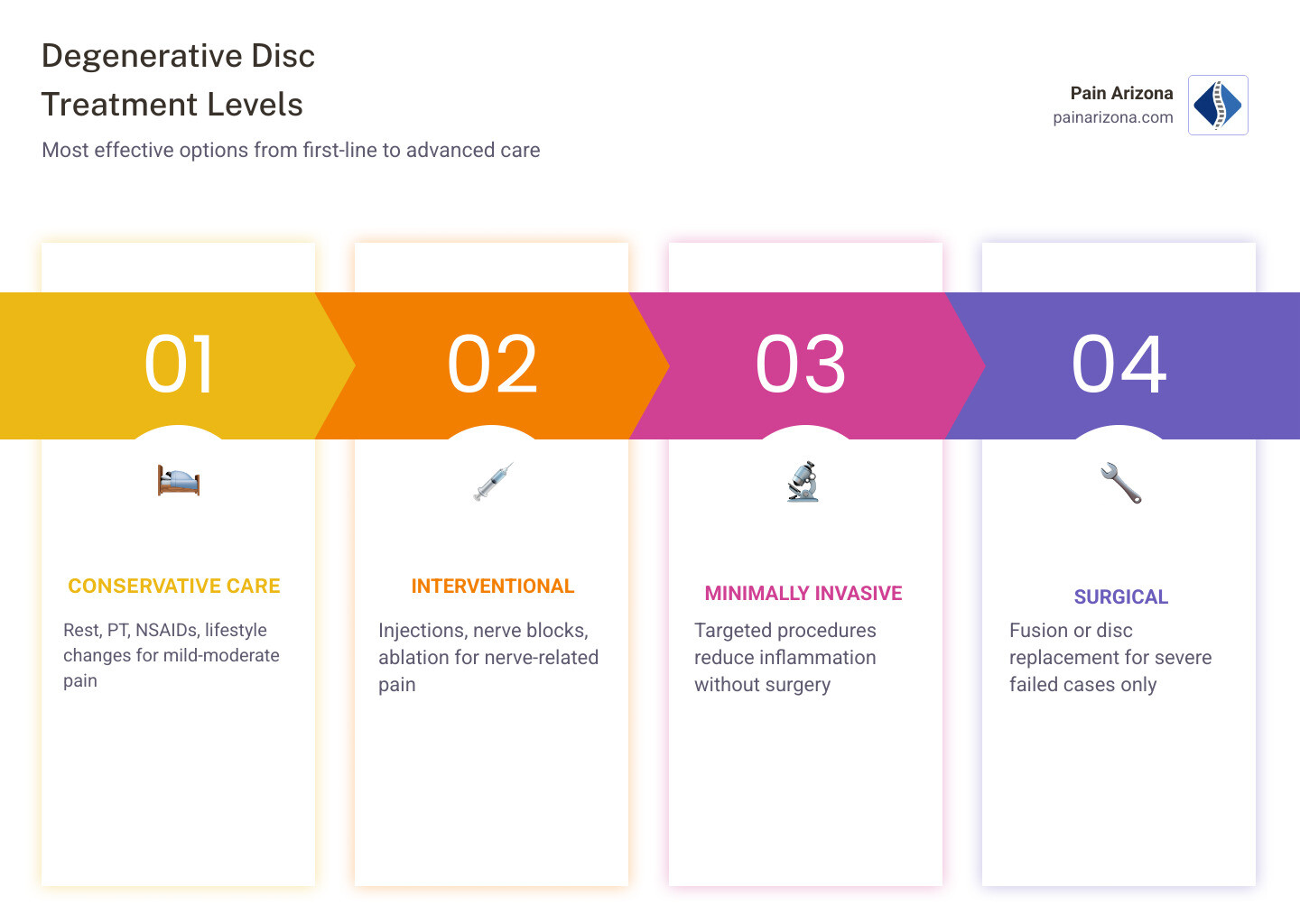
Here’s a quick overview of your main treatment options:
| Treatment Type | Examples | Best For |
|---|---|---|
| Conservative (first-line) | Rest, heat/ice, NSAIDs, physical therapy | Mild to moderate pain |
| Interventional | Epidural steroid injections, nerve blocks, radiofrequency ablation | Moderate to severe pain, nerve involvement |
| Surgical | Discectomy, spinal fusion, disc replacement | Severe cases after conservative treatment fails |
Most people — roughly 80% of those with acute symptoms — respond well to conservative, non-surgical care. Surgery is only needed in about 5% of cases.
Back pain that won’t go away is exhausting. It affects your sleep, your work, and the things you love doing. If you’ve been told you have degenerative disc disease, you may be wondering what that actually means — and whether you’re stuck with this pain forever.
You’re not.
This guide walks you through every level of treatment, from simple home strategies to advanced minimally invasive procedures, so you can make confident, informed decisions about your spine health.
I’m Dr. Nasser, a double board-certified physical medicine, rehabilitation, and pain medicine physician with decades of experience developing personalized degenerative disc treatment plans — from conservative therapies to advanced minimally invasive procedures. I’ve performed tens of thousands of spinal interventions and lead Pain Arizona’s multidisciplinary team across the Greater Phoenix area, and I’m here to help you understand your options clearly.
Degenerative disc treatment definitions:
Understanding the “Disease” That Isn’t One
One of the first things we tell our patients in Phoenix and Scottsdale is that “Degenerative Disc Disease” (DDD) is a bit of a misnomer. It isn’t a disease in the infectious or spreading sense; rather, it is a natural aging process of the spine.
Think of your spinal discs as high-performance shock absorbers. Each disc is made of two main parts:
- Annulus Fibrosus: The sturdy, tire-like outer layer.
- Nucleus Pulposus: The soft, jelly-like center that provides cushioning.
As we get older, these discs naturally lose their water content (dehydration) and elasticity. They become thinner and less effective at absorbing shock. By age 65, about 20% of U.S. adults show some signs of disc degeneration, and that number jumps to 35% by age 80. In fact, research indicates that 30% of people already have some evidence of DDD by age 35!
When these discs wear down, the vertebrae can begin to rub together, or the disc might bulge or rupture. This can lead to various disc problems like inflammation or nerve compression. You can find a more detailed degenerative disc disease overview to see how these structural changes progress over time.
First-Line Conservative Degenerative Disc Treatment

When you visit us at Pain Arizona, our first goal is almost always to avoid the operating room. Most patients find significant relief through a combination of lifestyle changes and non-invasive therapies.
Lifestyle Modifications
Small changes can yield big results for your spine. We often recommend:
- Weight Management: Excess weight puts a literal “heavy” burden on your lumbar spine. Losing even a few pounds can significantly reduce the pressure on your discs.
- Ergonomics: If you work at a desk in Mesa or Gilbert, ensure your chair provides proper lumbar support. We suggest standing up to stretch every 20-30 minutes.
- Anti-Inflammatory Diet: Foods rich in Omega-3s and antioxidants can help manage the systemic inflammation that contributes to disc pain.
- Smoking Cessation: This is a big one. Smoking reduces blood flow to the spinal discs, accelerating dehydration and preventing them from healing. In fact, smokers have a much higher risk of “pseudoarthrosis” (failed healing) if they ever do need surgery.
For more details on these approaches, explore our guide on non-surgical back treatment options.
The Role of Physical Therapy in Degenerative Disc Treatment
Physical therapy (PT) is the cornerstone of managing low back pain. It’s not just about “working out”; it’s about targeted rehabilitation.
A skilled therapist focuses on:
- Core Stability: Strengthening the “natural corset” of muscles around your spine to take the load off your discs.
- Posture Education: Learning how to sit, stand, and lift without straining your back.
- Flexibility: Hamstring stretching is vital, as tight hamstrings can pull on the pelvis and worsen lower back pain.
- Low-Impact Aerobics: Activities like swimming or walking increase blood flow to the spine, delivering nutrients to the discs and releasing endorphins—your body’s natural painkillers.
There is extensive scientific research on nonsurgical treatments showing that these methods improve function and reduce disability for the vast majority of patients.
Medications for Symptom Management
Medications are often used as a “bridge” to help you feel well enough to participate in physical therapy. We provide a comprehensive guide to pain treatments that includes:
- NSAIDs: Ibuprofen or naproxen to reduce inflammation.
- Acetaminophen: For pure pain relief without the anti-inflammatory component.
- Muscle Relaxants: These are typically used for short bursts (1-2 weeks) if you are experiencing acute spasms.
- Nerve Pain Medications: For those experiencing “pins and needles” or radiating pain.
Interventional and Minimally Invasive Procedures
If conservative measures aren’t enough, we move to interventional degenerative disc treatment. These are minimally invasive procedures performed in our clinics across the Phoenix Area.
Targeted Spinal Injections
We use fluoroscopy (real-time X-ray guidance) to ensure that medication is delivered exactly where it’s needed.
- Epidural Steroid Injections: These deliver powerful anti-inflammatories directly around the compressed nerve root. They are highly effective for radiating pain (sciatica). You can read more epidural steroid injection details to understand the process.
- Facet Joint Injections: If the degeneration has led to arthritis in the small joints of the spine, these injections can provide significant relief.
For a full list of what we offer, visit our information on spinal injections.
Advanced Interventional Degenerative Disc Treatment
At Pain Arizona, we stay at the forefront of medical technology. Some of our advanced options include:
- Basivertebral Nerve Ablation: This is a treatment for “vertebrogenic” pain. If your MRI shows “Modic changes” (inflammation in the bone next to the disc), we can use radiofrequency energy to stop the nerve inside the bone from sending pain signals. Studies show 65-75% of patients see clinically relevant improvement.
- Radiofrequency Neurotomy (RFA): This “blocks” pain signals from the facet joints for 6 to 12 months or longer. Check out our radiofrequency ablation services.
- Regenerative Medicine: We are exploring the use of PRP therapy and other biologics to help supplement the disc’s natural structure and potentially stimulate healing.
When is Surgery Necessary for DDD?
Surgery is rarely the first step. We generally only consider surgical intervention after at least 6 months of failed conservative and interventional care. However, there are “red flags” that might move surgery to the top of the list:
- Neurological Deficits: Increasing weakness in your legs or arms.
- Cauda Equina Syndrome: A rare emergency involving loss of bowel or bladder control.
- Intractable Pain: Pain so severe it prevents any quality of life despite all other treatments.
When surgery is needed, we help you navigate the options. Here is a comparison of the two most common approaches:
| Feature | Spinal Fusion | Artificial Disc Replacement |
|---|---|---|
| Goal | Stop motion at the painful segment | Preserve motion at the segment |
| Method | Join two vertebrae together with bone grafts/rods | Replace the disc with a metal/plastic implant |
| Recovery | Longer (months for bone to fuse) | Generally faster |
| Long-term | May increase stress on nearby discs | Reduces stress on nearby discs |
For a deeper dive, see our comprehensive guide to back surgery options.
Common Surgical Procedures
Modern surgery is often much less invasive than it used to be. Many procedures are now performed through tiny incisions with the help of endoscopes.
- Laminectomy: Removing a portion of the bone to relieve pressure on the spinal cord. 70-80% of patients see significant functional improvement.
- Discectomy: Removing the part of the disc that is pressing on a nerve.
- Minimally Invasive Spine Surgery: These endoscopic spine procedures often allow for faster recovery and less post-operative pain.
Frequently Asked Questions about Degenerative Disc Disease
How is DDD diagnosed by a specialist?
Diagnosis is a puzzle. We start with a thorough medical history and physical examination. While MRIs are great, they have limitations—many people have “scary looking” discs on an MRI but feel zero pain! We look for a correlation between your symptoms and the images. Sometimes, we use diagnostic injections (nerve blocks) to “test” if a specific spot is the true source of your pain. See our diagnostic conditions overview for more information.
What are the primary symptoms of disc degeneration?
Symptoms depend on where the disc is (Cervical/Neck or Lumbar/Back). Common signs include:
- Pain that worsens when sitting, bending, or lifting.
- Radiating pain: Pain that travels into the buttocks or legs (sciatica).
- Numbness and tingling: The “pins and needles” sensation.
- Muscle weakness: Feeling like your leg might “give out.” These are often similar to herniated disc symptoms.
What is the recovery process like after treatment?
Recovery is a journey, not a sprint. For non-surgical treatments, you might feel better within days or weeks. After a procedure like an epidural injection, most patients return to normal activities the very next day. If surgery is required, recovery can range from 2 weeks (for sedentary jobs) to 12 weeks (for strenuous labor). We provide specialized care for recovery from bulging discs and other spinal issues to ensure you get back to your life safely.
Conclusion
At Pain Arizona, we understand that living with back or neck pain is more than just a physical burden—it’s a mental and emotional one too. Serving the Greater Phoenix Area, including Mesa, Gilbert, Scottsdale, and Glendale, our double board-certified physicians are dedicated to finding the degenerative disc treatment that works for you.
We prioritize a compassionate, evidence-based, and minimally invasive approach to address the root cause of your pain. We accept most insurance plans; please check with our office manager to see if your specific plan is accepted.
Don’t let your discs dictate your life. Schedule a consultation with us today and let’s start your journey toward relief.