
Left Side Abdominal Pain: Causes & How To Treat
What Is Pain One Side? Quick Answers Before We Dive In
Pain one side of your body is one of the most common reasons people search for medical answers online — and for good reason. It can mean something as simple as trapped gas, or something as serious as appendicitis or a kidney infection.
Here are the most common causes, organized by location:
| Location | Common Causes |
|---|---|
| Upper left abdomen | Pancreatitis, enlarged spleen, stomach ulcer, indigestion |
| Lower left abdomen | Diverticulitis, ovarian cysts, ectopic pregnancy, kidney stones |
| Upper right abdomen | Gallstones, liver disease, kidney infection |
| Lower right abdomen | Appendicitis, hernia, ovarian issues |
| Left or right back/flank | Muscle strain, kidney infection, sciatica, SI joint pain |
Pain that is sudden, severe, or comes with fever, blood in your urine or stool, or shortness of breath needs immediate medical attention.
Your pain’s location is one of the most useful clues a doctor has. The abdomen is divided into four quadrants, and each one houses different organs. Knowing which quadrant hurts helps narrow down what might be wrong.
It’s also worth knowing that pain doesn’t always come from where you feel it. This is called referred pain — for example, a heart attack can show up as left-sided abdominal discomfort, and a kidney problem can feel like lower back pain on one side.
I’m Dr. Nasser, a double board-certified physician in Physical Medicine and Rehabilitation and Pain Medicine, and I’ve spent my career diagnosing and treating the full spectrum of conditions that cause unilateral pain one side of the body — from musculoskeletal injuries to complex nerve and organ-related conditions. In the sections ahead, I’ll walk you through exactly what might be causing your pain and what you can do about it.

Pain one side word guide:
Understanding Pain One Side: Anatomy and Quadrants
When you visit us at Pain Arizona, one of the first things we do is “map” your discomfort. To make diagnosis easier, healthcare providers divide the area between your ribs and pelvis into four sections called quadrants. This anatomical mapping is vital because it tells us which organs are likely involved in your pain one side.
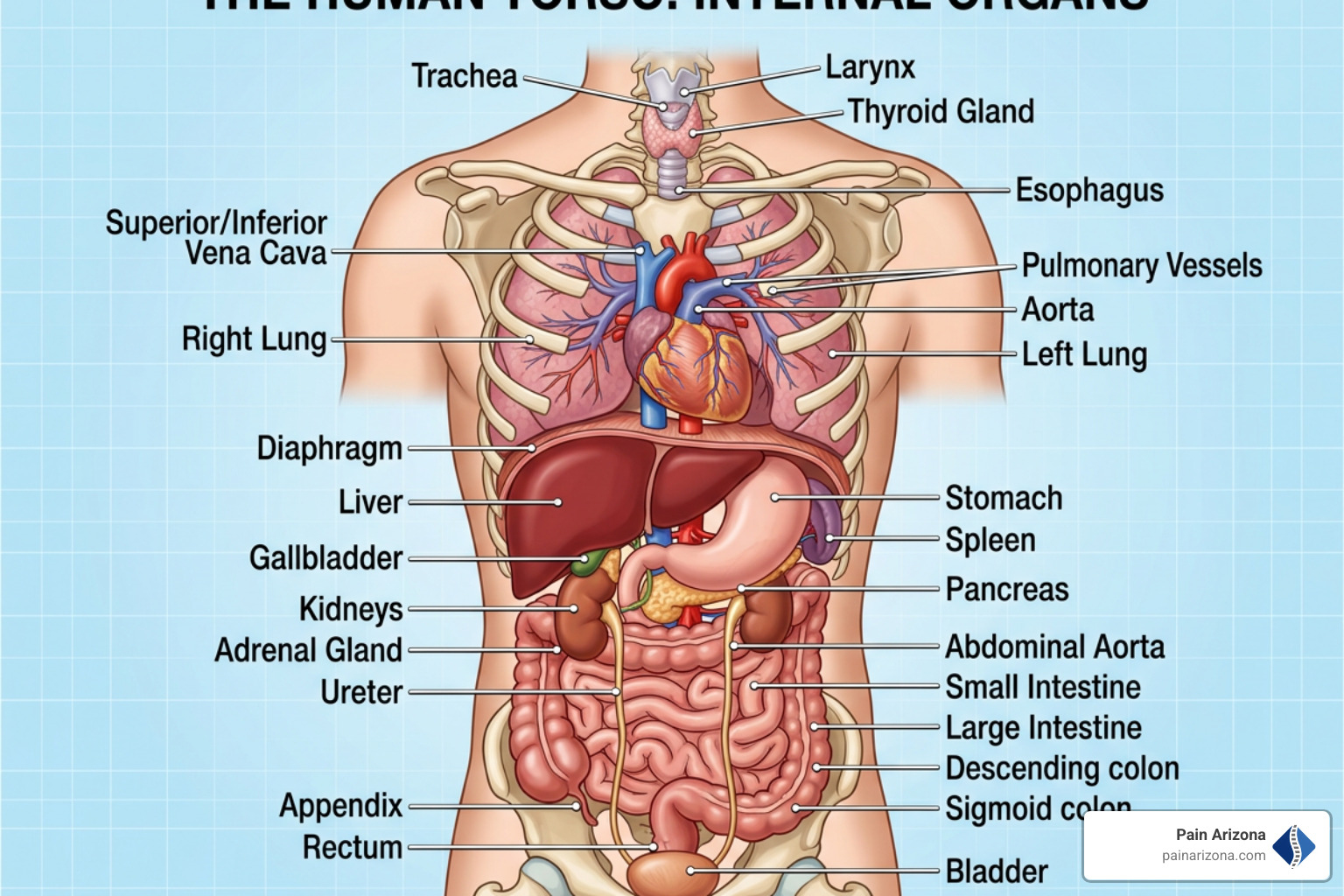
The abdominal cavity is lined by a protective membrane called the peritoneum. Within this space, organs are packed tightly. On your left side, you’ll find the stomach, the spleen, the tail of the pancreas, and the descending part of the colon. On the right, you have the liver, gallbladder, and the famous appendix.
However, the human body likes to keep us on our toes. Sometimes, the pain you feel in your abdomen isn’t actually starting there. This is known as referred pain. Because the nerves serving your heart, lungs, and kidneys often share pathways with the nerves in your abdominal wall, a problem in the chest or back can “refer” pain to the side of your belly. For instance, scientific research on splenic rupture notes that a damaged spleen can cause pain that radiates all the way up to the left shoulder.
Left Side vs. Right Side: An Organ Comparison
| Left Side Organs | Right Side Organs |
|---|---|
| Stomach | Liver |
| Spleen | Gallbladder |
| Pancreas (Tail) | Appendix |
| Left Kidney & Ureter | Right Kidney & Ureter |
| Left Ovary/Fallopian Tube | Right Ovary/Fallopian Tube |
| Descending Colon | Ascending Colon |
Common Causes of Left-Sided Abdominal Pain
If you are experiencing pain one side specifically on the left, you are certainly not alone. This is one of the most frequent complaints we see in the Phoenix area. While it can be as benign as a heavy meal, it can also signal issues within the digestive or urinary tracts.
One of the most common culprits for lower left pain is diverticulitis. This occurs when small pouches in the colon (diverticula) become inflamed or infected. According to the National Institute of Diabetes and Digestive and Kidney Diseases on Diverticulitis, this pain is typically sharp and persistent.
Other common causes include:
- Gas Buildup: Sometimes, gas accumulates in the “splenic flexure” (the bend in the colon near the spleen), causing surprisingly sharp, stabbing pain.
- Kidney Stones: These can cause excruciating, “colic” pain that comes in waves as the stone moves through the ureter.
- Constipation: A backup in the descending colon often manifests as a dull, heavy ache on the left side.
- Nerve Issues: Believe it or not, back issues can cause side pain. You can find more info about Sciatica causes to see how nerve irritation in the spine radiates around the torso.
Upper Quadrant Pain One Side
Pain tucked up under your left ribs often involves the “upper” organs.
- Spleen Issues: An enlarged spleen (splenomegaly) can cause a vague sense of fullness or pain. The NHS guide on spleen problems explains that infections or injuries are often to blame.
- Pancreatitis: Inflammation of the pancreas usually causes pain that starts in the upper left and radiates straight through to the back.
- Stomach Ulcers: These often cause a burning sensation that feels worse when the stomach is empty.
- Costochondritis: This is an inflammation of the cartilage connecting your ribs to your breastbone. It can feel like a heart attack but is actually a musculoskeletal issue.
Lower Quadrant Pain One Side
When the pain is closer to your hip bone on the left, we often look at the reproductive or “lower” digestive systems.
- Ovarian Cysts: Many women experience a sharp “twinge” during ovulation, but a large or ruptured cyst can cause significant pain. Research on ovarian cyst management highlights that while many resolve on their own, some require medical intervention.
- Ectopic Pregnancy: This is a medical emergency where a fertilized egg grows outside the uterus, usually in a fallopian tube.
- Inguinal Hernia: A small bulge of intestine through the abdominal wall can cause pain that worsens when you cough or lift heavy objects.
- Pelvic Inflammatory Disease (PID): An infection of the reproductive organs that often causes unilateral or bilateral lower pain.
- Piriformis Syndrome: Sometimes, a tight muscle in the buttock can compress the sciatic nerve, leading to pain that feels like it’s coming from the lower pelvic or side area. You can read more details on Piriformis Syndrome to understand this connection.
One-Sided Back and Flank Pain
The “flank” is the area on the side of your body between the ribs and the hip. Pain one side in this region is incredibly common—in fact, 80% of adults will experience back or flank pain at some point.
Most flank pain is “mechanical,” meaning it involves the muscles, nerves, or joints of the spine. A simple muscle strain from lifting a box incorrectly in Mesa or Scottsdale is a frequent cause. However, because the kidneys sit right against the back muscles, it can be hard to tell the difference between a pulled muscle and a kidney stone.
Key spine-related causes include:
- Lumbar Radiculopathy: This occurs when a nerve root in the lower back is compressed, sending “electric” shocks or numbness down one side. Check out the Lumbar Radiculopathy symptoms for a full checklist.
- SI Joint Pain: The sacroiliac joints connect your spine to your pelvis. If one becomes inflamed, it causes deep, aching pain one side of the lower back. Learn about SI Joint Pain treatment options we offer.
- Facet Joint Syndrome: The small joints that help your spine twist can develop arthritis, leading to localized pain. We specialize in treating Facet Joint Syndrome using minimally invasive techniques.
If you’re looking for One-Sided Back Pain relief, it’s important to determine if the cause is a disc, a joint, or an internal organ like the kidney.
When Unilateral Pain Becomes an Emergency
While many cases of pain one side resolve with rest, some are life-threatening. You should never “tough it out” if you experience what we call “red flag” symptoms.
Appendicitis is perhaps the most famous right-sided emergency. It often starts as a dull ache near the belly button before migrating to the lower right quadrant and becoming sharp and severe. If left untreated, it can rupture, leading to a life-threatening infection.
Other emergencies include:
- Heart Attack: The American Heart Association on heart attack warning signs notes that left-sided pain, especially if it radiates to the jaw or arm and is accompanied by shortness of breath, requires a 911 call.
- Testicular Torsion: This occurs when a testicle rotates, twisting the spermatic cord and cutting off blood flow. Emergency research on testicular torsion emphasizes that treatment must occur within 6 hours to save the testicle.
- Sepsis: This is a severe systemic response to infection (like an untreated kidney infection). Symptoms include high fever, confusion, and extreme pain.
- Nerve Compression Syndrome: If you experience sudden loss of bowel or bladder control along with back pain, this could be Cauda Equina Syndrome, a surgical emergency. Read more on Nerve Compression Syndrome.
Treatment and Prevention Strategies
The good news is that most non-emergency pain one side can be managed effectively with the right approach.
Home Remedies and Lifestyle
For mild digestive pain, many patients find relief using the BRAT diet (Bananas, Rice, Applesauce, Toast) to rest the bowel. You can also explore home remedies for digestive discomfort like ginger for indigestion or peppermint tea for cramps. Hydration is also key, especially in our dry Arizona climate, to prevent kidney stones and constipation.
Professional Pain Management
If the pain is chronic or related to the spine and nerves, we offer several advanced treatments:
- Epidural Steroid Injection: To reduce inflammation around a pinched nerve. Epidural Steroid Injection
- Radiofrequency Ablation: This uses heat to “turn off” pain signals from arthritic joints. Radiofrequency Ablation
- Sciatica Care: We offer a full spectrum of Sciatica Treatment options to get you back on your feet.
Prevention
Prevention is always better than a cure. You can reduce your risk of pain one side by:
- Increasing fiber intake to prevent diverticulitis and constipation.
- Practicing posture correction, especially if you work at a desk in Phoenix or Gilbert, to prevent Pinched Nerve care issues.
- Staying active to keep the core muscles strong, which protects the spine.
Frequently Asked Questions about Pain One Side
What organs are located on the left side of the abdomen?
The left side of your abdomen houses several vital organs, including the stomach, the spleen, and the tail of the pancreas. You also have the left kidney (located toward the back), the descending colon (part of the large intestine), and parts of the small intestine. In females, the left ovary and fallopian tube are also located in the lower left quadrant.
Why does my pain one side come and go in waves?
Pain that comes and goes in waves is often called colic. This usually happens when a “hollow” organ—like the colon, gallbladder, or ureter—contracts or squeezes to try and push something through. Common causes include gas moving through the intestines, gallbladder contractions due to stones, or a kidney stone trying to pass through the urinary tract.
How can I tell if my side pain is muscular or organ-related?
A general rule of thumb: if the pain gets worse when you twist, bend, or cough, it is more likely to be musculoskeletal (muscle or joint). If the pain is constant, accompanied by fever, nausea, or changes in your bathroom habits, it is more likely to be organ-related. However, conditions like Cervical Radiculopathy or lumbar issues can sometimes mimic organ pain, which is why a professional diagnosis is essential.
Conclusion
Whether it’s a nagging ache in your flank or a sharp twinge in your abdomen, pain one side of the body should never be ignored. At Pain Arizona, we understand that living with pain limits your ability to enjoy everything the Greater Phoenix Area has to offer—from hiking in Scottsdale to spending time with family in Mesa.
Led by myself, Dr. Nasser, and our team of double board-certified physicians, we focus on evidence-based, compassionate care. We don’t just mask the symptoms; we use minimally invasive treatments to address the root cause of your discomfort. We accept most insurance plans; please check with our office manager to see if your specific plan is accepted at our Phoenix, Mesa, Gilbert, Scottsdale, or Glendale locations.
Don’t let unilateral pain hold you back any longer. Schedule a Sciatica Consultation or a general pain evaluation with us today, and let’s get you back to living your life to the fullest.