
Your Guide to Minimally Invasive Spine Surgery for Lasting Relief
Understanding Minimally Invasive Spine Procedures
Minimally invasive spine procedures are surgeries that treat painful spinal conditions through small incisions — causing far less damage to muscles and surrounding tissue than traditional open surgery.
Here’s a quick overview of what they involve:
| Feature | Minimally Invasive | Traditional Open Surgery |
|---|---|---|
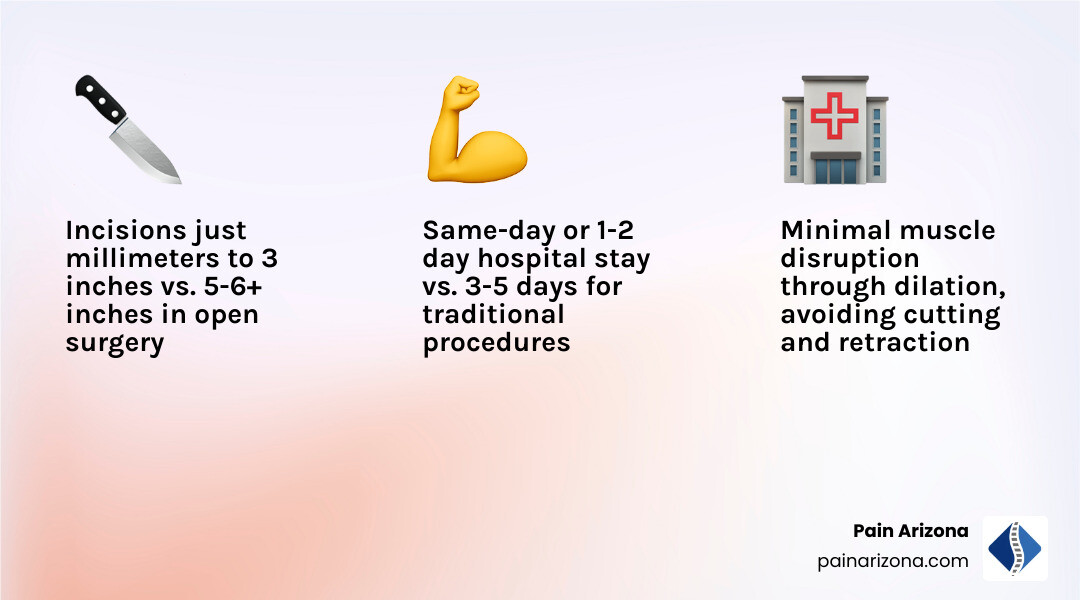
| Incision size | A few millimeters to ~3 inches | 5–6 inches or more |
| Muscle disruption | Minimal (dilation, not cutting) | Significant (cutting and retraction) |
| Hospital stay | Same day or 1–2 days | 3–5 days |
| Recovery time | Weeks | Months |
| Blood loss | Low | Higher |
| Infection risk | Lower | Higher |
These procedures can treat conditions like herniated discs, spinal stenosis, spondylolisthesis, and more — often as an outpatient, meaning you go home the same day.
If you’ve been living with chronic back or neck pain that hasn’t responded to physical therapy, medications, or injections, a minimally invasive approach may offer the lasting relief you’ve been looking for — without the long, difficult recovery of open spine surgery.
I’m Dr. Nasser, a double board-certified physician in physical medicine, rehabilitation, and pain medicine, with advanced fellowship training and hands-on experience performing minimally invasive spine procedures including endoscopic discectomy, nerve ablation, and other targeted interventions. Throughout my career, I’ve helped thousands of patients across the Greater Phoenix Area find real, lasting relief through these precise, muscle-sparing techniques.
Minimally invasive spine procedures word guide:
The philosophy behind minimally invasive spine procedures is simple: do the least amount of damage to healthy tissue while fixing the problem in the spine. In traditional “open” surgery, we would have to make a long incision and pull muscles away from the bone (retraction). This often caused more pain than the original back problem!
With MISS, we use a technique called “progressive dilation.” Instead of cutting through your back muscles, we use a series of small tubes, known as tubular retractors, to create a tunnel directly to the spinal column. We gently push the muscle fibers aside rather than tearing them. Once the procedure is done and the tubes are removed, the muscles simply crawl back into their original position.
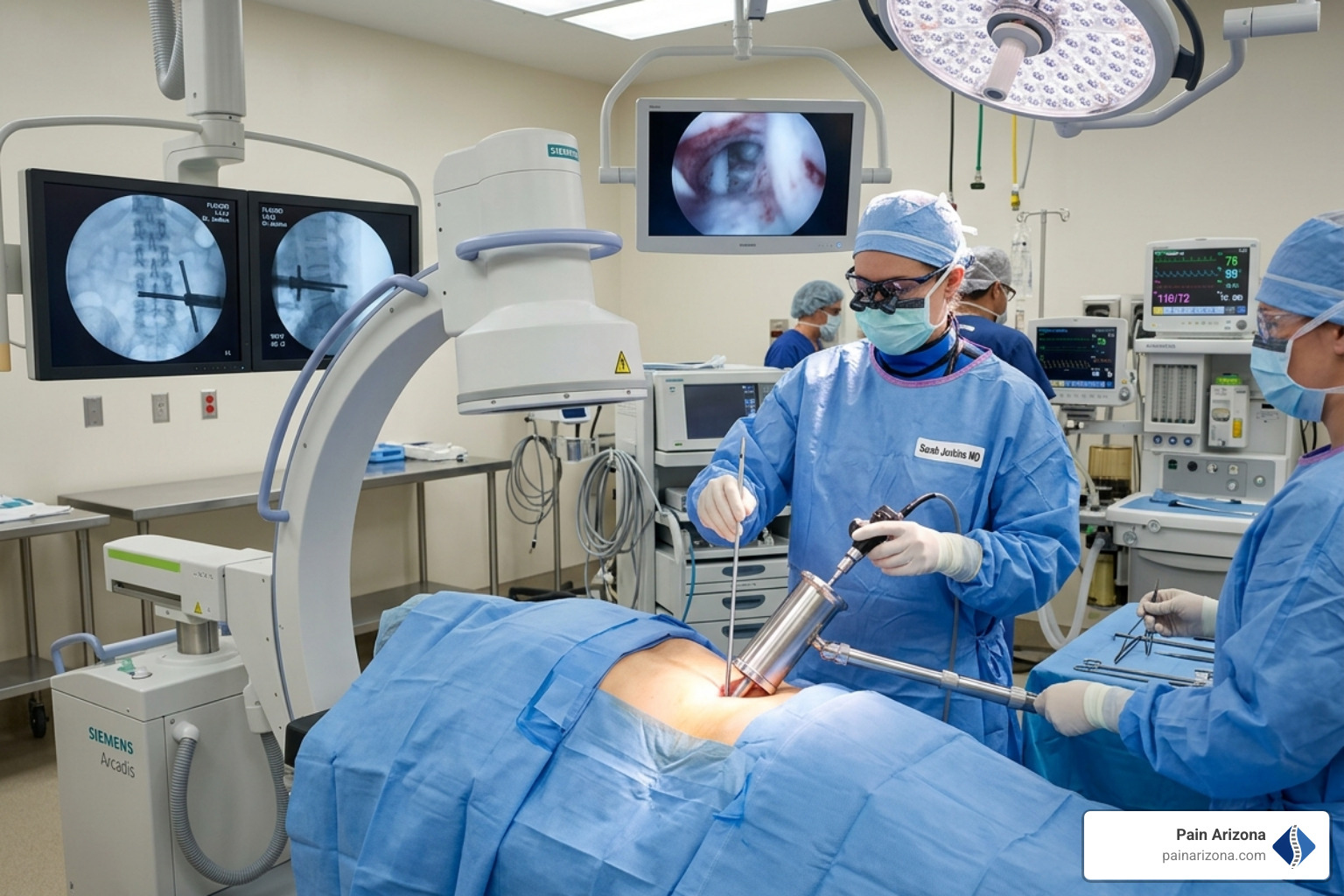
To see what we’re doing through these tiny openings, we rely on high-tech visualization. This includes fluoroscopy, which is a real-time X-ray that acts like a GPS for the spine, and operating microscopes or endoscopes that provide a high-definition, magnified view of the nerves and discs.
Common Conditions Treated with Minimally Invasive Spine Procedures
You might be surprised to learn just how many conditions we can treat using these specialized techniques. At Pain Arizona, we often see patients who think they are “stuck” with their pain because they don’t want a major operation. However, MISS is highly effective for:
- Herniated Disks: When the soft center of a spinal disk pushes through a crack in the exterior, it can pinch nearby nerves. We can remove that portion of the disk with a tiny incision.
- Lumbar Spinal Stenosis: This is a narrowing of the spaces within your spine. We use the MILD for Lumbar Stenosis (Minimally Invasive Lumbar Decompression) to remove thickened ligament tissue and restore space for your nerves.
- Spondylolisthesis: This occurs when one vertebra slips forward over the one below it. We can stabilize these bones using minimally invasive fusion techniques.
- Degenerative Disc Disease: Wear and tear on spinal disks can lead to chronic pain that we can address by stabilizing the affected segment.
- Spinal Tumors and Fractures: We can often remove tumors or stabilize vertebral compression fractures (using kyphoplasty) through very small ports.
Specialized Minimally Invasive Spine Procedures and Their Uses
Not all minimally invasive spine procedures are the same. We tailor the approach to your specific anatomy and the root cause of your pain.
- Microdiscectomy: This is the “gold standard” for a herniated disc. We use a microscope to find the disc material pressing on the nerve and remove it.
- MI-TLIF (Transforaminal Lumbar Interbody Fusion): We perform a spinal fusion from the back but through small incisions, using screws and rods to stabilize the spine.
- XLIF/LLIF (Lateral Approaches): These procedures allow us to access the spine from the side of the body. This avoids the major muscles of the back entirely, often resulting in a much faster recovery.
- Intracept (Basivertebral Nerve Ablation): This is a game-changer for “vertebrogenic” pain. If your pain is coming from the vertebral endplates (often seen as “Modic changes” on an MRI), we use radiofrequency energy to heat the basivertebral nerve, stopping it from sending pain signals to the brain.
- LIFT Procedure: Using the Minuteman G3R device, we can achieve lateral interspinous fusion through a one-inch incision, providing stability without the need for large metal hardware.
Research on MILD effectiveness has shown that 88% of patients who undergo the MILD procedure avoid major back surgery for at least five years, which is a testament to how powerful these “small” procedures can be.
Key Techniques and Advanced Technologies
The reason we can do so much through such small incisions is the incredible technology available today. It’s a bit like modern aviation—we have better “instruments” than ever before.
One of the most significant leaps forward is the use of Robotics and Navigation. In the past, surgeons relied on their “free-hand” feel and standard X-rays. Today, we use CT-based navigation systems. Think of this as a 3D map of your spine that updates in real-time. This technology has been shown to provide superior accuracy in hardware placement compared to traditional methods.
| Technology | Purpose | Key Benefit |
|---|---|---|
| Endoscopy | Visualization via a tiny camera | Allows for incisions as small as 7mm; less scarring. |
| Robotics | Mechanical guidance for tools | Eliminates human tremor and increases precision. |
| Navigation | Real-time 3D mapping | Reduces radiation exposure by over 90% for patients. |
We also utilize biportal endoscopy, which uses two small ports instead of one. This gives us a much wider field of view and better “elbow room” to work, making the procedure safer and more thorough. Furthermore, systems like the Mazor X Stealth Edition allow us to plan your entire surgery on a computer before we even step into the operating room.
Benefits and Potential Risks of MISS
The benefits of minimally invasive spine procedures are numerous. Because we aren’t “opening you up” in the traditional sense, there is significantly less blood loss. In fact, many of our procedures result in less than a tablespoon of blood loss.
Most MISS procedures are performed as outpatient or 23-hour observation cases. This means you can recover in the comfort of your own home in the Phoenix area rather than spending a week in a hospital bed.
Other major benefits include:
- Lower Infection Rates: Smaller incisions mean less exposure to the environment.
- Reduced Pain Medication: Because we don’t cut the muscles, the post-operative “surgical pain” is much lower.
- Faster Return to Work: Many patients return to light activity within a week or two.
However, no surgery is without risk. While the AANS Guide to MISS Benefits highlights the advantages, we always discuss potential complications with our patients. These can include a dural leak (a small leak of spinal fluid), nerve injury, or the rare possibility that we may need to “convert” to an open surgery if the anatomy is more complex than expected. At Pain Arizona, our double board-certified team takes every precaution to minimize these risks.
The Path to Recovery: What to Expect
Recovery from a minimally invasive spine procedure is generally much smoother than traditional surgery, but it still requires your active participation.
1. Preparation Before surgery, we will review your preoperative MRI and ensure your health is optimized. One of the most important things you can do is quit smoking. Nicotine constricts blood vessels and can prevent bone grafts from fusing properly.
2. The Day of Surgery Most patients arrive at our Phoenix area facility, undergo the procedure in about an hour, and are walking within a few hours of waking up.
3. The First Few Weeks You will focus on gentle movement. We emphasize “spine-neutral” mechanics—learning how to move without twisting or bending excessively. We often recommend a short course of physical therapy to help you regain core strength.
4. Long-Term Healing For procedures involving fusion, it takes time for the bone graft to mature and harden. We will use follow-up imaging (X-rays or CT scans) to monitor this process. Most patients report a significant reduction in their “nerve pain” almost immediately, while the “structural” soreness fades over a few weeks.
Frequently Asked Questions about Minimally Invasive Spine Surgery
Who is a good candidate for minimally invasive spine procedures?
Not everyone is a candidate for MISS, but many people are. You might be a good candidate if:
- You have failed conservative care (PT, injections, medications) for at least 6 months.
- Your pain source is clearly pinpointed on an MRI or CT scan.
- Your spinal anatomy allows for an accessible “corridor” for our instruments. There are certain candidate considerations for MIS that we evaluate during your consultation, such as the degree of spinal instability or the presence of severe scar tissue from previous surgeries.
How long does the recovery process take?
For many minimally invasive spine procedures, you are discharged the same day. Patients typically return to “desk work” within 1 to 2 weeks. If your job is physically demanding, it may take 4 to 6 weeks. Compare this to traditional open surgery, where patients are often out of work for 3 to 6 months!
What are the long-term success rates?
Clinical evidence is very strong for MISS. For example, Long-term MILD studies show that the procedure is as safe as a simple steroid injection but provides much more durable relief. Lateral fusions (LLIF) boast a fusion rate of over 90%, and 88% of MILD patients remain surgery-free for at least five years. These aren’t just short-term fixes; they are long-term solutions.
Conclusion
Living with chronic back pain can make your world feel very small. But at Pain Arizona, we believe your treatment shouldn’t be as traumatic as the condition itself. By utilizing minimally invasive spine procedures, we can address the root cause of your pain with precision, compassion, and a focus on getting you back to your life in the Greater Phoenix Area as quickly as possible.
Our team of double board-certified physicians is dedicated to providing evidence-based care that prioritizes your long-term health and mobility. We accept most insurance plans, and our office managers in Mesa, Gilbert, Scottsdale, and Glendale are happy to help you verify your coverage.
If you’re ready to stop managing your pain and start treating it, schedule a consultation for minimally invasive spine surgery with us today. Let’s find the path to lasting relief together.