
The Best Minimally Invasive Spine Doctors: What to Look For
When Back Pain Won’t Quit: Finding the Right Minimally Invasive Spine Doctor
A minimally invasive spine doctor is a fellowship-trained orthopedic surgeon or neurosurgeon who uses small incisions, specialized tools, and advanced imaging to treat spinal conditions — with less tissue damage, less pain, and faster recovery than traditional open surgery.
Quick answer — what to look for in a minimally invasive spine doctor:
- Board certification in orthopedic surgery or neurosurgery
- Fellowship training specifically in minimally invasive spine techniques
- Membership in the Society for Minimally Invasive Spine Surgery (SMISS)
- High patient satisfaction scores and documented surgical outcomes
- Experience with advanced tools like endoscopes, robotic guidance, and intraoperative imaging
- A conservative-first philosophy — surgery is offered only when non-surgical options have been exhausted
Chronic back and neck pain can feel like a life sentence. You’ve tried medications. You’ve done physical therapy. Maybe you’ve been told surgery is your only option — and the idea of a large incision, weeks in the hospital, and months of recovery feels overwhelming.
That’s exactly where minimally invasive spine surgery changes things.
Smaller incisions. Less blood loss. Same-day or short hospital stays. Faster return to your normal life.
These aren’t marketing claims — they’re well-documented outcomes backed by clinical research. Procedures like lumbar microdiscectomy have shown up to 80–90% success rates in pain relief for carefully selected patients. And with incisions as small as 1–5 cm, many patients go home the same day or within 24 hours.
But the results depend heavily on who performs the procedure. Not every spine surgeon has specialized minimally invasive training, and not every facility has the technology to support it. Choosing the right doctor matters — a lot.
I’m Dr. Nasser, a double board-certified pain medicine physician with advanced training in minimally invasive endoscopic spine procedures, and I’ve spent my career helping patients in the Greater Phoenix area find lasting relief through the least invasive, most effective options available. As Chief Medical Officer at Pain Arizona, I work alongside a multidisciplinary team to ensure that every patient — including those exploring a minimally invasive spine doctor — gets a care plan built around their specific condition, not a one-size-fits-all protocol.
Minimally invasive spine doctor word roundup:
Understanding the Role of a Minimally Invasive Spine Doctor

When you search for a minimally invasive spine doctor, you aren’t just looking for someone who can make a small cut. You are looking for a specialist who has mastered the art of “muscle-sparing” techniques. In traditional surgery, the “open” approach often requires a surgeon to peel back or cut through large sections of muscle and ligament to see the spine. This “collateral damage” is frequently what causes the most post-operative pain and the longest recovery times.
I’m Dr. Nasser, and I often tell my patients in Phoenix and Scottsdale that the modern minimally invasive spine doctor acts more like a precision navigator than a traditional carpenter. We use specialized equipment—like tubular retractors—to create a narrow tunnel directly to the problem area. By gently pushing the muscle fibers aside rather than cutting them, we preserve the structural integrity of your back.
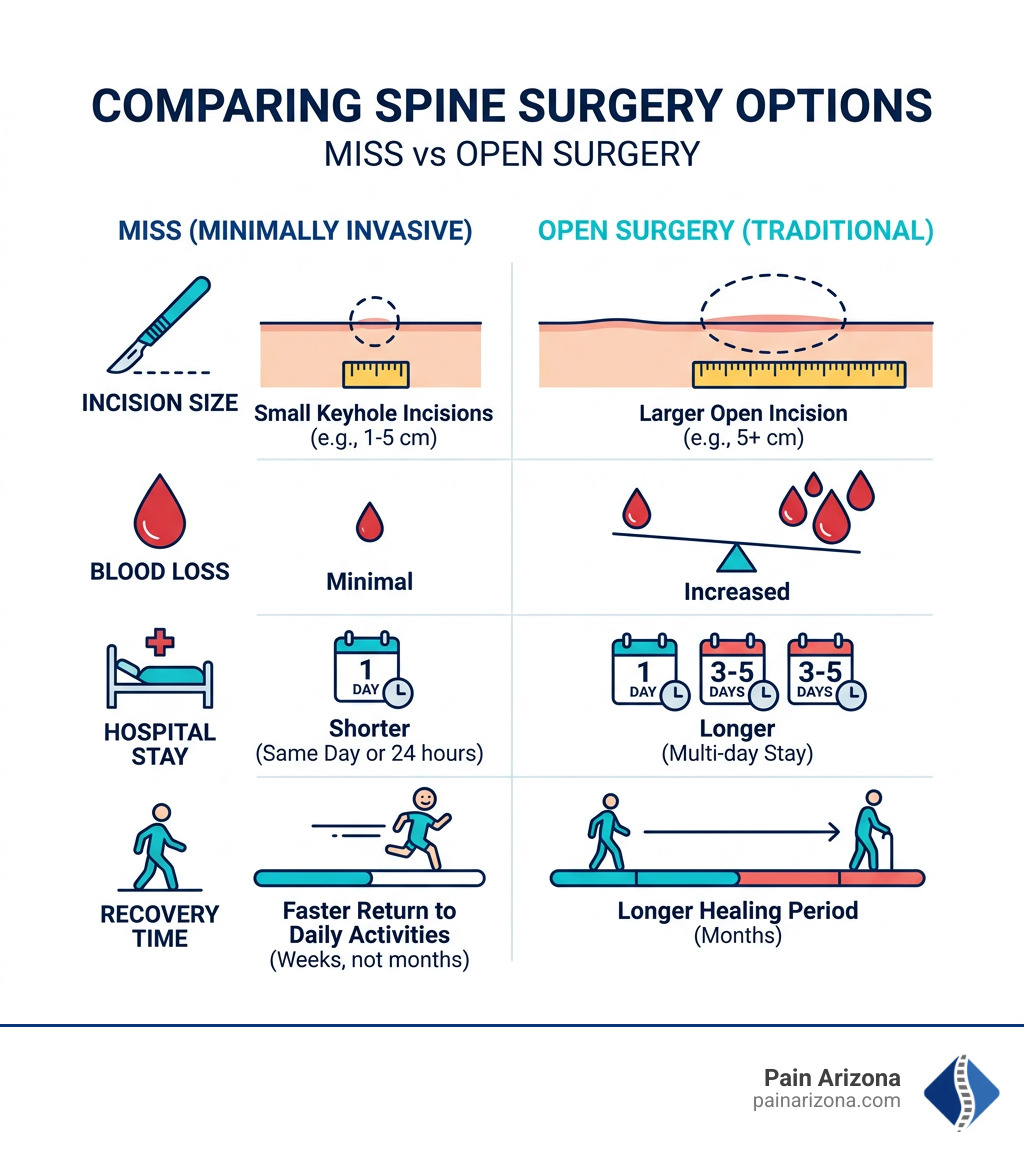
Key Differences: MISS vs. Traditional Open Surgery
The primary difference lies in the “approach.” Think of traditional surgery as taking the roof off a house to fix a leaky pipe. Minimally invasive spine surgery (MISS) is more like using a small camera and a specialized tool to fix that same pipe through a tiny hole in the wall.
| Feature | Minimally Invasive (MISS) | Traditional Open Surgery |
|---|---|---|
| Incision Size | 2–5 cm (often less than 1 inch) | 5–15+ cm |
| Muscle Impact | Muscles are spared/dilated | Muscles are cut or stripped |
| Blood Loss | Minimal | Significant |
| Hospital Stay | Same-day to 1–2 days | 3–7 days |
| Recovery Time | Weeks | Months |
Research shows that MISS results in significantly less postoperative pain and a reduced risk of infection because the internal tissues are less exposed to the environment. In fact, many MISS procedures allow patients to be up and walking within just a few hours of the operation.
Advanced Technologies Used by a Minimally Invasive Spine Doctor
Technology is the backbone of what we do. A qualified minimally invasive spine doctor utilizes a suite of high-tech tools to ensure accuracy without the need for large incisions:
- Intraoperative Radiographs & Fluoroscopy: Real-time X-ray imaging that allows us to see exactly where our instruments are at every second.
- Operating Microscopes & Endoscopes: High-definition cameras that provide a “bird’s eye view” of the nerves and discs through a tiny port.
- Robotic Assistance: Some surgeons use robotic arms to guide the placement of screws or implants with sub-millimeter precision.
- Laser Spine Surgery: While often misunderstood, lasers can be used in specific cases to “de-bulk” a disc or remove scar tissue with extreme heat and precision.
To learn more about how these tools are used in practice, you can explore our overview of Pain Arizona Minimally Invasive Spine Surgery & Endoscopic Spine Procedures.
Conditions Treated with Minimally Invasive Techniques
Many patients are surprised to learn that a minimally invasive spine doctor can treat a wide variety of conditions that were once thought to require “the big surgery.” Because the spine is a delicate stack of bones, discs, and nerves, even a small amount of pressure in the wrong place can cause debilitating pain.
The most common conditions we address include:
- Herniated Discs: When the soft center of a spinal disc pushes through a crack in the tougher exterior, it can pinch nearby nerves. We use microdiscectomy to remove only the part of the disc that is causing the trouble.
- Spinal Stenosis: This is a narrowing of the spaces within your spine, which can put pressure on the nerves. MISS techniques allow us to “decompress” these areas by removing small amounts of bone or thickened ligament.
- Sciatica: Often caused by a herniated disc or stenosis in the lower back, sciatica involves shooting pain down the leg. Relieving the pressure at the source often provides immediate relief.
- Degenerative Disc Disease: As we age, discs can lose their cushioning. A minimally invasive spine doctor can perform fusions or disc replacements to stabilize the spine and reduce pain.
Treating Complex Disorders: Scoliosis and Spondylolisthesis
Even complex deformities like scoliosis (a sideways curve of the spine) or spondylolisthesis (where one vertebra slips forward over another) can sometimes be managed through minimally invasive means. In the past, these required massive incisions and long metal rods. Today, we can often achieve stabilization using smaller “percutaneous” (through the skin) screws and rods.
Whether you are dealing with chronic Back Pain or persistent Neck Pain, the goal is motion preservation. We want to fix the problem while keeping as much of your natural spinal movement as possible. This is especially true for conditions like a Bulging Disc, where early intervention can prevent more serious nerve damage.
Specialized Procedures for Rapid Relief
For patients looking for alternatives to major surgery, we offer several targeted procedures:
- Percutaneous Discectomy: A procedure where a small needle is used to remove disc tissue, reducing pressure on the nerve without a surgical incision.
- Direct Visual Rhizotomy: Using an endoscope to find and deaden the specific tiny nerves causing facet joint pain.
- Kyphoplasty: A “miracle” for many elderly patients with compression fractures from osteoporosis. We use a small balloon to create space in a collapsed vertebra and then fill it with medical-grade cement to stabilize the bone.
- Radiofrequency Neurotomy Ablation: Using heat to “turn off” pain signals from the joints in your back.
How to Choose a Qualified Minimally Invasive Spine Doctor
Choosing your surgeon is the most important decision you will make in your recovery journey. Not all doctors who claim to do “minimally invasive” work have the same level of expertise. In the Phoenix area, we have many options, but you should look for specific markers of quality.
Credentials and Experience to Verify
When you sit down for a consultation, don’t be afraid to ask about their background. A top-tier minimally invasive spine doctor should have:
- Board Certification: They should be certified by the American Board of Orthopaedic Surgery or the American Board of Neurological Surgery.
- Fellowship Training: This is extra, specialized training completed after residency. Look for fellowships specifically in “Spine Surgery” or “Minimally Invasive Spine Surgery.”
- High Surgical Volume: Ask how many of these specific procedures they perform each year. Surgeons who perform a high volume of MISS procedures typically have lower complication rates.
- SMISS Membership: Being part of the Society for Minimally Invasive Spine Surgery shows a commitment to the latest research and techniques.
At Pain Arizona, our Surgery philosophy is built on diagnostic accuracy. We don’t just treat the image on an MRI; we treat the patient. This means we spend time ensuring the pain is actually coming from the spot we intend to fix.
Evaluating a Minimally Invasive Spine Doctor Through Patient Outcomes
Success rates for procedures like lumbar microdiscectomy can be as high as 80-90% for pain relief. However, these numbers only apply to “selected patients”—those who have the right condition and have tried conservative treatments first.
Look for a doctor with high patient satisfaction ratings. For instance, leading surgeons in the field often maintain ratings of 4.7 out of 5 or higher across hundreds of reviews. When reading testimonials, look for mentions of:
- Professionalism and “listening” skills.
- Clear explanations of the risks and benefits.
- Successful returns to daily activities.
- Effective long-term Conditions management.
The Recovery Journey and Post-Operative Care
One of the greatest benefits of working with a minimally invasive spine doctor is the recovery timeline. Because we don’t tear through muscle, your body doesn’t have to spend months knitting soft tissue back together.
Most MISS procedures are now performed on an outpatient basis. This means you can often go home within 23 hours of your surgery. You’ll be encouraged to walk almost immediately to prevent blood clots and help the healing process.
What to Expect During the First 48 Hours
The first two days are about managing discomfort and letting the anesthesia wear off. While MISS is “less” painful than open surgery, it is still surgery. We use a variety of Treatments to keep you comfortable:
- Oral Medications: A combination of anti-inflammatories and short-term pain relief.
- Lumbar Epidural Steroid Injection: Sometimes administered during or shortly after the procedure to reduce local nerve inflammation.
- Nerve Root Block: Can be used if specific nerve irritation persists during the early healing phase.
You will have some activity restrictions—usually no heavy lifting (over 5-10 lbs), no excessive bending, and no twisting (the “BLT” rule).
Long-Term Success and Rehabilitation Protocols
Physical therapy is the “secret sauce” of a successful spine surgery. Most patients start formal PT about 4 to 6 weeks after surgery. The goal is to strengthen your “core”—the muscles that support your spine—so the problem doesn’t return.
To ensure the best results, we recommend:
- Smoking Cessation: Nicotine constricts blood vessels and significantly slows down bone and tissue healing.
- Gradual Activity: Increasing your walking distance every day.
- Core Strengthening: Working with a therapist to stabilize your lower back.
- Follow-up Care: Using treatments like a Facet Joint Injection if minor joint soreness occurs during the “re-entry” to physical activity.
Frequently Asked Questions about Minimally Invasive Spine Surgery
Who is the best candidate for MISS?
The best candidates are those with a clear, “focal” problem—like a single herniated disc or a specific area of stenosis—that hasn’t improved with 6-12 weeks of conservative care (PT, injections, medication). Patients should be in relatively good health, though MISS is often safer for elderly patients than open surgery because it’s less taxing on the heart and lungs.
What are the potential risks and complications?
No surgery is without risk. While the risks are lower than open surgery, they still include:
- Infection (though the rate is significantly lower in MISS).
- Nerve damage or persistent pain.
- Spinal fluid leak.
- The rare need to “convert” to an open surgery if the doctor finds they cannot safely complete the procedure through the small incision.
How much does minimally invasive spine surgery cost?
The cost varies based on the complexity of the procedure and the facility used. Because MISS often avoids long hospital stays, it can be more cost-effective than traditional surgery. We accept most insurance plans. Check with our office manager to see if your plan is accepted. We also offer options for those who may be self-paying.
Conclusion
At Pain Arizona, we believe that you shouldn’t have to choose between living in pain and undergoing a traumatic, “old-school” surgery. Our team of double board-certified experts in the Greater Phoenix Area is dedicated to providing compassionate, evidence-based care that prioritizes your long-term health.
Whether you are in Mesa, Gilbert, Scottsdale, or Glendale, we are here to help you navigate your options. From advanced diagnostics to the latest keyhole techniques, we focus on the root cause of your pain to get you back to the life you love.
If you’re ready to stop managing your pain and start treating it, schedule a consultation for minimally invasive spine surgery with us today. Let’s see if a minimally invasive spine doctor is the right next step for your journey.