
A Practical Guide to Lumbar Epidural Injections
When Your Back Pain Won’t Quit: What to Know About Lumbar Epidural Injections
Lumbar epidural injections are shots of anti-inflammatory steroid medicine delivered directly into the epidural space — the area just outside the fluid sac surrounding your spinal cord in the lower back. They are used to relieve nerve-related pain that radiates from your low back into your hips or legs.
Here’s what you need to know at a glance:
| Question | Quick Answer |
|---|---|
| What is it? | A steroid injection into the epidural space of the lower spine |
| What does it treat? | Sciatica, herniated disc, spinal stenosis, nerve root inflammation |
| How long does relief last? | Weeks to months; up to 6–12 months in some cases |
| How often can you get it? | Typically 2–3 times per year |
| Is it painful? | Most patients feel only minor discomfort from local anesthetic |
| Does it require surgery? | No — it is a minimally invasive, outpatient procedure |
Chronic low back pain is one of the most common reasons people seek medical care in the United States. For many people in the Greater Phoenix Area, the pain doesn’t just stay in the back — it travels down the leg, disrupts sleep, and makes everyday activities feel impossible. When medications and physical therapy haven’t helped enough, epidural injections lumbar procedures offer a targeted, non-surgical path toward relief.
Studies show that up to 70% of patients with nerve-related low back pain from a disc herniation feel at least 50% better within one to two months of receiving a lumbar epidural steroid injection. That’s a meaningful number for anyone who has been stuck in a cycle of ineffective treatments.
I’m Dr. Nasser — a double board-certified PM&R and pain medicine physician with extensive experience performing fluoroscopy-guided epidural injections lumbar procedures for patients with complex spinal conditions. In this guide, I’ll walk you through everything you need to know, from how the procedure works to what recovery looks like.
Understanding Epidural Injections Lumbar
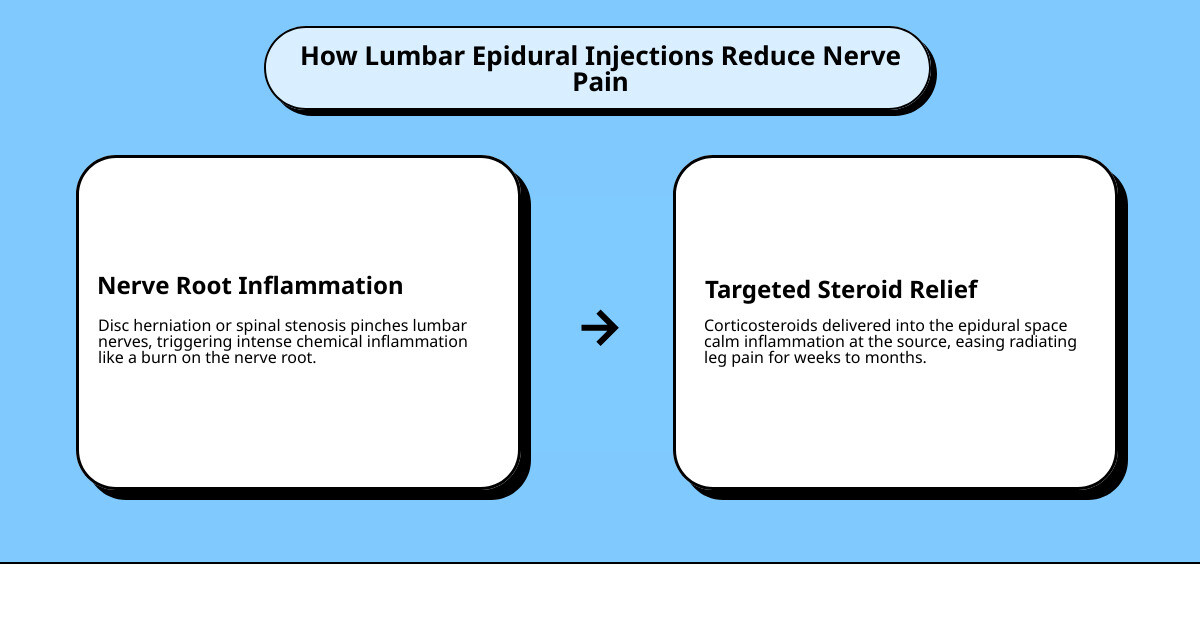
To understand how epidural injections lumbar work, we first have to look at the anatomy of your “low back” or lumbar spine. Your spinal cord ends at roughly the L1 or L2 level, and below that, a bundle of nerve roots continues down. These nerves pass through the epidural space—a small gap between the protective sac of the spinal cord (the dura mater) and the bony walls of the vertebrae.
When a disc herniates or the spinal canal narrows, these nerves get squeezed or “pinched.” This mechanical pressure triggers a massive inflammatory response. Think of it like a chemical burn on the nerve. The Lumbar Epidural Steroid Injections: What It Is, Benefits, Risks & Side Effects guide explains that the primary goal is to deliver a potent dose of anti-inflammatory medication (corticosteroids) directly to that inflamed site.
By bathing the irritated nerve in steroids, we reduce the swelling and “flush out” the inflammatory chemicals. This helps break the pain cycle. Unlike oral medications that have to travel through your entire digestive system and bloodstream, these injections are a form of precision medicine. You can learn more about how this differs from other shots in our article on Demystifying Cortisone Injections Pain Relief or Potential Pitfalls.
Who is a Candidate for Epidural Injections Lumbar?
We typically recommend epidural injections lumbar for patients experiencing “radiculopathy”—pain that travels from the back down into the leg, often referred to as sciatica. Common conditions we treat include:
- Herniated Discs: When the soft center of a spinal disc leaks out and irritates a nearby nerve.
- Spinal Stenosis: A narrowing of the spaces within your spine, which can put pressure on the nerves.
- Degenerative Disc Disease: The natural wear and tear of spinal discs that leads to inflammation.
- Spondylolisthesis: When one vertebra slips forward over another, pinching nerve roots.
If you’ve been struggling with these symptoms, you can read more about Injections for Sciatica and how they fit into a broader plan, including Everything You Need to Know About Joint Injections.
Diagnostic Benefits of the Procedure
One “secret” benefit of these injections is that they are also diagnostic. During the procedure, we often mix the steroid with a local anesthetic (numbing medicine). If your leg pain disappears instantly for a few hours while the numbing agent is active, it confirms that we have found the exact nerve root causing your trouble. This “test run” is invaluable for planning future treatments or, if necessary, surgical interventions. For a deeper look at how we isolate specific nerves, check out The Nerve of It A Deep Dive into Nerve Block Injections.
Procedural Approaches: Interlaminar, Transforaminal, and Caudal
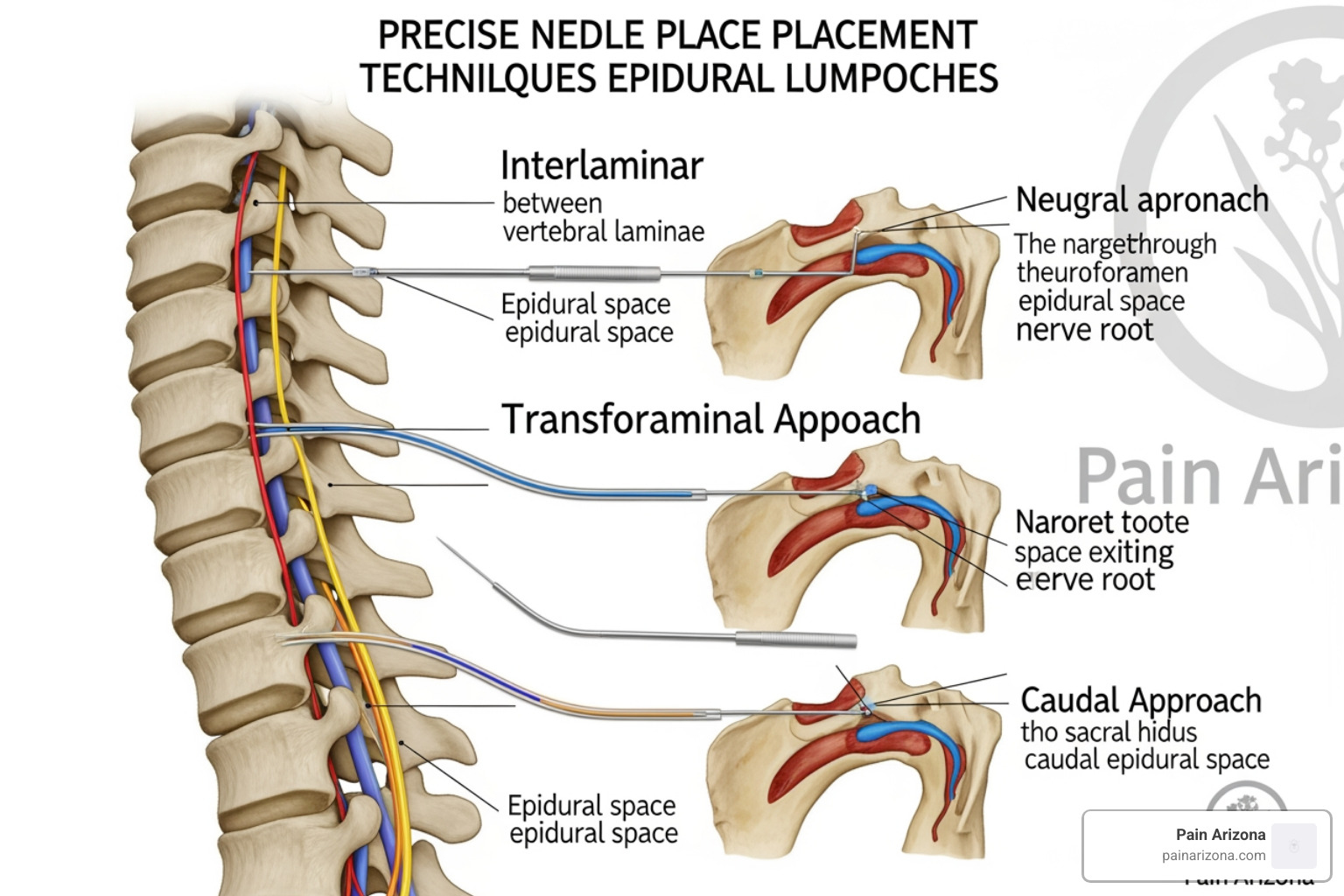
Not all epidural injections lumbar are performed the same way. Depending on your specific anatomy and where the pain is coming from, we choose one of three main “routes” to reach the epidural space.
Comparing Techniques for Epidural Injections Lumbar
- Interlaminar Approach: The needle enters from the back of the spine, between the “laminae” (the bony plates of the vertebrae). This is the most traditional method and is great for delivering medication over a wide area, which is helpful if you have pain on both sides or multi-level issues.
- Transforaminal Approach: Often called a “root block,” the needle enters from the side of the spine into the “foramen” (the opening where the nerve exits). This allows us to target a specific nerve root very precisely. Research suggests this approach may offer better “ventral spread”—meaning the medicine gets to the front of the nerve where the disc herniation usually is. You can find more details on our Transforaminal Epidural Injection page.
- Caudal Approach: The needle enters through the sacral hiatus, a small opening near your tailbone. This is often the safest route if you have had previous back surgery (Failed Back Surgery Syndrome) where scar tissue might make the other approaches difficult.
| Feature | Interlaminar | Transforaminal | Caudal |
|---|---|---|---|
| Entry Point | Between vertebrae | Side (nerve exit) | Tailbone area |
| Best For | Multi-level pain | Single nerve root | Post-surgery/scarring |
| Spread | Broad | Targeted/Ventral | Lower sacral nerves |
The Role of Image Guidance
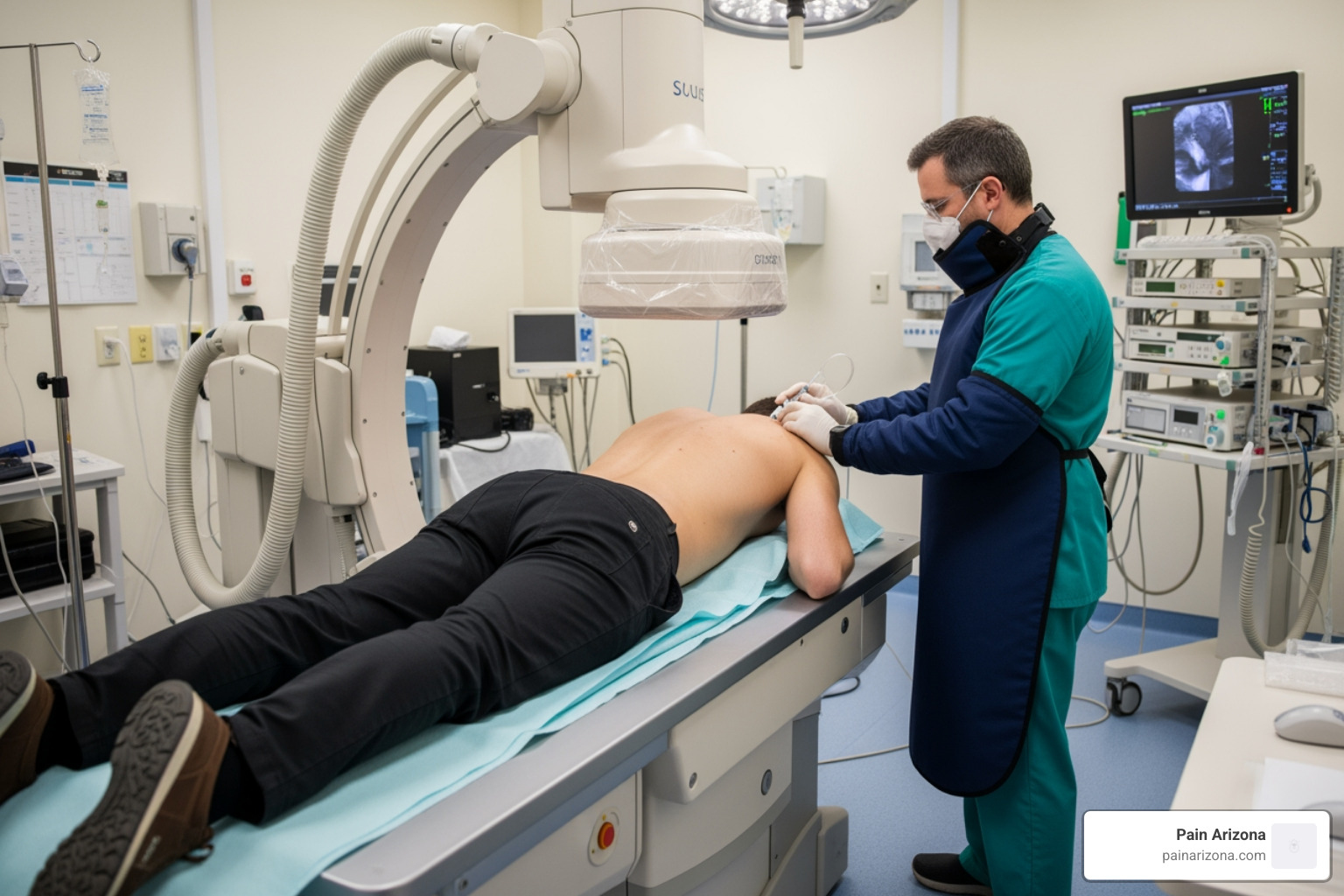
In May 2026, the standard of care for any epidural injections lumbar is the use of fluoroscopy (real-time X-ray). We never “guess” where the needle is going. By using fluoroscopic guidance and a small amount of contrast dye, we can see exactly where the medication will flow before we ever inject the steroid. This ensures maximum safety and ensures the medicine reaches the “target zone.” This level of precision is highlighted in the ASIPP Guidelines as essential for minimizing risks like intravascular injection.
Effectiveness and Recovery Expectations
How well do these injections actually work? According to StatPearls, for patients with radicular pain from a disc herniation, up to 70% experience significant relief. While the relief isn’t always permanent, it often lasts between three to six months, and in some lucky cases, up to a full year.
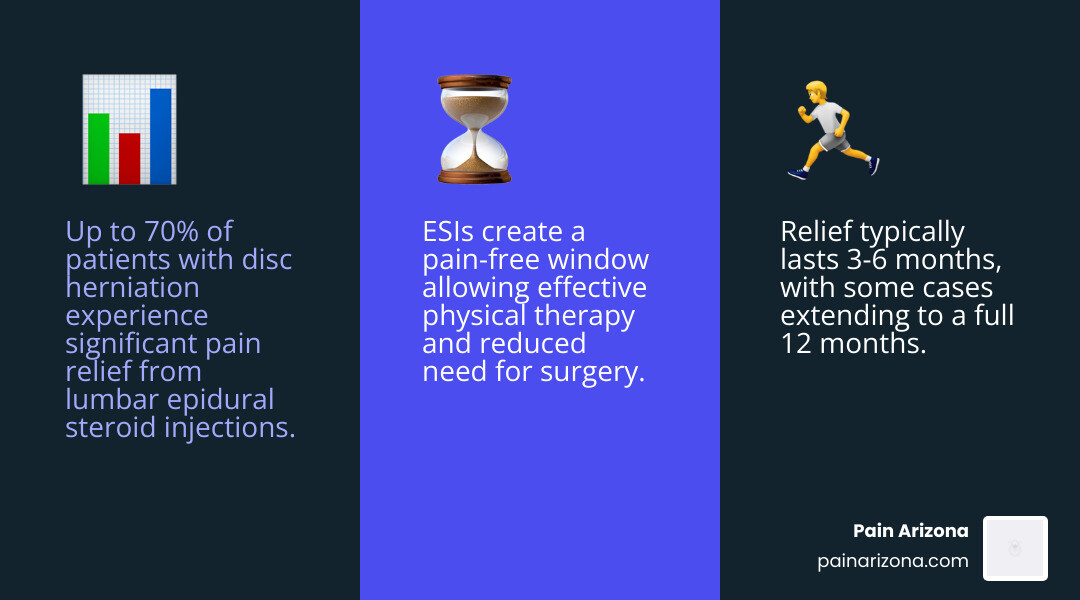
It’s important to manage expectations: an ESI is rarely a “one-and-done” cure for the underlying structural issue (like a herniated disc), but it provides a vital “window of opportunity” for you to engage in physical therapy without being in agony. This is why many patients find that Joint Injections in Phoenix Are the Real Deal for Relief.
Post-Procedure Care and Aftercare
The recovery process is generally very straightforward. Most patients spend 15 to 20 minutes in our observation area before being cleared to go home.
- The First 24 Hours: You should rest and avoid strenuous activity. You can shower, but we usually recommend avoiding baths or hot tubs for 24 hours to prevent infection at the injection site.
- Soreness: It is normal to feel a bit of a “pinch” or pressure at the site. You can use an ice pack for 10-20 minutes at a time to soothe the area.
- The “Steroid Flare”: Sometimes, your pain might actually feel slightly worse for 2-3 days before the steroid kicks in. Don’t panic! This is normal. The full benefits usually appear within 3 to 5 days.
- Activity: Listen to your body. If you feel great, don’t immediately go out and run a marathon. Gradually return to your normal routine as instructed.
For more tips on managing the days following your shot, see our guide on Navigating SI Joint Injections.
Long-term Outcomes and Physical Therapy
The most successful patients are those who use the pain relief from epidural injections lumbar to jump-start their rehabilitation. While a Randomized Trial for Spinal Stenosis showed that steroids might provide more modest benefits for stenosis than for herniated discs, the goal remains the same: restore mobility and delay or eliminate the need for surgery. Approximately 14% of patients with radiculopathy eventually require surgery, but ESIs help the other 86% manage their symptoms conservatively.
Safety, Risks, and Preparation
While epidural injections lumbar are considered very safe, no medical procedure is without risk. We take every precaution to ensure your safety.
Preparing for Your Procedure
Preparation is key to a smooth experience. Before your appointment at one of our Phoenix-area clinics:
- Imaging: We will need a recent MRI or CT scan to visualize your pathology.
- Medications: You may need to temporarily stop blood thinners (like aspirin, warfarin, or clopidogrel) for several days. We will provide specific instructions based on your medication.
- Fasting: Depending on whether you choose to have mild sedation, you may be asked not to eat or drink for a few hours before the procedure.
- Transportation: You must have someone to drive you home. Even without sedation, the local anesthetic can cause temporary leg “heaviness,” making it unsafe to drive.
For a comprehensive checklist, see Unlocking Relief Everything You Need to Know About SI Joint Injections.
Understanding Potential Side Effects
Most side effects are mild and temporary. These can include:
- Nausea or Dizziness: Usually resolves quickly after the procedure.
- Headache: In rare cases (less than 1%), the needle can puncture the dural sac, causing a “spinal headache.” This is treatable but requires us to know right away.
- Steroid Effects: Some patients experience a “flushing” sensation, temporary sleep disruption, or a brief rise in blood sugar (important for our diabetic patients to monitor).
- Leg Heaviness: The numbing medicine can make your legs feel like lead for a few hours. This is why we insist on a driver!
You can read more about corticosteroid specifics in our Cortisone vs Corticosteroids comparison.
Frequently Asked Questions about Lumbar Epidural Injections
How often can I safely receive these injections?
Most providers, including us here at Pain Arizona, limit epidural injections lumbar to two or three times per year. While the steroids are effective, repeated use in the same area can potentially weaken local tissues or bone (osteoporosis) over a long period. We aim for the “minimum effective dose” to keep you moving safely.
How long does the pain relief typically last?
Relief is highly variable. For some, it lasts 3 months; for others, the inflammation is knocked down permanently. In many cases of acute disc herniation, one or two injections provide enough relief for the disc to heal naturally over 4 to 6 months.
Is the procedure painful?
We use a very fine needle to numb the skin first. Most patients describe the actual epidural as a sensation of “pressure” or a “deep ache” rather than sharp pain. If you are particularly anxious, we can discuss mild sedation options to make the experience more comfortable.
Conclusion
If you are living in Mesa, Gilbert, Scottsdale, or anywhere in the Greater Phoenix Area and chronic back pain is stealing your quality of life, you don’t have to suffer in silence. At Pain Arizona, our double board-certified physicians specialize in evidence-based, minimally invasive treatments designed to get you back to the activities you love.
Epidural injections lumbar are a powerful tool in our arsenal, offering a safe and effective way to manage radicular pain without jumping straight to surgery. We accept most insurance plans—simply check with our office manager to see if your plan is accepted.
Ready to take the first step toward relief? Schedule a consultation for lumbar epidural steroid injections with our team today. Let’s work together to find the root cause of your pain and get you moving again.