
Headache Behind the Left Eye Explained and How to Treat It
What Frequent Headaches Behind the Left Eye Can Mean
Frequent headaches behind the left eye are often caused by migraine, tension-related muscle strain, eye strain, sinus inflammation, or, less commonly, cluster headache. The pattern matters: throbbing pain with nausea or light sensitivity often points to migraine; short, extreme attacks with tearing or a stuffy nostril on the same side can suggest cluster headache; and pain tied to screen use, posture, or neck stiffness may involve eye strain or the neck.
Do not assume it is “just a sinus headache.” Many headaches felt behind one eye are migraines. Seek emergency care now for a sudden worst-ever headache, new vision loss or double vision, a red painful eye, weakness, confusion, fever with a stiff neck, or headache after a significant injury.
Because several nerves, muscles, sinuses, and eye structures can refer pain to the same small area, a repeat pattern deserves a careful diagnosis, especially when over-the-counter medicine is no longer helping.
I’m Dr. Nasser, a double board-certified pain medicine and PM&R physician with experience evaluating complex nerve, neck, and musculoskeletal pain that can contribute to frequent headaches behind left eye. In the sections ahead, I will explain how to recognize the likely cause, identify urgent warning signs, and discuss evidence-based treatment options.
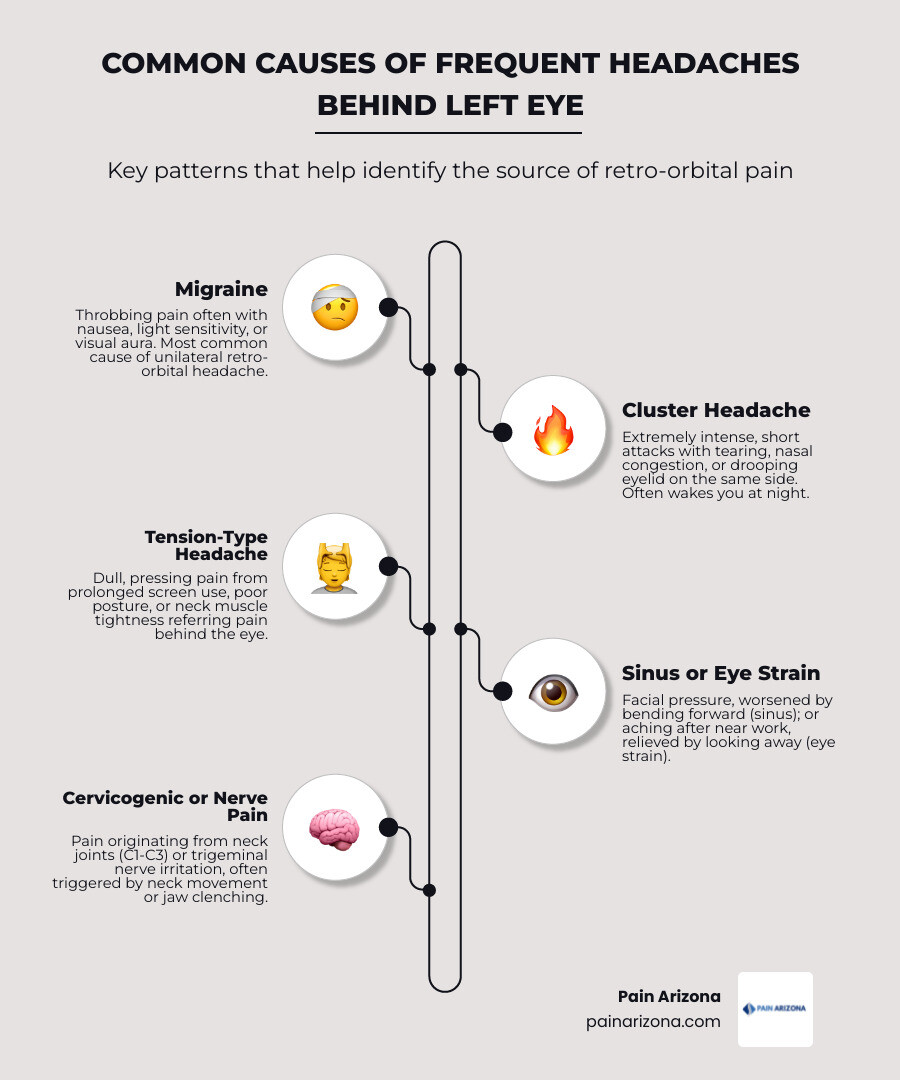
Common Causes of Frequent Headaches Behind Left Eye
When pain strikes specifically in the retro-orbital region (the space directly behind your eye socket), it can feel like someone is inflating a balloon inside your skull. The reason this area is such a frequent target comes down to neuroanatomy.
The ophthalmic branch ($V_1$) of the trigeminal nerve supplies sensation to your forehead, eye socket, and the membranes covering the front of the brain. When these neural pathways experience irritation, they release inflammatory neuropeptides—such as Calcitonin Gene-Related Peptide (CGRP) and Substance P. This cascade causes local neurogenic inflammation and blood vessel dilation, transmitting intense pain signals directly behind the orbit.
To help you understand what might be happening, let’s look at how the primary types of headaches present in this region:
| Headache Type | Pain Quality & Location | Duration | Accompanying Symptoms |
|---|---|---|---|
| Migraine | Throbbing, pulsating; strictly unilateral (one-sided) in over 80% of cases | 4 to 72 hours | Nausea, vomiting, photophobia (light sensitivity), phonophobia (sound sensitivity), visual aura |
| Cluster Headache | Piercing, burning, “hot poker” or “ice-pick” sensation centered behind one eye | 15 to 180 minutes | Tearing (lacrimation), eyelid drooping (ptosis), nasal congestion, restlessness/pacing |
| Tension-Type Headache | Dull, aching, constant band-like tightness around the forehead and temples | 30 minutes to several days | Mild scalp tenderness, tight neck and shoulder muscles, lack of autonomic or gastrointestinal symptoms |
| Sinus Infection (Sinusitis) | Deep, heavy, throbbing facial pressure over cheeks, brow, and behind the eyes | Days to weeks | Thick discolored nasal drainage, facial fullness that worsens when bending forward, fever |
| Cervicogenic Headache | Dull ache beginning in the neck/suboccipital region and radiating forward to the eye | Variable; often continuous or fluctuating | Reduced neck range of motion, trigger points in upper cervical spine, pain triggered by neck posture |
A comprehensive medical overview of pain behind the eye shows that while primary headache disorders represent the majority of cases, structural neck conditions and nerve compressions frequently play an overlooked role.
Primary Headache Syndromes and Frequent Headaches Behind Left Eye
Primary headache disorders are conditions where the headache itself is the primary issue, rather than a symptom of an underlying disease.
Migraine With and Without Aura
Migraines affect roughly 12% of the population, impacting women nearly three times as often as men due to hormonal fluctuations. When a migraine activates the left trigeminal nerve pathway, it causes moderate to severe throbbing pain behind that eye. In about one-third of migraine sufferers, the episode is preceded by an “aura”—a neurological phenomenon characterized by shimmering lights, blind spots, or zig-zag patterns across the visual field. If you are struggling with debilitating episodes, exploring comprehensive migraine treatment in Phoenix can help identify your specific neurovascular triggers and provide lasting relief.
Cluster Headaches (Trigeminal Autonomic Cephalalgias)
Though far less common—affecting roughly 0.1% of people—cluster headaches are among the most severe pain syndromes known to medicine. Often termed “suicide headaches” due to their sheer intensity, they primarily affect individuals between ages 20 and 50 and are three times more common in men.
According to clinical research on cluster headache symptoms, these attacks occur in cyclical bouts (cluster periods) lasting weeks to months. The pain arrives abruptly, creating an excruciating stabbing sensation behind one eye. Hallmark autonomic signs on the affected side include:
- Profuse eye tearing (lacrimation)
- Eye redness (conjunctival injection)
- Eyelid drooping (ptosis) and pupil constriction (miosis)
- Runny or blocked nostril (rhinorrhea)
- Agitation and an inability to sit still during the attack
Hemicrania Continua
This is a rare, continuous, strictly one-sided headache that never switches sides. It varies in intensity but remains constantly present behind the eye and temple, occasionally flaring with autonomic symptoms like tearing and nasal congestion. It is unique because it responds completely to a specific prescription NSAID called indomethacin.
Cervical, Nerve, and Musculoskeletal Culprits
Your neck and jaw share intricate nerve pathways with your face and eyes. Irritation in the upper spine can easily refer pain forward into the retro-orbital space.
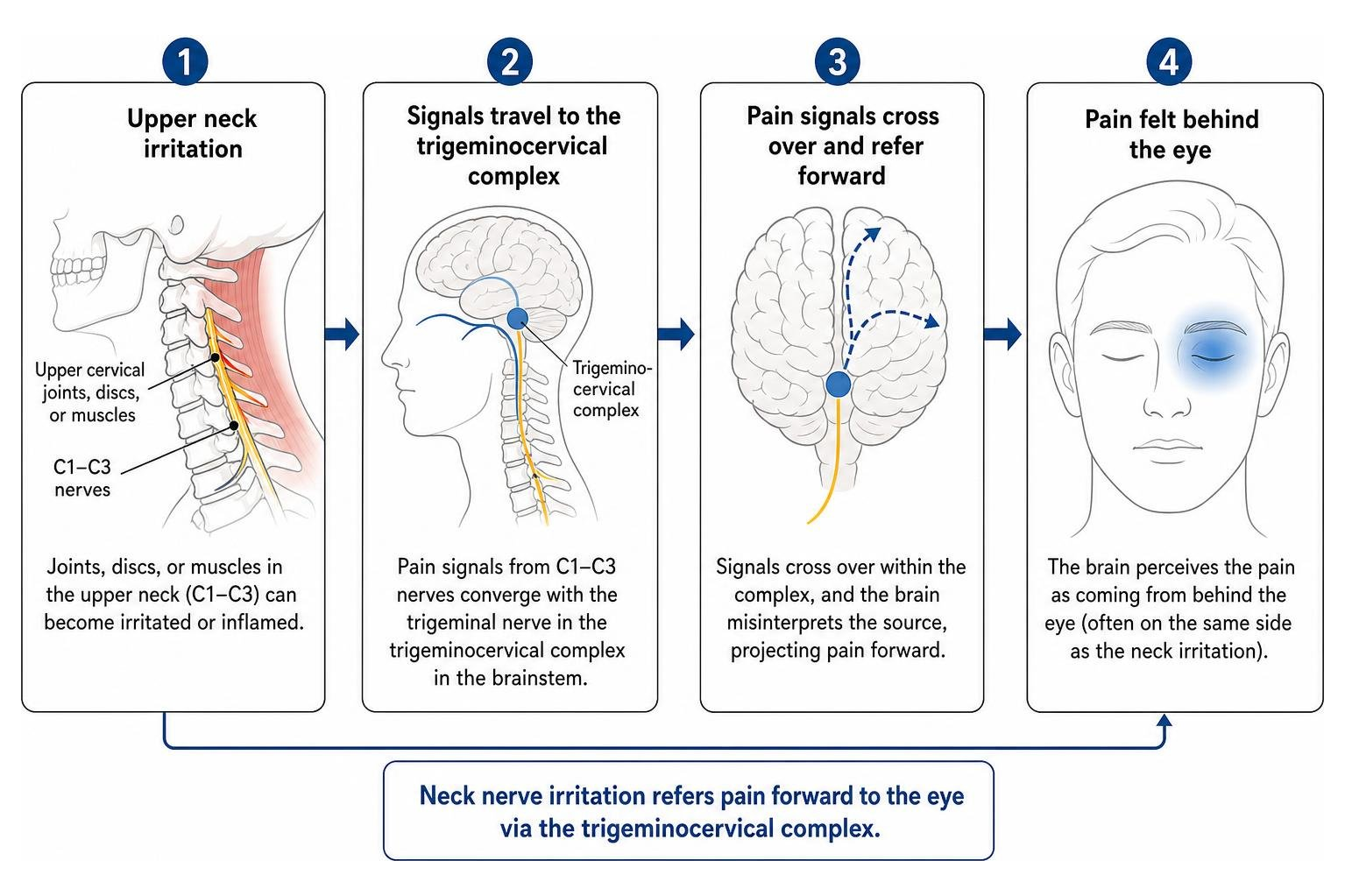
Cervicogenic Headaches
The upper three cervical spinal nerves ($C1, C2, C_3$) converge with the trigeminal nerve inside the brainstem at an anatomical junction called the trigeminocervical complex. When joints, discs, or muscles in the upper neck become inflamed, pain signals cross over, causing your brain to perceive the pain as coming from behind your left eye. Patients dealing with chronic neck pain in Chandler often find their persistent eye aches improve dramatically once their cervical alignment and muscle tension are addressed.
Nerve Compression and Spinal Trauma
Cervical spine injuries can irritate exiting nerve roots. Individuals undergoing targeted cervical radiculitis management often report a reduction in referred cranial and retro-orbital aching. Similarly, acceleration-deceleration injuries disrupt the deep stabilizing muscles of the cervical spine; obtaining specialized treatment for whiplash is crucial to preventing long-term cervicogenic pain loops that project forward to the orbit.
Temporomandibular Joint (TMJ) Dysfunction
The muscles controlling your jaw share branches of the trigeminal nerve ($V_3$). Chronic clenching, teeth grinding (bruxism), or jaw misalignment can cause muscle spasms that radiate pain upward through the temple and deep behind the eye socket. Securing comprehensive TMJ dysfunction relief can remove this continuous muscular trigger.
Ocular, Sinus, and Secondary Conditions
Outside of primary headaches and spinal issues, localized structures within the head and face can cause significant eye-area discomfort.
Digital Eye Strain and Refractive Errors
In our modern screen-heavy environment, spending hours focusing on digital displays forces the ciliary muscles inside the eye to remain constantly contracted. Uncorrected astigmatism, farsightedness, or improper prescription lenses amplify this strain, creating a dull, persistent ache behind the eyes. A detailed guide to eye-related headache types emphasizes that while digital strain causes fatigue and dull aching, it rarely produces the severe, throbbing pain of a primary neurovascular headache.
True Sinus Infections (Sinusitis)
The sphenoid and ethmoid sinuses sit deep behind the nasal cavity and eye sockets. When infected, fluid accumulation creates significant retro-orbital pressure. However, true sinusitis is almost always accompanied by thick green or yellow nasal discharge, reduced sense of smell, facial tenderness, and fever. Over 80% of self-diagnosed “sinus headaches” without nasal infection symptoms are actually migraines.
Optic Neuritis and Trigeminal Neuralgia
Optic neuritis is an inflammation of the optic nerve often associated with demyelinating conditions such as multiple sclerosis. It produces deep retro-orbital pain that characteristically worsens with eye movement and is accompanied by blurred vision or reduced color perception.
Meanwhile, neuropathic conditions like trigeminal neuralgia cause sudden, severe, electric-shock-like jolts across the facial branches of the fifth cranial nerve. Patients seeking targeted trigeminal neuralgia therapy can find relief through minimally invasive nerve blocks and neuro-modulating protocols designed to calm these hyperactive signals.
Understanding the root cause is critical, as explained in this clinical discussion of causes of ocular pressure.
Identifying Warning Signs and Critical Red Flags
While most headaches behind the left eye are manageable primary disorders or musculoskeletal issues, certain symptoms indicate a medical emergency requiring immediate evaluation.

Seek emergency care or go to the nearest emergency department if you experience any of the following “red flag” symptoms:
- Thunderclap Onset: A blinding, excruciating headache that peaks to 10/10 severity within 60 seconds (often described as the “worst headache of your life”). This can indicate a subarachnoid hemorrhage from a ruptured cerebral aneurysm.
- Acute Angle-Closure Glaucoma: Severe pain behind or in the eye accompanied by a red eye, cloudy cornea, fixed dilated or mid-dilated pupil, seeing rainbow halos around lights, nausea, and rapid vision loss.
- Giant Cell Arteritis (Temporal Arteritis): Typically seen in individuals over 50, causing severe temple or eye pain, scalp tenderness when brushing hair, jaw pain while chewing (jaw claudication), and sudden vision loss.
- Neurological Deficits: Sudden weakness, facial droop, numbness, slurred speech, confusion, loss of balance, or difficulty walking.
- Systemic Signs: High fever, stiff neck (inability to touch chin to chest), altered mental state, or a new headache pattern if you have a history of cancer or immunosuppression.
Diagnosis and Comprehensive Treatment Strategies
Finding lasting relief starts with an accurate diagnosis. Because overlapping nerve pathways can confuse where the pain originates, self-treatment often leads to frustration.
A thorough evaluation typically involves:
- Clinical and Neurological History: Tracking attack frequency, duration, pain quality, visual symptoms, and daily triggers.
- Diagnostic Imaging: Brain MRI or CT scans to rule out secondary causes, vascular anomalies, or sinus disease. High-resolution magnetic resonance angiography (MRA) can evaluate cranial blood vessels.
- Diagnostic Nerve Blocks: Administering a local anesthetic near the greater occipital nerve or sphenopalatine ganglion can confirm if specific nerve pathways are driving your pain.
At Pain Arizona, our double board-certified physicians specialize in uncovering the root cause of complex cranial, facial, and neck pain. If standard treatments have fallen short, our dedicated team offering specialized migraine care in Mesa can build a tailored, minimally invasive treatment plan suited to your specific biology.
Clinical Treatments for Frequent Headaches Behind Left Eye
Modern medicine provides exceptional options for both stopping acute attacks and preventing future episodes:
- CGRP Antagonists: Advanced medications (such as monoclonal antibodies like galcanezumab or oral gepants like rimegepant) specifically target and block the CGRP neuropeptide, turning down the neurogenic inflammatory cascade.
- 100% High-Flow Oxygen Therapy: The gold-standard acute abortive treatment for cluster headaches. Inhaling 100% pure oxygen at 12–15 liters per minute through a non-rebreather mask induces rapid intracranial vasoconstriction, aborting attacks within 15 minutes.
- Subcutaneous Triptans: Fast-acting abortive medications that constrict dilated cranial blood vessels and block pain transmission in acute migraine and cluster attacks.
- Sphenopalatine Ganglion (SPG) Blocks: A minimally invasive procedure delivering numbing medication to a key nerve bundle located deep in the nasal cavity, providing rapid relief for refractory migraines, cluster attacks, and facial pain.
- Occipital Nerve Blocks: Targeted injections around the greater and lesser occipital nerves at the base of the skull to disrupt cervicogenic pain signals radiating to the orbit.
- Botulinum Toxin Therapy (Botox): FDA-approved for chronic migraines (15 or more headache days per month). Injections around specific cranial and cervical muscle groups block neurotransmitter release, significantly reducing headache frequency.
At-Home Remedies and Daily Prevention
While clinical therapies address the underlying neurobiology, everyday preventive habits help keep headache triggers below your pain threshold:
- Follow the 20-20-20 Rule: To combat digital eye strain, every 20 minutes, look at an object at least 20 feet away for at least 20 seconds. This allows your ciliary muscles to relax.
- Use FL-41 Tinted Lenses: If you suffer from photophobia, precision-tinted FL-41 lenses filter out specific blue-green light wavelengths emitted by screens and fluorescent lighting that aggravate the trigeminal system.
- Apply Temperature Therapy: Place a cold gel compress over your left eye and forehead to constrict dilated blood vessels during a vascular migraine. For tension-related or neck pain, use a warm heating pad across your neck and shoulders to release muscle spasms.
- Maintain Sleep and Meal Regularity: Irregular sleep schedules, skipped meals, and dehydration are potent triggers. Aim for 7–8 hours of consistent sleep and drink plenty of water throughout the day.
- Avoid Medication Overuse: Taking over-the-counter pain relievers (like ibuprofen, acetaminophen, or combination pills containing caffeine) more than 10–15 days per month can cause medication overuse headaches (rebound headaches), worsening your overall frequency.
Frequently Asked Questions About Retro-Orbital Headaches
How can I tell if my left-eye headache is a migraine or a sinus issue?
The key differences lie in accompanying symptoms and nasal discharge:
- Migraines cause throbbing, pulsating unilateral pain, accompanied by nausea, vomiting, and sensitivity to light and sound. Nasal drainage, if present, is clear and watery.
- Sinus Infections produce dull, heavy, aching pressure across the cheeks, brow, and between the eyes. Pain intensifies when bending forward and is accompanied by thick green or yellow nasal discharge, nasal congestion, facial tenderness, and often a low-grade fever. Gastrointestinal symptoms like nausea are absent.
Can neck problems cause sharp pain behind the left eye?
Yes. Due to the convergence of the upper cervical nerve roots ($C1-C3$) with the trigeminal nerve at the trigeminocervical complex in the brainstem, inflammation or muscle spasms in the upper neck regularly project pain forward into the forehead and retro-orbital area. Suboccipital muscle tightness, facet joint arthritis, poor desk posture, and cervical disc herniations are frequent causes of chronic, one-sided eye pain.
When should I seek immediate emergency care for left-eye pain?
You should seek emergency medical care immediately if the headache arrives suddenly with explosive intensity (“thunderclap”), or if it is accompanied by fever, neck stiffness, confusion, motor weakness, numbness, difficulty speaking, sudden vision loss, or a red, hazy eye with a fixed, dilated pupil.
Conclusion
Frequent headaches behind your left eye should never be ignored or accepted as a normal part of life. Whether your pain stems from migraines, cluster cycles, digital eye strain, or referred tension from the cervical spine, an accurate differential diagnosis is the essential first step toward reclaiming your quality of life.
At Pain Arizona, our double board-certified physicians provide compassionate, evidence-based care tailored to your unique condition. We focus on identifying and treating the true source of your pain using advanced, minimally invasive interventions. We accept most insurance plans; check with our office manager to see if your plan is accepted.
If you are ready to find lasting relief, start by unmasking the causes of left side pain and headache and schedule a comprehensive evaluation with our medical team today across our Greater Phoenix locations, including Phoenix, Mesa, Gilbert, Scottsdale, and Glendale.