
TMJ Phoenix AZ: Why Your Jaw is Clicking and How to Fix It
Why Your Jaw Pain Shouldn’t Be Ignored
TMJ pain Phoenix residents experience ranges from mild clicking to debilitating jaw dysfunction that affects eating, speaking, and sleep. If your jaw pops when you chew, locks open or closed, or causes chronic headaches, you’re dealing with temporomandibular joint disorder (TMD)—and you’re not alone.
Quick answer for TMJ pain in Phoenix:
- What it is: Inflammation or dysfunction of the jaw joint (TMJ) and surrounding muscles
- Common symptoms: Jaw clicking, popping, locking, facial pain, headaches, ear pain, limited mouth opening
- Main causes: Teeth grinding (bruxism), stress, jaw injury, arthritis, misalignment
- Treatment options: Custom nightguards, Botox injections, physical therapy, lifestyle changes, advanced diagnostics
- When to see a specialist: If pain persists beyond 2 weeks, limits daily activities, or causes chronic headaches
More than 10 million Americans suffer from TMD at any given time, with 90 percent of those seeking treatment being women between ages 30 and 50. The condition stems from micro or macro injuries to the joint, repetitive stress from grinding or clenching, or structural issues that put excessive strain on the jaw.
Many Phoenix residents live with TMJ pain for years, trying over-the-counter remedies or ignoring symptoms until they become severe. The problem is that untreated TMD often worsens over time, leading to more serious complications like permanent joint damage, chronic migraines, and sleep disorders.
I’m Dr. Nasser, Chief Medical Officer at Pain Arizona, and I’ve spent my career helping patients understand the root causes of complex pain conditions including TMJ pain Phoenix patients experience daily. Our multidisciplinary team uses advanced diagnostics and minimally invasive treatments to address jaw dysfunction at its source, not just mask symptoms.
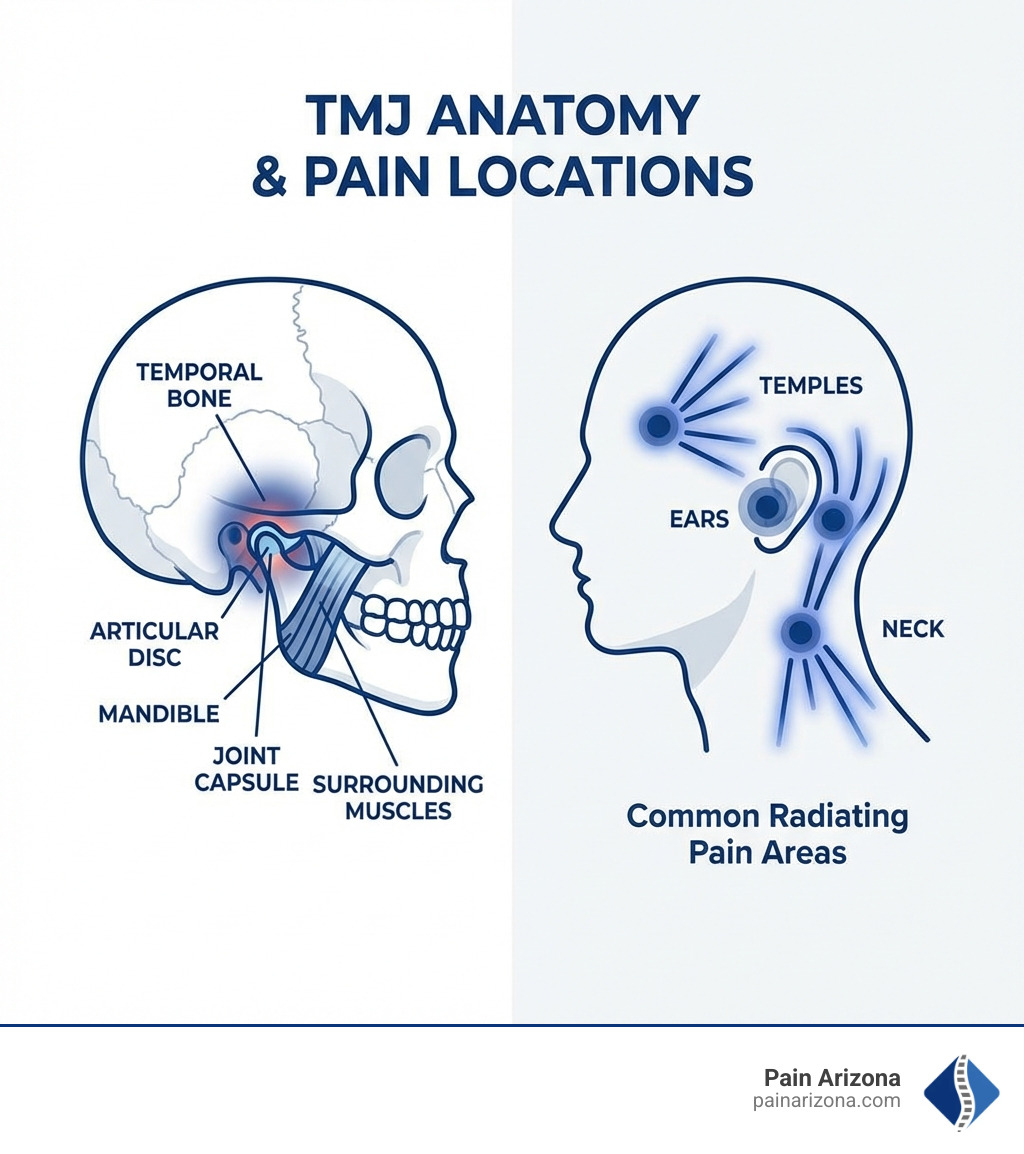
Quick look at TMJ pain phoenix:
Understanding TMJ Pain in Phoenix: What is TMD?
To understand why your jaw is acting up, we first have to look at the anatomy. The temporomandibular joint (TMJ) is one of the most complex joints in your body. It acts like a sliding hinge, connecting your lower jaw (the mandible) to the temporal bone of your skull. You have one on each side of your face, right in front of your ears.
When these joints and the attached muscles are working correctly, you can chew, talk, and yawn without a second thought. However, when the joint becomes inflamed, the disc slips out of place, or the muscles become overly tight, we call this Temporomandibular Joint Disorder (TMD).
In the Greater Phoenix Area, we see a high volume of patients who confuse TMD with simple earaches or dental issues. Because the joint is so close to the ear canal, inflammation here often mimics other conditions. This is why a proper diagnosis is critical. You can learn more about the specifics of temporomandibular joint pain and gain a deeper tmj disorders understanding jaw pain and dysfunction by exploring our dedicated condition pages.
At Pain Arizona, we look at the joint as part of a larger system. It’s not just about the bone; it’s about the nerves, the ligaments, and the way your bite aligns. When one part of this “hinge” fails, the whole system feels it.
Common Symptoms and Causes of Jaw Dysfunction
How do you know if that clicking sound is just a quirk or a medical issue? TMJ pain Phoenix patients often report a “constellation” of symptoms that might seem unrelated at first.
The Warning Signs
- Jaw Clicking and Popping: This is often the first sign. It happens when the articular disc inside the joint slips forward or backward as you open your mouth.
- Locking: Your jaw might get stuck in an open or closed position, which can be quite frightening.
- Pain in the “Triangle”: Pain that radiates from the jaw to the ear, temple, and down into the neck.
- Tinnitus or Ear Fullness: Many patients visit an ENT first because their ears feel “stuffed” or they hear ringing, only to find the jaw is the culprit.
- Facial Swelling: Inflammation can cause visible puffiness on the side of the face.
- Difficulty Chewing: A feeling that your upper and lower teeth don’t fit together quite right (malocclusion).
Why Does This Happen?
The causes of TMD are varied, and often, it’s a combination of factors.
- Bruxism (Teeth Grinding): This is perhaps the most common cause we see in our Phoenix, Mesa, and Scottsdale clinics. Many people grind their teeth at night without knowing it, putting hundreds of pounds of pressure on the joint.
- Stress: Stress leads to unconscious clenching. In a environment, your jaw often carries the weight of your day.
- Arthritis: Just like your knees or hips, the TMJ can be affected by osteoarthritis or rheumatoid arthritis, which wears down the cartilage.
- Trauma: A car accident, a sports injury, or even a hard blow to the face can displace the joint.
- Poor Posture: Believe it or not, leaning forward at a desk all day (the “tech neck” phenomenon) strains the muscles that support the jaw.

If you are experiencing secondary issues like face pain or debilitating head pain headaches migraines, it is highly likely that your TMJ is a contributing factor.
Non-Surgical Relief for TMJ Pain in Phoenix
At Pain Arizona, we believe in starting with the most conservative, least invasive options first. Many patients are relieved to learn that surgery is rarely the first step. In fact, for many, simple lifestyle adjustments and targeted therapies can provide significant relief.
Conservative Care and Lifestyle Adjustments
- Soft Food Diet: Giving your jaw a “vacation” for two weeks can allow inflammation to subside. Avoid chewy steaks, crunchy carrots, and gum.
- Moist Heat and Ice: Applying a warm compress can relax tight muscles, while ice can numb sharp pain and reduce swelling.
- Posture Correction: We often work with patients to align their neck and shoulders, which takes the “pull” off the jaw muscles.
- Physical Therapy: Specific jaw exercises can help strengthen the muscles and improve the range of motion.
For those with more persistent inflammation, we may recommend joint injections to deliver anti-inflammatory medication directly where it’s needed.
Managing TMJ Pain in Phoenix with Oral Appliances
Oral appliances, often called nightguards or stabilization splints, are the “gold standard” for patients suffering from bruxism. These aren’t the bulky, “boil-and-bite” guards you find at a drugstore. A medical-grade splint is custom-fitted to your bite.
How they work:
- They prevent the upper and lower teeth from interlocking.
- They “re-train” the jaw muscles to rest in a neutral position.
- They protect the tooth enamel from being ground down.
Since 90 percent of TMD patients are women between 30 and 50, many of whom lead busy lives in the Phoenix area, these appliances offer a passive way to treat the condition while you sleep.
Botox and Injections for TMJ Pain in Phoenix
If you’ve heard of Botox, you probably think of wrinkles. However, in pain management, neuromodulators like Botox are a game-changer for TMJ pain Phoenix relief.
When injected into the masseter muscle (the large muscle you use for chewing), Botox temporarily weakens the muscle’s ability to clench with extreme force. It doesn’t stop you from eating or talking, but it prevents the destructive, high-pressure grinding that happens at night.
We also utilize trigger point injections for patients whose pain has spread into the neck and shoulders. By “resetting” these hyper-irritable spots in the muscle, we can break the cycle of chronic tension. This approach is also highly effective for those seeking botox for migraines beauty meets medical relief, as jaw tension and migraines are often linked.
Advanced Diagnosis and Treatment Options
When conservative methods aren’t enough, we dig deeper. Modern technology allows us to see exactly what is happening inside the joint without an incision.
- CBCT Imaging: This 3D imaging gives us a crystal-clear view of the bone structure and joint space.
- Joint Vibration Analysis (JVA): This tool measures the vibrations made by the joint during movement. Different “sounds” or vibrations tell us if the disc is displaced or if there is bone-on-bone contact.
- Minimally Invasive Procedures: In some cases, we may perform an arthrocentesis, where the joint is “washed out” with sterile fluid to remove inflammatory byproducts and break up minor adhesions.
Comparison of Treatment Approaches
| Treatment Tier | Method | Best For |
|---|---|---|
| Conservative | Soft diet, heat/ice, stretching | Mild, occasional flare-ups |
| Interventional | Custom nightguards, Physical Therapy | Chronic grinding, muscle tension |
| Medical | Botox, Trigger Point Injections | Severe clenching, associated headaches |
| Advanced | Arthrocentesis, CBCT-guided injections | Joint locking, internal derangement |
For a comprehensive look at how we structure these plans, check out our guide on TMD TMJ Treatment in Phoenix.
Frequently Asked Questions about TMJ
Is TMJ pain permanent?
Absolutely not. While TMD can be a chronic condition if left untreated, most patients achieve long-term relief through a combination of conservative management and early intervention. The goal is to manage the triggers (like stress or grinding) so that symptom recurrence becomes rare.
Can stress cause my jaw to click?
Yes. When you are stressed, your body produces cortisol and your muscles naturally tense up—this is the “fight or flight” response. Many people hold that tension in their jaw. Over time, this constant clenching can pull the articular disc out of place, leading to that characteristic clicking sound.
How do I know if I need a specialist?
You should seek a specialist if:
- Your jaw “locks” in any position.
- You have unexplained ear ringing or dizziness.
- You have chronic headaches that haven’t responded to other treatments.
- The pain is interfering with your ability to eat or speak.
- You’ve been using over-the-counter pain relievers for more than two weeks with no improvement.
Conclusion: Finding Relief at Pain Arizona
You don’t have to live with a clicking jaw or the constant threat of a “locked” mouth. At Pain Arizona, our double board-certified physicians take a multidisciplinary approach to TMJ pain Phoenix care. We don’t just look at your jaw; we look at your lifestyle, your stress levels, and your overall musculoskeletal health to find the root cause of your pain.
Whether you are in Phoenix, Mesa, Gilbert, Scottsdale, or Glendale, our team is here to provide compassionate, evidence-based care. We accept most insurance plans—simply check with our office manager to see if your specific plan is accepted.
Stop letting jaw pain dictate what you eat and how you feel. Schedule a consultation for relief today and take the first step toward a pain-free smile.