
If you are searching for pain management in Phoenix, you are probably not having your best week. Maybe your back went out again, maybe the sciatica that flares every few months has decided to stay, or maybe you have been living with chronic pain for years and you are simply tired of being told to wait it out. I understand. I am Dr. Paul Lynch, CEO of Pain Arizona, and I have spent 17 years as a double board-certified pain care physician and anesthesiologist here in the Valley. In that time I have learned something that shapes everything we do: pain is not just physical. It wears on your sleep, your mood, your relationships, and your sense of who you are. Choosing the right pain management Phoenix clinic may be one of the most important health decisions you make this year, so I want to walk you through how I would make that choice if I were in your shoes.
Why Choosing the Right Pain Management Clinic in Phoenix Matters
Phoenix is a big city with a lot of options, and honestly, not all of them are equal. Some clinics are little more than prescription mills. Others jump straight to aggressive procedures before trying anything conservative. Both extremes can leave patients worse off than when they started.
My mission, and the mission that drives everyone at Pain Arizona, is to save one million lives. That sounds ambitious, and it is. But when you have watched chronic pain take people’s careers, marriages, and in the worst cases their lives, you understand why we take this so seriously. The clinic you choose determines whether your pain is treated as a quick billing opportunity or as the complex, deeply personal problem it actually is.
A good pain management Phoenix practice should do three things well:
- Diagnose the actual source of your pain, not just the symptom
- Start with conservative, evidence-based options before escalating
- Treat you as a whole person, including the psychological burden that chronic pain carries
If a clinic cannot show you how it does all three, keep looking.
Start With Credentials: What Board Certification Really Tells You
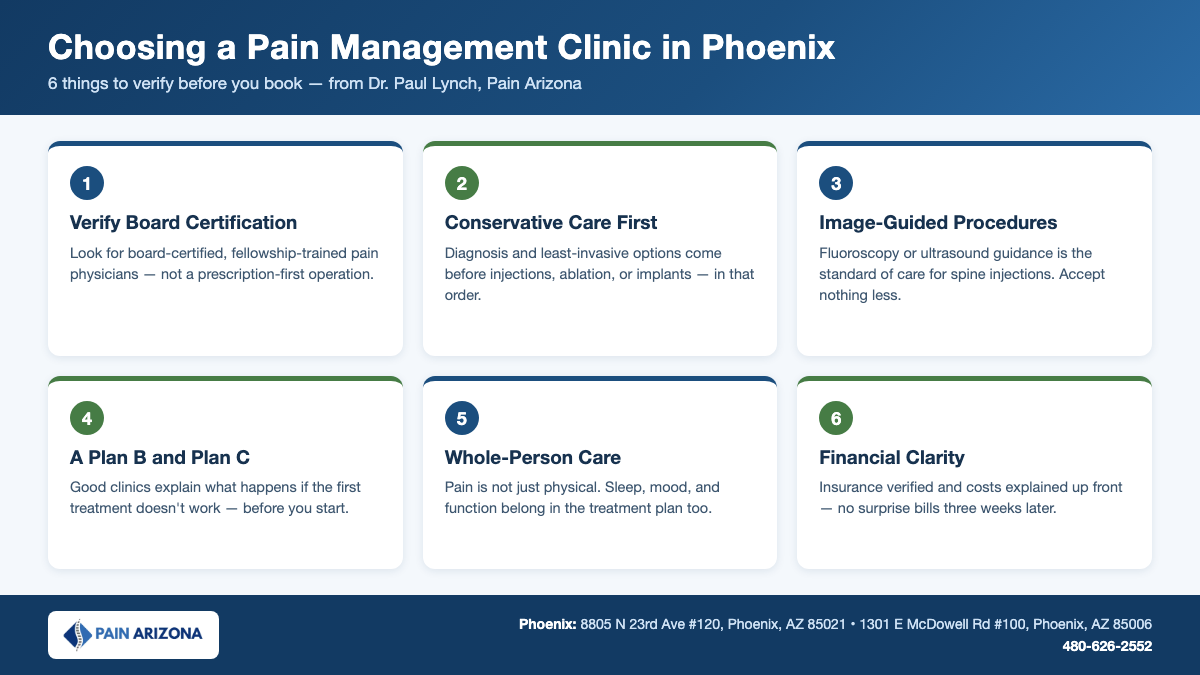
Interventional pain medicine is a specialty, not a side business. The physicians treating your spine should have completed dedicated training in anesthesiology, physical medicine, or a related field, followed by fellowship-level work in pain management. Board certification is the clearest external signal of that training; you can verify any physician’s credentials through the American Board of Medical Specialties.
When you research a pain clinic in Phoenix, look for:
- Board certification in pain medicine, anesthesiology, or physical medicine and rehabilitation
- Fellowship training in interventional pain procedures
- Years in practice treating the specific condition you have
- A full care team, including nurse practitioners and physician assistants who know your chart
At Pain Arizona you can review every member of our practitioner team before you ever walk in the door. I encourage you to do the same with any clinic you consider. If a practice will not tell you who is performing your procedure or what their training is, that silence is an answer in itself.
Look for a Conservative-First Treatment Philosophy
Here is something that may surprise you coming from an interventional pain physician: the best procedure is often the one you never need. I have performed thousands of injections and implants over my career, and I still believe the right first question is always, “What is the least invasive option likely to help this patient?”
A trustworthy Phoenix pain specialist should offer a ladder of care, something like this:
- Step one: accurate diagnosis, imaging review, activity modification, and physical therapy referrals where appropriate
- Step two: targeted, image-guided injections such as epidural steroid injections or joint injections
- Step three: longer-lasting interventions like radiofrequency ablation, which can quiet irritated nerves for many patients for months at a time
- Step four: advanced options such as spinal cord stimulation for carefully selected patients with nerve-related pain that has not responded to other care
Notice what is missing from the top of that ladder: a prescription pad. Medication has a role in pain care, but a clinic that leads with long-term opioids and little else is not practicing modern pain medicine. Arizona has lived through the consequences of that approach, and I have made it part of my life’s work to offer patients something better.
Pain Management Phoenix Patients Can Verify: Questions to Ask Before You Book
You do not need a medical degree to vet a clinic. You need a short list of direct questions and the willingness to ask them. When you call a prospective pain management Phoenix doctor, ask:
- “Who will actually diagnose me?” You want a clinician who examines you and reviews your imaging personally, not a one-size-fits-all protocol.
- “What conditions do you treat most often?” The answer should align with your problem. Our team sees everything from back pain and sciatica to joint pain, neuropathy, and post-surgical pain.
- “What happens if the first treatment doesn’t work?” A good clinic has a plan B and a plan C, and will explain them before you start.
- “Do you use image guidance for injections?” Fluoroscopy or ultrasound guidance is the standard of care for most spine procedures. Accept nothing less.
- “How do you handle the emotional side of chronic pain?” If the person on the phone seems confused by the question, that tells you a great deal.
That last question matters more than most people realize. Chronic pain and depression travel together. A clinic that treats the disc but ignores the person is treating half the problem.
Ready to talk with a Phoenix pain management team that puts you first?
Pain Arizona – Phoenix
8805 N 23rd Ave #120, Phoenix, AZ 85021
1301 E McDowell Rd #100, Phoenix, AZ 85006
Call 480-626-2552
Convenience Counts: Location, Access, and Scheduling in the Valley
Chronic pain care is not a single visit. It is a relationship that may involve a consultation, a diagnostic injection, a follow-up, and periodic maintenance care. If the clinic is an hour away across the Valley, every one of those visits becomes a burden, and burdens are exactly what patients in pain tend to skip.
We built Pain Arizona around that reality. We maintain two Phoenix offices, one at 8805 N 23rd Ave near the I-17 corridor and one at 1301 E McDowell Rd near the downtown medical district, along with locations in Mesa/Gilbert, Scottsdale, and Glendale. One phone number, 480-626-2552, reaches all of them. Whichever Phoenix pain clinic you choose, make sure you can realistically get there, park, and be seen without turning every appointment into a half-day expedition.
Scheduling matters too. Ask how long new patients typically wait for a first appointment. Pain that is ignored for six weeks while you wait does not politely pause. It digs in.
Insurance, Costs, and Honest Conversations About Money
I wish money never entered into medical decisions, but pretending otherwise does not help you. Before you commit to a clinic, confirm that it accepts your insurance and is willing to explain costs up front. A reputable practice will verify your benefits before a procedure, tell you what your estimated responsibility looks like, and discuss financing if you need it.
At Pain Arizona we publish our insurance and financing information openly because I believe surprise bills damage trust, and trust is the foundation of everything we do. Any chronic pain treatment Phoenix patients receive should come with financial clarity, not a mystery envelope three weeks later.
Red Flags That Should Send You Somewhere Else
After 17 years in this field, I can tell you the warning signs that make me wince when patients describe their previous care:
- Opioids on the first visit with no diagnostic workup. Medication-first, questions-later care is how so many patients ended up trapped.
- Every patient gets the same procedure. If a clinic’s answer to every spine complaint is the identical injection series, the treatment is serving the clinic, not the patient.
- No one examines you. Imaging is a tool, not a substitute for hands-on evaluation and a real conversation.
- Pressure to book procedures on the spot. Sound medical decisions survive a night of sleep. High-pressure tactics belong in car lots.
- Dismissiveness about your pain. If you feel unheard during the consultation, you will feel unheard during treatment. Pain that is invisible on an MRI is still real, and a good physician knows that.
None of these red flags requires medical expertise to spot. They only require you to trust your own judgment, which, after months or years of pain, many patients have been conditioned to doubt. Please don’t.
What a Pain Management Phoenix First Visit Should Feel Like
Let me paint the picture of what you should expect from a well-run interventional pain management Phoenix practice, because knowing the standard helps you recognize when a clinic falls short.
You should be asked about your pain history in detail: when it started, what makes it better or worse, what treatments you have already tried, and how it affects your work, sleep, and mood. You should receive a physical examination. Your imaging should be reviewed with you, on a screen, in plain language. And you should leave with a plan that has stages, timelines, and honest expectations, including the possibility that the first approach may need adjusting.
Most importantly, you should feel like a partner in the plan rather than a passenger. I tell our team constantly: our patients have often been dismissed, doubted, and passed around the system before they reach us. The first visit is where we start repairing that, and it is why our approach to care begins with listening. You can explore the full range of treatments we offer to get a sense of what a staged, personalized plan can draw from.

Frequently Asked Questions
Do I need a referral to see a pain management specialist in Phoenix?
It depends on your insurance. Many PPO plans allow you to book directly with a pain specialist, while most HMO plans require a referral from your primary care physician. When you call us at 480-626-2552, our team can check your specific plan requirements before you schedule, so there are no surprises.
What conditions does a pain management clinic actually treat?
More than most people expect. Beyond back and neck pain, a comprehensive pain practice treats sciatica, joint pain from arthritis, nerve pain such as diabetic neuropathy, headaches and migraines, post-surgical pain, SI joint dysfunction, and pain from auto or work injuries. If pain is limiting your life, it is worth a consultation even if you are unsure your condition “qualifies.”
Will I be pushed toward surgery or opioids?
Not at a well-run clinic. Modern interventional pain medicine exists largely to help patients avoid both. We use conservative, evidence-based options first, escalate only when needed, and reserve advanced interventions for patients who genuinely need them. Opioids, when used at all, are one small tool inside a much larger plan, never the plan itself.
How soon can treatment realistically help?
It varies by condition and treatment, and I would be cautious of anyone who promises specific results. Some patients feel meaningful relief within days of a targeted injection; others with complex, long-standing pain improve gradually over weeks or months of staged care. What I can tell you is that most patients do better the earlier they seek skilled evaluation, because chronic pain tends to get more stubborn the longer it goes unaddressed.
My Bottom-Line Advice for Choosing a Phoenix Pain Clinic
Choose credentials you can verify. Choose a philosophy that starts conservative and escalates thoughtfully. Choose a team that asks about your life, not just your spine. And choose a clinic close enough that you will actually keep your appointments.
Whether you choose Pain Arizona or another practice, please choose someone. The most heartbreaking cases I see are patients who waited years because they assumed pain was just their lot in life. It usually is not. There is almost always something more that can be done, and finding the right pain management Phoenix team is the first step toward finding out what that something is for you.
This article is for educational purposes only and is not medical advice. It does not replace an evaluation by a licensed medical professional. Treatment options, risks, and results vary from patient to patient; please consult a qualified physician about your specific situation.
Take the first step today. Our Phoenix team is ready to listen.
Pain Arizona – Phoenix
8805 N 23rd Ave #120, Phoenix, AZ 85021
1301 E McDowell Rd #100, Phoenix, AZ 85006
Call 480-626-2552