
If your doctor has recommended an epidural steroid injection in Mesa, or you suspect one might be in your future, you probably have three questions: What will it cost? What actually happens during the procedure? And when will I feel better? I am Dr. Paul Lynch, CEO of Pain Arizona and a double board-certified pain care physician and anesthesiologist with 17 years of experience, and our Mesa/Gilbert offices on Baseline Road perform these injections regularly. I want to answer those three questions the way I would for a friend sitting across from me, honestly and without the sales pitch, because an informed patient makes better decisions and, in my experience, gets better results.
What an Epidural Steroid Injection Actually Is
The epidural space is a thin sleeve that surrounds the dura, the protective covering of your spinal cord and nerve roots. When a disc herniates, a spinal canal narrows, or an irritated nerve root becomes inflamed, that inflammation is often the engine driving your pain, numbness, and that electric line of discomfort running down your leg or arm.
An epidural steroid injection delivers a small dose of anti-inflammatory corticosteroid, usually mixed with a local anesthetic, directly into that epidural space, right where the inflammation lives. Taking an oral anti-inflammatory for nerve root inflammation is like watering your yard and hoping some reaches one specific plant. An epidural injection is watering the plant.
We most commonly use these injections for:
- Herniated or bulging discs pressing on a nerve root
- Sciatica, the radiating leg pain that so many of our Mesa patients describe as their breaking point
- Spinal stenosis, the age-related narrowing of the spinal canal
- Radiculopathy in the neck or low back from degenerative disc changes
One thing I want to be clear about up front: an epidural steroid injection does not repair a disc or reverse arthritis. It reduces inflammation so your body can calm down, so you can move again, and so physical therapy and time can do their work. For many patients that window of relief is exactly what recovery needed. For others it is one step in a larger plan.
Epidural Steroid Injection Mesa Cost: What to Expect
Let’s talk money, because nobody else seems to want to. The honest answer is that epidural steroid injection cost in Mesa varies based on several factors, and anyone quoting a single flat epidural steroid injection Mesa price without asking questions is guessing.
What drives the cost:
- Your insurance coverage. Most commercial plans, Medicare, and many AHCCCS plans cover epidural steroid injections when they are medically necessary and conservative care has been documented. Your real cost is usually your deductible, copay, or coinsurance, not the sticker price.
- Where the procedure is performed. Injections done in an office-based fluoroscopy suite are generally billed differently than those done in an ambulatory surgery center. Hospital outpatient departments are typically the most expensive setting of all.
- The level and type of injection. A single-level lumbar epidural steroid injection differs from a cervical injection or a transforaminal approach targeting one specific nerve root.
- Sedation. Most patients do well with local anesthetic alone, but if sedation is used, that adds cost.
For uninsured patients, cash prices for a spinal injection in the Phoenix East Valley commonly run from several hundred dollars to a couple of thousand depending on the setting, which is a wide range, and that is exactly why I tell patients to insist on a quote first. At Pain Arizona, our team verifies your benefits before the procedure and tells you what your estimated out-of-pocket responsibility is, and our insurance and financing page explains the options if cost is a barrier. One call to 480-626-2552 gets that process started. Surprise bills break trust, and trust is the whole foundation of pain care.
Want a real answer on cost and whether an epidural is right for you?
Pain Arizona – Mesa/Gilbert
4824 E Baseline Rd #140, Mesa, AZ 85206
4860 E Baseline Rd #103, Mesa, AZ 85206
Call 480-626-2552
The Process, Step by Step: What Happens at Our Mesa Offices
Fear of the unknown is half the anxiety around spine injections, so let me walk you through the entire visit. From check-in to discharge, most patients are with us for under an hour, and the injection itself typically takes 10 to 15 minutes.
Before the procedure. We review your imaging, usually an MRI, and confirm that the injection target matches your symptoms. This step matters more than any other. An expertly performed injection in the wrong spot helps no one. We also review your medications; blood thinners in particular may need to be managed with the prescribing doctor’s guidance beforehand.
During the procedure. You lie face down on a procedure table. We clean the skin and numb it with local anesthetic, which is a brief sting, and for most patients it is honestly the most uncomfortable part. Using fluoroscopy, a live X-ray, we guide a thin needle to the epidural space and confirm placement with a small amount of contrast dye. Only then do we inject the steroid and anesthetic mixture. You may feel pressure or a brief echo of your familiar pain down the leg; that is common and usually fleeting.
After the procedure. We watch you for a short recovery period, then you head home with a driver. Plan on taking it easy the rest of the day. Most people return to normal light activity the next day. Your leg may feel temporarily numb or heavy from the anesthetic; that fades within hours.
Image guidance is not optional in my book. Blind epidural injections, done without fluoroscopy, miss the epidural space a meaningful percentage of the time. If any clinic offers you a spine injection without image guidance, I would respectfully suggest you keep driving down Baseline Road.
Relief Timeline for an Epidural Steroid Injection: Mesa Patients’ Most Common Question
“When will I feel better?” Here is the honest timeline I give every patient, with the caveat that individual responses genuinely vary:
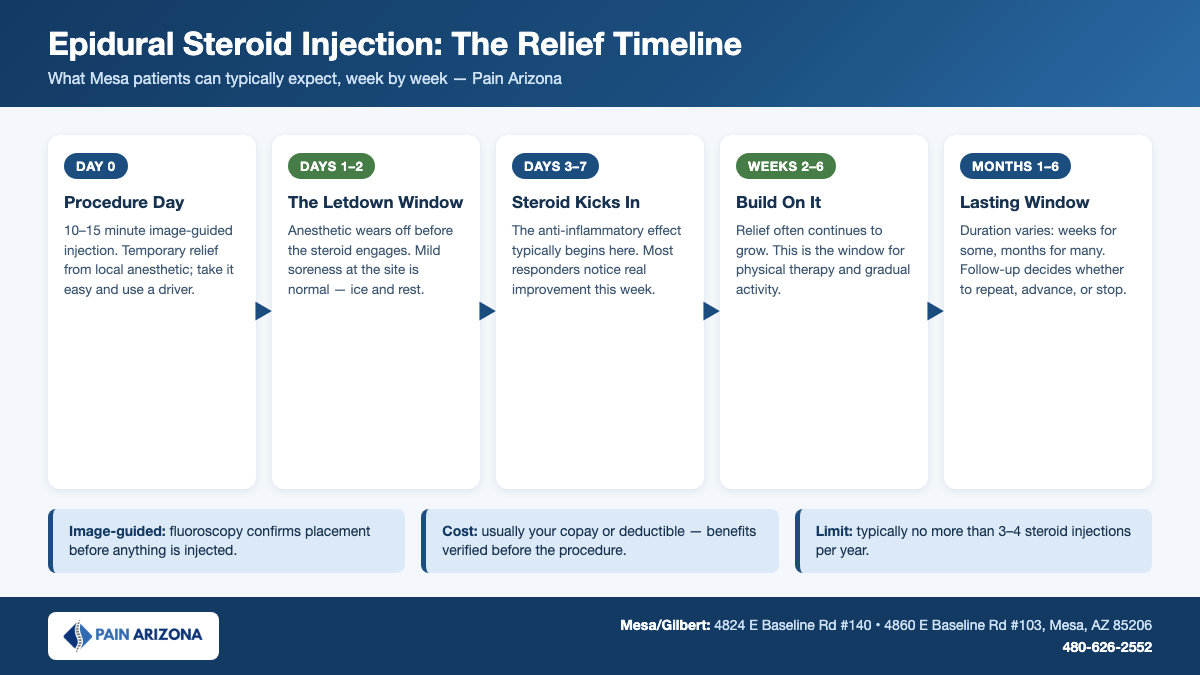
- Day of injection: Many patients feel immediate partial relief from the local anesthetic. Enjoy it, but know that it is temporary and typically wears off within hours.
- Days 1 to 2: A letdown window. The anesthetic has worn off and the steroid has not fully engaged. Some patients feel a temporary flare of soreness at the injection site. This is normal and usually settles with ice and rest.
- Days 3 to 7: This is when the corticosteroid typically begins reducing inflammation, and most patients who respond start noticing real improvement during this window.
- Weeks 2 to 6: Relief often continues to build. This is the window where I push patients hard toward physical therapy and gradual activity, because motion is how you convert temporary relief into lasting progress.
- Months 1 to 6 and beyond: Duration varies widely. Some patients get a few weeks of relief; many get several months; and a fortunate group finds that one or two injections, combined with rehab, breaks the pain cycle for good.
Roughly speaking, most patients with nerve-related leg or arm pain experience meaningful short-term relief, but I will never promise a specific result, and you should be wary of anyone who does. If the first injection helps but wears off, a repeat injection may be reasonable; we generally limit steroid injections to a conservative number per year to protect your tissues and overall health. And if injections are clearly not the answer for you, we say so and move to the next option rather than repeating what is not working.
Why Choose a Mesa Clinic With a Full Treatment Ladder
My mission at Pain Arizona is to save one million lives, and that mission has taught me humility about any single procedure. An epidural steroid injection is one rung on a ladder, not the whole ladder. The reason to have your injection with a comprehensive pain practice in Mesa rather than a one-procedure shop is simple: if the injection is not enough, your care does not hit a dead end.
At our Mesa/Gilbert offices, the same team that performs your epidural can offer facet joint injections, joint steroid injections, radiofrequency ablation, regenerative options, and advanced therapies for the small group of patients who need them. Just as importantly, we pay attention to the person attached to the spine. Pain is not just physical. The sleepless nights, the canceled plans, the quiet depression that follows months of sciatica, those are part of the condition too, and a clinic that ignores them is treating half of you.
How to Prepare and Get the Most From Your Injection
A few practical tips I give every Mesa patient before their epidural:
- Arrange a driver. Even without sedation, we want someone else behind the wheel on procedure day.
- Tell us about blood thinners, diabetes, and infections. Blood thinners may need coordinated adjustment. Steroids can temporarily raise blood sugar, so diabetic patients should monitor closely for several days. Any active infection or fever means we reschedule.
- Don’t schedule the injection as a miracle deadline. Give yourself a cushion before big events. The relief timeline is a curve, not a switch.
- Commit to the follow-through. The patients who do best treat the injection as the start of a rehab window, not the finish line. Walk, stretch, do the therapy. The injection buys you the ability; you supply the effort.
- Track your relief honestly. We often ask patients to note their pain scores for two weeks afterward. That record tells us whether to repeat, advance, or change course, and it makes your follow-up visit far more productive.
Frequently Asked Questions
Does an epidural steroid injection hurt?
Less than most patients fear. The local anesthetic sting at the skin is typically the most uncomfortable moment, similar to a dental numbing shot. During needle placement you may feel pressure or a brief reproduction of your usual pain. Most of our Mesa patients tell us afterward that the anticipation was far worse than the procedure.
How many epidural injections can I have in a year?
Most pain physicians, myself included, keep steroid injections to a conservative limit, commonly no more than three or four in a twelve-month period — consistent with guidance from groups like the American Society of Regional Anesthesia and Pain Medicine, and only when each one is earning its place by producing meaningful relief. If injections stop helping, repeating them is not the answer; adjusting the plan is.
Can I go back to work the next day?
Most patients with desk or light-duty jobs return to work the day after their injection, and some feel well enough the same evening. If your work involves heavy lifting or long drives, we may suggest a short modified-duty window. We will give you specific guidance based on your job and how you respond.
What if the epidural doesn’t work for me?
Then we learn from it and adjust, and I mean that sincerely. Even a non-response gives us diagnostic information about where your pain is coming from. Depending on your situation, next steps might include a different injection approach, radiofrequency ablation, physical rehabilitation, or evaluation for other interventions. A failed injection is a data point, not a dead end.
The Bottom Line for Mesa Patients
An epidural steroid injection Mesa patients receive at our Baseline Road offices is a brief, image-guided, generally well-tolerated procedure that can meaningfully reduce nerve-related back, neck, leg, or arm pain for weeks to months, at a cost that is usually manageable once insurance is verified up front. It is not magic and it is not permanent, but used at the right time, in the right patient, inside a complete treatment plan, it is one of the most useful tools we have, and after 17 years and thousands of these procedures, I do not say that lightly.
This article is educational only and is not medical advice. It does not replace an in-person evaluation by a licensed medical professional. Risks, benefits, costs, and results vary by individual; please discuss your specific situation with a qualified physician before making treatment decisions.
Sciatica or back pain running your life? Our Mesa team can help you find out why.
Pain Arizona – Mesa/Gilbert
4824 E Baseline Rd #140, Mesa, AZ 85206
4860 E Baseline Rd #103, Mesa, AZ 85206
Call 480-626-2552