
Every October, like clockwork, the phones at our Glendale clinic get busier. The first real cold front pushes through the Valley, overnight temperatures drop twenty degrees, the barometric pressure swings, and suddenly patients who were managing their arthritis or old back injury just fine all summer are calling about weather change pain flares. After 17 years as a double board-certified pain care physician and anesthesiologist, I can almost predict the week it will happen. I am Dr. Paul Lynch, CEO of Pain Arizona, and I want to explain why Arizona’s fall weather shift genuinely does trigger pain flares, what the science says and does not say, and what you can actually do about it, because “it’s just the weather” is not a treatment plan.
Yes, Weather Change Pain Flares Are Real: What Glendale Patients Feel Every Fall
Let me start by validating something many of my patients have been told to doubt. For generations, people who claimed they could “feel a storm coming” in their knees were dismissed as folklore. Research on the weather-pain connection has produced mixed results over the years, but several large studies, including the Cloudy with a Chance of Pain smartphone study tracking thousands of chronic pain patients in real time, have found a meaningful association between pain flares and changes in barometric pressure, humidity, and temperature.
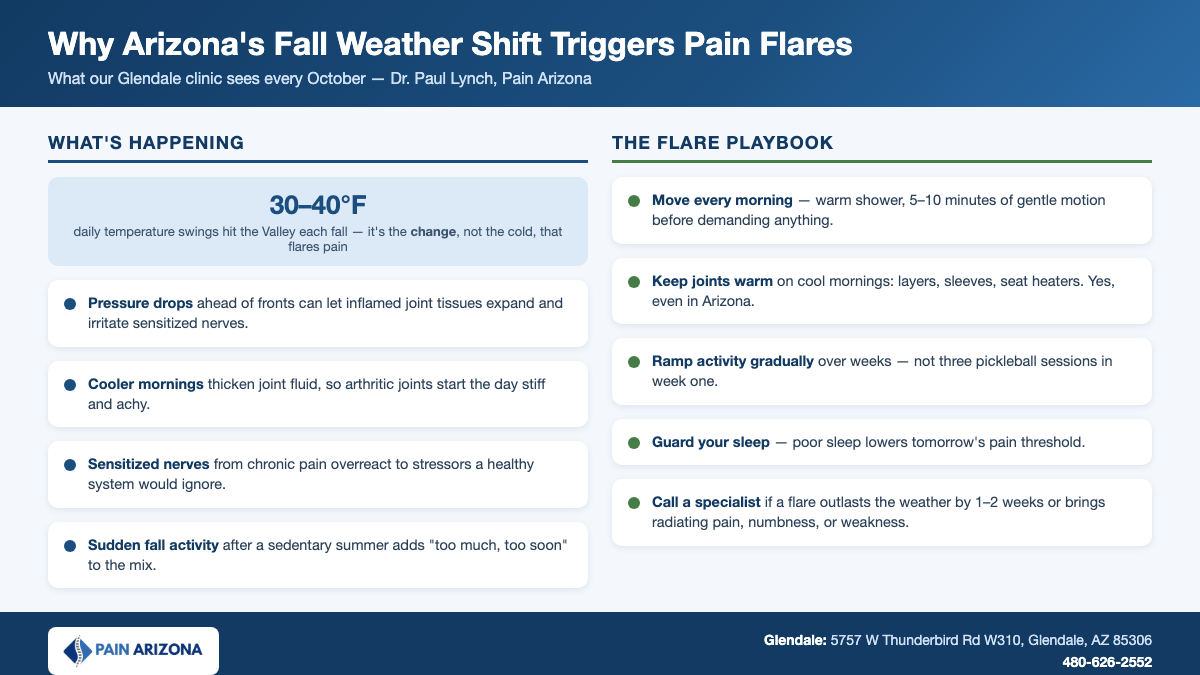
Notice the key word: changes. It is usually not the cold itself that stirs things up. It is the transition. And that is exactly what Arizona’s fall delivers. We go from 105-degree stability in September to swinging 30-to-40-degree daily temperature ranges by late October, with pressure fronts rolling through for the first time in months. For Glendale residents with arthritis, old injuries, neuropathy, or chronic back pain, that transition season is often the roughest stretch of the year, sometimes rougher than anything our mild winter actually brings.
The Mechanisms: Why a Pressure Drop Can Light Up an Old Injury
Nobody can give you a single proven mechanism, and I will not pretend otherwise. But several plausible, partially supported explanations likely combine:
- Barometric pressure and tissue expansion. When atmospheric pressure falls ahead of a front, tissues in and around joints may expand very slightly. In a healthy joint, no problem. In a joint already inflamed by osteoarthritis or scarred by old injury, even small volume changes can irritate sensitized nerve endings.
- Temperature and joint fluid. Cooler temperatures appear to thicken synovial fluid, the joint’s natural lubricant, which can make arthritic joints feel stiffer and achier, especially in the morning.
- Nerves that learned to overreact. Chronic pain sensitizes the nervous system. Nerves that have been firing for years develop a hair trigger, and modest environmental stressors that a healthy nervous system would ignore can set them off.
- Behavior change. This one is underrated. When the weather shifts, people sleep differently, move less, tense their muscles against the chill, and change routines. Less movement is fuel for most chronic pain conditions.
Headache patients deserve a special mention. Barometric swings are among the most commonly reported triggers for migraines and other headache disorders, and our fall front season reliably brings a wave of them into the clinic.
Why Glendale’s Fall Shift Hits Harder Than You’d Expect
People in Buffalo laugh when Arizonans complain about fall weather. Let them laugh. There are real reasons the Valley’s autumn transition is uniquely tough on pain patients.
First, the swing is dramatic. A Glendale October day can start at 55 degrees and peak near 90. That is a 35-degree intraday swing, repeated daily for weeks, and each swing is a little stress test for sensitized joints and nerves.
Second, our bodies de-acclimate. After five months of relentless heat, your blood vessels, muscles, and nervous system have fully adapted to summer. The first cool mornings hit an unprepared system. Patients from the Midwest tell me all the time that 55 degrees in Glendale somehow feels colder than 40 did back home. Physiologically, there is something to that.
Third, fall is when Valley residents suddenly get active again. Hiking at Thunderbird Conservation Park, golf leagues, pickleball, yard work that was unthinkable in July, all of it restarts in the same few weeks the weather is swinging. Deconditioned bodies plus sudden activity plus pressure fronts is the exact recipe for the flare season we see every year at our Glendale office on Thunderbird Road.
Fall flare that isn’t settling down? Our Glendale team sees this every October.
Pain Arizona – Glendale
5757 W Thunderbird Rd W310, Glendale, AZ 85306
Call 480-626-2552
Which Conditions Flare Most With Arizona’s Weather Shift
Not every condition produces weather change pain flares, but certain ones show up in our Glendale exam rooms every fall with remarkable consistency:
- Osteoarthritis of the knees, hips, and hands, the classic “I can feel the front coming” condition
- Old injuries and post-surgical sites, including fractures that healed decades ago and still announce weather changes
- Chronic low back and neck pain, especially facet joint arthritis, which often stiffens notably in cooler mornings
- Neuropathic pain, including diabetic peripheral neuropathy, where temperature shifts can amplify burning and tingling
- Fibromyalgia and widespread pain syndromes, which tend to be sensitive to nearly any environmental stressor, weather included
- Migraines and headache disorders, strongly tied to barometric swings for many sufferers
If you recognize yourself in that list, the goal is not to dread October. It is to plan for it, the same way an allergy patient plans for spring.
What You Can Do at Home: My Fall Flare Playbook
Here is the practical advice I give Glendale patients about weather change pain flares every autumn. None of it is glamorous, and most of it works better than people expect.
- Keep moving, especially in the morning. Motion is lotion for arthritic joints. Five to ten minutes of gentle movement before you demand anything of your body, a warm shower followed by easy stretching, can soften the whole day.
- Layer up for morning activities. It sounds absurd for Arizona, but keeping joints warm during those 55-degree mornings genuinely helps many patients. Knee sleeves, light layers, warm-up time in the car with the seat heater on; use the tools.
- Ramp activity gradually. Do not go from a sedentary summer to three pickleball sessions a week in October. Build up over several weeks. Most of the “weather flares” I see each fall have a healthy dose of “too much, too soon” mixed in.
- Guard your sleep. Flare season disrupts sleep, and poor sleep lowers your pain threshold the next day, which disrupts sleep again. Breaking that spiral early matters more than almost anything else on this list.
- Use heat strategically. Warm packs on stiff joints in the morning, and save ice for genuinely inflamed, swollen areas after activity.
- Track your flares. A simple note on your phone, pain score, weather, activity, sleep, turns vague misery into a pattern we can actually treat. Bring two or three weeks of notes to your appointment and you have given your physician a gift.
When a Weather Flare Is Something More: Signs It’s Time to Call
A true weather-related flare typically rides the front in and settles within a few days as conditions stabilize. What concerns me as a physician is when patients let “it’s just the weather” explain away something that has fundamentally changed. Call a pain specialist, in Glendale or wherever you are, when:
- The flare lasts more than a week or two after the weather stabilizes
- Each fall’s flare is noticeably worse than the last year’s
- Pain begins radiating somewhere new, down a leg or arm, or brings numbness, tingling, or weakness
- Pain is waking you from sleep night after night
- You are steadily increasing medication just to hold the same ground
- You have started canceling activities you love because you no longer trust your body
That last one is the one patients apologize for mentioning, and it is the one I take most seriously. Pain is not just physical. When it starts shrinking your life, stealing the hike, the grandkids’ games, the golf league, it is doing psychological damage that compounds the physical kind. That is precisely the point where good interventional care can change a person’s trajectory, and waiting another season rarely makes it easier.
How Our Glendale Clinic Treats Weather-Sensitive Pain
When a patient comes to our Glendale office with seasonal flares, we do not treat the weather. We treat the underlying condition that the weather keeps exposing. The fall flare is a signal flare: it shows us exactly where your body’s reserve is thinnest.
Our approach is conservative first and evidence-based always. That may mean a precise diagnosis of an arthritic facet joint followed by targeted injections, or radiofrequency ablation to quiet the nerves feeding a chronically arthritic joint, often for months at a time, which can carry patients comfortably through an entire flare season and beyond. For nerve pain, headaches, and complex cases, we have a full range of treatments and a team that will not stop at the first thing that half-works.
The mission I have built this practice around is to save one million lives, and most of that mission is not dramatic. It is one person at a time getting their mornings back, their sleep back, their fall hiking season back. If your Octobers have become something you brace for, I would genuinely like to change that.

Frequently Asked Questions
Can weather changes really cause pain, or is it in my head?
It is not in your head. Large patient-tracking studies have found real associations between barometric pressure changes, humidity, temperature shifts, and pain flares, particularly for arthritis and migraine sufferers. The effect varies a great deal between individuals, but if you have noticed the pattern for years, trust your own data.
Why does my pain get worse in fall when Arizona winters are so mild?
Because it is usually the change, not the cold, that triggers flares. Arizona’s fall packs months of weather transition into a few weeks: big daily temperature swings, the first pressure fronts since spring, and bodies that fully adapted to summer heat. Once winter stabilizes, many patients actually feel better than they did in October.
Should I just wait for the weather to settle before seeing a doctor?
If the flare is mild and follows your usual pattern, home care and patience are reasonable. But if a flare outlasts the weather by more than a week or two, keeps escalating year over year, or brings new symptoms like radiating pain, numbness, or weakness, waiting usually means treating a bigger problem later. An evaluation costs you an hour; an untreated progressing condition costs seasons.
Do treatments like radiofrequency ablation help with weather-related flares?
For the right patient, they can help significantly, not by changing your weather sensitivity, but by treating the underlying arthritic joints or irritated nerves that the weather keeps aggravating. Many patients who respond to ablation report that the following fall simply never produces the flare they had braced for. Results vary, which is why we confirm the pain source with diagnostic blocks first.
This article is for educational purposes only and is not medical advice. It does not replace an evaluation by a licensed medical professional. Individual conditions, risks, and results vary; please consult a qualified physician about your specific symptoms.
Don’t spend another fall bracing for the front. Let’s find the real source.
Pain Arizona – Glendale
5757 W Thunderbird Rd W310, Glendale, AZ 85306
Call 480-626-2552