
Every October, the Valley fills back up. License plates from Alberta, Minnesota, Illinois, and Washington reappear in the parking lots, and my Scottsdale schedule fills with a very particular kind of patient: the winter resident whose pain care lives two thousand miles away. If that is you, this article is my attempt to make snowbird pain management Arizona style actually work, instead of becoming the annual scramble it so often is. I am Dr. Paul Lynch, CEO of Pain Arizona and a double board-certified pain care physician and anesthesiologist. In 17 years of practicing here, I have watched hundreds of seasonal residents arrive in November with three months of medication, a vague plan, and a flare-up that did not check the calendar first. There is a better way, and it starts before you pack.
Why Snowbird Pain Management Arizona Planning Should Start Before You Pack
Chronic pain does not take the winter off, and in my experience it often does the opposite. The long drive or flight down, the new mattress in the winter home, the sudden jump in golf, pickleball, and hiking after months of northern hibernation: all of it loads stress onto the same spines and joints that were already complaining back home.
Here is the pattern I see every single season. A patient arrives in Scottsdale in late October feeling reasonable. By Thanksgiving the increased activity has stirred up their back pain or their knees. By mid-December they are hurting, their pain physician is in Minneapolis, and they are discovering that establishing care with a new specialist from scratch, in the middle of the Valley’s busiest medical season, can take weeks they do not want to spend on the couch.
The fix is not complicated. Treat your pain care the way you treat your mail, your golf membership, and your HOA: set up the Arizona side before you need it. Good snowbird pain management Arizona planning means your winter physician has your records, understands your treatment history, and can see you quickly when the first flare hits, rather than meeting you for the first time in the middle of one.
Step 1: Get Your Records Moving Before You Do
Every solid snowbird pain management Arizona plan begins with paperwork, unglamorous as that is. The single most useful thing you can do costs nothing: ask your home pain clinic to send your records ahead of you. Specifically, your new Arizona team will want:
- Recent imaging and reports. MRI, CT, and X-ray reports from the last two to three years, and ideally the images themselves on disc or through an imaging portal.
- Procedure notes. If you have had epidural injections, facet injections, radiofrequency ablation, or a stimulator implant, the notes tell us exactly what was done, at which levels, and how you responded.
- Your current medication list. Complete and current, including doses and the prescriber for each.
- A brief summary from your home physician. Even a one-page letter describing your diagnosis and plan is gold. Most pain physicians are happy to write one for a longtime patient.
When those records arrive before you do, your first Arizona appointment becomes a continuation of your care instead of a restart. That difference can easily save you a month.
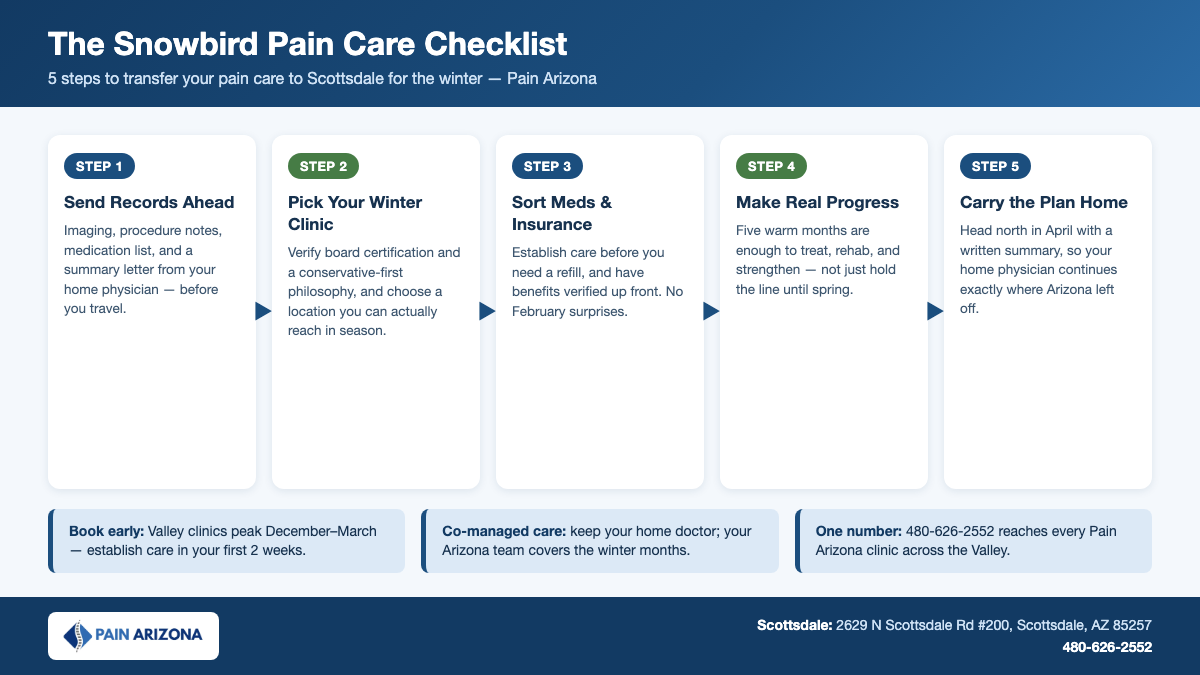
Step 2: Choose Your Winter Clinic the Way You Chose Your Home One
Seasonal care is still care, and the standards do not drop just because you will only be here through April. When you evaluate a Scottsdale pain clinic, verify the same credentials you would at home: board certification in pain medicine, anesthesiology, or physical medicine, which you can confirm yourself through the American Board of Medical Specialties; fellowship training in interventional procedures; and a full care team that will actually know your chart. You can review every clinician on our practitioner team online before you ever call, and I would encourage you to do that with any practice you consider.
Philosophy matters as much as credentials. My conviction, after thousands of procedures, is that the best clinic is the one that starts conservative and escalates thoughtfully. Snowbird pain management Arizona patients are sometimes treated like transients: a quick refill, a fast injection, no real plan. You deserve the same staged, evidence-based approach a year-round resident gets, and you should walk out of your first visit with one.
One practical Scottsdale note: choose a clinic you can actually reach in season. Winter traffic in the Valley is real. Our Scottsdale office at 2629 N Scottsdale Rd puts most of the McCormick Ranch, Old Town, and south Scottsdale winter communities within a short drive, and our Phoenix, Mesa/Gilbert, and Glendale offices cover the rest of the Valley under the same phone number, 480-626-2552.
Setting up your winter in Scottsdale? Set up your pain care at the same time.
Pain Arizona – Scottsdale
2629 N Scottsdale Rd #200, Scottsdale, AZ 85257
Call 480-626-2552
Step 3: Sort Out Medications and Insurance Before the First Flare
Medications are where seasonal care most often goes sideways, and controlled medications are where it goes sideways fastest. Arizona participates in a prescription monitoring program, and most pain practices, ours included, follow careful protocols around prescribing for new patients. What that means for you practically:
- Do not assume a three-month supply will stretch five months. It rarely does, and running short in February with no local prescriber is a genuinely miserable position.
- Establish with your Arizona clinic before you need a refill, and bring your home prescriber’s contact information so the two offices can coordinate. One patient, one plan, two zip codes.
- Verify your insurance works here. Most Medicare plans travel well, and many Medicare Advantage and commercial plans have Arizona networks, but “many” is not “all.” Our team verifies benefits before any visit or procedure, and our insurance and financing page explains the options if something does not line up. A five-minute phone call in October beats a surprise bill in January.
I will add one conviction of mine here: medication alone was never meant to be the whole plan. If your winter care consists only of refills, you are maintaining your pain, not treating it, and the season is long enough to do better than that.
Step 4: Use the Season to Make Actual Progress
Here is the part of snowbird pain management Arizona residents overlook, and it is my favorite part: five or six months in the Valley is long enough to genuinely improve, not just hold the line.
Think about what the winter gives you. Warm, stable weather that is kind to arthritic joints. Flat walking terrain and year-round pools. Time, often more of it than you have at home. That combination is close to ideal for a structured plan: a proper evaluation, targeted treatment, and the consistent movement that converts short-term relief into lasting function. The National Library of Medicine’s overview of back pain makes the same point clinicians have known for decades: staying active, within sensible limits, is one of the most effective things most people with chronic back pain can do.
For many of our seasonal patients, the winter plan looks something like this:
- November: establishing visit, records review, and a baseline examination while you are feeling relatively good
- December to February: targeted treatment where appropriate, from arthritis care and joint injections to procedures like radiofrequency ablation for facet-related back or neck pain, paired with physical therapy and a graded return to golf, pickleball, and hiking
- March to April: consolidation, a re-check, and a written summary that travels home with you so your northern physician knows exactly what was done
Patients who follow a plan like that often head north in April in better shape than they arrived, which is precisely the point. You came here for the sunshine. Leave with something more durable.
Step 5: Know What Can Be Done Here, and What Should Wait
A fair question I hear from winter residents: “Should I have a procedure here, or wait until I am home?” The honest answer is that it depends on the procedure and the timeline, and a good Arizona physician will tell you which is which.
Most injections and ablations are well suited to seasonal care. They are brief, image-guided, and the follow-up window fits comfortably inside a winter stay. The full menu of what we offer is on our treatments page, and for the majority of snowbird patients with back, neck, or joint pain, everything they need can be done right here. Larger interventions, such as implanted devices, deserve more thought about where your long-term follow-up will live; sometimes the answer is still Arizona, especially for patients who winter here every year, and sometimes the wiser move is coordinating with your home team. What you should never accept is a clinic that recommends a major procedure in week one without asking where you will be in week twelve.
And if you are a planner by nature, as most successful snowbirds are, consider this: patients who return to us each winter have a chart, a history, and a team that already knows them. By the second season, snowbird pain management Arizona stops being a logistics problem and becomes what it should have been all along, which is simply your pain care, continued in a better climate.

Frequently Asked Questions
Can I see an Arizona pain specialist while keeping my doctor back home?
Yes, and that is exactly the arrangement we recommend. Think of it as co-managed care: your home physician remains your year-round anchor, and your Arizona team handles evaluation, flares, procedures, and prescriptions during the months you are here. With records flowing both directions, there is no conflict, only continuity. That co-managed model is the backbone of good snowbird pain management Arizona care, and we run it for seasonal patients every winter.
Will my Medicare or insurance cover pain treatment in Arizona?
Usually, but verify before you assume. Original Medicare travels with you anywhere in the country. Medicare Advantage and commercial plans vary: some have strong Arizona networks, others treat out-of-state care as out-of-network. Call us at 480-626-2552 with your plan information and our team will check your benefits before you book anything, so the financial picture is clear up front.
How early should I schedule after arriving for the winter?
Ideally, before you arrive, or within your first two weeks here. The Valley’s medical season peaks from December through March, and waiting until a flare forces the issue means competing for appointments at the busiest time of year. An early establishing visit while you feel good gives us a baseline and makes any later flare a quick follow-up instead of a new-patient workup.
What should I bring to my first Scottsdale appointment?
Bring your photo ID and insurance cards, a complete medication list with doses and prescribers, recent imaging reports (and the images if you have them), notes from prior procedures, and your home physician’s contact information. If your records were sent ahead, even better; the visit then focuses on examining you and building the winter plan rather than reconstructing your history.
The Bottom Line for Winter Residents
You already plan the house, the car, the tee times, and the flight home. Add one more line to the checklist. Thoughtful snowbird pain management Arizona preparation comes down to four moves: send your records ahead, establish care early with a board-certified team, square away medications and insurance before the first flare, and then use the season to actually get better rather than just get by. Pain is not just physical; it is the thing that decides whether you spend this winter on the course and the trail or watching both from the patio. My mission is to save one million lives, and a meaningful number of those are seasonal lives, lived better from November to April. If we can help with yours, our Scottsdale team is ready when you are.
— Dr. Paul Lynch is a double board-certified pain physician and anesthesiologist and CEO of Pain Arizona. Connect with him on LinkedIn.
This article is for educational purposes only and is not medical advice. It does not replace an evaluation by a licensed medical professional. Treatment options, risks, insurance coverage, and results vary from patient to patient; please consult a qualified physician about your specific situation.
Make this the winter your pain plan travels with you.
Pain Arizona – Scottsdale
2629 N Scottsdale Rd #200, Scottsdale, AZ 85257
Call 480-626-2552