
The Back-Saver Handbook: How to Conquer Your Aches and Pains
Why Back Pain Doesn’t Have to Control Your Life
How to fix back pain starts with understanding that you have more control than you think. Most back pain responds well to simple, proven strategies you can start today.
Quick Answer: The Most Effective Ways to Fix Back Pain
- Stay active – Gentle movement beats bed rest
- Apply heat or ice – Heat for stiffness, ice for acute injuries (15-20 minutes)
- Strengthen your core – Supports your spine and prevents future pain
- Fix your posture – Proper sitting and standing reduces strain
- Try OTC pain relievers – NSAIDs like ibuprofen reduce inflammation
- Stretch daily – Keeps muscles flexible and joints mobile
- Seek professional help if pain lasts beyond a few weeks or you have numbness, weakness, or loss of bladder control
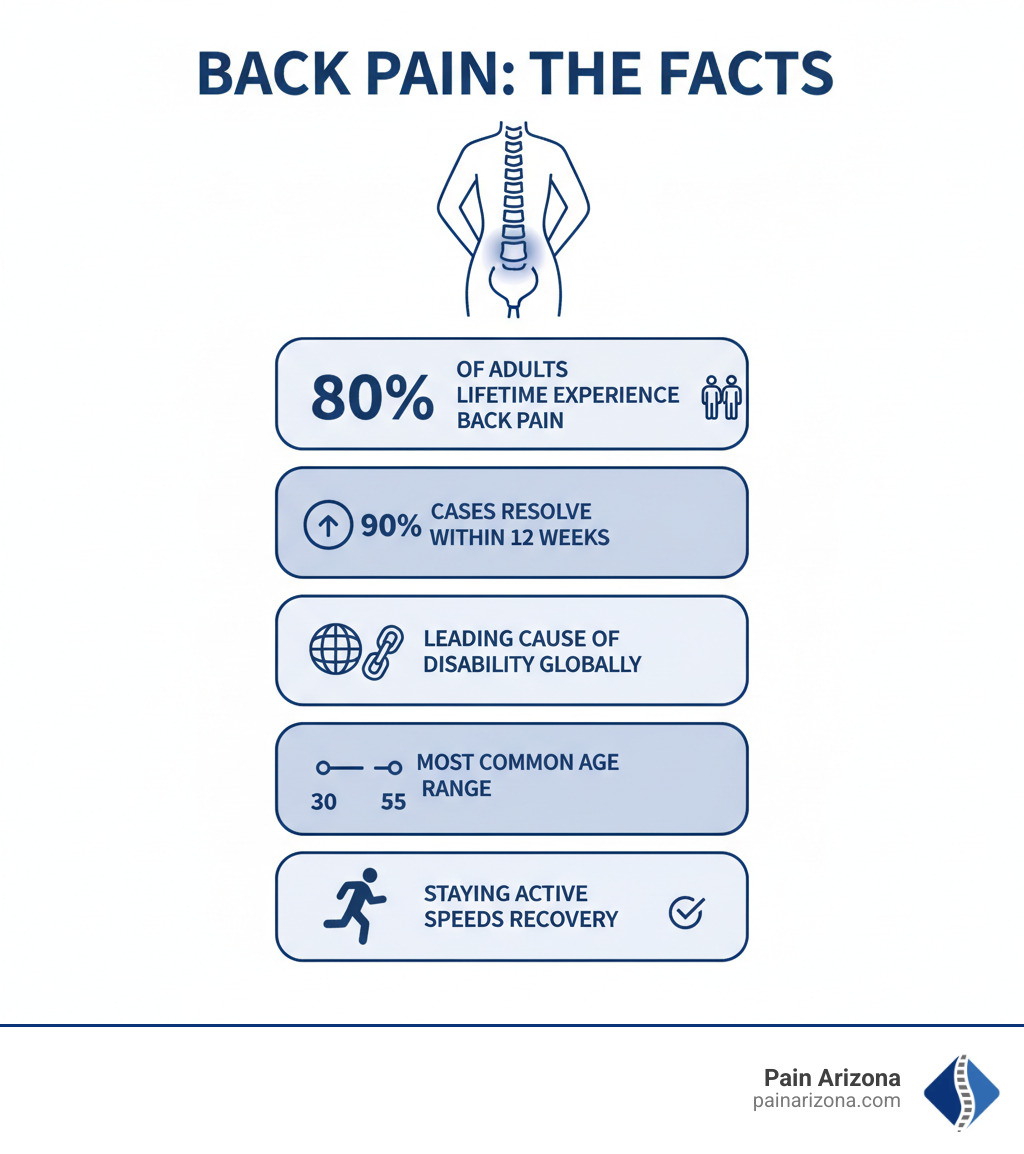
If you’re reading this, you’re not alone. About 80% of adults experience back pain at some point in their lives. It’s one of the most common reasons people visit the doctor.
But here’s the good news: nearly 90% of back pain cases are temporary. Most people make a full recovery within 12 weeks using simple treatments they can do at home.
Your back pain might feel overwhelming right now. Maybe it’s keeping you from work, stopping you from playing with your kids, or making simple tasks like grocery shopping feel impossible. You might worry that you’re facing surgery or a lifetime of prescription painkillers.
The reality is different. Most back pain improves with the right approach – and that approach often doesn’t require invasive procedures or heavy medication.
I’m Dr. Nasser, Chief Medical Officer at Pain Arizona, and over my career I’ve helped thousands of patients overcome chronic and complex back pain using evidence-based treatments focused on addressing root causes, not just masking symptoms. Understanding how to fix back pain effectively means looking at your whole picture – not just where it hurts.
This guide will walk you through everything from immediate relief strategies to long-term prevention, so you can take control of your back health and get back to living your life.
Understanding Your Pain: Common Causes and Triggers
Your back is hurting, and you want answers. Before we can talk about how to fix back pain, let’s figure out what’s actually going on back there.
The truth is, your lower back has one of the toughest jobs in your body. It bears most of your weight, keeps you balanced, and moves in just about every direction you can imagine. No wonder it complains sometimes.

The most common culprit? Muscle or ligament strain. Maybe you helped your neighbor move that couch. Or you twisted wrong reaching for something in the back seat. Or you’ve been sitting hunched over your laptop for eight hours a day. All of these can overwork or pull the muscles and ligaments supporting your spine.
Improper lifting is a classic way to hurt your back. When you lift with your back instead of your legs, you’re putting enormous pressure on your spine. It’s like trying to lift a heavy box using a weak hinge instead of strong cables.
Sometimes the problem goes deeper than muscles. Your spine is made up of bones called vertebrae, cushioned by gel-filled discs that act like shock absorbers. When one of these discs bulges or ruptures – we call this a herniated disc – it can press on nearby nerves. That pressure can cause sharp pain that might shoot all the way down your leg.
As we get older, our bodies change. Degenerative disc disease is just a fancy way of saying your spinal discs are wearing down over time, losing their cushioning ability. Think of them like the shock absorbers on your car – eventually, they don’t absorb bumps as well as they used to.
Arthritis doesn’t just affect your knees and hands. It can develop in your spine too, causing inflammation, stiffness, and sometimes bone spurs. The joints in your spine can become painful and swollen, making movement uncomfortable.
Spinal stenosis happens when the spaces in your spine narrow, putting pressure on your spinal cord and nerves. It’s like trying to run water through a kinked garden hose – things get squeezed and can’t flow properly. This can lead to pain, numbness, or weakness in your legs.
You’ve probably heard of sciatica – that shooting pain that runs from your lower back down through your leg. It happens when something (often a herniated disc) pinches the sciatic nerve. The pain can be sharp, burning, or feel like an electric shock.
Age-related changes affect all of us eventually. Most people start experiencing back pain after age 30, and it becomes more common as the years go by. Your discs dry out, your muscles might not be as strong, and your spine has simply been working hard for decades.
Here’s something that might surprise you: in about 90% of lower back pain cases, we can’t pinpoint one specific cause. Your back is a complex system, and sometimes pain comes from a combination of factors. But don’t let that discourage you. Even when we can’t identify the exact source, we can still effectively treat your pain and help you feel better.
Immediate At-Home Fixes for Back Pain Relief
When back pain hits, your first instinct might be to crawl into bed and stay perfectly still until it goes away. I understand that impulse – when something hurts, we naturally want to protect it. But here’s what research has taught us: gentle movement is usually better than prolonged bed rest for most types of back pain.
The good news? Most back pain improves within a few days or weeks with simple self-care strategies you can start right now. Let me walk you through the most effective immediate approaches for how to fix back pain at home.

Keep moving, even if it feels counterintuitive. While you might need to take it easy for a day or two if the pain is severe, staying in bed for longer can actually make things worse. Your back becomes stiffer, and the muscles that support your spine get weaker. Instead, try to continue your normal daily activities as much as you can tolerate. Walking is particularly helpful – even a short walk around your house or neighborhood can help. Just stop any activity that clearly increases your pain, but don’t avoid all movement out of fear.
Heat therapy works wonders for stiffness and muscle spasms. There’s something deeply comforting about warmth on an aching back, and it’s not just psychological. Heat helps relax tense muscles and increases blood flow to the affected area, which promotes healing. You can use a heating pad, a warm compress, or even soak in a warm bath. Apply heat for about 15 to 20 minutes at a time, two or three times throughout the day.
Cold therapy is your friend for recent injuries. If your back pain started within the last day or two and you notice any swelling, reach for an ice pack instead. Cold helps numb the pain and reduce inflammation. Wrap the ice pack in a towel (never apply ice directly to your skin) and hold it on the painful area for no more than 20 minutes at a time. You can repeat this every two to four hours, especially during those first 24 to 48 hours after injury.
Over-the-counter pain relievers can provide real relief. For mild to moderate back pain, nonsteroidal anti-inflammatory drugs like ibuprofen or naproxen sodium can be very effective. They tackle both the pain and the inflammation that’s often causing it. Acetaminophen is another option that provides pain relief, though it doesn’t reduce inflammation. Always follow the dosage instructions on the label, and check with a healthcare provider or pharmacist if you’re taking other medications or have existing health conditions.
Modify your activities temporarily. Pay attention to what makes your pain worse. You might need to take a break from heavy lifting, avoid twisting motions, or be more careful about bending from the waist. This doesn’t mean you should stop moving entirely – it just means being smart about which movements you do. As your pain improves, you can gradually reintroduce these activities.
Do’s and Don’ts for the First 48 Hours:
- DO stay as active as possible with gentle movements like walking
- DO apply ice for acute pain and swelling (first 24-48 hours), then switch to heat for stiffness
- DO take OTC pain relievers as directed
- DO listen to your body and avoid movements that significantly increase pain
- DON’T stay in bed for more than a day or two
- DON’T twist, bend from the waist, or lift heavy objects
- DON’T ignore worsening symptoms or “red flag” signs (we’ll cover these later)
These immediate strategies can make a real difference in how quickly you recover. But if your pain persists beyond a few weeks or you develop any concerning symptoms, it’s time to seek professional help – and we’ll talk about when that’s necessary in the sections ahead.
How to Fix Back Pain with Long-Term Strategies
When back pain keeps coming back, it’s your body’s way of telling you something needs to change. The good news? You have more control than you might think. Building a stronger, more resilient body isn’t about becoming a gym rat or completely overhauling your life overnight. It’s about small, consistent changes that add up to real relief.
Think of it this way: immediate fixes are like putting a bandage on a cut, but long-term strategies are about making sure you don’t keep getting cut in the first place. We want to help you build a back that can handle whatever life throws at it.

Build a Stronger Core and Back
Your core muscles are like a built-in back brace. When they’re strong, they take pressure off your spine and help you move without pain. We’re talking about your abdominal muscles, back muscles, and even your hip muscles – they all work together to support your spine like a team.
Here’s what happens when you strengthen these muscles: increased blood flow brings fresh nutrients and oxygen to your spinal discs, helping them stay healthy and recover from daily wear and tear. Strong muscles provide better support for your spine, which means your ligaments and discs don’t have to work as hard. Plus, regular stretching keeps everything flexible and prevents the kind of tightness that can turn into tomorrow’s pain.
You don’t need fancy equipment or a gym membership to get started. Some of the most effective exercises can be done right in your living room. The Bird-Dog is a perfect example – start on your hands and knees, then slowly extend one arm forward while reaching the opposite leg back. Hold for a few seconds, then switch sides. It looks simple, but it builds serious stability.
The Bridge Pose is another winner. Lie on your back with your knees bent and feet flat on the floor. Tighten your belly and glutes, then lift your hips until your body forms a straight line from knees to shoulders. Hold for a few breaths, then lower down gently. This one strengthens your glutes and lower back at the same time.
If you’re ready for something more challenging, try a Plank. Get into a push-up position but rest on your forearms instead of your hands. Keep your body straight as a board from head to heels, and engage your core. Even holding this for 20-30 seconds can make a real difference.
For flexibility, nothing beats the Cat-Cow Stretch. Start on your hands and knees, then gently arch your back upward like a scared cat, tucking your chin. Then let your belly drop toward the floor as you lift your head, like a cow. This gentle movement keeps your spine flexible and feels amazing after a long day.
The key is to start slowly and listen to your body. If something hurts, stop. Pain is your body’s warning system, not something to push through. You can find more simple core exercises from medical experts to expand your routine. And if you want structured guidance, our Exercise-Based Rehab programs can give you a personalized plan that’s safe and effective.
How to fix back pain by Mastering Your Daily Posture
Your grandmother was onto something when she told you to sit up straight. Poor posture is one of the sneakiest causes of back pain because it happens so gradually that we don’t notice until the damage is done. Every hour you spend hunched over a computer or slouched on the couch adds up.
When you’re sitting, think about creating right angles. Your back should be straight and supported against your chair, your feet flat on the floor, and your knees bent at about 90 degrees. If your chair doesn’t support the natural curve of your lower back, roll up a small towel or grab a lumbar pillow to fill that gap. And here’s a rule that’s easy to remember: if you’ve been sitting for an hour, it’s time to stand up and move around. Even a quick lap around the office helps.
Standing posture matters just as much. Distribute your weight evenly on both feet, keep your shoulders back and relaxed, and avoid locking your knees. Imagine a string pulling gently upward from the top of your head – that’s the alignment you’re aiming for.
Now let’s talk about lifting, because this is where a lot of back injuries happen. The golden rule is simple: use your legs, not your back. Bend at your knees and hips, keep whatever you’re lifting close to your body, and keep your back straight. Never twist while you’re holding something heavy – that’s a recipe for disaster. And if something is too heavy, there’s no shame in asking for help. Your back will thank you.
Optimize Your Sleep for Spinal Health
You spend about a third of your life sleeping, so your sleep position matters more than you might think. The wrong position can undo all the good work you’re doing during the day.
If you’re a side sleeper, place a pillow between your knees. This simple trick keeps your spine aligned and prevents your top leg from pulling your spine out of position. For back sleepers, slide a pillow under your knees to support the natural curve of your lower back and take pressure off your spine.
Stomach sleeping is the one position we really discourage. It forces your neck to twist and flattens your lower back’s natural curve. But if you absolutely can’t sleep any other way, try putting a thin pillow under your pelvis to reduce the strain.
Your mattress matters too. A sagging, worn-out mattress can contribute to back pain no matter how perfect your sleeping position is. You want something that’s comfortably firm – supportive enough to keep your spine aligned, but not so hard that it creates pressure points.
How to fix back pain through Lifestyle Changes
Sometimes how to fix back pain has less to do with your back and more to do with your overall lifestyle. These bigger-picture changes can make a huge difference in whether your back pain keeps coming back.
Weight management is one of the most powerful tools you have. Extra weight, especially around your middle, puts constant pressure on your lower back. It’s like carrying a heavy backpack all day, every day. Losing even a few pounds can significantly reduce that load and give your spine a break.
What you eat matters too. An anti-inflammatory diet can help reduce the kind of inflammation that contributes to back pain. Load up on fresh fruits, leafy greens, whole grains like brown rice and oats, fatty fish like salmon, nuts, seeds, and calcium-rich foods. On the flip side, try to limit fried foods, processed snacks, sugary drinks, and excessive sweets. You don’t have to be perfect – just making better choices most of the time can help.
If you smoke, quitting might be the single best thing you can do for your back. Smoking restricts blood flow to your spinal discs, which means they don’t get the nutrients they need to stay healthy. It also interferes with calcium absorption and slows down bone growth, increasing your risk of conditions like osteoporosis. You can read more about smoking’s link to osteoporosis to understand the full impact. Quitting isn’t easy, but your back – and the rest of your body – will be much better for it.
When to See a Doctor: Professional Treatments for Persistent Pain
Most back pain improves on its own with the home strategies we’ve discussed. But sometimes, despite your best efforts, the pain persists or signals something more serious that needs professional attention. Knowing when to reach out for help is just as important as knowing how to fix back pain at home.
If your back pain hasn’t improved after a few weeks of consistent self-care, it’s time to see a doctor. Severe or worsening pain that’s constant or getting progressively worse also warrants a professional evaluation. Your body is trying to tell you something important.
There are certain “red flag” symptoms that should never be ignored. Numbness or weakness in your legs can indicate nerve compression that needs prompt treatment. Loss of bowel or bladder control is a medical emergency – if you experience this, seek immediate medical attention. Fever accompanying your back pain could signal an infection, while unexplained weight loss might indicate a more serious underlying condition. If your back pain started after a fall or accident, or if pain radiates below your knee with numbness or tingling, these are all signs you need professional care.
If you have a history of cancer or a compromised immune system, any new back pain deserves closer medical evaluation. Don’t wait – early intervention often leads to better outcomes.
At Pain Arizona, our double board-certified physicians specialize in helping people who’ve been struggling with persistent, complex back pain. We focus on evidence-based treatments that address the root cause of your discomfort, not just mask the symptoms. Our approach is minimally invasive whenever possible, because we believe in helping you heal without unnecessary procedures.
Physical therapy is often where we start for many patients. It’s powerful medicine – strengthening the right muscles, improving flexibility, correcting posture problems, and restoring natural movement patterns. Our Physical Therapy programs are customized to your specific situation and goals.
For some patients, chiropractic adjustments provide significant relief. These hands-on treatments can relax tight muscles, reduce pain, and improve spinal alignment. Learn more about how Chiropractic Adjustments might help you.
When pain is caused by inflammation around nerve roots – often from herniated discs or spinal stenosis – an epidural steroid injection can be remarkably effective. This treatment delivers powerful anti-inflammatory medication directly to the source of your pain. Many patients experience significant relief that allows them to participate more fully in physical therapy and daily activities. Find more about Epidural Steroid Injections and whether they might be right for you.
For severe pain that hasn’t responded to other treatments, nerve blocks can target specific nerves to interrupt pain signals, offering immediate relief when you need it most. Read about Nerve Blocks and how they work.
If nerve blocks provide temporary relief but the pain returns, radiofrequency ablation might be the next step. This procedure uses radio waves to disrupt pain signals from specific nerves, often providing relief that lasts much longer than injections alone. Learn more about Radiofrequency Ablation and its benefits.
These treatments aren’t one-size-fits-all. We develop a comprehensive pain management plan custom to your specific situation, with the goal of reducing your pain, improving your function, and helping you reclaim your quality of life. We accept most insurance plans, so check with our office manager to see if your plan is accepted.
You don’t have to live with chronic back pain. Professional help is available, and it doesn’t necessarily mean surgery or a lifetime of heavy medications. Sometimes, the right intervention at the right time makes all the difference.
Conclusion: Take Control of Your Back Health Today
Back pain might feel like an unwelcome companion right now, but here’s what I want you to remember: you have more power than you think. Most back pain improves with the right approach, and you’ve just learned exactly what that approach looks like.
We started by understanding what causes your pain – whether it’s a simple muscle strain, a herniated disc, or age-related changes in your spine. Then we walked through immediate relief strategies like applying heat or ice, staying gently active instead of staying in bed, and using over-the-counter pain relievers wisely. These simple steps can make a real difference in those first few days.
But the real change happens when you think long-term. Building a stronger core gives your spine the support it needs. Fixing your posture throughout the day – whether you’re sitting at your desk or lifting groceries – takes pressure off your back. Optimizing how you sleep and making lifestyle changes like maintaining a healthy weight and quitting smoking all work together to create a back that’s more resilient and less prone to pain.
And when home remedies aren’t enough? That’s where we come in. Professional treatments like physical therapy, chiropractic adjustments, epidural steroid injections, and other minimally invasive options can address the root cause of persistent pain – not just mask the symptoms.
The path to fix back pain isn’t about one magic solution. It’s about taking consistent, informed action. It’s about listening to your body and knowing when to push forward and when to seek help. Most importantly, it’s about refusing to let pain dictate how you live your life.
At Pain Arizona, we’ve helped thousands of people in Phoenix, Mesa, Gilbert, Scottsdale, and Glendale reclaim their lives from chronic back pain. Our double board-certified physicians combine compassion with evidence-based medicine, always focusing on the least invasive options first. We accept most insurance plans – just check with our office manager to see if yours is accepted.
You don’t have to figure this out alone. Whether you’re dealing with occasional flare-ups or persistent pain that’s lasted months, we’re here to help. Take that first step today and explore our advanced treatment options. Your back – and your future self – will thank you.