
If you have been researching radiofrequency ablation Phoenix clinics offer for chronic back pain, you have probably run into two kinds of information: technical articles that read like a physics textbook, and marketing pages that promise the moon. Neither one helps you make a real decision. I am Dr. Paul Lynch, CEO of Pain Arizona and a double board-certified pain care physician and anesthesiologist, and over 17 years in the Valley I have performed this procedure thousands of times. I want to give you the explanation I give my own patients at our Phoenix offices: what radiofrequency ablation actually does, who it tends to help, what the procedure feels like, and the honest version of what to expect afterward, because an informed patient makes better decisions and, in my experience, gets better results.
What Radiofrequency Ablation Actually Does
Start with the problem. A large share of chronic back pain, especially in patients over 50, comes not from the discs but from the facet joints, the small paired joints that link each vertebra to the next. Like any joint, they wear with age and use. Arthritic facet joints ache with standing, arching backward, and twisting, and they are a major reason so many people say their back is “just worn out.”
Each facet joint reports its pain to the brain through tiny sensory branches called medial branch nerves. These nerves do essentially nothing else; they carry sensation from the joint and nearby tissue, not strength or movement to your legs. That makes them a remarkably clean target.
Radiofrequency ablation, sometimes called RFA or rhizotomy, uses a thin, insulated needle placed alongside the medial branch nerve under live X-ray guidance. The tip is heated in a precise, controlled way, creating a small lesion that interrupts the nerve’s ability to transmit pain signals. The joint is still arthritic afterward; the difference is that it can no longer shout about it. Peer-reviewed summaries in the National Library of Medicine describe the same mechanism and the same core appeal: meaningful, durable relief from a minimally invasive outpatient procedure.
Because the treated nerves are sensory branches, ablating them does not weaken your legs or numb your skin in any broad way. And because peripheral nerves slowly regenerate, the effect is long-lasting but not permanent, a point I will come back to, because it is the most misunderstood part of the whole conversation.
Who Is, and Is Not, a Candidate
Here is something that may surprise you coming from an interventional physician: I talk more patients out of radiofrequency ablation than into it. The procedure is excellent for the right problem and nearly useless for the wrong one, so candidacy is where good clinics earn their keep.
RFA tends to help patients who have:
- Facet-mediated back or neck pain, typically worse with standing, extension, or rotation, often from arthritis or years of wear
- Pain that has persisted despite conservative care, such as physical therapy, activity modification, and anti-inflammatory strategies
- A positive response to diagnostic medial branch blocks, the test injections that prove the targeted nerves are actually the messengers of your pain
- SI joint pain, in selected cases, where a similar lateral-branch technique can quiet the sacroiliac joint
It is generally the wrong tool for pain that shoots down the leg from a pinched nerve root. That pattern points toward a herniated disc or spinal stenosis, where options like an epidural steroid injection address the inflamed nerve root directly. Part of what you are paying a specialist for is precisely this sorting: matching the procedure to the pain generator rather than running every patient through the same machine.
The diagnostic blocks deserve emphasis, because they are the step corner-cutting clinics skip. Before we schedule any radiofrequency ablation Phoenix patients first receive one or two medial branch blocks, brief numbing injections at the same nerves. If numbing those nerves gives you substantial temporary relief, we have proven the target and RFA is likely to work. If it does not, we just saved you a procedure that was never going to help, and that is a win too.
Wondering whether your back pain is facet-related? A proper evaluation can tell you.
Pain Arizona – Phoenix
8805 N 23rd Ave #120, Phoenix, AZ 85021
1301 E McDowell Rd #100, Phoenix, AZ 85006
Call 480-626-2552
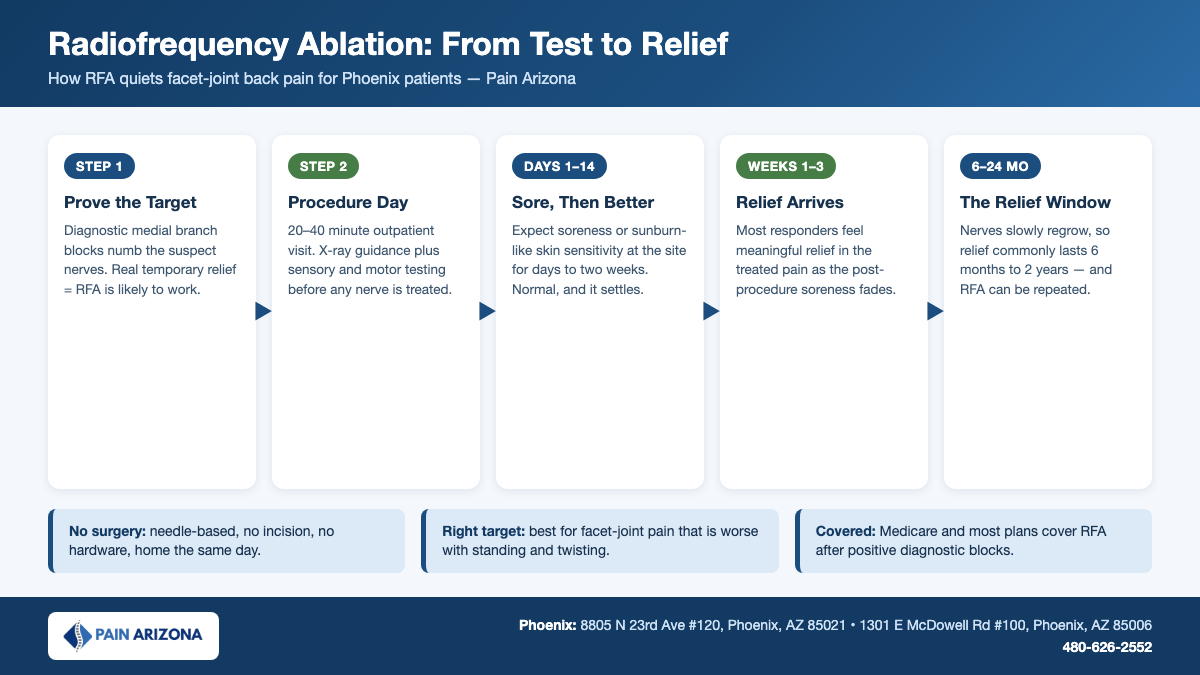
Radiofrequency Ablation Phoenix Patients Can Expect: The Procedure, Step by Step
Fear of the unknown is half the anxiety around any spine procedure, so let me walk you through the visit at our Phoenix offices on 23rd Avenue and McDowell Road.
Before. We review your imaging and your response to the diagnostic blocks, confirm the levels to be treated, and go over medications. Most patients need no sedation beyond local anesthetic, though light sedation is available for those who want it.
During. You lie face down on the procedure table. We numb the skin, then use fluoroscopy, a live X-ray, to guide a thin radiofrequency needle to each target nerve. Before any lesion is made, we test: a brief sensory stimulation to confirm we are at the right nerve, and a motor test to confirm we are safely away from anything that moves your legs. Only then is the tip heated, typically for about 90 seconds per nerve. Most sessions treat several nerves and take 20 to 40 minutes.
After. You are monitored briefly and go home the same day with a driver. Expect soreness at the treatment site for a few days to a couple of weeks, occasionally with odd sunburn-like sensitivity over the area. That is the nerve reacting, it is common, and it settles.
One standard I will state plainly: image guidance and stimulation testing are not optional extras. Any radiofrequency ablation Phoenix clinics perform should include both on every case. If a practice cannot describe its testing protocol in one sentence, keep looking, and verify your physician’s training yourself through the American Board of Medical Specialties.
The Honest Results Conversation: Relief, Duration, and Repeats
Now the part you actually care about. When the diagnostic blocks were properly positive, the majority of radiofrequency ablation Phoenix patients get meaningful relief in the treated pain, though how much varies from person to person. Relief usually arrives over one to three weeks as the post-procedure soreness fades, occasionally sooner, occasionally closer to a month.
Duration is where honesty matters most. The medial branch nerves regenerate slowly, so relief typically lasts somewhere in the range of six months to two years, with many patients landing around the one-year mark. When the pain returns, the procedure can usually be repeated with similar results, and many of my long-term patients simply build a repeat RFA into their routine the way they would any other maintenance of an aging joint.
Two more honest notes. First, RFA treats the pain signal, not the arthritis itself; your spine still deserves the strengthening and movement work that protects it, and the months of relief are the ideal window to do that work. Second, no responsible physician promises a specific result. I can tell you the odds are good when candidacy is confirmed properly, and I can tell you that for the right patient this is among the most satisfying procedures we do, because it converts a daily grind into something that no longer runs the calendar.
Cost, Insurance, and Why the Blocks Come First
The radiofrequency ablation Phoenix patients receive is a well-established, widely covered procedure. Medicare and most commercial plans cover it when facet-mediated pain is documented and diagnostic blocks are positive, which is one more reason the blocks come first: they are both good medicine and what your insurer requires. Your real out-of-pocket cost is usually your deductible, copay, or coinsurance rather than the sticker price, and the setting matters; office-based and surgery-center procedures generally cost less than the same procedure in a hospital outpatient department.
At Pain Arizona we verify your benefits before any procedure and tell you your estimated responsibility up front, and our insurance and financing page lays out the options if cost is a barrier. One call to 480-626-2552 starts that process. Surprise bills break trust, and trust is the foundation of everything we do.
Where RFA Fits in a Complete Phoenix Pain Plan
My mission at Pain Arizona is to save one million lives, and that mission has made me wary of any clinic built around a single procedure. Radiofrequency ablation is one rung on a ladder that runs from conservative care and targeted injections up through advanced options for the small group who need them. You can see the full range on our treatments page.
The reason that ladder matters: pain is not just physical. By the time most patients ask me about ablation, their back pain has been editing their life for years, shrinking their activity, their sleep, and sometimes their optimism. The procedure quiets the signal; the plan rebuilds the life. The patients who do best treat their months of relief as an opening, walking more, strengthening more, sleeping better, and arriving at their follow-up with a list of things they did rather than things they missed. That is the outcome we are actually after, and it is why the question I ask at every RFA follow-up is not “How is your back?” but “What did you get back?”
Frequently Asked Questions
Does radiofrequency ablation hurt?
The procedure itself is better tolerated than most patients expect. The local anesthetic sting at the skin is typically the most uncomfortable moment, and the stimulation testing feels like brief tapping or thumping. Afterward, plan on a sore back for several days to two weeks, sometimes with temporary skin sensitivity over the area. Most of our Phoenix patients describe the recovery as an annoyance, not an ordeal.
How long does the relief from RFA last?
Typically six months to two years, with many patients centering around a year. The treated nerves slowly regenerate, which is why relief is long-lasting rather than permanent. When pain returns, the procedure can usually be repeated with comparable results. Individual responses genuinely vary, which is why confirmed diagnostic blocks beforehand matter so much.
Is radiofrequency ablation the same as surgery?
No. There is no incision, no hardware, no general anesthesia, and no overnight stay. RFA is a needle-based outpatient procedure done through numbed skin under X-ray guidance, and most patients return to light normal activity within a day or two. It is frequently chosen precisely because it can delay or avoid the need to consider surgery at all.
Will my insurance cover radiofrequency ablation in Phoenix?
Usually, yes, when the clinical criteria are met. Medicare and most commercial plans cover the radiofrequency ablation Phoenix clinics perform for documented facet-related pain after positive diagnostic medial branch blocks. Requirements vary by plan, which is why our team verifies your specific benefits and explains your estimated costs before anything is scheduled. Call 480-626-2552 and we will check your plan for you.
The Bottom Line for Phoenix Patients
If your back pain is worse with standing and twisting, has outlasted conservative care, and your imaging shows wear in the facet joints, radiofrequency ablation deserves a place on your list of options, behind a proper evaluation and positive diagnostic blocks, never ahead of them. Done in the right patient, it is a brief outpatient procedure that commonly delivers months to years of substantial relief and can be repeated when needed. When you compare radiofrequency ablation Phoenix providers, choose board-certified training, insist on image guidance and stimulation testing, and pick a team that treats the person attached to the spine. After 17 years and thousands of these procedures, my advice is simple: the procedure is good, the plan around it is what changes lives.
— Dr. Paul Lynch is a double board-certified pain physician and anesthesiologist and CEO of Pain Arizona. Connect with him on LinkedIn.
This article is for educational purposes only and is not medical advice. It does not replace an evaluation by a licensed medical professional. Candidacy, risks, benefits, costs, and results vary from patient to patient; please consult a qualified physician about your specific situation.
Find out if radiofrequency ablation is the right next step for your back.
Pain Arizona – Phoenix
8805 N 23rd Ave #120, Phoenix, AZ 85021
1301 E McDowell Rd #100, Phoenix, AZ 85006
Call 480-626-2552