
There is a sentence I hear almost every week at our Mesa offices, and it is usually delivered with an apologetic shrug: “I figured it would go away on its own.” Sometimes the person saying it has been hurting for three months. Sometimes it has been three years. If you have been putting off back pain treatment Mesa has plenty of company for you, and I want to be clear from the start that this article is not here to scold anyone. I am Dr. Paul Lynch, CEO of Pain Arizona and a double board-certified pain care physician and anesthesiologist with 17 years in the Valley, and I understand exactly why people wait: backs often do get better on their own, life is busy, and nobody wants to be told they need surgery. But waiting is only the right strategy for some backs, for a limited time. My goal here is to help you tell the difference between pain that deserves patience and pain that is quietly asking you to stop waiting it out.
When Waiting Is Actually the Right Call
Let me start by being fair to the wait-and-see approach, because it has real medicine behind it. The majority of new episodes of back pain are what we call non-specific: a strain, a tweak, an angry few weeks after you moved the couch or overdid the yard work. Most of these improve substantially within four to six weeks with sensible self-care, which the National Library of Medicine’s back pain overview summarizes well: stay as active as you reasonably can, use heat or ice for comfort, use over-the-counter anti-inflammatories judiciously if your doctor says they are safe for you, and avoid prolonged bed rest, which tends to make backs worse, not better.
So if your pain is new, stays in your back, is improving week over week, and is not accompanied by any of the warning signs below, patience plus movement is a legitimate plan. The honest rule of thumb I give Mesa patients is this: a new, uncomplicated backache has earned about four to six weeks of self-care. After that, the odds that it resolves by itself start falling, and the case for a proper evaluation starts rising fast.
Back Pain Treatment Mesa Patients Should Not Postpone: 6 Signs
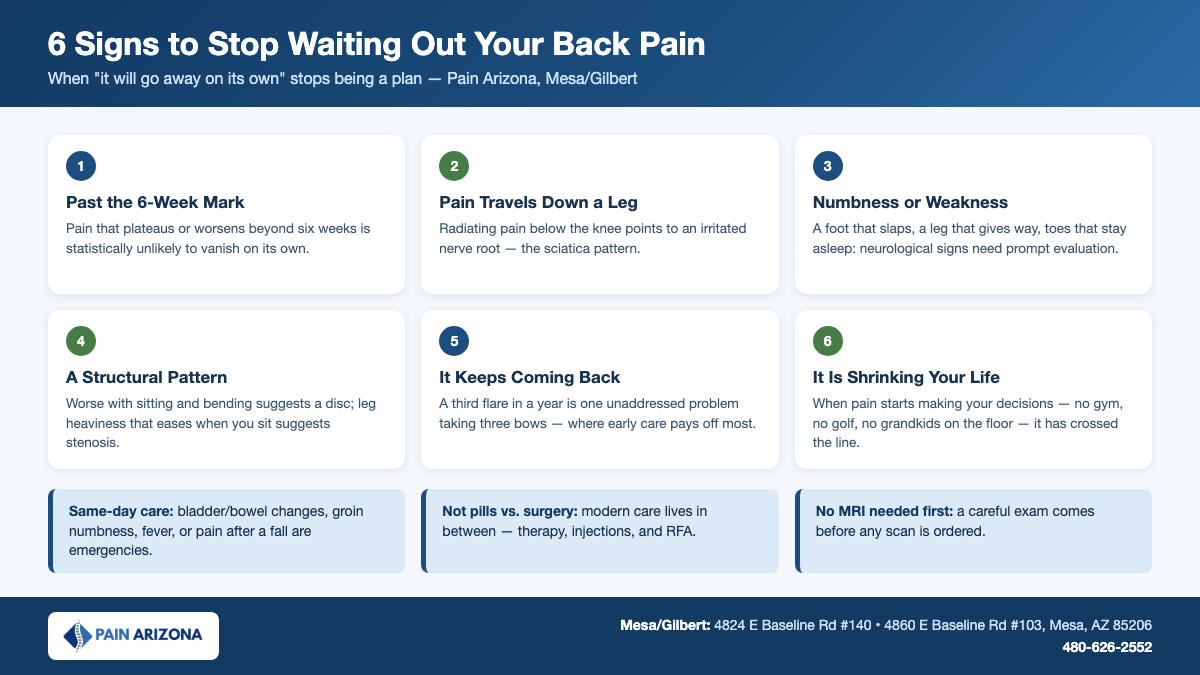
Here are the six signs that tell me, after 17 years of these conversations, that waiting has stopped being a strategy and started being a risk.
- 1. The pain has passed the six-week mark without clear improvement. Pain that plateaus or worsens beyond six weeks has declared itself. At that point it is statistically less likely to vanish on its own, and the deconditioning that comes with guarding it makes everything harder to fix later.
- 2. Pain is traveling down your leg. Radiating pain, especially below the knee, with or without tingling or numbness, suggests an irritated nerve root, the pattern most people know as sciatica. Nerve pain behaves differently from muscle pain and responds to different treatment.
- 3. Numbness, tingling, or weakness. A foot that slaps, a leg that gives way on the stairs, toes that stay asleep: these are neurological signs, not aches, and they deserve evaluation promptly rather than eventually.
- 4. The pattern fits a structural problem. Pain that is clearly worse with sitting and bending can point toward a herniated disc. Leg heaviness when you walk that eases when you sit or lean on the shopping cart is the classic signature of spinal stenosis. Patterns like these rarely wait themselves better.
- 5. It keeps coming back. A third flare in a year is not three separate bad weeks; it is one unaddressed problem taking three bows. Recurring episodes are precisely where early, targeted care pays off most.
- 6. It is shrinking your life. You have quietly stopped the gym, the golf, the grandkids on the floor, the long drives. When pain starts making your decisions for you, it has crossed the line from symptom to condition, whatever the MRI says.
One more category stands apart: red flags that mean same-day medical attention, not an eventual appointment. New loss of bladder or bowel control, numbness in the groin or inner thighs, back pain with fever, pain after a significant fall or accident, or unexplained weight loss alongside back pain. These are rare, and they are emergencies. Please do not wait on any of them.
Recognize yourself in these signs? Our Mesa team will find out what is actually going on.
Pain Arizona – Mesa/Gilbert
4824 E Baseline Rd #140, Mesa, AZ 85206
4860 E Baseline Rd #103, Mesa, AZ 85206
Call 480-626-2552
Why Waiting Too Long Makes Back Pain Harder to Treat
Patients sometimes assume that waiting is at worst neutral, that the problem simply sits there unchanged until they get around to it. I wish that were true. Three things tend to happen while chronic back pain waits.
The body compensates. You shift your gait, favor one side, stop bending. Within months, the hips, the opposite side of the back, and the hamstrings are carrying loads they were never meant to carry, and now there are two or three sore regions where there used to be one.
The body deconditions. Guarding a painful back means moving less, and moving less weakens exactly the muscles that stabilize the spine. It is a quiet spiral: pain reduces activity, reduced activity weakens support, weaker support worsens pain.
The nervous system learns the pain. This is the part medicine has come to understand much better during my career. Pain signals that fire for months can sensitize the system that carries them, so the alarm keeps ringing louder than the damage justifies. This is one of many reasons I tell patients that pain is not just physical; untreated pain rewires sleep, mood, and the nervous system itself, and the longer that goes on, the more patient and layered the treatment has to be.
None of this means a long-standing back is hopeless; we help patients every week who waited years. It simply means the earlier version of your problem was easier to treat than the current one, and the current one is easier than next year’s. On the question of timing for back pain treatment Mesa patients rarely regret coming in too early. I have never once heard the opposite regret expressed kindly.
What Modern Treatment Actually Looks Like (It Is Not Pills or Surgery)
Here is the misconception that keeps more Mesa patients on the couch than any other: the belief that seeking back pain treatment Mesa clinics offer means choosing between a lifetime of pills and an operation. Modern interventional pain medicine exists almost entirely in the territory between those two extremes, and that territory is wide.
A well-run evaluation starts with an examination and a real conversation, reviews your imaging with you in plain language, and identifies the likely pain generator: muscle, disc, nerve root, facet joint, or SI joint. The plan then starts conservative and escalates only as needed:
- Foundation first. Activity modification, a structured physical therapy program, and honest coaching about movement, sleep, and pacing. For a meaningful share of patients, done properly, this is enough.
- Targeted injections where inflammation is the driver. An epidural steroid injection can calm an inflamed nerve root from a disc herniation or stenosis, often converting a miserable leg into a workable rehab window.
- Longer-lasting options where joints are the driver. For facet-related pain, radiofrequency ablation can quiet the nerves that carry the joint’s pain signal for months to a year or more at a time.
- Advanced options for the few who need them. A small minority of patients with stubborn nerve pain benefit from technologies like spinal cord stimulation, and a smaller minority still are best served by a surgical consultation. In a conservative-first practice, those referrals are made honestly and rarely.
Notice what that ladder is designed to do: resolve your pain at the lowest effective rung. That philosophy is the heart of the back pain treatment Mesa patients get from our team. My mission at Pain Arizona is to save one million lives, and the unglamorous truth is that most of those saves look like a retiree in Mesa getting an accurate diagnosis, a targeted treatment, and their morning walk back, without ever seeing an operating room.
What to Expect From a First Visit at Our Mesa Offices
If you decide to stop waiting, here is what the first step actually involves at our Mesa/Gilbert offices on Baseline Road, because knowing the standard also helps you vet any back pain treatment Mesa clinics advertise. You will be asked about your pain history in detail: when it started, what makes it better and worse, what you have already tried, and what it is costing you in sleep, work, and daily life. You will be examined, not just imaged. If you have prior MRIs or X-rays, bring them; if imaging is needed, we will explain why before ordering it. And you should leave with a staged plan, in plain language, including what we try first, what we try if that is not enough, and when we will know. Credentials matter here as everywhere: you can verify any physician’s board certification yourself through the American Board of Medical Specialties, and I encourage you to do exactly that, with us or anyone else.
Insurance should never be the mystery that keeps you waiting, either. Our team verifies benefits before your visit and explains your estimated costs up front. One call to 480-626-2552 answers both questions at once: what is wrong, and what it will take to fix it.

Frequently Asked Questions
How long should I wait before seeing a doctor for back pain?
For a new, uncomplicated backache with no warning signs, four to six weeks of sensible self-care is reasonable. Seek evaluation sooner if the pain radiates down a leg, involves numbness or weakness, follows an accident, or comes with fever or bladder or bowel changes, the last of which warrants same-day care. And if the pain has already been there for months, the six-week clock expired long ago; the next good time is now.
Do I need an MRI before coming in?
No. Bring any imaging you already have, but do not wait on getting a scan to be seen. A careful history and examination often tell us more than an early MRI, many backaches never need one, and when imaging is genuinely indicated we will order the right study and review it with you in plain language.
Will I be pushed toward surgery or opioids?
Not at our practice, and you should not accept it anywhere. Modern interventional pain care exists largely to help patients avoid both. We start conservative, escalate thoughtfully, and reserve advanced interventions for patients who genuinely need them. Surgery is a referral we make honestly when it is the right answer, which is far less often than most patients fear.
What does back pain treatment in Mesa cost with insurance?
For most of the back pain treatment Mesa patients receive from us, the real cost is a specialist copay for the evaluation, and procedure costs depend on your deductible and plan. Medicare, most commercial plans, and many AHCCCS plans cover medically necessary interventional pain care. We verify your benefits before your visit and before any procedure, so you will have a real number instead of a guess. Call 480-626-2552 and we will check your plan.
The Bottom Line: Give It Six Weeks, Not Six Years
If your back pain is new, mild, and improving, be patient with it, keep moving, and let your body do what it usually does. But if you have passed six weeks, if the pain travels, tingles, or weakens, if it keeps returning, or if it has started making your decisions for you, then waiting it out has quietly stopped working and something better is available. The right back pain treatment Mesa patients need is almost never dramatic: an accurate diagnosis, the least invasive effective option, and a team that treats the whole person, because pain is not just physical. You have already given this problem enough of your year. Let’s find out, together, what is actually going on, and get you back to the life the pain has been editing.
— Dr. Paul Lynch is a double board-certified pain physician and anesthesiologist and CEO of Pain Arizona. Connect with him on LinkedIn.
This article is for educational purposes only and is not medical advice. It does not replace an evaluation by a licensed medical professional. Treatment options, risks, costs, and results vary from patient to patient; please consult a qualified physician about your specific situation.
Stop waiting it out. Our Mesa team is ready to listen.
Pain Arizona – Mesa/Gilbert
4824 E Baseline Rd #140, Mesa, AZ 85206
4860 E Baseline Rd #103, Mesa, AZ 85206
Call 480-626-2552