
Almost every week at our Glendale clinic on Thunderbird Road, a new patient sets a plastic bag of pill bottles on the exam table and says some version of the same thing: “I’ve tried everything, and none of it really works anymore.” If you are searching for pain management Glendale AZ options because the pills have stopped helping, or because you are tired of how they make you feel, this article is for you. I am Dr. Paul Lynch, CEO of Pain Arizona and a double board-certified pain care physician and anesthesiologist with 17 years in the Valley. I want to walk you through the honest difference between managing pain with medication alone and treating it with interventional pain management, because they are not the same strategy, and understanding the difference can change the next ten years of your life.
Two Very Different Philosophies of Pain Care
Medication-centered care and interventional care start from different questions. A medication-first approach usually asks, “How do we make this person feel less pain today?” That is a reasonable question, and for short-term injuries it is often the right one. An interventional approach asks a different question: “Where exactly is this pain coming from, and can we treat that source directly?”
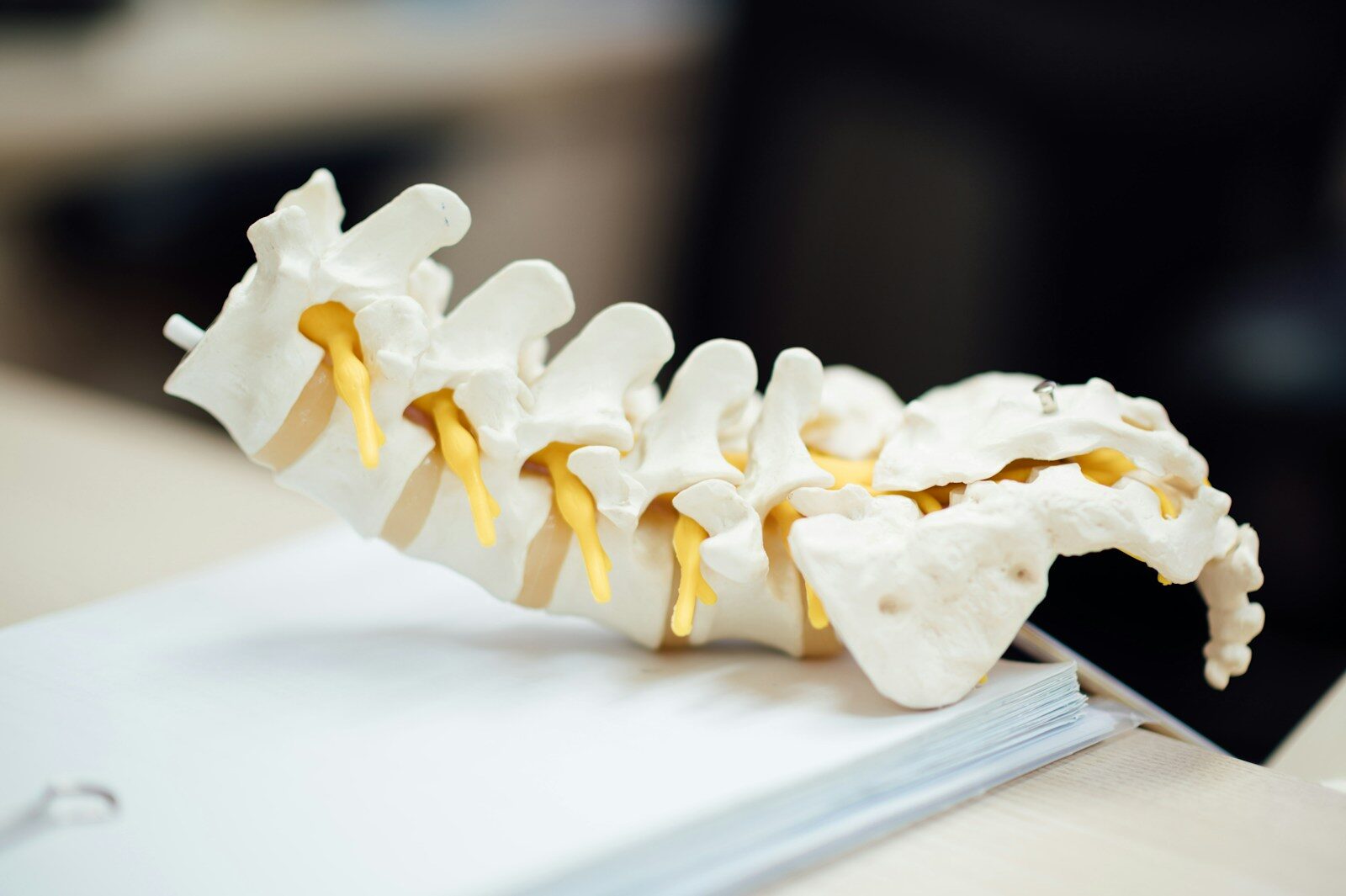
That difference sounds subtle, but it drives everything that follows. Pills travel through your entire bloodstream to reach one irritated nerve or one arthritic joint. Every other organ, including your stomach, liver, kidneys, and brain, comes along for the ride. Interventional pain management uses precise, image-guided procedures to deliver treatment to the specific structure generating your pain, whether that is an inflamed nerve root, a worn facet joint, or an irritated sacroiliac joint.
Neither philosophy is evil, and I am not anti-medication. I prescribe medications every week, and for many patients they are a useful part of a plan. What I am against is medication as the entire plan, year after year, with doses creeping upward and nobody stopping to ask whether the underlying problem has ever been properly diagnosed.
Why Pain Pills Alone Often Stop Working
Most of the patients who come to us for pain management Glendale AZ residents trust have not failed treatment. Their treatment has failed them, usually for one of a few predictable reasons.
- Pills treat the volume, not the source. An anti-inflammatory or an opioid can turn down how loudly pain registers, but it does nothing to the herniated disc, the arthritic joint, or the compressed nerve that keeps producing the signal.
- Tolerance is real. With some medications, especially opioids, the body adapts over time, and the same dose often delivers less relief than it once did.
- Side effects accumulate. Stomach irritation, constipation, drowsiness, mental fog, and effects on the kidneys or liver can quietly add up, particularly in older adults who take several medications.
- Life shrinks around the schedule. Patients plan driving, work, and family time around when the next dose kicks in or wears off. That is not a life; it is a timetable.
The National Library of Medicine’s consumer guide to pain relievers describes the main medication classes and their risks in plain language, and I recommend every patient read it. Understanding what you are taking is the first step to deciding whether it is still the right tool.
Tired of managing your life around pill bottles? Let our Glendale team find the source.
Pain Arizona – Glendale
5757 W Thunderbird Rd W310, Glendale, AZ 85306
Call 480-626-2552
What Interventional Pain Management Glendale AZ Patients Receive
“Interventional” is a big word for a straightforward idea: diagnose precisely, then treat precisely. When you visit our Glendale pain management clinic, the first visit is about understanding, not prescribing. We take a detailed history, examine you, review any imaging, and form a hypothesis about which structure is generating your pain. Then we choose treatments matched to that structure. Common options include:
- Epidural steroid injections for pain that radiates down an arm or leg from an inflamed nerve root, often due to a herniated disc or spinal stenosis.
- Facet joint injections and medial branch blocks for back or neck pain that worsens with standing, twisting, or bending backward.
- Radiofrequency ablation, which can quiet the small sensory nerves that carry arthritic joint pain, often for many months at a time.
- Joint injections for knees, hips, shoulders, and the sacroiliac joint, frequently helpful for arthritis pain.
- Spinal cord stimulation for a smaller group of patients with persistent nerve pain who have not responded to other treatments.
Most of these are outpatient procedures performed under live X-ray guidance, take well under an hour, and let you go home the same day. Many patients are back to light activity within a day or two. And here is a point people often miss: some of these procedures are also diagnostic. If numbing a specific nerve makes your pain disappear for a few hours, we have learned exactly where the pain lives. That kind of certainty is something a pill can never give you.
A Side-by-Side Comparison
When patients ask me to compare the two approaches directly, I usually sketch something like this on the whiteboard in our exam room:
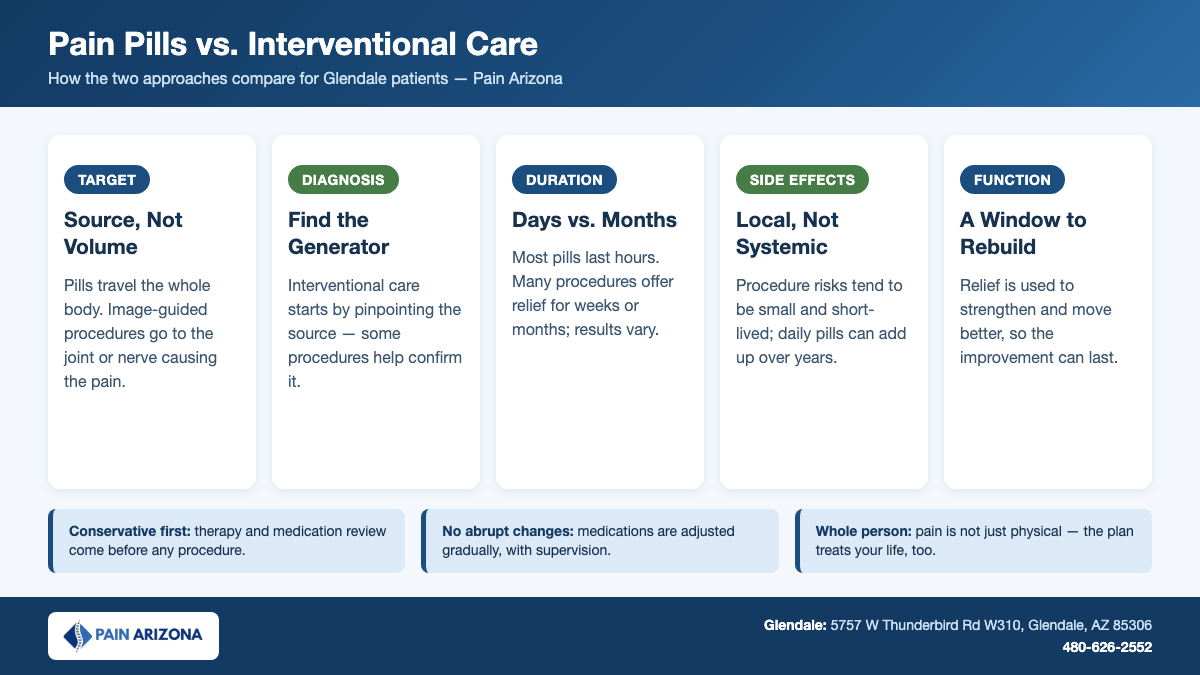
- Target: Pills act on the whole body. Interventional procedures act on the specific joint, nerve, or tissue generating the pain.
- Diagnosis: Pills can be prescribed without knowing the exact source. Interventional care depends on identifying it, and some procedures help confirm it.
- Duration: Most pills last hours and must be repeated daily. Many interventional treatments provide relief measured in weeks or months, though results vary from person to person.
- Side effects: Pills carry systemic side effects that can build over time. Interventional procedures carry their own small risks, such as soreness, temporary numbness, or, rarely, infection, but they tend to be localized and short-lived.
- Function: Pills may dull pain without improving movement. Interventional relief is often used as a window to rebuild strength and mobility through therapy and exercise.
None of this means interventional care is right for everyone. Some patients do well on a modest, stable medication regimen, and that is perfectly fine. The point is that you deserve to know your options, and too many people in the West Valley were never told they had any. Good pain management Glendale AZ patients can rely on puts both columns on the table and lets you decide with full information.
Conservative First: How We Build a Plan at Our Glendale Clinic
You might expect an interventional physician to rush every patient to the procedure room. I do the opposite. My philosophy has always been conservative first, and that applies to how we approach pain management Glendale AZ patients receive at our Thunderbird Road office.
For a typical new patient, a plan might look like this. First, a precise diagnosis based on history, exam, and imaging when it is truly needed. Second, conservative care: physical therapy, targeted exercise, sleep and activity changes, and a careful review of your current medications, sometimes reducing or simplifying them. Third, if pain persists and the source is clear, a targeted procedure chosen to fit that source. Fourth, a follow-up plan that uses any relief window to rebuild strength so the improvement lasts.
That staged approach matters because pain is not just physical. Chronic pain wears down sleep, mood, relationships, and confidence. A patient who has spent five years building life around a pill schedule often needs more than a procedure; they need a plan that helps them reclaim the parts of life they quietly gave up. That is why our mission at Pain Arizona is to save one million lives, not one million spines. The treatment is a tool. The life is the goal.
Want a conservative-first plan built around the real source of your pain?
Pain Arizona – Glendale
5757 W Thunderbird Rd W310, Glendale, AZ 85306
Call 480-626-2552
What About the Medications You Take Now?
One of the most common fears I hear is, “If I come to a pain clinic, are you going to take my medication away?” The honest answer is no, not abruptly and not without a conversation. Stopping certain medications suddenly can be uncomfortable and, in some cases, unsafe. Any change to your regimen should be gradual, supervised, and agreed upon together.
What often happens instead is that, as targeted treatment reduces the pain at its source, many patients find they need less medication on their own. They choose to cut back because they simply do not need as much. That is a very different experience from being told to stop, and it tends to stick. If you are worried about the long-term effects of what you are taking, the federal MedlinePlus chronic pain resource is a good, balanced place to start learning about alternatives to discuss with your doctor.
Bring every medication you take to your first pain management Glendale AZ appointment, including over-the-counter pain relievers and supplements. The full picture helps us spot interactions, duplications, and opportunities to simplify, which is one of the most valuable things a pain management Glendale AZ specialist can do for you.
Who Is a Good Candidate for Interventional Care?
Interventional pain management tends to make the most sense for people who:
- Have pain that has lasted longer than about three months despite rest, medication, or therapy
- Have a pain pattern that points to a specific structure, such as leg pain from a nerve root or back pain from facet joints
- Are experiencing side effects from medication, or want to avoid long-term medication use
- Want to stay active, keep working, or avoid or delay surgery
- Have been told “there’s nothing more we can do” without ever having a precise diagnosis
It may not be the first step for someone with a brand-new injury that is improving on its own, or for someone whose medical conditions make a particular procedure inappropriate. That is exactly why an individual evaluation matters. A good pain specialist should be just as willing to tell you that you do not need a procedure as to recommend one. Before you commit to any clinic offering pain management Glendale AZ residents can choose from, it is reasonable to verify the physician’s board certification through the American Board of Medical Specialties.
Frequently Asked Questions
Is interventional pain management safer than taking pain pills long-term?
It depends on the person and the treatment, but for many patients, targeted procedures carry fewer cumulative whole-body side effects than daily medication over years. Every procedure has its own risks, which are usually small and localized, and your physician should walk you through them. The safest plan is the one matched to your diagnosis, your health history, and your goals.
Do injections and procedures hurt?
Most patients tolerate them better than they expect. We numb the skin first, and the procedures are guided by live X-ray for precision. You may feel pressure and some soreness afterward for a few days. Light sedation is available for some procedures if you are anxious, and our Glendale team will talk you through every step before we begin.
Will I still be able to take medication if I choose interventional care?
Yes. Interventional care and medication are not mutually exclusive. Many patients use both, especially early in their treatment. Over time, as targeted treatment reduces pain at its source, many people choose to reduce their medications gradually, always with medical supervision and never abruptly.
How do I get started with pain management in Glendale?
Call 480-626-2552 or use our scheduling page to book an evaluation at our Glendale clinic at 5757 W Thunderbird Rd. Bring your medication list, any imaging you have, and a short history of what you have already tried. Our team will verify your insurance benefits and explain your estimated costs before any procedure is scheduled.
The Bottom Line: A Better Path Is Usually Available
If your current plan consists of refilling prescriptions and hoping next month is better, you deserve a second look. Medication can be a helpful part of care, but for many people living with chronic back, neck, joint, or nerve pain, it should not be the whole story. Interventional pain management offers something pills cannot: a precise diagnosis and a treatment aimed squarely at the source, followed by a plan to rebuild the life the pain took from you. You can explore the full range of options on our treatments page. After 17 years of caring for patients across the Valley, I have seen that path change lives over and over again, and the best pain management Glendale AZ families can find starts with someone willing to ask where the pain is really coming from.
— Dr. Paul Lynch is a double board-certified pain physician and anesthesiologist and CEO of Pain Arizona. Connect with him on LinkedIn.
This article is for educational purposes only and is not medical advice. It does not replace an evaluation by a licensed medical professional. Never stop or change a prescribed medication without talking to your doctor. Candidacy, risks, benefits, costs, and results vary from patient to patient; please consult a qualified physician about your specific situation.
Ready to explore a path beyond pain pills? Start with an evaluation in Glendale.
Pain Arizona – Glendale
5757 W Thunderbird Rd W310, Glendale, AZ 85306
Call 480-626-2552