
Left Temple Throbbing and Your Hormones: What the Connection Means
I’m Dr. Nasser from Pain Arizona. If you experience intense, pulsating discomfort on one side of your head, understanding how left temple headache hormones interact with your vascular and nervous systems is essential for finding lasting relief. Cyclical drops in estrogen and neurochemical shifts frequently trigger unilateral migraine attacks by sensitizing cranial nerve pathways.
The Biological Link: Left Temple Headache Hormones and Vascular Pain
To understand why a hormonal shift can cause intense throbbing in your left temple, we have to look closely at the neurological and vascular systems inside the brain. The primary biochemical driver behind these headaches is estrogen. Beyond its role in reproduction, estrogen acts as a natural neurosteroid and pain modulator in the central nervous system. It directly influences how brain cells communicate, regulates blood vessel dilation, and dampens pain transmission pathways.
When estrogen levels fall rapidly—most notably right before menstruation or during hormone withdrawal phases—this natural neuroprotective shield drops. The brain’s pain processing center becomes hyperexcitable.
This cascade activates the trigeminovascular system, a complex network of sensory nerves wrapping around the blood vessels of the brain’s outer covering (the meninges). Once triggered, these nerve fibers release potent inflammatory signaling molecules, prominently calcitonin gene-related peptide (CGRP), substance P, and neurokinin A. The sudden release of CGRP triggers sterile neurogenic inflammation and local vasodilation.
At the cellular level, fluctuating sex hormones also increase susceptibility to cortical spreading depression (CSD)—a slowly propagating wave of neuronal and glial depolarization across the cerebral cortex known to trigger migraine auras and activate downstream trigeminal pain pathways (Martinez et al., 2023). For a detailed dive into the biochemical interactions of estrogens, progesterone, and androgens on neural tissue, molecular mechanisms of sex hormones in migraine provide essential scientific insight.
How Left Temple Headache Hormones Fluctuate Across the Menstrual Cycle
Throughout a typical menstrual cycle, estrogen rises and falls across distinct phases:
- Early Follicular Phase: Estrogen and progesterone sit at baseline low levels.
- Late Follicular / Ovulatory Phase: Estrogen spikes significantly to trigger ovulation, which can provoke mid-cycle headaches in some individuals.
- Luteal Phase: Progesterone climbs alongside a secondary rise in estrogen.
- Late Luteal / Perimenstrual Window: If pregnancy does not occur, both estrogen and progesterone plummet precipitously.
This late-luteal estrogen withdrawal—often defined as the window from two days before bleeding starts through the third day of menstruation—is the most volatile period for migraine sufferers. Research shows that menstrual migraine attacks can last up to 35% longer than non-menstrual migraines and are notably more resistant to standard acute medications.
In addition to estrogen withdrawal, uterine tissue releases a surge of prostaglandins into the systemic circulation during shedding. These inflammatory lipids promote uterine cramping while simultaneously increasing systemic pain sensitivity and intracranial vessel reactivity.
Emerging neuroendocrine studies have also uncovered a parallel decline in oxytocin alongside estrogen drops. Because oxytocin acts on specific receptors within the trigeminal ganglion to dampen nociceptive signaling, losing this peptide leaves pain circuits disinhibited. Recent research linking oxytocin and neuroinflammation in menstrual migraine underscores how multiple hypothalamic pathways converge to amplify attack severity during the menstrual window.
The Trigeminal Pathway and One-Sided Temple Throbbing
Why does the pain settle so specifically over the left temple?
The trigeminal nerve (Cranial Nerve V) provides the primary sensory innervation for the face, scalp, meninges, and intracranial vessels. It branches into three distinct divisions: the ophthalmic branch ($V1$), the maxillary branch ($V2$), and the mandibular branch ($V_3$).
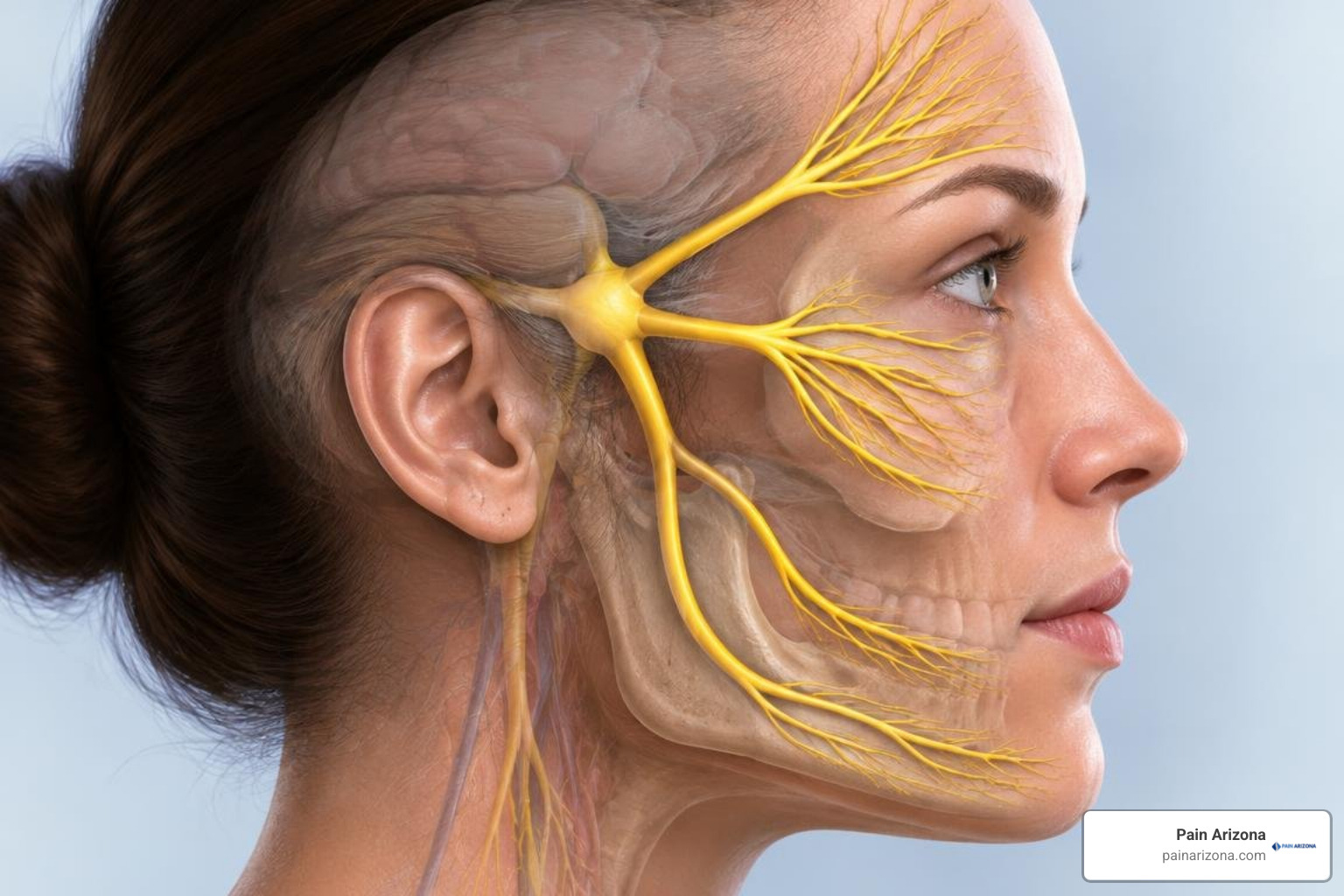
The ophthalmic branch ($V1$) innervates the meningeal arteries, the forehead, the orbit, and the temple region. When the trigeminovascular system ignites, inflammatory signals travel along these $V1$ pathways back toward the brainstem’s trigeminocervical complex.
Migraine is inherently a unilateral phenomenon in the majority of sufferers. Although systemic hormone fluctuations circulate throughout the entire body, the neurological threshold for firing is rarely completely symmetrical. Minor baseline asymmetries in vascular tone, trigeminal nerve branch arborization, or previous mechanical irritation can make the left trigeminal pathway cross its activation threshold first. Once central sensitization develops on the left side, every arterial pulsation against the inflamed perivascular nerves is registered as a pounding, throbbing ache directly over the left temple.
Hormonal Transitions: Birth Control, Pregnancy, and Perimenopause
Hormonal headaches are not static; they shift dramatically across reproductive milestones and medication changes:
- Combined Hormonal Contraceptives: Standard 21/7 oral contraceptive packs feature a 7-day placebo week designed to induce withdrawal bleeding. This artificial drop in synthetic ethinyl estradiol mimics the natural perimenstrual drop, frequently triggering severe left temple migraines during the pill-free days. Switching to extended-cycle or continuous regimens can prevent this drop.
- Pregnancy: During the second and third trimesters, circulating estrogen and progesterone rise steadily to sustained, stable high levels without cyclical fluctuations. As a result, 50% to 80% of women with hormonal migraines experience substantial relief or complete remission during this period.
- Perimenopause: The transition toward menopause is characterized by unpredictable hormonal volatility rather than a smooth decline. Erratic estrogen spikes followed by steep, sudden drops often make perimenopause the most challenging life stage for migraine sufferers, leading to increased attack frequency and refractory temple pain.
- Menopause: Once ovarian hormone production ceases and postmenopausal hormone levels stabilize at a constant baseline, up to two-thirds of women see their migraines lessen significantly or disappear entirely.
To explore how these fluctuating biological cycles drive female migraine susceptibility across populations, read more about estrogen withdrawal and migraine research.
Evidence-Based Relief: Medical Treatments and Preventative Therapies
Managing hormone-driven left temple headaches requires a dual approach: stopping acute attacks quickly and stabilizing underlying neurochemical pathways before pain starts. Comprehensive clinical insights from the Mayo Clinic guide on headaches and hormones highlight the importance of pairing abortive precision with targeted prevention.
Medical Treatments for Left Temple Headache Hormones and Pain Relief
When treating hormonal migraines, standard treatment strategies are categorized into acute rescue therapies, perimenstrual “mini-prevention” (short-term prophylaxis timed strictly to vulnerable cycle days), and daily systemic prevention.
| Medication Category | Drug Name(s) & Route | Primary Mechanism of Action | Clinical Role & Timing |
|---|---|---|---|
| Long-Acting Triptans | Frovatriptan (2.5 mg oral), Naratriptan (1–2.5 mg oral) | $5\text{-HT}_{1\text{B}/1\text{D}}$ receptor agonists; constrict dilated vessels and block neurogenic peptide release | Mini-Prevention & Acute: Taken twice daily starting 2 days prior to expected bleeding, continued for 5–7 days. |
| Targeted NSAIDs | Naproxen sodium (500–550 mg oral), Mefenamic acid | Non-selective COX inhibition; blocks prostaglandin synthesis and reduces neurovascular inflammation | Perimenstrual Prophylaxis: Started 2–3 days before cycle onset to blunt prostaglandin surges. |
| CGRP Receptor Antagonists (Gepants) | Rimegepant (75 mg oral), Ubrogepant (50–100 mg oral), Atogepant | Small-molecule CGRP receptor antagonists; directly block calcitonin gene-related peptide | Acute & Preventative: Excellent safety profile; avoids vasoconstriction; ideal for patients who do not tolerate triptans. |
| CGRP Monoclonal Antibodies | Erenumab, Fremanezumab, Galcanezumab, Eptinezumab (Injectable/IV) | Monoclonal antibodies targeting either the CGRP ligand or its primary receptor | Chronic Daily Prevention: Monthly or quarterly administration for high-frequency or refractory menstrual migraines. |
| Transdermal Estradiol | $17\beta\text{-estradiol}$ patch (0.1 mg / 24 hr transdermal) | Delivers stable, continuous estrogen absorption to smooth out endogenous luteal drops | Mini-Prevention: Applied 48 hours prior to anticipated menses and worn for 6–7 consecutive days. |
Critical Safety Consideration (Migraine with Aura): Combined oral contraceptive pills containing synthetic estrogen are strictly contraindicated in patients who experience migraine with aura (such as visual scintillations, blind spots, or sensory tingling preceding headache onset). The presence of aura combined with exogenous oral estrogens significantly elevates the relative risk of ischemic stroke. In these patients, non-hormonal preventatives, progestin-only options, or transdermal hormone formulations under strict neurological guidance must be used.
Targeted Supplements: Magnesium, Riboflavin, and CoQ10
Nutraceuticals play an evidence-based role in stabilizing neural thresholds, reducing mitochondrial oxidative stress, and supporting neurotransmitter regulation:
- Magnesium (400–600 mg daily, as Magnesium Glycinate, L-Threonate, or Oxide): Intracellular magnesium regulates NMDA receptor gating and prevents spontaneous cortical spreading depression. Serum and intracellular magnesium concentrations drop by up to 15% during the late luteal phase. Daily supplementation—or targeted increases 15 days into the cycle through menstruation—reduces attack frequency and restores neurovascular tone.
- Riboflavin / Vitamin B2 (400 mg daily): Riboflavin serves as a vital cofactor in mitochondrial electron transport chain complexes. Clinical studies demonstrate that sustained 400 mg daily dosing over three months can cut migraine attack frequency by up to 50% by enhancing cellular energy reserves within the cerebral cortex.
- Coenzyme Q10 (150–300 mg daily): CoQ10 functions as an essential antioxidant and bioenergetic transporter in mitochondrial respiration, helping decrease neuroinflammatory cytokine expression.
- Omega-3 Fatty Acids (1,000–2,000 mg EPA/DHA daily): High-dose eicosapentaenoic acid (EPA) competitively inhibits arachidonic acid conversion into pro-inflammatory series-2 prostaglandins, reducing vascular hypersensitivity.
Non-Pharmacological and Lifestyle Strategies
Because the hormonally sensitized brain has a lower threshold for external stressors, maintaining neurobiological homeostasis is essential:
- Sleep Schedule Regularity: Irregular sleep cycles disrupt hypothalamic melatonin and orexin signaling, directly triggering trigeminal activation. Maintain identical bedtimes and wake times within a 30-minute window, even on weekends.
- Blood Glucose Stabilization: Reactive hypoglycemia triggers adrenaline and cortisol surges that promote intracranial vasospasm. Consume balanced meals featuring complex carbohydrates, lean protein, and healthy fats every 3 to 4 hours; avoid skipping meals during the luteal window.
- Proactive Hydration Protocols: Dehydration reduces intravascular volume, promoting vascular headache cascades. Aim for 2 to 2.5 liters of water daily, supplemented with balanced electrolytes during high-temperature months.
- Targeted Cold Application: Placing an ice pack or gel compress over the left temple and the base of the skull causes local superficial vasoconstriction and slows conduction along peripheral sensory nerve fibers, offering fast, drug-free symptom relief.
- Neuromodulation Devices: Non-invasive external trigeminal nerve stimulators (e-TNS) and remote electrical neuromodulation (REN) provide targeted, medication-free abortive and preventative therapy by modifying central pain gating.
Distinguishing Hormonal Attacks from Musculoskeletal and Secondary Causes
While cyclical timing strongly points toward hormones, the left temple is also a frequent site of pain referred from the musculoskeletal structures of the neck, jaw, and cranial vasculature.
Cervicogenic Tension and Musculoskeletal Triggers
A major source of non-hormonal temple throbbing is cervicogenic referral. The upper three cervical spinal nerves ($C1, C2, C3$) converge directly onto the trigeminocervical nucleus in the upper spinal cord—the same anatomical relay hub that processes sensory information from the ophthalmic ($V1$) branch of the trigeminal nerve.
When postural strain, facet joint irritation, or suboccipital muscle spasms develop in the neck, aberrant nociceptive signals flood the trigeminocervical nucleus. The brain frequently misinterprets these upper neck signals as originating from the left temple or eye.
Furthermore, hormonal changes can indirectly worsen musculoskeletal pain: during the premenstrual phase, circulating relaxin and systemic inflammatory cytokines can increase joint laxity, muscle guarding, and cervical tenderness. If your left temple throbbing starts in your suboccipital neck or shoulder before moving forward, evaluating for underlying cervical spine dysfunction is an essential diagnostic step in unmasking the causes of one-sided head pain.
Red-Flag Symptoms and When to Seek Medical Evaluation
While the vast majority of cyclical left temple headaches represent benign primary headache disorders, specific “red flag” symptoms require immediate neurological evaluation and diagnostic imaging (MRI or CT) to rule out life-threatening secondary conditions:
- Thunderclap Onset: Severe pain that peaks within 60 seconds (requires immediate emergency evaluation for subarachnoid hemorrhage).
- Temporal Tenderness in Patients Over 50: A prominent, tender, or non-pulsatile superficial temporal artery on the left side, often accompanied by jaw claudication, scalp pain when brushing hair, or sudden vision loss, points toward temporal arteritis (giant cell arteritis)—a medical emergency requiring prompt ESR/CRP testing and corticosteroid therapy to prevent permanent blindness.
- Focal Neurological Deficits: New weakness, facial asymmetry, slurred speech, ataxia, or confusion (concerning for ischemic or hemorrhagic stroke).
- Systemic Features: Unexplained fever, stiff neck, night sweats, significant weight loss, or known active malignancy.
- Positional Headaches: Pain that changes significantly when transitioning between lying flat and standing upright (concerning for intracranial pressure anomalies).
Frequently Asked Questions About Hormonal Headaches
Why does my hormonal migraine always strike on the left side?
Migraine pain is processed through the trigeminal nerve pathways. Although systemic hormone fluctuations circulate uniformly through the entire bloodstream, individual anatomy is rarely perfectly symmetrical.
Baseline differences in vascular architecture, past physical trauma, localized nerve sensitivity, or unilateral muscle tension in the left upper neck can make the left trigeminal pathway more reactive. When estrogen levels drop, it lowers the overall threshold for pain processing across the entire brain—and the side with higher baseline sensitivity fires first, localizing the throbbing sensation directly to the left temple.
Can estrogen patches prevent menstrual migraines?
Yes. For individuals with predictable menstrual migraines who do not have contraindications (such as migraine with aura), low-dose transdermal $17\beta\text{-estradiol}$ patches (typically 0.1 mg per 24 hours) can be applied 48 hours prior to the anticipated drop in estrogen and worn throughout the vulnerable cycle window.
Because transdermal delivery provides a steady, controlled absorption of natural estradiol directly into the blood without first-pass hepatic metabolism, it effectively smoothes out the rapid hormonal drop, preventing the trigeminovascular activation that triggers the headache.
How long do hormone-triggered left temple headaches typically last?
Hormone-related migraines are clinically recognized for lasting longer and resisting standard abortive treatments compared to non-hormonal attacks. While an episodic non-menstrual migraine typically resolves within 4 to 24 hours with treatment, a menstrual migraine frequently lasts 48 to 72 hours or longer, occasionally recurring over several consecutive days during the menstrual window.
This extended duration occurs because endogenous hormone levels remain low throughout the bleeding phase, keeping the underlying trigeminovascular pain pathway sensitized until hormone levels begin their follicular recovery.
Conclusion
A recurring, throbbing left temple headache is rarely an isolated symptom. It reflects complex interactions between your neurovascular pathways, fluctuating sex hormones, and cervical musculoskeletal health. When estrogen levels fall, the sudden loss of natural neurochemical protection can activate the trigeminal nerve, trigger local neurovascular inflammation, and produce debilitating, one-sided pain.
At Pain Arizona, we specialize in comprehensive, evidence-based chronic pain management for patients across the Greater Phoenix Area, including our clinics in Phoenix, Mesa, Gilbert, Scottsdale, and Glendale. Our double board-certified physicians take a thorough multidisciplinary approach—combining advanced neurological assessments, targeted hormonal strategies, state-of-the-art non-opioid medications, and minimally invasive interventional treatments to resolve the true root cause of your pain. We accept most major insurance plans; contact our office manager today to confirm your coverage and schedule your comprehensive evaluation.
Scientific Citations
Martinez CI, Liktor-Busa E, Largent-Milnes TM. “Molecular mechanisms of hormones implicated in migraine and the translational implication for transgender patients..” Frontiers in pain research (Lausanne, Switzerland), 2023. PMCID PMC10546064.