
A – Z Guide to Left Side Abdominal Pain
What Is Left Side Abdominal Pain — and Should You Be Worried?
Left side abdominal pain is any discomfort felt to the left of your body’s midline, between your chest and groin. It can range from a mild, passing ache to severe pain that needs emergency care.
Quick answer — common causes by location:
| Location | Common Causes |
|---|---|
| Upper left | Gastritis, enlarged spleen, pancreatitis, kidney stones |
| Lower left | Diverticulitis, IBS, constipation, ovarian cysts, kidney stones |
| Both areas | Gas, muscle strain, referred pain from the chest |
Seek emergency care immediately if your pain comes with:
- High fever (above 101°F)
- Blood in your stool or vomit
- Persistent vomiting
- A rigid or board-like abdomen
- Fainting or signs of shock
Pain on the left side of your abdomen has many possible causes — some harmless, some serious. It might be nothing more than trapped gas. Or it could be a sign of diverticulitis, a kidney stone, or something that needs urgent attention.
You’re not alone. Nearly 9.5 million Americans visit the emergency room each year because of abdominal pain — making it the single most common reason adults seek emergency care in the United States.
Understanding where your pain is, what it feels like, and what other symptoms come with it can make a real difference in getting the right care, fast.
I’m Dr. Nasser — a double board-certified physician in physical medicine, rehabilitation, and pain medicine, with decades of experience evaluating and treating complex pain conditions, including left side abdominal pain that stems from musculoskeletal, spinal, and referred pain sources. As Chief Medical Officer at Pain Arizona, I’ve guided thousands of patients in the Greater Phoenix Area toward lasting relief — and this guide is built to help you do the same.
Anatomy of Left Side Abdominal Pain
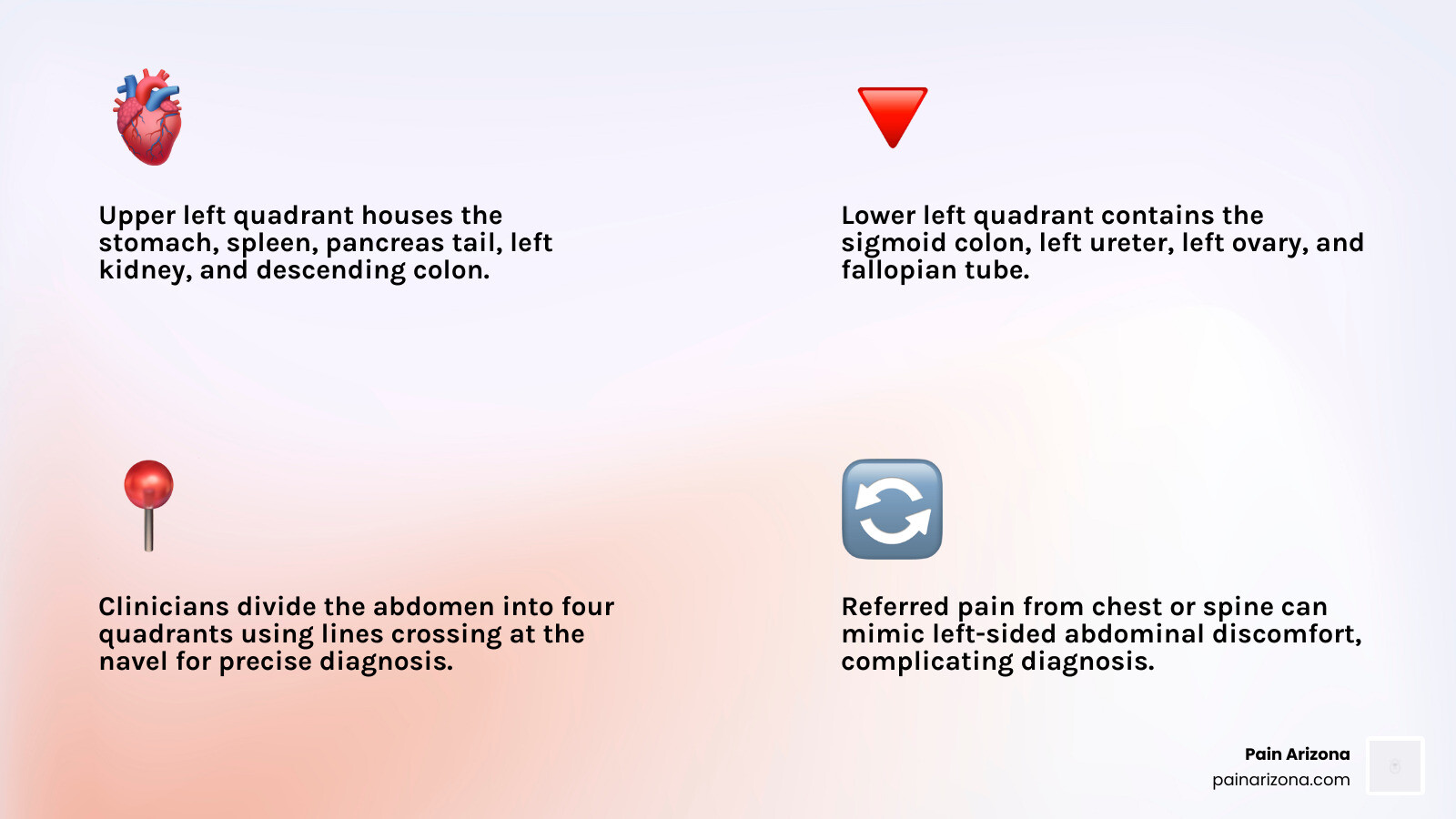
To understand why your left side hurts, it helps to understand what lies beneath the skin. Clinicians divide the abdomen into four distinct quadrants using an imaginary vertical and horizontal line intersecting at the navel. This quadrant system serves as an essential diagnostic map.
When you experience discomfort on the left side, the pain is often tied directly to the specific organs nestled within either the upper or lower left quadrant.

However, the body’s nervous system can sometimes pull a fast one on us through a phenomenon known as referred pain. For example, conditions originating in the chest—such as lower-lobe pneumonia, pleurisy (inflammation of the lung lining), or even certain cardiac events—can send pain signals traveling down nerve pathways, manifesting as upper left abdominal pain. Similarly, a pinched nerve or muscle spasm in your lower back can project pain forward into your lower left abdomen.
For a complete clinical picture of how these pathways interact, you can read more in this Clinical overview of left-sided pain.
Organs Located in the Upper Left Quadrant
The Left Upper Quadrant (LUQ) is home to several vital organs protected partly by your lower rib cage:
- The Stomach: Where digestion begins. Irritation, ulcers, or acid reflux in the stomach typically present as pain in this upper-left or central region.
- The Spleen: Positioned just under your left rib cage, this organ filters your blood and recycles old red blood cells. An enlarged or ruptured spleen can cause deep, structural pain here.
- The Tail of the Pancreas: The pancreas produces digestive enzymes and hormones like insulin. The tail of this organ extends into the LUQ, and inflammation here (pancreatitis) can cause severe, radiating pain.
- The Left Kidney: Located toward your back (the flank), your left kidney filters waste. Kidney stones or infections here frequently project pain to the upper left side and back.
- The Descending Colon: This portion of your large intestine carries waste downward, and gas or inflammation in this section can cause localized upper-left cramping.
Organs Located in the Lower Left Quadrant
The Left Lower Quadrant (LLQ) extends from below your belly button down to your hip bone. The organs situated here are primarily involved in waste elimination and reproduction:
- The Sigmoid Colon: This S-shaped curve of your large intestine connects to the rectum. It is the most common site for digestive strain, waste accumulation, and structural pockets to form.
- The Left Ureter: The thin tube that drains urine from your left kidney down to your bladder.
- The Left Ovary and Fallopian Tube: In women, these reproductive structures sit in the lower pelvic cavity on the left side.
- The Left Spermatic Cord: In men, this structure supports the testicular pathways and runs through the lower groin region.
Common Causes of Left-Sided Discomfort
Because so many organ systems overlap in this region, left-sided discomfort can stem from simple, everyday digestive adjustments or more complex medical issues.
To help you distinguish between a minor stomachache and a potentially serious medical condition, we have put together this quick comparison table:
| Symptom / Indicator | Likely Gas, Bloating, or Indigestion | Likely a Serious Medical Condition |
|---|---|---|
| Pain Pattern | Shifting, sharp but brief, or crampy; improves after passing gas or a bowel movement. | Constant, progressive, deep, or worsening over several hours; does not resolve with a bowel movement. |
| Physical Feeling | Soft abdomen, mild localized bloating. | Rigid, hard, or highly sensitive to the lightest touch (guarding). |
| Associated Symptoms | Mild flatulence, burping, temporary nausea that fades quickly. | High fever, chills, persistent vomiting, unexplained weight loss, or dizziness. |
| Stool Changes | Normal or transient diarrhea/constipation. | Bloody stools (bright red or dark, tarry black), or complete inability to pass gas or stool. |
Many minor episodes of left-sided discomfort are simply due to transient digestive issues. For instance, constipation can cause localized, dull, aching pain in the lower left quadrant as the sigmoid colon stretches to accommodate backed-up waste.
Irritable Bowel Syndrome (IBS)—a chronic functional gastrointestinal disorder affecting roughly 6% of U.S. adults—frequently presents as recurring lower left abdominal cramping accompanied by bloating, gas, and alternating bouts of diarrhea and constipation.
For a deeper look into these digestive interactions and structural triggers, check out our comprehensive guide on left side abdominal pain.
Gastrointestinal Issues and Diverticulitis
When it comes to persistent, sharp, or severe lower left abdominal pain, diverticulitis is often the prime suspect, particularly for adults over the age of 40.
As we age, pressure within the colon can cause small, bulging pouches called diverticula to push outward through weak spots in the colon wall. This condition is known as diverticulosis, and it is incredibly common—affecting more than 30% of U.S. adults between the ages of 50 and 59.
When these tiny pouches become blocked, inflamed, or infected, the condition escalates to diverticulitis. Because diverticula most frequently develop in the sigmoid colon on the lower left side, diverticulitis is a leading cause of localized lower left pain. This pain is typically constant, severe, and accompanied by a low-grade fever, nausea, and changes in bowel habits.
To prevent diverticular disease, maintaining a high-fiber diet, staying consistently hydrated, and engaging in regular physical activity are vital. For a detailed breakdown of symptoms, diagnostic approaches, and recovery pathways, read our dedicated Diverticulitis guide.
Gynecological and Reproductive Causes of Left Side Abdominal Pain
In women, lower left abdominal pain can frequently be traced back to the reproductive organs. Because these structures sit in close proximity to the digestive tract, gynecological pain can easily mimic or overlap with bowel issues:
- Ovarian Cysts: Fluid-filled sacs can develop on the left ovary. While many cysts are harmless and resolve on their own, a large cyst can cause a dull, heavy ache. If a cyst ruptures or causes the ovary to twist (ovarian torsion), it triggers sudden, excruciating, one-sided pelvic pain that requires emergency surgery to save the ovary.
- Ectopic Pregnancy: This occurs when a fertilized egg implants outside the uterus, most commonly in a fallopian tube. An ectopic pregnancy on the left side is a life-threatening medical emergency. It presents as sharp, severe lower left pain, often accompanied by abnormal vaginal bleeding and dizziness in early pregnancy.
- Endometriosis: A chronic condition where tissue similar to the lining of the uterus grows outside of it—on the ovaries, fallopian tubes, or outer colon wall. This can lead to localized inflammation, scarring, and deep, cyclic pelvic pain that worsens during menstruation.
- Pelvic Inflammatory Disease (PID): An infection of the female reproductive organs, often caused by untreated sexually transmitted infections. PID can cause persistent lower abdominal pain, abnormal discharge, fever, and pain during intercourse.
Urinary and Kidney Conditions
Your urinary system is another frequent source of left-sided abdominal or flank pain. The kidneys sit toward the back of the abdominal cavity, meaning issues here often start in the side or back and migrate forward:
- Kidney Stones: These hard mineral deposits affect roughly 11% of Americans, with rates climbing fastest among women. When a stone travels from the left kidney into the narrow left ureter, it blocks the flow of urine. This causes the kidney to swell, triggering a sharp, knife-like pain in the left flank or lower back that radiates down to the lower left abdomen and groin. The pain often comes in intense waves and is accompanied by painful urination or blood in the urine.
- Urinary Tract Infections (UTIs) and Kidney Infections: A bladder infection can cause lower pelvic cramping and painful, frequent urination. If the bacteria travel up to the left kidney (pyelonephritis), it can cause deep left-sided flank pain, high fever, chills, and nausea.
Staying well-hydrated is one of the most effective ways to flush out bacteria and prevent the crystal formations that lead to painful kidney stones.
Medical Evaluation: Diagnosis, Treatment, and Red Flags
If you visit a clinic for left-sided abdominal pain, your healthcare provider will use a systematic approach to pinpoint the root cause.

The diagnostic process typically begins with a thorough clinical history and a physical exam, during which the doctor will gently palpate your abdomen to check for tenderness, swelling, or rigidity.
To look inside, doctors rely on several key diagnostic tools:
- Imaging Studies: An abdominal CT scan is the gold standard for diagnosing acute issues like diverticulitis, kidney stones, or atypical presentations like left-sided appendicitis (which can occur in rare cases of intestinal malrotation). Pelvic ultrasounds are highly effective for evaluating gynecological causes like ovarian cysts.
- Laboratory Tests: Blood tests, such as a white blood cell (WBC) count, help identify active infections or inflammation. Urinalysis can detect blood or bacteria indicative of a kidney stone or UTI.
Treatment Options
Treatment for left side abdominal pain is highly individualized and depends entirely on the underlying cause:
- Conservative and Home Therapies: For mild, transient digestive issues like gas or mild constipation, temporary bowel rest (such as the BRAT diet), staying well-hydrated, and applying gentle heat therapy (like a warm bath or heating pad) can provide significant relief.
- Medications: Doctors may prescribe antibiotics for bacterial infections (like diverticulitis or UTIs), antispasmodics for IBS, or specific laxatives for chronic constipation.
- Interventional and Advanced Pain Therapies: For chronic abdominal pain that persists after structural issues have been treated or ruled out, specialized interventional therapies—such as targeted nerve blocks, medication management, or biofeedback—can help desensitize overactive nerve pathways and restore your quality of life.
Red-Flag Symptoms of Left Side Abdominal Pain
While many cases of abdominal discomfort resolve on their own, certain “red-flag” symptoms indicate a potentially life-threatening emergency. Head to the nearest emergency room or call 911 immediately if your pain is accompanied by:
- A sudden, unbearable spike in pain (often described as a “sucker punch to the gut”).
- High fever (above 101°F) or severe, uncontrollable chills.
- Bloody, black, or tarry stools, or vomiting blood.
- Persistent, uncontrollable vomiting that prevents you from keeping fluids down.
- A rigid, hard, or severely swollen abdomen that is agonizing to touch.
- Dizziness, fainting, confusion, or a rapid heart rate (signs of internal bleeding or shock).
Frequently Asked Questions about Left-Sided Belly Pain
What does gas pain on the left side feel like?
Gas pain on the left side typically feels like a sharp, stabbing, or crampy sensation that can shift locations quickly. It is often accompanied by bloating, abdominal distension, and flatulence. A key indicator that your pain is simply gas is that the discomfort temporarily improves or completely resolves after you pass gas or have a bowel movement.
Can a kidney stone cause left-sided abdominal pain?
Yes, absolutely. If a kidney stone forms in or exits your left kidney, it can cause excruciating pain. This pain typically begins as a sharp, severe ache in your left flank (the side of your back under your ribs) and often radiates forward into your lower left abdomen and down toward your groin. It is frequently accompanied by an urgent need to urinate, pain during urination, and pink, red, or cloudy urine (hematuria).
How do doctors diagnose diverticulitis?
Doctors typically diagnose diverticulitis using a combination of a physical examination (checking for localized tenderness in the lower left quadrant), blood tests to look for an elevated white blood cell count (a sign of infection), and an abdominal CT scan. The CT scan is highly reliable, as it provides detailed cross-sectional images showing any inflamed or infected pouches along your colon wall.
Conclusion
Whether your left-sided abdominal pain is a temporary digestive nuisance or a chronic condition that disrupts your daily life, you do not have to navigate it alone. At Pain Arizona, we specialize in comprehensive, evidence-based chronic pain management. Serving the Greater Phoenix Area—including Phoenix, Mesa, Gilbert, Scottsdale, and Glendale—our double board-certified physicians are dedicated to finding and treating the root cause of your discomfort using compassionate, minimally invasive therapies.
If you are struggling with persistent or recurring abdominal discomfort, we invite you to explore our advanced abdominal pain treatment options. We accept most insurance plans to ensure you get the high-quality care you deserve. Please check with our office manager to see if your plan is accepted, and take your first step toward lasting relief today.