
Everything You Need to Know About Neck Surgery
What Are Cervical Spine Surgeries? A Quick Overview
Cervical spine surgeries are procedures performed on the neck region of the spine to relieve pressure on compressed nerves or the spinal cord, reduce pain, and restore function. Here are the most common types at a glance:
| Surgery Type | Primary Goal | Approach |
|---|---|---|
| ACDF | Remove damaged disc, fuse vertebrae | Anterior (front) |
| Cervical Disc Replacement | Replace damaged disc, preserve motion | Anterior (front) |
| Laminectomy | Remove bone to widen spinal canal | Posterior (back) |
| Posterior Foraminotomy | Enlarge nerve opening | Posterior (back) |
| Posterior Fusion | Stabilize multiple vertebrae | Posterior (back) |
Your neck — the cervical spine — is made up of seven vertebrae separated by soft discs. These discs and bones protect your spinal cord and support nearly every head movement you make. When they break down, get injured, or press on nerves, the pain can be severe enough to affect daily life.
The good news? Most cervical spine procedures today can be performed using minimally invasive techniques, and many patients go home the same day or after just one night in the hospital.
I’m Dr. Nasser, a double board-certified physician in Physical Medicine and Rehabilitation and Pain Medicine with advanced fellowship training in minimally invasive spine interventions — including endoscopic techniques used in cervical spine surgeries. I’ve helped thousands of patients across the Greater Phoenix area navigate their options and find lasting relief.
Cervical spine surgeries helpful reading:
Common Conditions Treated with Cervical Spine Surgeries
When we talk about the neck, we are looking at a very crowded neighborhood. Within a few inches of space, you have the spinal cord, major nerve roots, the esophagus, and the trachea. When things go wrong, the symptoms aren’t always just “neck pain.” You might feel electricity running down your arm or realize you can’t button your shirt as easily as you used to.
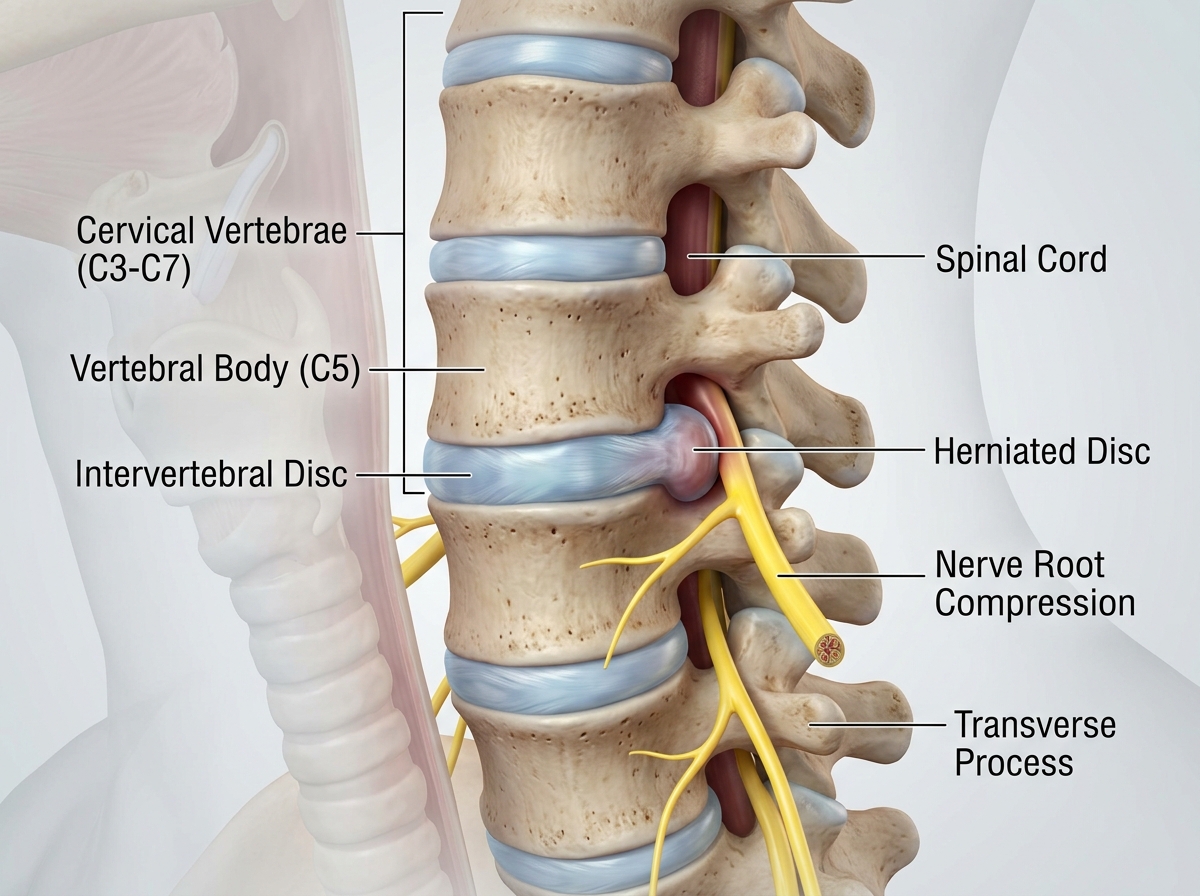
At Pain Arizona, we see several primary conditions that lead patients to consider surgical options:
- Cervical Radiculopathy: This is the medical term for a “pinched nerve.” It happens when a nerve root in the neck is compressed, leading to pain, numbness, or weakness that radiates into the shoulder and arm. If you want to dive deeper into how this feels and why it happens, check out our guide on cervical radiculopathy.
- Spinal Stenosis: This is a narrowing of the spaces within your spine. Think of it like a hallway getting tighter; eventually, the people (your nerves) start getting bumped. We have a detailed resource for decoding symptoms and causes to help you understand if this is what you’re experiencing.
- Degenerative Disc Disease (DDD): Despite the name, this isn’t actually a “disease.” It’s the natural wear and tear of the intervertebral discs. Over time, these discs lose their water content and cushioning, which can lead to bone spurs and instability.
- Cervical Myelopathy: This is a more serious condition where the spinal cord itself is compressed. This can lead to balance issues, difficulty walking, and loss of fine motor skills in the hands. Understanding myelopathy management is crucial because, unlike radiculopathy, myelopathy can sometimes lead to permanent neurological damage if left untreated.
- Spondylosis: This is essentially “arthritis of the neck.” It involves the joints and discs and is a very common cause of chronic discomfort. We often help patients identify their specific neck pain triggers and remedies before moving toward surgical discussions.
Primary Types of Neck Surgery: ACDF vs. Disc Replacement
If you’ve been told you need surgery, you are likely hearing two acronyms or terms: ACDF and Disc Replacement. These are the “heavy hitters” of cervical spine surgeries. While they both aim to fix the same problem—nerve compression—they do it in very different ways.
| Feature | ACDF (Fusion) | Cervical Disc Replacement (Arthroplasty) |
|---|---|---|
| Motion | Eliminates motion at the treated level | Preserves motion at the treated level |
| Stability | Very high; bones grow together | Maintains natural spinal mechanics |
| Recovery | 6–12 months for full bone fusion | Generally quicker return to full activity |
| Long-term Risk | Adjacent segment disease (stress on nearby discs) | Lower risk of adjacent segment stress |
| Hardware | Plates, screws, and bone graft | Artificial joint (metal and plastic) |
Understanding ACDF as a Standard for Cervical Spine Surgeries
Anterior Cervical Discectomy and Fusion (ACDF) has been the “gold standard” for decades. In fact, approximately 132,000 people in the United States undergo this procedure every year.
The procedure follows the “Robinson-Smith technique,” which has been refined since the 1950s. We make a small incision in the front of the neck (anterior), move the soft tissues aside, and remove the damaged disc. To keep the space open and stable, we insert an interbody spacer—often a small cage filled with bone graft. Over time, your body heals by growing bone across that space, “fusing” the two vertebrae into one solid piece.
Why do we still do this if it stops motion? Because it works. The success rates of ACDF procedures are remarkably high, with 85% to 95% of patients reporting significant relief from arm pain and numbness. It is an incredibly stable fix for a “wobbly” or painful spine segment.
The Rise of Motion-Preserving Cervical Spine Surgeries
In recent years, Cervical Disc Replacement (also called Arthroplasty) has become a popular alternative. Instead of “welding” the bones together, we insert an artificial disc that mimics the movement of a natural one.
The primary benefit here is motion preservation. By allowing the segment to move, we theoretically reduce the “domino effect” known as adjacent segment disease, where the discs above and below a fusion have to work harder and wear out faster.
Recent research on disc replacement vs fusion has shown impressive results. One 2023 NIH study revealed that cervical disc replacement had a success rate of 62.4% compared to 22.2% for ACDF in certain clinical trial parameters, though both remain highly effective depending on the patient’s specific anatomy. You can learn more about these outcomes to see if you might be a candidate for this “newer” tech.
Surgical Approaches: Anterior, Posterior, and Minimally Invasive
When we plan cervical spine surgeries, the “how” is just as important as the “what.”
- Anterior Approach: Most surgeons, including us, favor the front-of-the-neck approach for many conditions. It allows us to reach the discs directly without moving the heavy muscles of the back of the neck. This usually results in less post-operative pain and a smaller scar.
- Posterior Approach: Sometimes, the pressure is coming from the back, or we need to stabilize multiple levels of the spine. In these cases, we go through the back of the neck. While this involves more muscle disruption, it is often necessary for complex cases of stenosis or deformity.
- Minimally Invasive Spine Surgery (MISS): This is where the field is truly headed. By using tubes, endoscopes, and specialized tools, we can perform many of these tasks through tiny incisions. This “small incisions, big impact” philosophy is central to our work at Pain Arizona. You can read more about what to expect from minimally invasive cervical surgery on our blog.
We utilize endoscopic spine procedures to minimize trauma to the surrounding tissues. For the patient, this typically means less blood loss, a lower risk of infection, and a much faster trip back to their normal life in Mesa or Scottsdale.
Decompression Techniques: Laminectomy and Foraminotomy
If the goal isn’t necessarily to replace a disc but just to “make more room,” we use decompression techniques:
- Laminectomy: We remove the “roof” of the spinal canal (the lamina) to give the spinal cord more space. This is common for severe stenosis.
- Foraminotomy: We enlarge the foramen—the “exit tunnels” where the nerves leave the spine. This is a great, often minimally invasive way to relieve radiculopathy.
- Laminoplasty: Instead of removing the bone, we create a hinge to swing it open like a door, which increases space while maintaining more stability than a traditional laminectomy.
Research shows that clinical outcomes for cervical radiculopathy are excellent when these decompression techniques are applied correctly to the right patient.
Recovery Timeline and Post-Operative Care
One of the most common questions I get in our Phoenix and Gilbert offices is: “When can I get back to my life?”
Recovery is a marathon, not a sprint, but the timeline is more manageable than you might think:
- Hospital Stay: Most patients stay only one night. Many minimally invasive cases are now performed as outpatient procedures, meaning you could be home by dinner.
- First 1-2 Weeks: Focus on wound healing. You may need to wear a cervical collar (neck brace) to support the muscles and hardware. You’ll likely be on a “soft food” diet for a few days if you had an anterior approach, as swallowing can feel a bit scratchy.
- Weeks 4-6: This is usually when rehabilitation after spine surgery begins. Physical therapy is vital to regain your range of motion and strengthen the “internal brace” of your neck muscles.
- 3-6 Months: Most patients return to full activity, including sports or strenuous work. However, bone fusion (in ACDF) can take up to a full year to completely solidify.
For a more detailed breakdown, we’ve put together a minimally invasive recovery time guide and a general back surgery recovery guide to help you plan your time off.
Frequently Asked Questions about Neck Surgery
When is surgery recommended over non-surgical treatments?
We almost always start with conservative care. Surgery is usually reserved for:
- Failure of non-surgical treatment options (like PT or medications) after 6 months.
- Progressive neurological deficits (getting weaker or losing balance).
- Severe, unremitting pain that prevents daily function.
Before jumping to surgery, we often try cervical facet joint injections or nerve blocks to see if we can manage the pain without an operation.
What are the success rates for relieving arm pain?
The success rate for relieving radiculopathy (arm pain/numbness) is very high—between 85% and 95%. Most patients are extremely satisfied with the results, often wishing they had done it sooner. Long-term studies on anterior vs. posterior approaches continue to show that both are effective when chosen for the right reasons.
What are the risks and potential complications?
No surgery is without risk. For cervical spine surgeries, these include:
- Dysphagia: Difficulty swallowing (usually temporary).
- Hoarseness: Changes in the voice due to the nerves near the vocal cords (usually temporary).
- Non-union: When the bones fail to fuse in an ACDF.
- Adjacent Segment Degeneration: Wear and tear on the levels above or below the surgery.
- Infection or Bleeding: Rare, but possible.
A study of over 5,000 patients found that morbidity following ACDF is generally low, but having pre-existing myelopathy can increase the risk of complications, which is why early intervention is often better.
Conclusion
At Pain Arizona, our goal is to get you back to the activities you love in the Greater Phoenix Area. Whether you are hiking in Scottsdale or playing with grandkids in Glendale, neck pain shouldn’t be the thing that stops you.
Our team of double board-certified physicians specializes in evidence-based, minimally invasive treatments. We aren’t just looking to mask the pain; we want to address the root cause. If you are tired of living with chronic neck or arm pain, it might be time to schedule a minimally invasive consultation with us.
We accept most insurance plans, and our office manager can help you verify if your specific plan is accepted. Let’s work together to find the right path—surgical or otherwise—for your recovery.