
Your Roadmap to Recovery: Cervical Radiculopathy PT Protocols
What Is Cervical Radiculopathy Treatment Physical Therapy — and Does It Work?
Cervical radiculopathy treatment physical therapy is one of the most effective non-surgical options for relieving a pinched nerve in the neck. Research shows that nearly 90% of patients improve without surgery, and a structured PT program is the cornerstone of that recovery.
Here’s what PT for cervical radiculopathy typically includes:
| Treatment Component | What It Does |
|---|---|
| Manual therapy & traction | Reduces pressure on the nerve root, relieves arm pain |
| Therapeutic exercises | Restores strength, posture, and neck mobility |
| Neural flossing | Reduces nerve tension and improves mobility |
| Posture education | Minimizes disc pressure and prevents recurrence |
| Pain management (ice, heat, collar) | Controls inflammation in the early recovery phase |
Most people see significant improvement within the first few weeks, and full recovery is common — especially when treatment starts early.
If you’re experiencing neck pain that shoots down your arm, numbness, tingling, or weakness in your hand, you’re likely dealing with a pinched nerve root. That’s exactly what this guide addresses.
I’m Dr. Nasser — a double board-certified physician in Physical Medicine & Rehabilitation and Pain Medicine with years of experience overseeing cervical radiculopathy treatment physical therapy as part of comprehensive, multimodal pain care. At Pain Arizona, I work alongside physical therapists and spine specialists to help patients across the Greater Phoenix area find lasting relief without defaulting to surgery.
Cervical radiculopathy treatment physical therapy helpful reading:
Understanding the Causes and Symptoms of a Pinched Nerve
To fix a problem, we first have to understand what’s actually happening under the hood. Cervical radiculopathy isn’t just “neck pain.” It is a specific clinical condition where a nerve root in your cervical spine (the neck) becomes compressed or irritated. This irritation usually happens where the nerve exits the spinal column through a small opening called the neural foramen.
According to a population-based study from Rochester, Minnesota, the annual incidence of cervical radiculopathy is about 83.2 per 100,000 people. It peaks in the fifth decade of life—so if you’re in your 40s or 50s and your neck is acting up, you’re in the “sweet spot” for this condition.
The Main Culprits: Why Nerves Get Grumpy
There are two primary reasons a nerve gets pinched in the neck:
- Disc Herniation: Think of your spinal discs as jelly donuts. If the “jelly” (nucleus pulposus) leaks out or bulges, it can press directly on the nerve root. This is more common in younger patients or following a sudden injury.
- Cervical Spondylosis (Degeneration): As we age, our spine undergoes wear and tear. Bone spurs (osteophytes) can grow, and the space for the nerve (the foramen) can narrow. This is known as foraminal narrowing.
Nerve Root Patterns: Where Does It Hurt?
The symptoms you feel depend entirely on which nerve is being squished. The C6 and C7 nerve roots are the most common victims.
- C6 Nerve Root: Usually causes pain or numbness that travels down to the thumb and index finger. You might also feel weakness when bending your elbow (biceps).
- C7 Nerve Root: This is the most frequent site of radiculopathy (affecting up to 69% of cases). Pain often radiates to the middle finger, and you might notice weakness when trying to straighten your arm (triceps).
Common symptoms include sharp, shooting, or burning pain, paresthesia (that “pins and needles” feeling), and in severe cases, actual muscle weakness. Interestingly, some patients find relief by resting their arm on top of their head—this is called the “shoulder abduction sign,” and it works by reducing tension on the irritated nerve.
How Physical Therapy Diagnoses Cervical Radiculopathy
Before we dive into cervical radiculopathy treatment physical therapy, we need to be sure we’re treating the right thing. While an MRI is great for looking at soft tissues, it doesn’t always tell the whole story. Many people have “scary-looking” MRIs but zero pain!
Physical therapists use a “cluster” of clinical tests to diagnose radiculopathy with high accuracy. The gold standard is Wainner’s Clinical Prediction Rule. Research on the diagnostic accuracy of clinical examinations shows that if a patient tests positive for all four of the following variables, the probability of them having cervical radiculopathy is over 90%:
- Spurling’s Test: The therapist gently tilts your head toward the painful side and applies a small amount of downward pressure. If this reproduces your arm symptoms, it’s a positive sign.
- Upper Limb Tension Test (ULTT-A): This is like a “nerve stretch” test for your arm. By moving your arm and wrist into specific positions, the therapist can see if the nerve is sensitized.
- Cervical Distraction Test: While you lie down, the therapist gently pulls on your head to create space in the neck. If your arm pain decreases during this, it’s a strong indicator of a pinched nerve.
- Cervical Rotation: If you have less than 60 degrees of rotation toward the painful side, it fits the pattern.
By using these physical tests, we can often confirm the diagnosis in our Phoenix or Scottsdale offices without needing immediate, expensive imaging unless “red flags” are present.
Core Components of Cervical Radiculopathy Treatment Physical Therapy
The secret sauce of recovery is a multimodal approach. This means we don’t just do one thing; we combine several techniques to attack the pain from different angles. Scientific research on manual therapy and strengthening exercises indicates that this combination is significantly more effective than exercise alone.
Centralization: The Goal of Treatment
In PT, we talk a lot about centralization. If your pain starts in your hand and, after a few sessions, it moves up to your elbow, then your shoulder, and finally just stays in your neck—that is a massive win. It means the nerve is becoming less irritated. Even if the neck pain feels sharper, the fact that it is “leaving” the arm is the best sign of recovery.
The Role of Manual Therapy and Traction
Manual therapy is the “hands-on” part of cervical radiculopathy treatment physical therapy.
- Non-thrust Mobilization: These are gentle, rhythmic movements applied to the neck joints to reduce stiffness and pain.
- Thoracic Spine Thrust Manipulation: Sometimes, the best way to help the neck is to move the middle back (thoracic spine). Improving mobility in the upper back takes the “load” off the neck. One study showed that 66.7% of patients had successful outcomes when thoracic manipulation was included.
- Cervical Traction: This can be done manually by the therapist or with a mechanical machine. By gently stretching the neck, we create a vacuum-like effect that can help “decompress” the nerve root. A systematic review on adding traction to PT suggests it can provide significant long-term benefits in reducing disability and pain.
Therapeutic Exercises
Exercise is how we make the results “stick.”
- Chin Tucks (Craniocervical Flexion): This isn’t about making a double chin for a selfie; it’s about activating the deep muscles that support your neck.
- Neural Flossing: Nerves don’t like to be stretched, but they love to slide. Neural gliding exercises (or flossing) help the nerve move smoothly through its pathways without getting “stuck” on scar tissue or bone spurs. Research on neural mobilization supports its use for improving function and reducing nerve sensitivity.
- Scapular Squeezes: Your shoulder blades are the foundation for your neck. If they are weak, your neck muscles have to overwork.
A Phased Approach to Your Physical Therapy Protocol
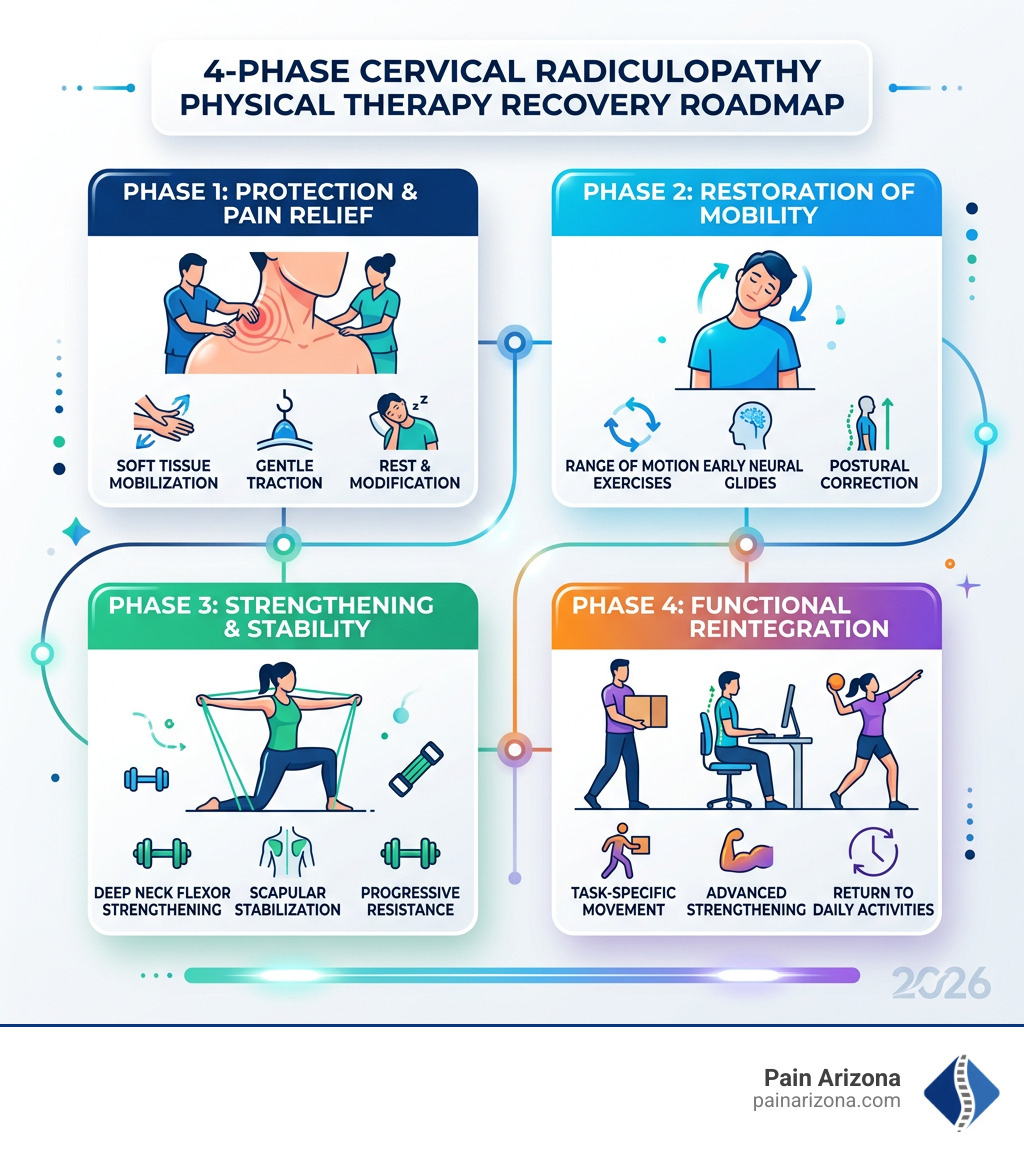
Recovery isn’t a straight line, but it does follow a logical roadmap. We break our cervical radiculopathy treatment physical therapy into four distinct phases to ensure you don’t do too much too soon.
Phase 1 & 2: Pain Management and Range of Motion
In the acute phase (the first 1-2 weeks), the nerve is “angry” and inflamed. Our goal is simple: calm it down.
- Ice and Heat: We usually recommend ice for the first 48 hours to curb inflammation, followed by moist heat to relax tight muscles.
- Activity Modification: We might suggest limiting sitting to 15-20 minutes at a time and avoiding heavy lifting.
- Gentle AROM: We start with pain-free range of motion. If a movement causes pain to shoot down your arm (peripheralization), we stop.
- Posture and Ergonomics: Research on stretching and ergonomic modifications shows that small changes—like adjusting your monitor height—can significantly reduce musculoskeletal discomfort.
Phase 3 & 4: Strengthening and Functional Return
Once the arm pain has centralized or vanished, we move into the “building” phase.
- Resisted Isometrics: Strengthening the neck muscles without actually moving the joints. This is safe and effective.
- Deep Neck Flexor Endurance: Training the muscles that keep your head from drooping forward during a long day at the office in Glendale or Mesa.
- Functional Training: We tailor your exercises to your life. If you’re a golfer, we work on rotation. If you work in a warehouse, we work on overhead reaching mechanics.
- Recurrence Prevention: This is the most important part. We give you a “maintenance” program of 2-3 days a week to keep the muscles strong and the nerves happy.
Frequently Asked Questions about Cervical Radiculopathy
How long does recovery typically take with physical therapy?
Most episodes of cervical radiculopathy last 3 to 6 weeks with consistent physical therapy (usually 2-3 sessions per week). Severe cases or those involving significant muscle weakness may take up to 8 to 12 weeks to fully resolve. Factors like smoking (which hinders disc nutrition) and diabetes can slow down your healing time, so lifestyle choices matter!
How does physical therapy compare to surgical options for a pinched nerve?
This is a great question. Many patients fear that surgery is the only answer for a “slipped disc.” However, a prospective randomized study comparing surgery and physiotherapy found that while surgery might offer slightly faster relief in the first few months, there were no significant differences in pain, strength, or sensation between the two groups after one and two years.
At Pain Arizona, we almost always recommend a 6-to-12-week course of conservative care before considering an Anterior Cervical Discectomy and Fusion (ACDF) or other surgical interventions.
What red flags indicate I need immediate medical attention?
While PT is effective for most, some symptoms require a trip to the specialist or even the ER. These include:
- Myelopathy symptoms: Difficulty with balance, tripping frequently, or losing fine motor skills in both hands (like struggling to button a shirt).
- Progressive weakness: If your arm weakness is getting worse day by day despite rest.
- Bowel or bladder changes: Any loss of control over your bathroom habits is an emergency.
- Severe muscle wasting: If the muscles in your hand or arm are visibly shrinking.
Conclusion
Cervical radiculopathy can be a frightening and painful experience, but the data is on your side. With the right cervical radiculopathy treatment physical therapy protocol—combining manual therapy, decompression, and specific strengthening—the vast majority of people return to their normal lives without the need for invasive surgery.
Early intervention is the key to preventing a “pinched nerve” from becoming a chronic problem. At Pain Arizona, our double board-certified physicians specialize in identifying the root cause of your neck and arm pain. We serve the entire Greater Phoenix area, including Mesa, Gilbert, Scottsdale, and Glendale, and we accept most insurance plans.
Don’t let a pinched nerve stop you in your tracks. Take the first step toward your recovery roadmap today.