
Bulging Disc Treatment: Effective Relief Options in Arizona
When Your Back Won’t Let You Live Your Life: Bulging Disc Pain in Phoenix
Bulging disc pain Phoenix residents experience is one of the most common — and most misunderstood — sources of chronic back and neck pain. If you’re looking for a quick answer on treatment options, here’s what works:
Top treatments for bulging disc pain in Phoenix:
- Physical therapy — strengthens core muscles, reduces pressure on the disc
- Spinal decompression therapy — gently stretches the spine to relieve nerve pressure
- Epidural steroid injections — reduces inflammation around the affected nerve
- Chiropractic care — improves spinal alignment
- Percutaneous discectomy — minimally invasive removal of disc material pressing on nerves
- Orthobiologics (PRP, bone marrow) — regenerative options to support disc healing
Most people start with conservative care and only move to procedures if needed.
Here’s the hard truth: an estimated 52% of people with a bulging disc have no symptoms at all. But if you’re in the other 48%, the pain can make even simple tasks — walking, bending, sitting at a desk — feel impossible. Radiating pain down the leg, numbness in the feet, or a constant ache in your lower back are signs your disc may be pressing on a nerve. Left unaddressed, that pain tends to get worse, not better, and your options can narrow over time.
Phoenix’s active lifestyle and warm climate are assets for recovery — but only if you get the right diagnosis and the right care plan first.
I’m Dr. Nasser, a double board-certified physician in Physical Medicine & Rehabilitation and Pain Medicine, with years of experience treating bulging disc pain Phoenix patients using both interventional procedures and regenerative medicine. As Chief Medical Officer at Pain Arizona, I’ve helped thousands of Greater Phoenix residents move from chronic pain back to the lives they deserve.
Must-know bulging disc pain Phoenix terms:
Understanding the Mechanics of Bulging Disc Pain Phoenix
To understand why your back or neck hurts, we first have to look at the anatomy of your spine. Think of your spinal discs as the unsung heroes of your body. They are the cushions that sit between your 33 vertebrae, absorbing shock and allowing you to bend, twist, and dance.
The Jelly Donut Analogy
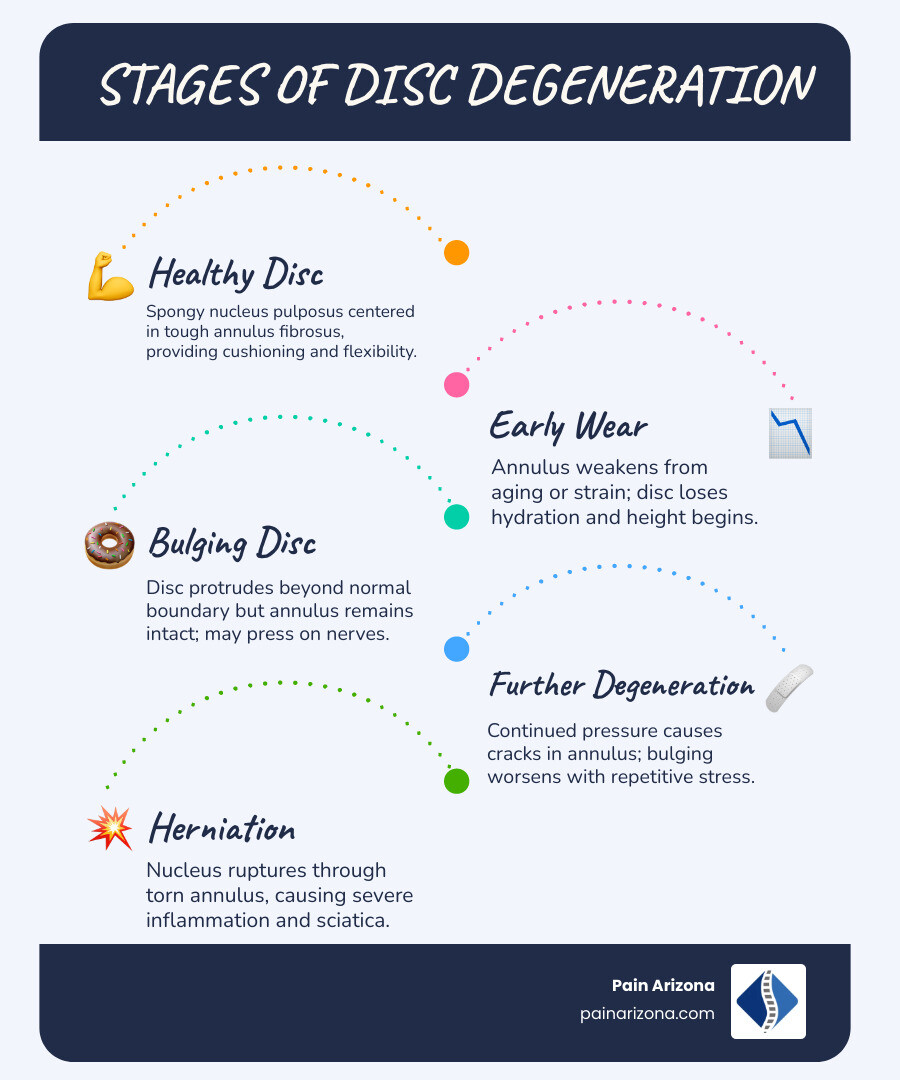
We often use the “jelly donut” analogy to explain disc health. A healthy disc has a tough, fibrous outer layer called the annulus fibrosus and a soft, gel-like center known as the nucleus pulposus.
In a Bulging Disc, the disc essentially “sags” or extends outside the space it should normally occupy. Imagine pressing down on a jelly donut; the sides bulge out, but the jelly stays inside. If that outer wall actually cracks and the jelly leaks out, you’ve moved into “herniated” territory.

Bulging vs. Herniated: What’s the Difference?
It is a common point of confusion for our patients in Mesa and Gilbert. While both can cause bulging disc pain Phoenix residents find debilitating, they are structurally different. A bulging disc involves a larger portion of the disc (usually more than 50%) and is considered “contained.” A herniated disc is often more localized and involves a rupture of the outer layer.
| Feature | Bulging Disc | Herniated Disc |
|---|---|---|
| Structure | Disc “bulges” out but remains intact | Outer layer tears; inner gel leaks out |
| Nerve Impact | May press on nerves if bulge is severe | Highly likely to irritate or compress nerves |
| Pain Level | Can be asymptomatic or cause dull aches | Often causes sharp, radiating pain |
| Commonality | Very common, often part of natural aging | Often results from acute injury or strain |
Understanding this Difference between herniated and bulging discs is the first step in creating a targeted treatment plan.
Identifying Symptoms and Root Causes
Identifying Bulging Disc Pain Phoenix Symptoms
How do you know if that twinge in your back is a bulging disc? Because the spine houses your central nervous system, a disc issue in one spot can cause “referred” pain elsewhere in the body.
Common symptoms we see at our Phoenix and Scottsdale clinics include:
- Sciatica: This is perhaps the most famous symptom. It’s a sharp, burning pain that travels from the lower back through the hips and down the leg.
- Radiating Pain: Depending on where the disc is (neck vs. lower back), you might feel pain traveling down your arms or into your buttocks.
- Numbness and Tingling: Often described as “pins and needles,” this happens when the disc interferes with sensory nerve signals.
- Muscle Spasms: Your body may try to “guard” the injured area by tightening the surrounding muscles, leading to painful cramps.
- Weakness: If a motor nerve is compressed, you might find it difficult to lift your foot (foot drop) or grip objects firmly.
If you are experiencing these, it’s important to look into Disc Problems and Herniated Discs to see which category your symptoms fall into.
Common Causes and Risk Factors
Why do discs bulge? Sometimes it’s a sudden event, but more often, it’s a slow process.
- Aging and Degeneration: This is the primary culprit. As we age, our discs lose water content and elasticity. This Degenerative Disc Disease makes discs more prone to bulging under normal pressure.
- Obesity: Carrying excess weight puts a constant, heavy load on the lumbar spine.
- Occupation and Repetitive Motion: Jobs that require heavy lifting, twisting, or even prolonged sitting (common in our Phoenix office workers) can wear down disc integrity.
- Genetics: Some people simply inherit “weaker” disc structures.
- Smoking: Nicotine restricts blood flow to the spinal discs, depriving them of the nutrients they need to stay hydrated and healthy.
For those interested in the long-term mechanics, you can find More info about degenerative disc disease to understand how lifestyle choices impact your spine.
Effective Non-Surgical Treatment Pathways
The good news is that surgery is rarely the first answer. At Pain Arizona, we believe in a “conservative first” approach. We want to help your body heal itself whenever possible.
Non-Surgical Relief for Bulging Disc Pain Phoenix
Most patients find significant relief through a combination of these therapies:
- Physical Therapy: This isn’t just about stretching. A skilled therapist helps you build a “natural corset” of core muscles that take the pressure off your spine.
- Spinal Decompression Therapy: This is a non-invasive treatment where we use a specialized table to gently stretch the spine. This creates “negative pressure” within the disc, which can help the bulging material retract away from the nerve. Learn more about Spinal Decompression Therapy.
- Epidural Steroid Injection: If inflammation is the main driver of your pain, we can precisely deliver anti-inflammatory medication to the space around the spinal nerves. We offer both general Epidural Steroid Injection and specific Lumbar Epidural Steroid Injection for lower back issues.
- Chiropractic Care: Gentle adjustments can help restore proper alignment, ensuring that weight is distributed evenly across your discs rather than concentrated on one “bulging” point.
Minimally Invasive Interventional Options
If conservative care doesn’t cut it after 4-6 weeks, we move to minimally invasive procedures. These are performed in-office with little to no downtime.
- Percutaneous Discectomy: This is a brilliant procedure where we use a small needle to remove a tiny amount of disc tissue. By reducing the volume of the disc, the “bulge” shrinks, and the pressure on the nerve is relieved instantly. Read more about Percutaneous Discectomy.
- Orthobiologics: We are leaders in Phoenix for regenerative medicine. Using Platelet-Rich Plasma (PRP) or bone marrow-derived cells from your own body, we can stimulate the body’s natural repair mechanisms to support the disc’s structural integrity.
To see how all these spinal components work together, I highly recommend you Watch Video: Spine 101.
Recovery Timelines and Prevention Strategies
“How long until I can hike Camelback Mountain again?” That’s the question we get most.
Recovery is a marathon, not a sprint. Typically, acute bulging disc pain Phoenix starts to subside within 2 to 4 weeks of starting treatment. However, full structural healing can take 3 to 6 months.
The Phases of Recovery
- The Acute Phase (Days 1-7): Focus is on reducing inflammation and pain. Rest is okay for 48 hours, but “bed rest” longer than that can actually make your back stiffer and more painful.
- The Sub-Acute Phase (Weeks 2-6): This is where physical therapy kicks in. We focus on mobility and gentle strengthening.
- The Maintenance Phase (Month 3+): This is about prevention.
Prevention Strategies
To keep the pain from returning, Phoenix residents should focus on:
- Weight Management: Reducing the load on your lumbar spine is the single best gift you can give your discs.
- Core Strength: Yoga and Pilates are excellent for building the “inner strength” needed to support the spine.
- Ergonomics: If you work in an office in Glendale or downtown Phoenix, ensure your monitor is at eye level and your chair supports your lower back.
- Hydration: Discs need water! In our Arizona heat, staying hydrated is essential for disc health.
For more deep dives into long-term management, check out our Chronic Back Pain Insights and general guides on Back Pain.
Frequently Asked Questions about Bulging Discs
How long does it take for a bulging disc to heal?
While every patient is unique, most people see significant symptomatic improvement within 4 to 6 weeks of conservative treatment. Structural healing—where the disc material actually changes shape or stabilizes—can take several months of consistent physical therapy and lifestyle changes.
Can a bulging disc be seen on a standard X-ray?
Technically, no. X-rays are great for looking at bones (vertebrae) but they don’t show soft tissues like discs. However, an X-ray can show “indirect” signs, such as narrowed spaces between vertebrae, which suggests a disc has thinned or bulged. For a definitive diagnosis, we typically use an MRI or CT scan.
Is walking recommended for someone with a bulging disc?
Absolutely! Unless you are in the middle of a severe, debilitating flare-up, walking is one of the best things you can do. It increases blood flow to the spinal structures and helps maintain mobility without the high impact of running. Start with short, flat walks around your neighborhood in Gilbert or Chandler.
Conclusion
Living with bulging disc pain Phoenix can feel like your world is shrinking, but it doesn’t have to stay that way. At Pain Arizona, our team of double board-certified physicians is dedicated to finding the root cause of your discomfort. We don’t just mask the pain; we work to restore your function and quality of life.
Whether you are in Mesa, Scottsdale, or Glendale, we offer evidence-based, minimally invasive care tailored to your specific needs. We accept most insurance plans, so please check with our office manager to see if your plan is accepted.
Don’t let a bulging disc dictate your future. If you’re ready to take the first step toward a pain-free life, explore our options for Low Back Pain Treatment in Chandler, Mesa, Scottsdale, Phoenix, and Glendale and schedule a consultation with us today.