
From Pain to Relief: Effective Treatments for Herniated Disc Sciatica
What You Should Know About Treatment for Herniated Disc and Sciatica
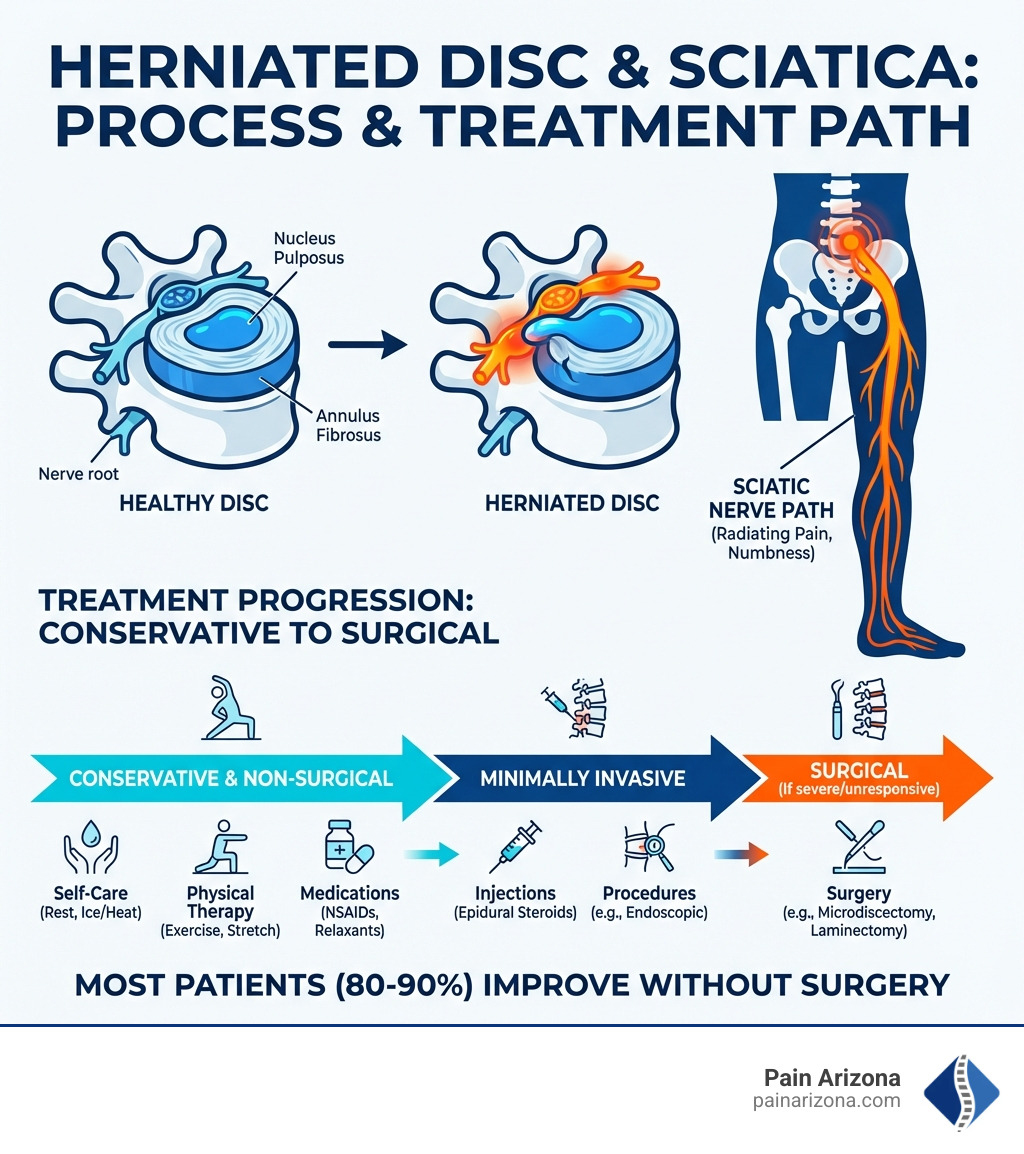
Treatment for herniated disc and sciatica typically starts with conservative, non-surgical options — and for most people, that’s all they’ll ever need.
Here’s a quick overview of the main treatment options, from least to most invasive:
| Treatment Type | Examples | Best For |
|---|---|---|
| Self-care | Ice/heat, rest, OTC pain meds | Mild to moderate acute pain |
| Physical therapy | McKenzie method, nerve glides, core strengthening | Most patients as a first-line approach |
| Medications | NSAIDs, muscle relaxants, nerve pain drugs | Short-term pain and inflammation control |
| Injections | Epidural steroids, nerve root blocks | Moderate to severe pain not responding to PT |
| Minimally invasive procedures | Spinal cord stimulation, endoscopic discectomy | Persistent pain after conservative care |
| Surgery | Microdiscectomy, laminectomy, disc replacement | Severe or worsening cases, nerve damage, or emergency |
The good news? Research shows that 80-90% of people with a herniated disc improve without surgery. Understanding your options is the first step toward lasting relief.
Up to 2% of American adults — nearly 7 million people — deal with a herniated disc every year. For many, it brings debilitating sciatica: shooting pain, numbness, and weakness that can make even simple daily tasks feel impossible.
What most people don’t realize is that effective treatment requires addressing both the physical source of nerve compression and the way your brain and body have learned to process pain. A one-size-fits-all approach rarely works.
I’m Dr. Nasser, a double board-certified physician in Physical Medicine & Rehabilitation and Pain Medicine with experience in the treatment for herniated disc and sciatica — from conservative care and guided injections to minimally invasive spine procedures. In this guide, I’ll walk you through every proven option so you can make confident, informed decisions about your recovery.
Quick treatment for herniated disc and sciatica definitions:
Recognizing Symptoms and Emergency Red Flags
Before we dive into the treatment for herniated disc and sciatica, we need to understand what we are fighting. Sciatica isn’t a diagnosis itself; it’s a symptom of an underlying issue, most commonly a herniated disc. When the jelly-like center of a spinal disc pushes through a tear in the outer layer, it can irritate or compress the nearby nerve roots.
This is where sciatica demystified comes in. The sciatic nerve is the largest in your body, originating from the L4-S3 segments of your spine. When it’s compressed, you might feel:
- Electric shock sensations: Searing, sharp pain that shoots from your lower back down into your leg.
- Numbness and Tingling: A “pins and needles” feeling in your foot or toes.
- Leg Heaviness: Difficulty lifting your foot (foot drop) or a general feeling of weakness.
When Sciatica Becomes an Emergency
While most cases are manageable, there is a rare but serious condition called Cauda Equina Syndrome. This occurs when the bundle of nerve roots at the lower end of the spinal cord is severely compressed. You must seek immediate medical attention if you experience:
- Sudden loss of bladder or bowel control (incontinence).
- Saddle anesthesia: Numbness or tingling in the areas that would touch a saddle (groin, buttocks, inner thighs).
- Rapidly progressing weakness in the legs.
First-Line Conservative Treatment for Herniated Disc and Sciatica
The first thing I tell my patients in Phoenix and Scottsdale is to breathe — the vast majority of herniated discs heal on their own. In fact, a study of 90 people with no symptoms found that over 36% actually had a herniated disc on their MRI! This means the body is incredibly resilient.
The modern medical consensus has shifted away from prolonged bed rest. We now know that staying active is far more essential to your body’s ability to recover. Too much rest can lead to stiff joints and weak muscles, which actually delays healing.
Temperature Therapy: Ice vs. Heat
In the acute phase (the first 48–72 hours), we focus on reducing inflammation.
- Cold Therapy: Apply ice packs for 20 minutes several times a day to numb the area and reduce swelling.
- Heat Therapy: After the initial inflammation subsides, switch to heat to increase blood flow and relax tight muscles.
Physical Therapy as a Treatment for Herniated Disc and Sciatica
Physical therapy is the cornerstone of non-surgical recovery. We often recommend the McKenzie Method, which focuses on “pain centralization.” This technique uses specific movements to move the pain from your leg back toward your lower back, which is a sign of healing.
Key components of a PT program include:
- Nerve Glides: Exercises designed to reduce tension and improve the flexibility of the sciatic nerve.
- Core Stabilization: Strengthening the abdominal and back muscles to support the spine, often supported by scientific research on motor control exercise.
- Water Therapy: Using the buoyancy of water to perform strengthening exercises without the stress of gravity.
Medications and At-Home Care
While we want to avoid long-term reliance on pills, medications can provide a “window of relief” that allows you to participate in physical therapy.
- NSAIDs: Ibuprofen or naproxen help reduce inflammation.
- Muscle Relaxants: These can help if you are experiencing painful back spasms.
- Neuropathic Drugs: Medications like gabapentin or tricyclic antidepressants can modulate how your nerves send pain signals to the brain.
However, we follow the NICE guidelines on neuropathic pain and local Arizona health standards, which advise against long-term opioid use for chronic sciatica due to the high risk of dependence.
Minimally Invasive Injections and Interventional Care
If conservative treatments haven’t provided enough relief after a few weeks, we may step up to interventional treatments. At Pain Arizona, we specialize in minimally invasive procedures that target the root cause of the pain without the downtime of surgery.
Epidural Steroid Injections (ESIs)
Epidural steroid injections involve delivering a powerful anti-inflammatory medication directly into the space around the spinal nerves. These injections inhibit the production of arachidonic acid, a major player in inflammation. Studies show success rates between 76% and 88% for treating disc herniations.
Selective Nerve Root Blocks (SNRBs)
A selective nerve root block is both a diagnostic and therapeutic tool. By injecting a local anesthetic and steroid around a specific nerve root, we can confirm exactly which disc is causing your pain while providing relief that can last up to a year for many patients.
Advanced Options
- Spinal Cord Stimulation: For patients with persistent pain (sometimes called post-laminectomy syndrome), spinal cord stimulation uses mild electrical pulses to mask pain signals before they reach the brain.
- Spinal Decompression Therapy: This non-surgical treatment gently stretches the spine to take pressure off the discs, promoting the movement of water, oxygen, and nutrient-rich fluids into the discs to help them heal. You can read more about spinal decompression therapy.
Surgical Options as a Treatment for Herniated Disc and Sciatica
Surgery is rarely the first choice, but it becomes an option if pain remains debilitating after 6 to 12 weeks of conservative care or if there is progressive nerve damage.
Microdiscectomy: The Gold Standard
A microdiscectomy accounts for approximately 90% of herniated disc surgeries. It is a minimally invasive spine surgery where the surgeon removes only the small portion of the disc that is pressing on the nerve.
- Recovery: Most patients go home the same day and return to light activity within 1–2 weeks.
- Effectiveness: It has a 90% success rate for relieving leg pain.
Other Surgical Techniques
- Laminectomy: Removing a portion of the vertebral bone (the lamina) to create more space for the nerves.
- Artificial Disc Replacement (ADR): Unlike fusion, ADR intends to preserve movement in the spine. Most patients recover within three months.
- Spinal Fusion: Joining two vertebrae together. We generally view this as a last resort, as statistics show that 41% of spinal fusion patients require further surgeries within three years, and many still require pain medications.
| Feature | Open Discectomy | Microscopic Discectomy | Tubular Discectomy |
|---|---|---|---|
| Incision Length | Longer | ~24mm Shorter | Shortest |
| Op Time | ~72 mins | ~84 mins | Variable |
| Hospital Stay | 3–5 days | Same day/1 day | Shortest |
| Blood Loss | Higher | Lower | Lowest |
Lifestyle Factors and Pain Retraining Strategies
One of the most overlooked aspects of treatment for herniated disc and sciatica is the role of the brain. When you have been in pain for a long time, your nervous system can become “hypersensitive.” This is called Central Sensitization. Essentially, your brain gets so good at processing pain that it continues to produce the sensation even after the physical tissue has started to heal.
Pain Retraining and Neuroplasticity
We encourage patients to use tools like the More Good Days app to help retrain their pain responses. By addressing stress, anxiety, and the psychological impact of chronic pain, you can actually dampen the pain signals your brain produces.
Holistic Recovery Tips
- Sleep Hygiene: Use a firm mattress and sleep with a pillow between your knees (if on your side) or under your knees (if on your back) to maintain spinal alignment.
- Anti-Inflammatory Diet: Focus on whole foods, lean proteins, and leafy greens to reduce systemic inflammation.
- Ergonomics: If you work in Phoenix or Mesa, ensure your office chair provides proper lumbar support and take frequent “micro-breaks” to stretch.
Frequently Asked Questions
How long does it take for a herniated disc and sciatica to heal?
Most people feel significantly better within 4 to 6 weeks. However, a full recovery of the disc tissue can take several months. Nerve-related symptoms like numbness or weakness often take the longest to resolve.
Can a herniated disc heal on its own without surgery?
Yes! The body has a natural process called resorption, where it breaks down and absorbs the herniated disc material. This is why 80-90% of cases do not require surgical intervention.
When is surgery absolutely necessary for sciatica?
Surgery is only “absolutely” necessary in emergency cases like Cauda Equina Syndrome (loss of bowel/bladder control). Otherwise, it is an elective decision made when pain is debilitating and non-surgical treatments have failed to provide relief after 6–12 weeks.
Conclusion
Navigating the treatment for herniated disc and sciatica can feel overwhelming, but you don’t have to do it alone. From the initial “shock” of the pain to long-term lifestyle adjustments, the journey to relief is a marathon, not a sprint.
At Pain Arizona, our double board-certified physicians specialize in creating personalized care plans that prioritize your quality of life. Whether you are in Phoenix, Gilbert, or Glendale, we are here to help you address the root cause of your pain with compassion and the latest evidence-based treatments. We accept most insurance plans — just check with our office manager to see if yours is on the list.
Ready to take the first step back to the activities you love? Schedule a consultation for sciatica relief with us today.