
Neck & Back Ache? It Might Be Your Facet Joints!
More Than Half of Chronic Neck Pain Traced to One Small Joint
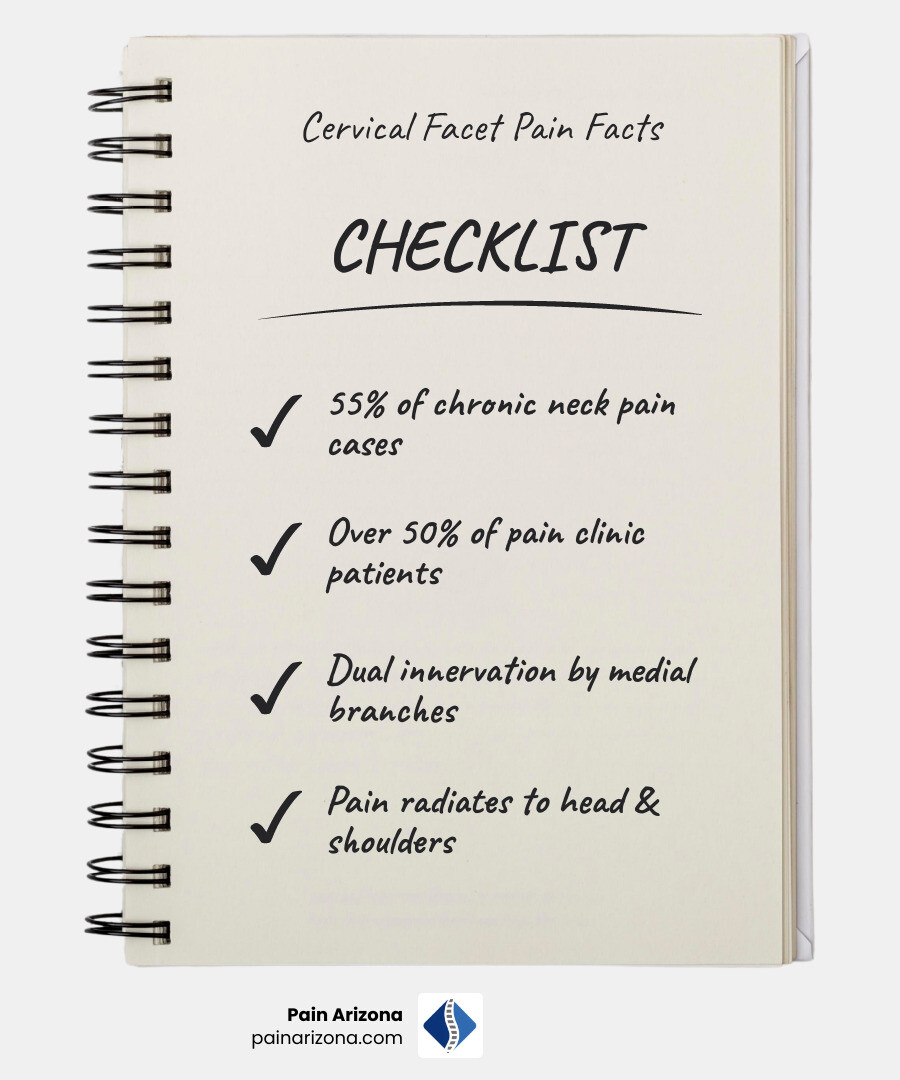
Cervical facet pain is one of the most common — and most overlooked — causes of chronic neck pain, affecting an estimated 55% of patients referred for interventional pain management.
Here’s a quick summary of what you need to know:
| Topic | Key Facts |
|---|---|
| What it is | Pain from the small joints at the back of the neck (zygapophyseal joints) |
| How common | ~55% of chronic neck pain cases; over 50% of pain clinic patients |
| Main causes | Aging, whiplash injury, poor posture, repetitive stress |
| Typical symptoms | Neck stiffness, headaches, pain with rotation or looking up |
| How it’s diagnosed | Physical exam, imaging, and diagnostic nerve blocks |
| Treatments | Physical therapy, injections, radiofrequency ablation |
If you’ve been living with persistent neck pain that nothing seems to fix — no amount of rest, medication, or physical therapy has given you lasting relief — your facet joints may be the source nobody has looked at closely enough.
These small joints sit at the back of every level of your cervical spine. They guide movement, absorb load, and when they become inflamed or worn down, they can generate deep, aching pain that spreads to your shoulders, upper back, and even your head. The tricky part? That pain doesn’t always follow a predictable pattern, which is why it’s frequently missed or misdiagnosed.
I’m Dr. Nasser, a double board-certified PM&R and pain medicine physician with decades of experience diagnosing and treating cervical facet pain through minimally invasive, evidence-based approaches. In this guide, I’ll walk you through everything you need to understand about this condition — from the anatomy behind it to the treatments that actually work.
Learn more about Cervical facet pain:
Understanding Cervical Facet Pain: Anatomy and Prevalence
To understand Cervical facet pain, we first have to look at how your neck is built. Your cervical spine consists of seven vertebrae (C1-C7). While the intervertebral discs sit in the front to absorb shock, the facet joints—also known as zygapophyseal joints—sit in the back. These are synovial joints, meaning they are lined with cartilage and lubricated by fluid, allowing your neck to bend and twist smoothly.

As of April 2026, clinical data continues to highlight just how prevalent this condition is. Research shows that the prevalence of facet joint syndrome is approximately 55% among patients with chronic, non-specific cervical spine pain. In fact, if you walk into a pain clinic in the Phoenix Area with neck pain, there is a better than 50% chance that your facet joints are the primary culprit.
One reason this pain is so difficult to pin down is its complex innervation. Each facet joint receives “dual innervation” from the medial branches of the dorsal rami. This means the joint at one level is actually supplied by nerves from the level above and the level it sits at. This overlapping nerve supply is why the pain feels deep and “ill-defined” rather than a sharp, easily localized point. For more technical details on how these joints present, you can explore Cervical Facet Joint Pain: Symptoms and Diagnosis.
Causes and Pathophysiology of Facet Syndrome
Why do these joints start hurting? At Pain Arizona, we see two primary pathways: slow-motion wear and tear, and sudden trauma.
The Aging Process and Degeneration
By the time we reach our 40s and 50s, almost everyone shows some sign of facet joint changes on an X-ray. As we age, the intervertebral discs often begin to shrink or lose height. This “disc shrinkage” places significantly more mechanical stress on the facet joints. As the cartilage erodes, bone-on-bone rubbing occurs, leading to the formation of bone spurs (osteophytes) and synovial inflammation.
Trauma and Whiplash
Trauma is the other major driver. During a car accident, whiplash creates a rapid “S-shape” motion in the cervical spine. This movement compresses the facet joints and strains the capsular ligaments. Even if an MRI looks “normal” immediately after an accident, the micro-tears in the ligaments can lead to long-term instability and chronic Cervical facet pain.
Other primary triggers include:
- Repetitive Stress: Long hours spent with “text neck” or poor ergonomic setups in the workplace.
- Spondylitis: Systemic inflammation of the spinal joints.
- Postural Stress: Weakness in the core and upper back muscles that forces the neck joints to carry too much weight.
Understanding neck pain causes is the first step toward a targeted treatment plan that addresses the root of the problem, not just the symptoms.
Recognizing the Symptoms and Referral Patterns
One of the most fascinating (and frustrating) aspects of Cervical facet pain is where you feel it. Unlike a pinched nerve that sends a “lightning bolt” down your arm, facet pain is “referred.” This means the brain misinterprets the signal, causing you to feel pain in areas distant from the actual joint.
The referral patterns usually follow specific levels:
- C2-C3: Often refers pain to the base of the skull, forehead, or even behind the eyes. This is a common cause of cervicogenic headaches.
- C3-C4: Typically felt in the suboccipital region and the posterolateral neck.
- C4-C5: Pain often settles at the base of the neck and the top of the shoulders.
- C5-C6: This is a very common level for issues, referring pain down to the shoulder blades (interscapular area).
- C6-C7: Can refer pain even further down toward the shoulder blades and upper outer arm.
Common symptoms we look for during an exam include:
- Axial neck pain: Pain that stays mostly in the neck and doesn’t go past the elbow.
- Stiffness: Difficulty turning your head to check your blind spot while driving.
- Pain with retroflexion: Discomfort that worsens when you look up at the ceiling or tilt your head back.
- Tenderness: Direct pressure over the “articular pillars” (the bony bumps on the side of your neck) feels very sore.
For those struggling with daily discomfort, reviewing neck pain remedies can offer temporary relief while you seek a formal diagnosis. You can also read more about the Cervical Facet Syndrome Clinical Presentation to see if your symptoms align with the classic medical definition.
How We Diagnose Cervical Facet Pain
Diagnosing Cervical facet pain is as much an art as it is a science. At our clinics in Mesa, Gilbert, and across the Phoenix Area, we start with a comprehensive physical exam. I’ll check your range of motion and palpate (feel) the joints to see if we can reproduce your pain.
One of the biggest “secrets” in spine medicine is that imaging—like MRIs and CT scans—often fails to tell the whole story. You can have a “terrible-looking” MRI with significant arthritis and feel no pain, or you can have a “clean” MRI and be in agony due to synovial inflammation. This is why we don’t just treat the image; we treat the patient.
When diagnosing neck pain in Phoenix, we must also rule out other conditions like cervical radiculopathy (nerve root compression) or discogenic pain (pain coming from the disc itself).
The Role of Diagnostic Blocks in Cervical Facet Pain
Because imaging isn’t definitive, the “gold standard” for diagnosis is the diagnostic medial branch block.
We use a tiny amount of local anesthetic to numb the medial branch nerves that supply the suspect joint. If your pain disappears by 50% to 80% while the numbing agent is active, we have confirmed the facet joint as the source.
However, we have to be careful. Single diagnostic blocks have a high “false-positive” rate—between 27% and 63%. This means the pain might go away for reasons other than the facet joint (like the placebo effect or the numbing medicine spreading to a nearby muscle). To be certain, we often perform a “double-block” technique using two different anesthetics (like lidocaine and bupivacaine) on different days. If both blocks provide relief, we have high confidence in the diagnosis. You can learn more about how we perform a medial branch block to ensure accuracy.
Effective Treatment Strategies: From Conservative to Interventional
Once we’ve confirmed the diagnosis, we move into treatment. We always prefer to start with the least invasive options possible.
| Phase | Treatment Type | Goal |
|---|---|---|
| Phase 1 | Conservative (PT, NSAIDs, Heat) | Reduce acute inflammation and restore basic movement. |
| Phase 2 | Diagnostic/Therapeutic Injections | Confirm the source and provide intermediate relief. |
| Phase 3 | Advanced Interventional (RFA) | Long-term pain interruption (6-18 months). |
| Phase 4 | Maintenance & Prevention | Posture correction and strengthening to prevent recurrence. |
Conservative management often involves a phased physical therapy program. We focus on:
- Pain Relief: Using heat, ice, and gentle stretching.
- Mobility: Restoring the ability to rotate and tilt the neck.
- Strengthening: Building the “deep neck flexors” to support the spine.
- Ergonomics: Adjusting your workstation to reduce repetitive strain.
If facet joint pain treatment through therapy and medications like NSAIDs or muscle relaxants isn’t enough, we then consider a facet joint injection. These injections can be both diagnostic and therapeutic, often containing a steroid to calm down joint inflammation.
Interventional Relief for Cervical Facet Pain
For patients who get good relief from diagnostic blocks but find the pain keeps returning, we offer Radiofrequency Ablation (RFA), also known as radiofrequency neurotomy.
In this procedure, we use a specialized needle that generates heat to “turn off” the medial branch nerves. This doesn’t damage the joint itself; it simply stops the joint from sending pain signals to the brain.
- Duration of Relief: Most patients experience 6 to 18 months of significant pain reduction.
- Recovery: The procedure is minimally invasive, performed in-office, and most patients return to normal activity the next day.
- Evidence: There is strong evidence supporting RFA for chronic cervical pain when diagnostic blocks have been successful.
We also offer specialized cervical facet joint injections and are staying at the forefront of regenerative medicine, exploring PRP (Platelet-Rich Plasma) options for patients looking to promote natural healing within the joint capsule.
Frequently Asked Questions about Facet Joints
How does facet pain differ from a herniated disc?
This is a great question. While both cause neck pain, they feel very different. A herniated disc often causes radiculopathy—pain, numbness, or weakness that travels down a specific “dermatome” into the arm or hand. You might feel a “pins and needles” sensation in your thumb or middle finger. Cervical facet pain is usually mechanical; it’s a deep ache that stays in the neck, shoulders, or upper back and is triggered by specific movements like looking up or twisting.
When is surgery necessary for cervical facet pain?
Surgery for isolated facet pain is quite rare. We only consider surgical consultations—such as ACDF (Anterior Cervical Discectomy and Fusion) or cervical fusion—when there is significant spinal instability, progressive neurological decline (like losing the ability to use your hands), or neuroforaminal stenosis that hasn’t responded to any other treatment. For the vast majority of our patients in Phoenix and Scottsdale, minimally invasive interventional care is the preferred path.
Can cervical facet syndrome be prevented?
While we can’t stop the clock on aging, we can certainly slow down joint wear. Core and neck strengthening are vital. Maintaining a healthy weight reduces the load on your spine, and avoiding “text neck” by keeping your screens at eye level makes a massive difference. If you already have signs of arthritis in the spine, early intervention is key to preventing a minor ache from becoming a chronic disability.
Conclusion
The prognosis for Cervical facet pain is generally very good. While it can be a frustrating and “invisible” source of chronic pain, modern interventional medicine offers highly effective ways to diagnose and treat it. You don’t have to simply “live with” a stiff, aching neck.
At Pain Arizona, we pride ourselves on providing personalized, evidence-based care to the Greater Phoenix Area. Our team of double board-certified physicians is dedicated to finding the root cause of your pain and helping you get back to the activities you love. We accept most insurance plans—just check with our office manager to see if yours is on the list.
If you’re ready to stop guessing and start healing, schedule your joint injections today at one of our convenient locations in Phoenix, Mesa, Gilbert, Scottsdale, or Glendale. Let’s get you back to living pain-free.