
Is Your Office Chair Literally a Pain in the Rear?
Is Prolonged Sitting Causing Your Sciatica? Here’s What You Need to Know
Sciatica from sitting is one of the most common — and most preventable — causes of radiating leg pain in adults today. Here’s a quick overview:
- What it is: Pressure on the sciatic nerve from prolonged sitting, causing pain that travels from the lower back through the buttocks and down the leg
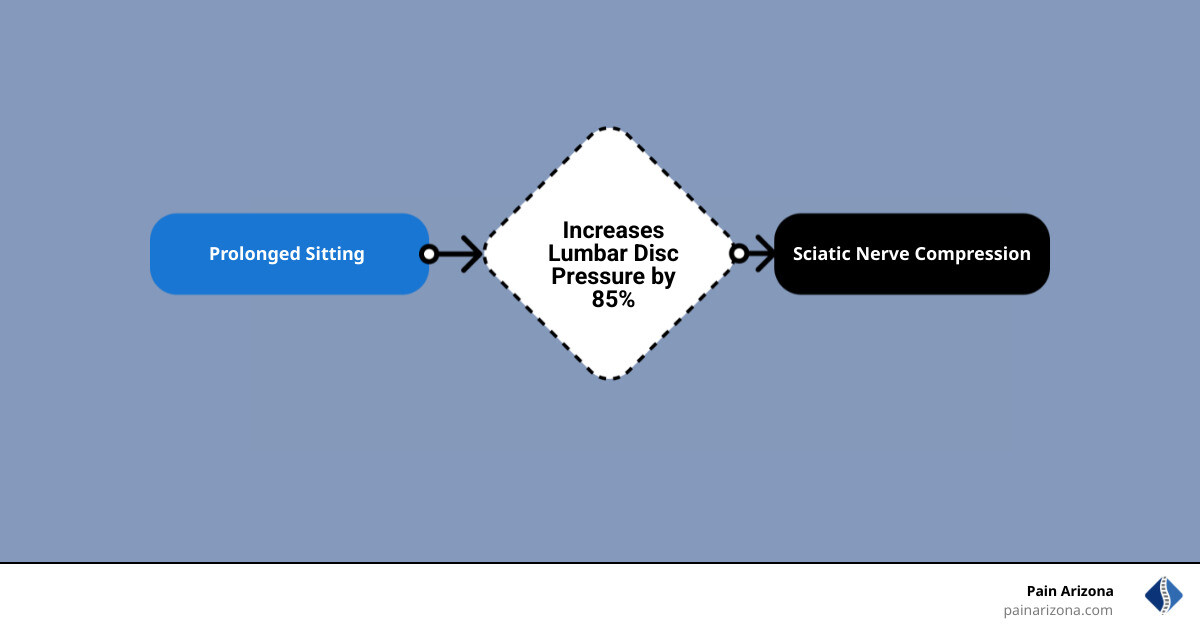
- Why it happens: Sitting increases disc pressure in your lumbar spine by up to 85%, which can irritate or compress the nerve roots that form the sciatic nerve
- Who’s at risk: Desk workers, drivers, and anyone who sits for hours at a time — roughly 40% of Americans will develop sciatica at some point in their lives
- How to prevent it: Better ergonomics, frequent movement breaks, targeted stretches, and core strengthening
- When to get help: If pain lasts more than a week, worsens, or is accompanied by numbness or leg weakness
If you spend most of your day in a chair, your office setup may be doing more damage than you realize. Sitting — especially with poor posture — puts enormous stress on the lower spine. Over time, that stress weakens spinal discs, which can bulge or herniate and press directly on the nerve roots that feed into your sciatic nerve. The result? That sharp, burning, shooting pain that travels from your back down through your leg.
The frustrating part is that it often doesn’t start with a dramatic injury. It builds quietly — one long workday at a time.
I’m Dr. Nasser, a double board-certified PM&R and pain medicine physician with extensive experience treating sciatica from sitting in patients across the Greater Phoenix area, and I’ve performed tens of thousands of minimally invasive procedures to address the exact kind of nerve compression that prolonged sitting causes. In this guide, I’ll walk you through exactly how to protect yourself — and what to do if the pain has already started.
Key terms for sciatica from sitting:
Understanding Sciatica from Sitting: Why Your Desk Job Hurts
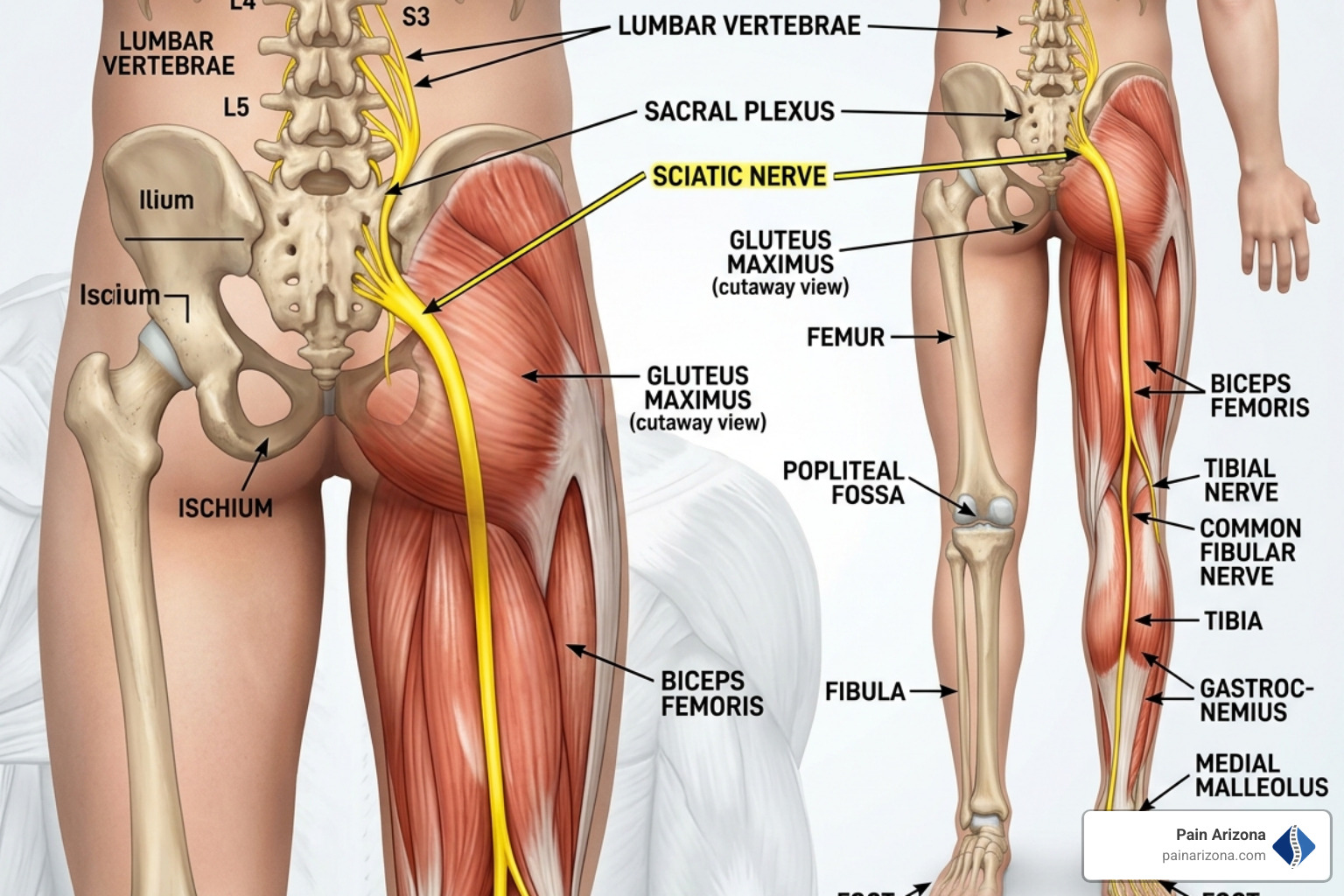
To understand why sciatica from sitting is such a prevalent issue in April 2026, we have to look at human anatomy. The sciatic nerve is the largest and longest nerve in your body—at its widest point, it is about the size of a penny. It starts in your lower back (the lumbar spine) and runs through your hips and buttocks and down each leg.
When we sit, we aren’t just “resting.” We are actually placing a significant mechanical load on the L4 through S1 vertebrae. Research shows that sitting increases the pressure on your spinal discs by 40% compared to standing. If you slouch—which most of us do by 3:00 PM—that pressure jumps by a staggering 85%.
This constant, heavy pressure can cause the soft material inside your spinal discs to bulge or herniate. When that disc material pushes outward, it can pinch the nearby nerve roots. This is why many of our patients in Mesa and Scottsdale report that their pain is at its absolute worst after a long commute or an afternoon of back-to-back Zoom calls. Prolonged sitting also reduces blood flow to the lower spine, which can worsen inflammation around the nerve.
For a deeper dive into the mechanics, you can read more about Sciatica Causes Symptoms and how these Symptoms and causes develop over time.
How to Identify Sciatica from Sitting vs. Other Back Pain
Not all back pain is sciatica. In fact, people often confuse general muscle strain with true nerve involvement. Here is how we differentiate sciatica from sitting from other conditions:
- The Path of Pain: True sciatica typically radiates. It starts in the lower back or buttock and travels down the back of the thigh, often passing the knee and reaching the calf or foot.
- One-Sided Nature: Sciatica usually affects only one side of the body. If both legs are hurting equally, it may be a different spinal issue.
- The Sensation: Patients often describe the pain as a “jolt,” “electric shock,” or “searing heat.” It is rarely just a dull ache.
- Positional Triggers: If your pain “zaps” you the moment you sit down or when you cough or sneeze, that is a classic sign of nerve root irritation.
- Numbness and Tingling: You might feel “pins and needles” in your foot or a patch of numbness on your outer leg.
If you are unsure, we often use specific Sciatica Diagnosis Tests like the straight leg raise to confirm if the nerve is being compressed.
The Role of Piriformis Syndrome in Office Workers
Sometimes, the problem isn’t in your spine at all—it’s in your glutes. This is known as Piriformis Syndrome. The piriformis is a small muscle located deep in the buttock, and in many people, the sciatic nerve runs right under (or even through) it.
When you sit for hours, this muscle can become tight, inflamed, or go into spasm, directly compressing the nerve. This is incredibly common among office workers in the Phoenix area who have a sedentary lifestyle. We often call it “wallet sciatica” because sitting on a thick wallet in your back pocket can aggravate this muscle even further. Understanding What Causes Sciatic Nerve Pain involves looking at both the spine and these surrounding muscles.
How to Prevent Sciatica from Sitting: Ergonomics and Movement
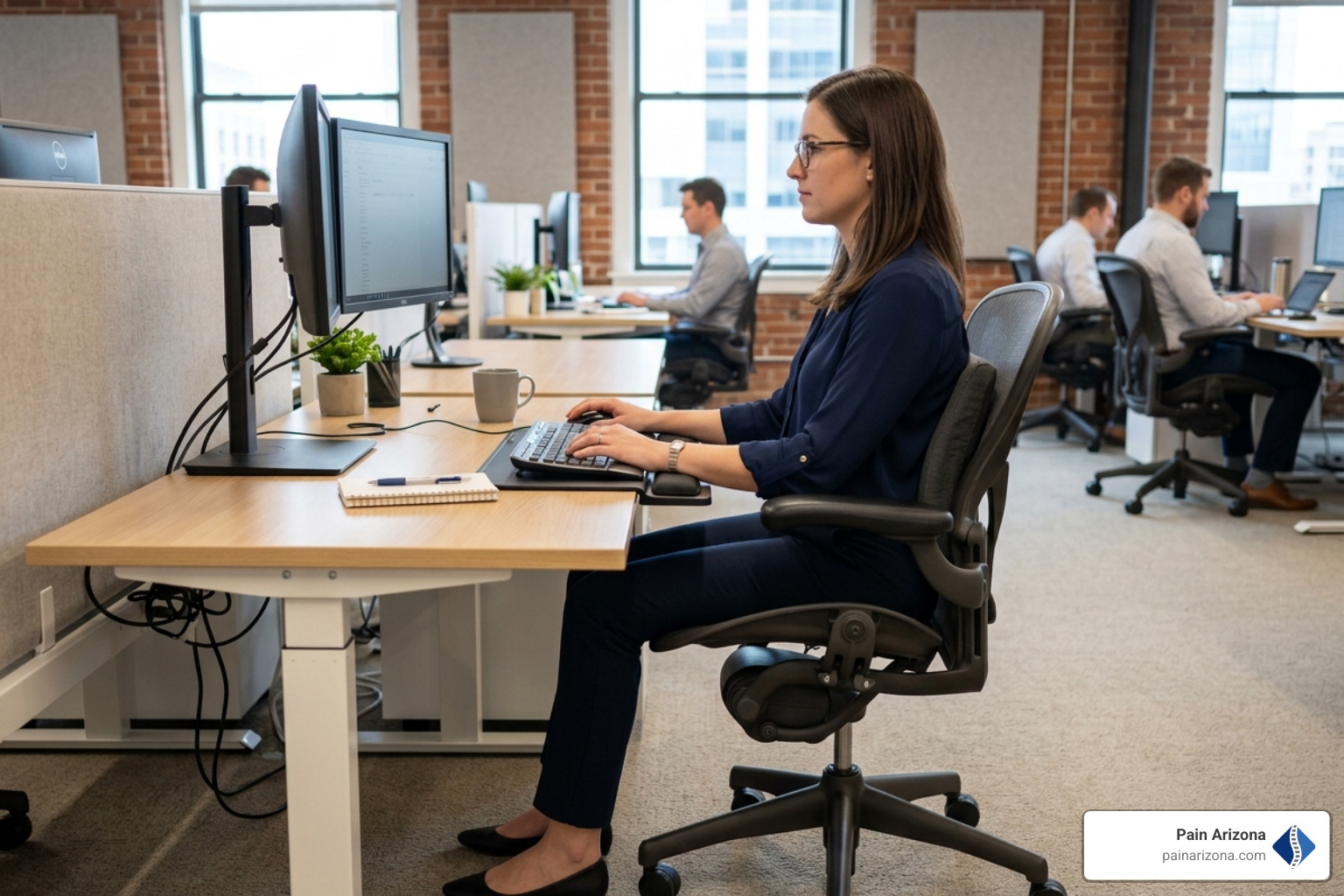
Prevention is always more comfortable than a flare-up. If your job requires you to be at a desk, you need to turn your workstation into a “sciatica-free zone.” Most people assume they need a $2,000 chair, but the truth is that even a basic chair can be made ergonomic with the right adjustments.
The goal is to maintain the natural inward curve of your lower spine (the lumbar curve). When you slump, that curve flattens, pushing your discs toward your nerves.
For more simple lifestyle adjustments, check out our guide on Dont Let Sciatica Get Your Goat Simple Steps To Relief.
Ergonomic Fixes to Prevent Sciatica from Sitting
If you want to stop sciatica from sitting before it starts, follow this checklist to optimize your desk setup:
- Chair Height: Adjust your chair so your feet are flat on the floor. Your knees should be at a 90-degree angle, level with or slightly lower than your hips.
- Lumbar Support: This is non-negotiable. If your chair doesn’t have built-in support, use a lumbar roll or even a rolled-up towel in the small of your back. This prevents the “forward pelvic tilt” that crushes your discs.
- Monitor Level: Your eyes should hit the top third of your screen. If you are looking down at a laptop, you are likely leaning forward, which rounds your lower back.
- Firm Cushioning: A chair that is too soft can actually be worse for sciatica because it doesn’t provide enough support for your “sit bones,” causing you to tilt your pelvis.
- Standing Desks: We highly recommend sit-stand desks. Alternating positions every 30 to 45 minutes can significantly reduce nerve irritation.
As noted in the Cleveland Clinic’s guide to Sciatica, maintaining good posture while sitting and standing is a primary pillar of prevention. You can also explore Sciatica Demystified Understanding Nerve Pain And Its Impact for more on why these fixes work.
The 30-2 Rule for Micro-breaks
At Pain Arizona, we teach our patients the 30-2 Rule. It is the single most effective habit you can build to prevent sciatica from sitting.
- Every 30 minutes of sitting…
- Take 2 minutes of movement.
You don’t need to run a marathon. Just stand up, walk to the breakroom, or do a few gentle standing back extensions. This “unloads” the pressure on your discs and allows blood to flow back into the compressed tissues. Movement is medicine for the sciatic nerve. These micro-breaks are among the Top Strategies For Sciatica Pain Relief because they prevent inflammation from reaching a “boiling point.”
Targeted Stretches and Exercises for Desk Workers
If you are already feeling that familiar tingle in your glutes, it is time to get active. While it is tempting to lie in bed, prolonged rest is actually one of the worst things you can do for sciatica. Light movement helps maintain flexibility and strengthens the muscles that support your spine.
Here are the top four exercises we recommend for those struggling with sciatica from sitting:
- Seated Figure-Four Stretch: While sitting, place your right ankle on your left knee. Gently lean forward with a straight back until you feel a stretch in your right buttock. This targets the piriformis muscle. Hold for 30 seconds and swap.
- Sciatic Nerve Gliding (Flossing): This is a game-changer. Sit tall and straighten one leg. As you straighten the leg, flex your foot toward your face and look up at the ceiling. Then, point your toe and look down at your chest. This “flosses” the nerve through the tissues without overstretching it.
- Cat-Cow: On your hands and knees, alternate between arching your back (like a cat) and letting your belly sink (like a cow). This promotes mobility in the lumbar spine.
- Glute Bridges: Lie on your back with knees bent and feet flat. Lift your hips toward the ceiling. Strengthening your glutes and core provides a “natural corset” for your spine, taking the load off your discs.
For more on why these movements are essential, the University of Utah Health discusses how Maybe You’re Sitting Too Much and provides context on active recovery.
Medical Interventions: When Self-Care Isn’t Enough
For about 75% to 90% of people, sciatica from sitting will improve within 4 to 6 weeks with conservative care—meaning posture changes, stretching, and over-the-counter anti-inflammatories like ibuprofen.
However, you should never “tough it out” if you experience red flags. Seek immediate medical attention at one of our Greater Phoenix locations or an emergency room if you notice:
- Sudden, severe weakness in your leg (e.g., you can’t lift your toes or “foot drop”).
- Numbness in your “saddle area” (groin and inner thighs).
- Any loss of bladder or bowel control.
If your pain is persistent but doesn’t meet emergency criteria, Sciatica Treatment often begins with physical therapy. A therapist can help correct muscle imbalances and teach you specific movements to decompress the nerve.
Advanced Relief Options for Chronic Nerve Pain
When the pain is so severe that you can’t even sit down to work, we offer advanced, minimally invasive options. We believe in addressing the root cause rather than just masking symptoms.
- Epidural Steroid Injections (ESI): We inject a powerful anti-inflammatory medication directly into the space around the compressed nerve. This reduces swelling and “puts out the fire,” allowing you to participate in physical therapy.
- Selective Nerve Root Blocks: These are even more precise than standard epidurals. Using X-ray guidance (fluoroscopy), we target the exact nerve root that is causing your leg pain.
- Disc Decompression: For chronic cases, minimally invasive procedures can help reduce the pressure within the disc without the need for major surgery.
You can learn more about how these procedures work in our detailed guide on Injections For Sciatica.
Frequently Asked Questions about Sciatica
How long does it take for sciatica from sitting to improve?
Most cases of sciatica from sitting show significant improvement within 4 to 6 weeks of conservative management. However, it can take several months for a herniated disc to be fully reabsorbed by the body. Consistency with your ergonomic setup and stretches is key to preventing a relapse. If you aren’t seeing progress after a month, it’s time for a professional evaluation of your Sciatica Symptoms.
Is walking better than sitting for sciatic nerve pain?
Absolutely. Walking is one of the best things you can do for your spine. It encourages blood flow, strengthens the core, and naturally decompresses the spine. We recommend short, frequent walks rather than one long trek. If you’ve been sitting for an hour, a 5-minute walk can do wonders for your pain levels.
Can a standing desk completely cure my sciatica?
A standing desk is a tool, not a cure-all. Standing all day can lead to its own set of problems, like lower back fatigue or foot pain. The “magic” happens in the transition. The goal is to avoid any static position for too long. Switch between sitting and standing every 30 to 45 minutes to keep your spine happy.
Conclusion
Sciatica from sitting doesn’t have to be a permanent part of your professional life. By understanding the pressure sitting puts on your spine, optimizing your ergonomics, and committing to regular movement, you can reclaim your comfort and productivity.
At Pain Arizona, we specialize in helping the residents of Phoenix, Mesa, Gilbert, Scottsdale, and Glendale find lasting relief from chronic nerve pain. Our double board-certified physicians use the latest evidence-based treatments to get you back to the activities you love—without the “pain in the rear.”
We accept most insurance plans to ensure our community has access to top-tier care. If you’re tired of the burning and tingling, don’t wait for it to get worse.
Schedule your evaluation for sciatica relief today and let us help you take the first step toward a pain-free life.