
Getting to the Root of It: How Epidural Steroid Injections Relieve Lumbar Pain
When Your Back Pain Won’t Quit: What a Lumbar Epidural Can Do
Lumbar epidural injection interventional pain management is one of the most commonly used non-surgical tools for relieving lower back and leg pain caused by inflamed or compressed spinal nerves.
Here’s what you need to know at a glance:
- What it is: An injection of corticosteroid and local anesthetic into the epidural space of the lower spine
- What it treats: Herniated discs, spinal stenosis, sciatica, degenerative disc disease, and radiculopathy
- How it works: Reduces nerve inflammation directly at the source, often within 24–72 hours
- How long relief lasts: Several days to up to 6–12 months, depending on the condition
- How many per year: Most guidelines allow up to 3–4 sessions per spinal region in a rolling 12-month period
- Is it surgery? No — it’s an outpatient procedure, typically done in under 30 minutes
Low back pain is extremely common. The CDC reports that roughly 28% of men and 31.6% of women in the U.S. experience lower back pain in any given three-month period. For many people, that pain radiates into the legs — a condition called radiculopathy — and it can make everyday activities feel impossible.
Medications and physical therapy help many patients. But when they don’t provide enough relief, interventional options like epidural steroid injections can bridge the gap between suffering and getting your life back — often without surgery.
I’m Dr. Nasser — a double board-certified PM&R and pain medicine physician at Pain Arizona, with extensive training in lumbar epidural injection interventional pain procedures and minimally invasive spine treatments performed across thousands of patient encounters. I’ll walk you through everything you need to understand about this procedure so you can make a confident, informed decision about your care.
What is a Lumbar Epidural Injection Interventional Pain Treatment?
To understand how a lumbar epidural injection interventional pain treatment works, we first have to take a quick trip back to high school anatomy. Don’t worry, there won’t be a pop quiz!
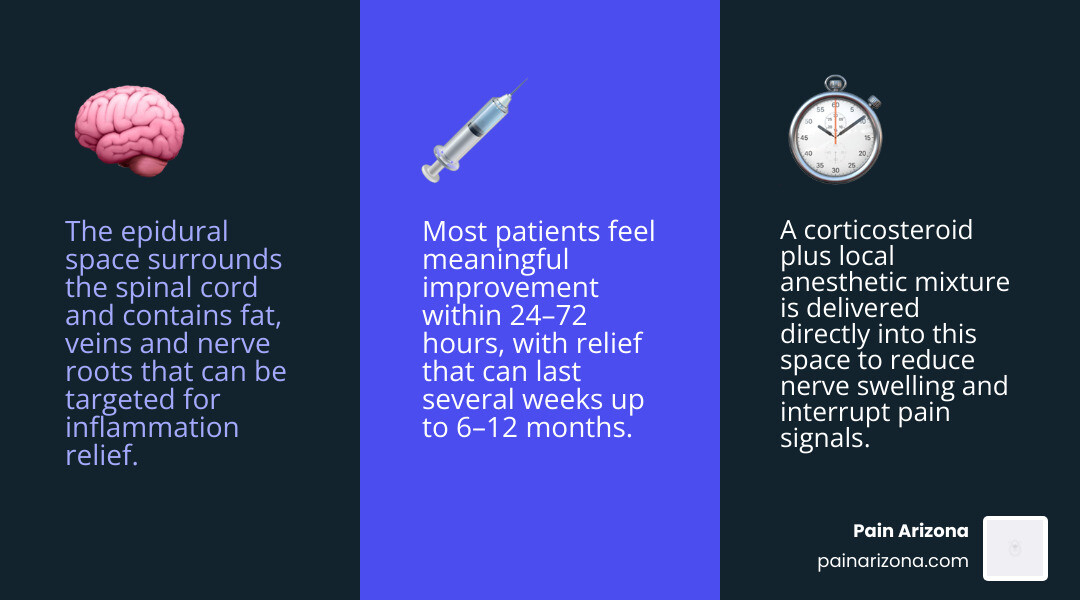
The spinal cord and the nerves that branch off it are protected by a series of membrane layers called meninges. The outermost, toughest protective layer is the dura mater. Surrounding this dura mater is a small, fat-filled sleeve known as the epidural space.
This epidural space is surprisingly narrow—typically only about 5 millimeters wide—but it plays a massive role in spinal health. It contains:
- Spinal nerve roots exiting the spinal canal
- Small blood vessels
- Connective tissue and protective fat cells
When a disc herniates or the spinal canal narrows, these exit pathways get crowded. The resulting pressure causes the nerve roots to become raw, swollen, and highly inflamed.
An epidural steroid injection (ESI) is a specialized interventional procedure where we deliver a powerful combination of medications directly into this epidural space. Unlike oral medications that have to travel through your entire digestive system and bloodstream, an ESI targets the exact site of nerve irritation.
According to the Cleveland Clinic ESI Guide, the injection typically consists of two main components:
- A Corticosteroid: A highly concentrated anti-inflammatory medication (such as dexamethasone, triamcinolone, or betamethasone) that calms down the inflamed, angry nerve roots.
- A Local Anesthetic: A numbing agent (like lidocaine or bupivacaine) that provides temporary, immediate pain relief and helps wash away inflammatory chemicals from the area.
How a Lumbar Epidural Injection Interventional Pain Procedure Works
When a spinal nerve root is compressed by a bulging disc or bone spur, it triggers a complex biochemical cascade. The mechanical pressure causes the release of an enzyme called phospholipase A2 (PLA2). This enzyme kickstarts the production of arachidonic acid, which then synthesizes highly inflammatory substances like prostaglandins and leukotrienes.
This chemical “soup” is what actually causes the burning, sharp, electric pain of sciatica, rather than just the physical pinching of the nerve itself.
By injecting a corticosteroid directly into the epidural space, we interrupt this biochemical pathway at its very root. The steroid works by:
- Inhibiting the phospholipase A2 enzyme, halting the production of inflammatory chemicals
- Suppressing the transmission of pain signals along nociceptive C-fibers (the slow-conducting nerve fibers responsible for chronic, aching pain)
- Reducing capillary permeability, which decreases swelling and local edema around the nerve root
By putting out the fire of chemical inflammation, the nerve root can finally heal, swelling goes down, and your body gets a much-needed break from sending constant pain signals to your brain. You can learn more about how we manage these burning nerve paths in our detailed guide on Injections for Sciatica.
Who Benefits Most from Lumbar Epidural Injection Interventional Pain Management?
While epidural injections are highly effective, they aren’t a “one-size-fits-all” cure for every type of back pain. They are specifically designed to treat radicular pain—pain that radiates from the spine down into the buttocks, thighs, calves, and feet.
The most common conditions we treat with lumbar ESIs include:
- Lumbar Disc Herniations: When the soft inner gel of a spinal disc leaks out, it physically presses against and chemically irritates the adjacent nerve root.
- Lumbar Spinal Stenosis: A gradual narrowing of the spinal canal or the lateral recesses where nerves exit, compressing the nerves and causing pain, cramping, or heaviness in the legs when walking.
- Degenerative Disc Disease (DDD): As discs wear down with age, they lose height and stability, leading to localized inflammation that spills over onto nearby nerves.
- Sciatica / Radiculopathy: The general term for pain, numbness, tingling, or weakness that travels along the path of the sciatic nerve.
- Post-Surgery Syndrome (Failed Back Surgery Syndrome): Persistent back or leg pain that continues after spinal surgery, often due to localized scar tissue or ongoing nerve irritation.
To see a complete breakdown of how we diagnose and treat disc-related nerve compression in the Phoenix Area, check out our Herniated Disc Phoenix Complete Guide.
Comparing the Three Primary Epidural Injection Approaches
Not all epidural injections are performed the same way. Depending on your specific anatomy, the location of your pain, and your prior surgical history, we will select one of three primary approaches.
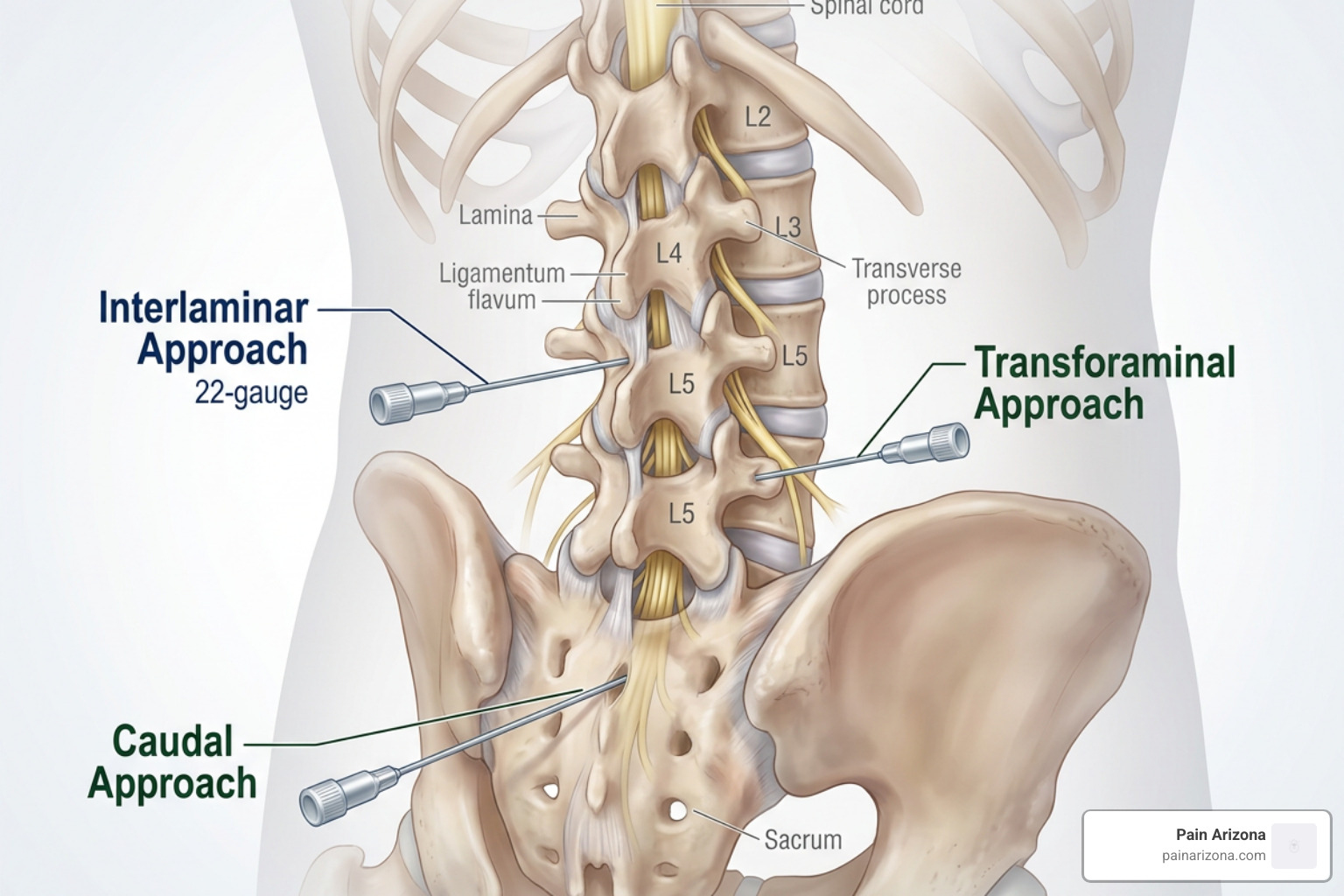
To help you understand how these approaches differ, let’s look at a comprehensive review of the landscape, supported by findings in the PMC Landscape Review:
1. The Interlaminar Approach (ILESI)
The interlaminar approach is the traditional method. The needle is directed through the back of the spine, passing directly between the laminae of two adjacent vertebrae to enter the posterior epidural space.
- Advantages: It allows us to deliver a larger volume of medication over a wider, multi-level area. This is highly beneficial if you have pain on both sides of your body or multi-level disc issues.
- Disadvantages: The medication is delivered to the back of the spinal canal, meaning it has limited ventral spread (it doesn’t always reach the front of the spinal canal where the disc herniation is actually pressing on the nerve).
2. The Transforaminal Approach (TFESI)
The transforaminal approach is a highly targeted technique. We guide the needle from the side of the spine directly into the intervertebral foramen (the “nerve exit window”) where the nerve root exits the spinal column. This area is often referred to as “Kambin’s triangle” or the “safe triangle.”
- Advantages: It delivers a highly concentrated dose of medication directly to the front of the spinal canal, right where the nerve root and disc meet. It also serves a diagnostic purpose: if the injection completely stops your pain, we have confirmed the exact nerve root causing your symptoms. Learn more about this targeted approach in our guide to Transforaminal Epidural Injection.
- Disadvantages: It requires advanced technical precision because of the nearby radicular arteries. In particular, the Artery of Adamkiewicz—which supplies blood to the lower spinal cord—is left-sided in 68% to 85% of cases and sits in the upper or mid-portion of the foramen. To maximize safety, we use nonparticulate steroids (like dexamethasone) which do not clump together if they accidentally enter a blood vessel.
3. The Caudal Approach (CESI)
The caudal approach accesses the epidural space through the sacral hiatus—a small opening located just above your tailbone at the very base of the spine.
- Advantages: This is the safest and easiest approach to perform, especially for patients who have had prior spine surgeries (like a laminectomy or fusion) that have left behind dense scar tissue in the lower back.
- Disadvantages: Because the injection site is at the very bottom of the spine, we must use a larger volume of fluid to ensure the medication travels high enough to reach the lumbar nerve roots.
| Feature / Approach | Interlaminar (ILESI) | Transforaminal (TFESI) | Caudal (CESI) |
|---|---|---|---|
| Primary Target | Posterior epidural space (broad spread) | Specific nerve root exit window (ventral space) | Sacral hiatus at the base of the spine |
| Best For | Multi-level pain, bilateral symptoms | Single-level disc herniation, localized sciatica | Complex post-surgical anatomy, scar tissue |
| Diagnostic Value | Low | High (confirms the exact pain-generating nerve) | Low |
| Injectate Volume | Moderate (3–5 mL) | Low (1.5–2.5 mL) | High (10–20 mL) |
What to Expect: The Procedure, Preparation, and Recovery
We believe that demystifying the procedure is the best way to ease any pre-appointment jitters. Here is exactly what you can expect when you visit one of our Pain Arizona clinics in the Greater Phoenix Area.
Step 1: Pre-Procedure Preparation
Preparation starts a few days before your appointment.
- Medications: If you take blood thinners (anticoagulants), we will coordinate with your prescribing doctor to have you safely hold them for a brief period before the injection to minimize bleeding risks.
- Antibiotics: If you are currently taking antibiotics for an active infection, we must postpone the procedure until you have finished your course and the infection is fully resolved.
- Fasting: We typically ask that you do not eat or drink for 4 to 6 hours prior to the procedure, especially if you opt for mild IV sedation to help you relax.
- Transportation: You must arrange for a trusted driver to take you home after the procedure. Because of the local anesthetics used, your legs may feel temporarily weak or heavy, making driving unsafe.
Step 2: The Injection Procedure
The entire procedure takes only 15 to 30 minutes.
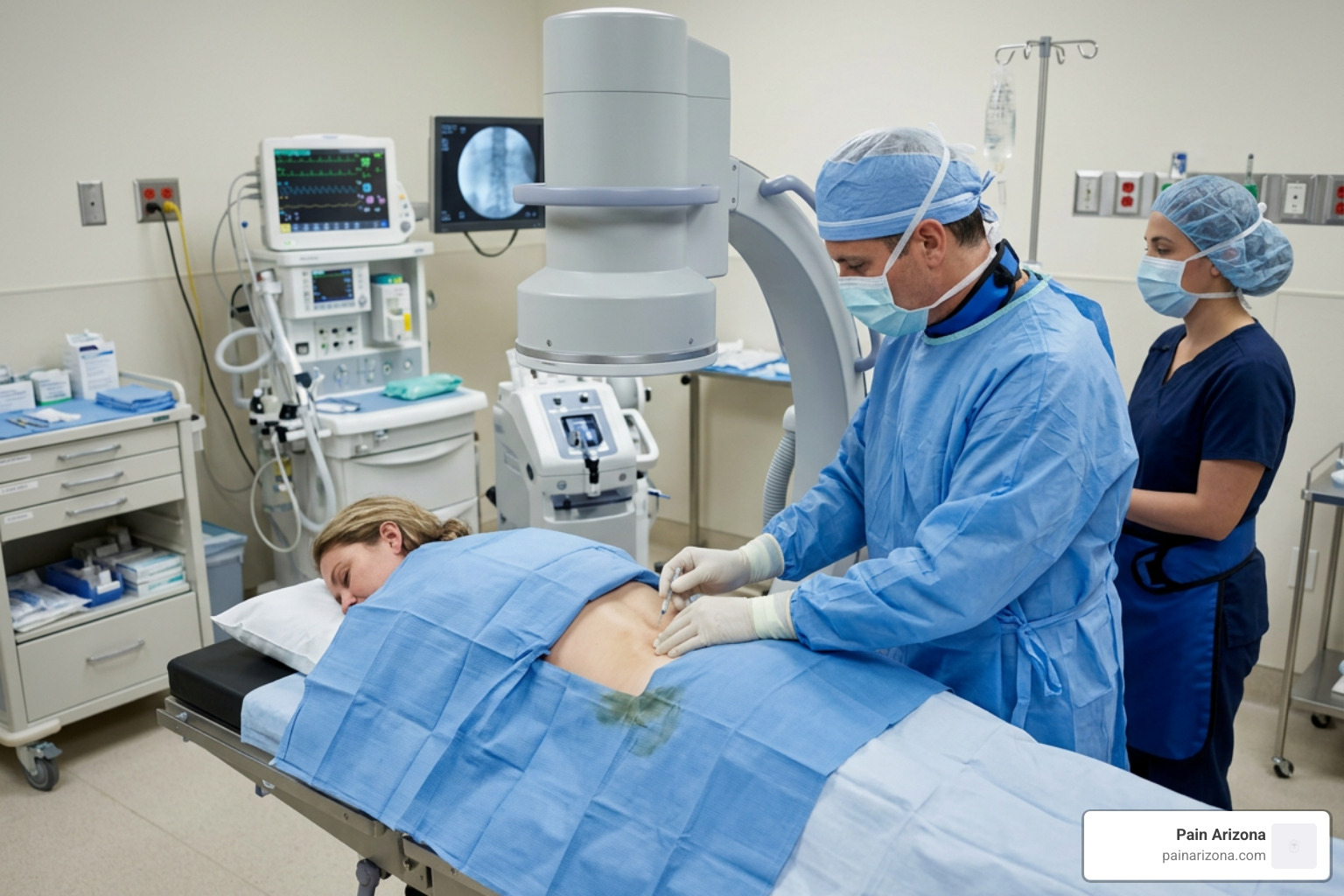
- Positioning: You will lie comfortably on your stomach on a specialized fluoroscopy table. We may place a bolster or pillow under your abdomen to slightly curve your lower back and open up the spaces between your vertebrae.
- Numbing: We clean your lower back with an antiseptic solution and numb the skin with a tiny needle containing a local anesthetic. You will feel a quick pinch and sting, but the area will quickly go numb.
- Fluoroscopic Guidance: Using real-time X-ray imaging (fluoroscopy), we guide a specialized epidural needle (such as a 17 to 20-gauge Tuohy needle) safely into the epidural space.
- Contrast Confirmation: Once the needle is in position, we inject a small amount of iodinated contrast dye. This allows us to confirm under the X-ray that the medication will flow perfectly around your nerves and has not entered a blood vessel.
- The Injection: We slowly inject the steroid and local anesthetic mixture. You may feel a brief sensation of pressure or a temporary replication of your typical leg pain as the fluid enters the tight space—this is completely normal and tells us we are in the right spot!
For a deeper dive into how image-guided injections fit into a broader recovery plan, explore our Back Pain Treatment Complete Guide.
Step 3: Post-Procedure Recovery
After the injection, we will monitor you in our recovery area for 15 to 20 minutes to ensure you are feeling well and that your vital signs are stable.
Once cleared to go home, follow these essential recovery steps:
- Rest: Take it easy for the first 24 hours. Avoid strenuous exercise, heavy lifting, or vigorous activities.
- Ice: If you experience mild soreness at the injection site, apply an ice pack for 15–20 minutes at a time. Avoid heat packs on the injection site for the first 24 hours.
- Bathing: You may shower, but do not soak in a bath, hot tub, or go swimming for at least 24 hours to let the needle track completely close and prevent infection.
- Monitor Symptoms: It is normal to feel a temporary increase in soreness or a flushing sensation in your face over the first 48 hours as the steroid begins to work.
Clinical Efficacy, Safety, and Insurance Guidelines
When it comes to the medical necessity and clinical safety of epidural injections, we strictly follow evidence-based protocols.
What the Science Says
Clinical studies show that epidural steroid injections provide a significant immediate-term reduction in pain (a weighted mean difference of -7.55 on a scale of 0 to 100) and function (a standardized mean difference of -0.33) for patients suffering from radiculopathy. Furthermore, for those dealing with acute radiculopathy, receiving an ESI is associated with a short-term surgery risk reduction (relative risk of 0.62).
Success rates vary by condition:
- For Lumbar Disc Herniations: Transforaminal ESIs yield success rates (defined as at least 50% pain relief) of 63% at 1 month, 74% at 3 months, and 64% at 12 months.
- For Lumbar Spinal Stenosis: Success rates are reported at 49% at 1 month, 48% at 3 months, and 59% at 12 months.
According to the comprehensive ASIPP Guidelines, there is Level I (strong) evidence supporting the use of caudal and lumbar interlaminar injections for disc herniations, and Level II evidence for spinal stenosis and post-surgery syndrome.
Safety and Risks
While ESIs are incredibly safe, no medical procedure is entirely without risk. A massive 2016 multi-institutional study of 16,638 consecutive epidural procedures reported zero major adverse events. A 2012 prospective study of over 10,000 procedures noted that minor local bleeding occurred in about 63% of cases, and minor intravascular penetration (which is immediately corrected using fluoroscopy) occurred in 4.3% of cases.
However, we must limit the frequency of these injections. Research indicates that each successive corticosteroid injection can increase the risk of spinal fractures by a factor of 1.21 (a 21% increase) in postmenopausal women due to systemic steroid absorption.
Insurance and Medicare Guidelines
To ensure that your insurance or Medicare plan covers the procedure, we must document that the treatment is medically necessary. Standard criteria (such as Medicare LCD L39240) typically require:
- Documented Radiculopathy: Clear evidence of nerve root irritation on physical exam, imaging (like an MRI), or electrodiagnostic testing.
- Failure of Conservative Care: You must have tried and failed at least 4 weeks of conservative treatments (such as physical therapy, home exercises, or oral anti-inflammatories).
- Session Limits: Injections are strictly limited to a maximum of four (4) sessions per spinal region within a rolling 12-month period.
- Documented Improvement: To qualify for a repeat injection, you must document at least a 50% improvement in pain or functional ability lasting for at least three months from the previous injection.
We accept most insurance plans. Check with our office manager to see if your plan is accepted. If you want to compare how ESIs stack up against other non-surgical options, you can read more about various Lower Back Pain Treatments.
Frequently Asked Questions about Lumbar Epidurals
How long does pain relief typically last after the injection?
The local anesthetic provides immediate relief that lasts for several hours. Once that wears off, your original pain may return temporarily. The corticosteroid usually begins to kick in within 2 to 3 days, but can take up to a week to reach full effect.
Once active, the pain-relieving effects typically last anywhere from 3 to 6 months, and in some cases, up to a full year. We view this relief as a “therapeutic window”—by reducing your pain, you can actively participate in physical therapy to strengthen your core and back muscles, which provides the true foundation for long-term, permanent recovery.
What are the main risks and side effects of the procedure?
The most common side effects are mild and temporary, such as localized soreness at the injection site, facial flushing, temporary sleeplessness, or a brief spike in blood sugar (especially important for our diabetic patients to monitor).
Rare but more serious risks include:
- Dural Puncture (“Wet Tap”): If the needle accidentally punctures the dura mater, spinal fluid can leak out, causing a severe “spinal headache” when you stand up. This is easily treated with bed rest, hydration, or a simple outpatient procedure called an epidural blood patch.
- Infection or Bleeding: Extremely rare (severe infection occurs in less than 0.1% of spinal injections) thanks to our sterile techniques and fluoroscopic guidance.
- Nerve Injury: An incredibly rare complication that we prevent by using real-time imaging to visualize exactly where the needle is at all times.
How many epidural injections can I safely receive in a year?
To protect your bone density, surrounding tissues, and overall endocrine health, we generally limit patients to a maximum of 3 to 4 epidural steroid injections per year within a rolling 12-month period. If an injection does not provide significant relief after two consecutive sessions, we will pivot to alternative interventional options rather than continuing to inject steroids into the same area.
Conclusion
Living with chronic, radiating lower back pain can make even the simplest daily tasks feel like climbing a mountain. But you don’t have to suffer in silence, and you don’t always have to turn to major spine surgery to find relief.
At Pain Arizona, our double board-certified physicians specialize in delivering compassionate, highly personalized, and evidence-based interventional care. We serve patients across the Greater Phoenix Area, with convenient clinic locations in Phoenix, Mesa, Gilbert, Scottsdale, and Glendale.
If you’re ready to stop managing your pain and start reclaiming your active lifestyle, we are here to help you get to the root of the problem. Schedule a Lumbar Epidural Steroid Injection Consultation with our team today, and let’s take the first step toward lasting relief together.