
The Real Cost of Cortisone Injections and How to Save
What Does an Intra Articular Steroid Injection Actually Cost in 2026?
Intra articular steroid injection cost varies widely depending on your insurance, provider, and location — but here’s a quick breakdown to get you oriented:
| Scenario | Typical Cost Range |
|---|---|
| With insurance (copay) | $20 – $100 |
| Medicare out-of-pocket | $50 – $146 |
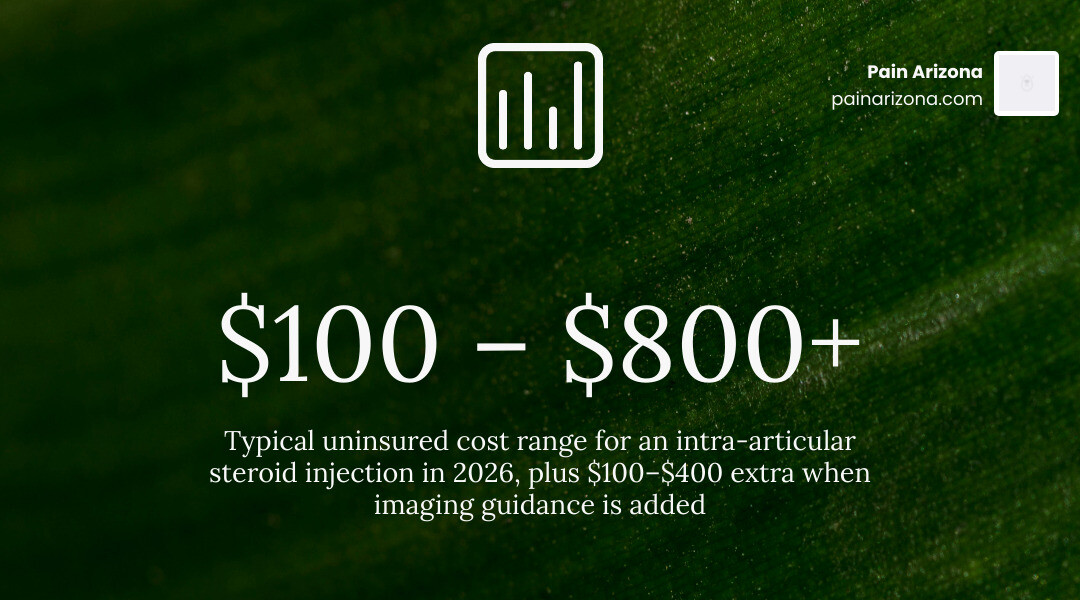
| Uninsured / self-pay | $100 – $800+ |
| With imaging guidance added | +$100 – $400 |
| Hospital vs. office setting | Hospitals can cost 2x more |
These are national estimates. Your actual cost depends on your specific plan and provider.
If you’re dealing with chronic knee pain in the Phoenix area and wondering whether a cortisone injection is worth it — financially and medically — you’re not alone. Knee osteoarthritis affects more than 9.3 million adults in the U.S., and intra-articular steroid injections are one of the most common first-line treatments. Yet pricing is often unclear, inconsistent, and full of surprises.
The truth is, what looks like a simple shot can come with layers of fees — office visits, imaging, facility charges — that add up fast. And if you’re uninsured or on a high-deductible plan, those numbers matter a lot.
At Pain Arizona, we accept most major insurance plans. Check with our office manager to confirm whether your plan is accepted.
I’m Dr. Nasser, a double board-certified PM&R and pain medicine physician with extensive experience performing intra articular steroid injection procedures guided by fluoroscopy and ultrasound across thousands of patients. In this guide, I’ll walk you through exactly what to expect on the cost side — and how to make sure you’re getting real value from your care.
Understanding the Average Intra Articular Steroid Injection Cost
When you start researching the intra articular steroid injection cost, the first thing you’ll notice is the massive spread in pricing. If you look at the raw medication itself, cortisone is actually highly affordable. In fact, checking Cortisone 2026 Prices, Coupons & Savings Tips – GoodRx shows that the steroid solution itself can often be purchased at retail pharmacies for very little.
However, you cannot simply buy the medication and administer it yourself. The real cost lies in the medical expertise, the clinical setting, and the precise delivery of the drug into the joint space.
To understand what you are actually paying for, it helps to read our comprehensive overview: Everything You Need to Know About Joint Injections.

Without insurance, a single joint injection typically ranges from $100 to $300 at a standard outpatient clinic. However, if the procedure is performed in a hospital outpatient department or a specialized surgical center, that price can easily climb to $1,000 or more.
With commercial insurance, your out-of-pocket obligation is usually limited to a specialist copay, which typically ranges from $20 to $100, assuming you have already met your annual deductible.
Here is a side-by-side comparison of what self-pay patients versus insured patients typically pay for a standard joint injection:
| Fee Component | Self-Pay / Uninsured | Insured (In-Network) |
|---|---|---|
| Initial Consultation | $150 – $400 | Covered (Copay: $20 – $70) |
| Steroid Medication | $25 – $100 | Covered |
| Procedure Fee (CPT 20610/20611) | $100 – $400 | Covered (Coinsurance: 10% – 20%) |
| Imaging Guidance (Ultrasound) | $100 – $200 | Covered |
| Follow-Up Office Visit | $100 – $300 | Covered (Copay: $20 – $50) |
| Total Estimated Out-of-Pocket | $475 – $1,400 | $40 – $250 |
Factors Influencing Your Intra Articular Steroid Injection Cost
Your final bill is not a random number. It is determined by several distinct variables:
- Facility Type: This is the single largest driver of cost. Receiving an injection in a hospital-owned facility can cost double or triple what you would pay at an independent, office-based practice. Standalone pain clinics keep overhead low, passing those savings directly to patients.
- Provider Specialty: A primary care doctor might offer a lower baseline fee for a blind (unguided) injection, but they often lack the specialized equipment to guarantee accuracy. Board-certified pain specialists or orthopedists charge slightly more but bring advanced precision to the procedure.
- Geographic Location: Healthcare costs reflect local real estate and labor markets. For a clear picture of local rates, you can review the Joint Injection with or without Fluoroscopic Guidance Cost in Arizona.
In the Greater Phoenix Area, patients have access to highly competitive outpatient pricing. If you want to know why so many local residents choose this path, explore Why Joint Injections in Phoenix Are the Real Deal for Relief.
Hidden Fees That Affect the Total Intra Articular Steroid Injection Cost
Many patients are caught off guard by “hidden” fees that are billed separately from the injection itself. When a clinic quotes you a price for a “cortisone shot,” they might only be referring to the physical injection of the drug.
To avoid surprise bills, you must account for:
- The Specialist Consultation: Before we can administer an injection, we must perform a physical evaluation, review your medical history, and confirm the diagnosis. This office visit is billed separately.
- Imaging Guidance: Injecting “blindly” (relying only on anatomical landmarks) has an accuracy rate of only 60% to 79% in the knee, and even lower in the hip. Using ultrasound or fluoroscopy (live X-ray) increases accuracy to nearly 100%. However, this guidance adds to the cost.
- Billing Codes (CPT Codes): Medical procedures are billed using standardized Current Procedural Terminology (CPT) codes. A standard joint injection without imaging is billed under CPT 20610, while an injection with ultrasound guidance is billed under CPT 20611.
The national data shows a staggering variance for CPT 20611. According to How Much Does Drain/inj joint/bursa w/us Cost? $7-$15,671 (CPT 20611) — MedRates.fyi , the cash price for this single code ranges from a mere $7 to over $15,671 depending on the hospital’s internal pricing structure. This highlights why shopping around and choosing independent clinics is so critical.
For a detailed breakdown of local pricing and what to expect during your appointment, see our Knee Injections Phoenix Guide.
Insurance Coverage and Out-of-Pocket Expenses

The good news is that because cortisone injections are a long-established, clinically proven treatment for joint inflammation, they are almost universally covered by both commercial insurance plans and Medicare.
Under Medicare Part B, joint injections are covered as an outpatient service when deemed medically necessary (for example, to treat symptomatic osteoarthritis). Once you have met your annual Part B deductible ($257 in 2026), Medicare covers 80% of the approved amount. You or your supplemental (Medigap) policy will be responsible for the remaining 20% coinsurance.
On average, Medicare patients pay approximately $84 for a joint injection performed in an office-based setting, compared to $146 if performed in a hospital outpatient department.
For commercial insurance plans, coverage depends on your specific plan design:
- Copay Plans: You will likely only pay your specialist copay at the time of the visit.
- High-Deductible Health Plans (HDHPs): You will be responsible for the contracted insurance rate (which is usually lower than the hospital’s list price but higher than a standard copay) until your annual deductible is fully met.
Before scheduling your procedure, we highly recommend calling your insurance provider and asking:
- Is CPT code 20611 covered for my diagnosis?
- Have I met my deductible for the year?
- What is my exact coinsurance or copay responsibility for an office-based procedure?
To learn more about how these treatments work and how to navigate the medical system, check out our guides on the Cortisone Shot in Knee and Demystifying Cortisone Injections: Pain Relief or Potential Pitfalls?.
Comparing Cortisone to Alternative Knee Pain Treatments
If you are trying to manage chronic knee pain, cortisone is not your only option. However, from a pure cost-to-benefit perspective, it remains one of the most attractive choices.
Let’s look at how the intra articular steroid injection cost compares to other common modalities:
1. Hyaluronic Acid (Gel) Injections
Also known as viscosupplementation, these injections supplement the natural lubricating fluid in your joint. While highly effective for some patients, gel injections are significantly more expensive. The medication alone can cost between $400 and $1,300 per course, with total treatment costs often exceeding $1,500.
Interestingly, large-scale insurance database studies show that corticosteroids actually offer superior cost-effectiveness compared to hyaluronic acid. Real-world data reveals that:
- The 10-year total knee arthroplasty (TKA) conversion rate was lower for patients who received corticosteroid injections (24.0%) compared to those who received hyaluronic acid (31.6%).
- Each additional corticosteroid injection delayed the need for knee replacement surgery by an average of 143 days, compared to only 72 days for hyaluronic acid.
- The median cost of care for patients receiving five or more corticosteroid injections was $1,610, compared to $2,753 for those receiving hyaluronic acid.
2. Platelet-Rich Plasma (PRP) Therapy
PRP is an autologous regenerative treatment where we concentrate growth factors from your own blood and inject them into the joint. Because PRP is still classified as investigational by most insurance companies, it is rarely covered. Patients must pay out of pocket, with cash prices typically ranging from $500 to $2,000 per injection.
3. Total Knee Arthroplasty (Surgery)
While surgery is sometimes unavoidable in end-stage joint degeneration, it represents a massive financial and physical undertaking. The median cost for patients undergoing a total knee replacement is approximately $14,733 to $15,563, and recovery requires months of intensive physical therapy.
By comparison, a strategically timed cortisone injection can provide rapid relief, allowing you to participate in physical therapy and delay or entirely avoid surgical intervention.
To better understand the differences between these medications, read our article Cortisone vs Corticosteroids: Unpacking the Anti-Inflammatory Powerhouses.
Frequently Asked Questions about Joint Injection Costs
How long do the effects of a steroid injection last?
On average, a cortisone injection provides robust pain relief and inflammation reduction for 3 to 6 months. However, this timeline varies. Some patients with mild to moderate arthritis experience relief for up to a year, while those with severe, “bone-on-bone” degeneration may only get a few weeks of benefit. Because a single $200 to $400 office-based injection can buy half a year of pain-free mobility, it is widely considered one of the most cost-effective conservative treatments available.
What are the risks of repeated cortisone shots?
While highly effective, cortisone is a powerful medication that must be used with moderation. Repeated, high-frequency steroid injections can accelerate cartilage degeneration, weaken local tendons and ligaments, and cause temporary spikes in blood sugar (which is particularly important for diabetic patients to monitor).
To minimize these risks, we strictly adhere to clinical guidelines that limit injections to 3 to 4 times per year per joint. Spacing out your treatments not only protects your joint tissue but also helps distribute your healthcare costs evenly throughout the year.
What should I ask my doctor before getting an injection?
To ensure you don’t face unexpected out-of-pocket costs, ask your provider the following questions during your consultation:
- Will this injection be performed under ultrasound or fluoroscopic guidance, and what is the separate fee for that imaging?
- Is the initial consultation fee bundled with the procedure, or will I receive two separate bills?
- Are there facility fees associated with this location, or is this billed strictly as an office-based procedure?
- What CPT codes will you be submitting to my insurance so I can verify my exact copay or coinsurance in advance?
Conclusion: Smart Saving Strategies for Your Joint Care
Managing joint pain shouldn’t require sacrificing your financial peace of mind. By choosing an independent, office-based practice rather than a hospital-affiliated clinic, verifying your insurance benefits ahead of time, and utilizing pre-tax HSA or FSA dollars, you can keep your out-of-pocket expenses to an absolute minimum.
At Pain Arizona, our double board-certified physicians are dedicated to providing transparent, compassionate, and highly precise care across our convenient locations in Phoenix, Mesa, Gilbert, Scottsdale, and Glendale. We focus on treating the root cause of your pain using advanced, minimally invasive techniques.
If you are ready to find lasting relief and want to discuss which treatment plan fits both your medical needs and your budget, Schedule a consultation for viscosupplementation or joint care with us today. We accept most insurance plans, and our office manager is always available to help you verify your coverage before your first visit.