
Look around any coffee shop in Old Town, any gate at Sky Harbor, or any kitchen table on a weeknight, and you will see the same posture: heads bowed, chins tucked, eyes locked on a screen. We spend hours a day in that position, and our necks are keeping score. If you have stiffness at the base of your skull, aching between your shoulder blades, or headaches that build through the workday, you may be dealing with what many people now call “tech neck.” I am Dr. Paul Lynch, CEO of Pain Arizona and a double board-certified pain care physician and anesthesiologist with 17 years in the Valley, and in this article I will explain what tech neck is, what you can do about it at home, and when tech neck treatment at our Scottsdale clinic makes sense for neck pain that will not quit.
What Tech Neck Actually Is
“Tech neck” is not a formal medical diagnosis. It is a useful nickname for neck and upper back pain linked to prolonged forward head posture, the position we fall into when looking down at phones, tablets, and laptops. Your head is heavy, and your neck is designed to balance it over your shoulders. When the head drifts forward and down, the muscles at the back of the neck and upper back must work much harder to hold it up, and the load on the joints and discs of the cervical spine increases.
Do that for a few minutes and nothing much happens. Do it for hours every day, for years, and the strain adds up. Common symptoms include:
- Stiffness and aching in the neck, especially at the end of the day
- Tightness across the tops of the shoulders and between the shoulder blades
- Tension-type headaches that start at the base of the skull
- Reduced ability to turn or tilt the head comfortably
- In some cases, tingling or pain traveling into the arm, which can signal nerve involvement
The National Library of Medicine’s MedlinePlus neck injuries and disorders page offers a helpful overview of the many causes of neck pain, and it is a good reminder that posture is only one possible factor. That is why the right tech neck treatment starts with ruling other causes in or out.
Why Tech Neck Is Showing Up in Our Scottsdale Clinic
We see tech neck across every age group at our Scottsdale office on North Scottsdale Road. Students and young professionals who spend the day on laptops. Remote workers who traded an ergonomic office for a couch. Retirees who discovered tablets, video calls with grandkids, and long reading sessions on their phones. And active Scottsdale residents whose golf, tennis, and cycling hobbies add their own neck strain on top of daily screen time.
Posture strain often coexists with age-related changes in the cervical spine, such as disc wear and arthritis in the small facet joints. Screen habits do not cause arthritis, but they can make an already vulnerable neck more irritable. The good news is that many cases respond well to simple changes, and for those that do not, effective tech neck treatment options exist.
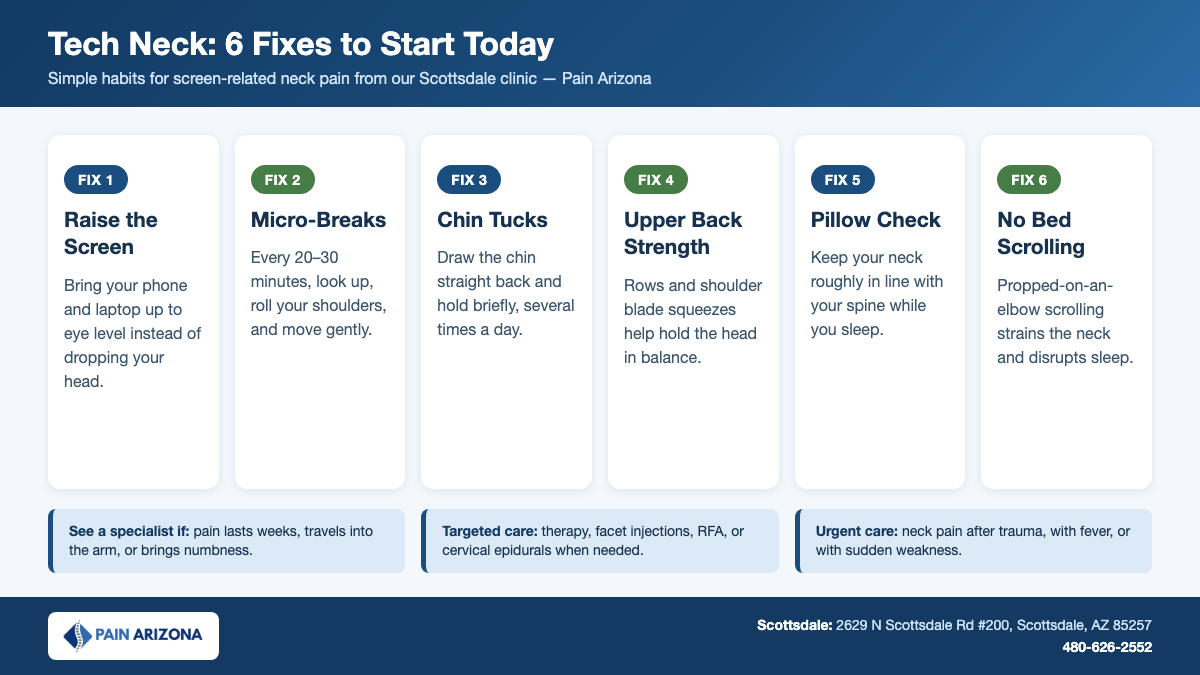
Seven Tech Neck Fixes You Can Start Today
My philosophy has always been conservative first, and tech neck is the perfect example. Before anyone considers a procedure, these everyday changes deserve a fair trial:
- Raise the screen, not your shoulders. Bring your phone up toward eye level instead of dropping your head down to it. Prop tablets on a stand.
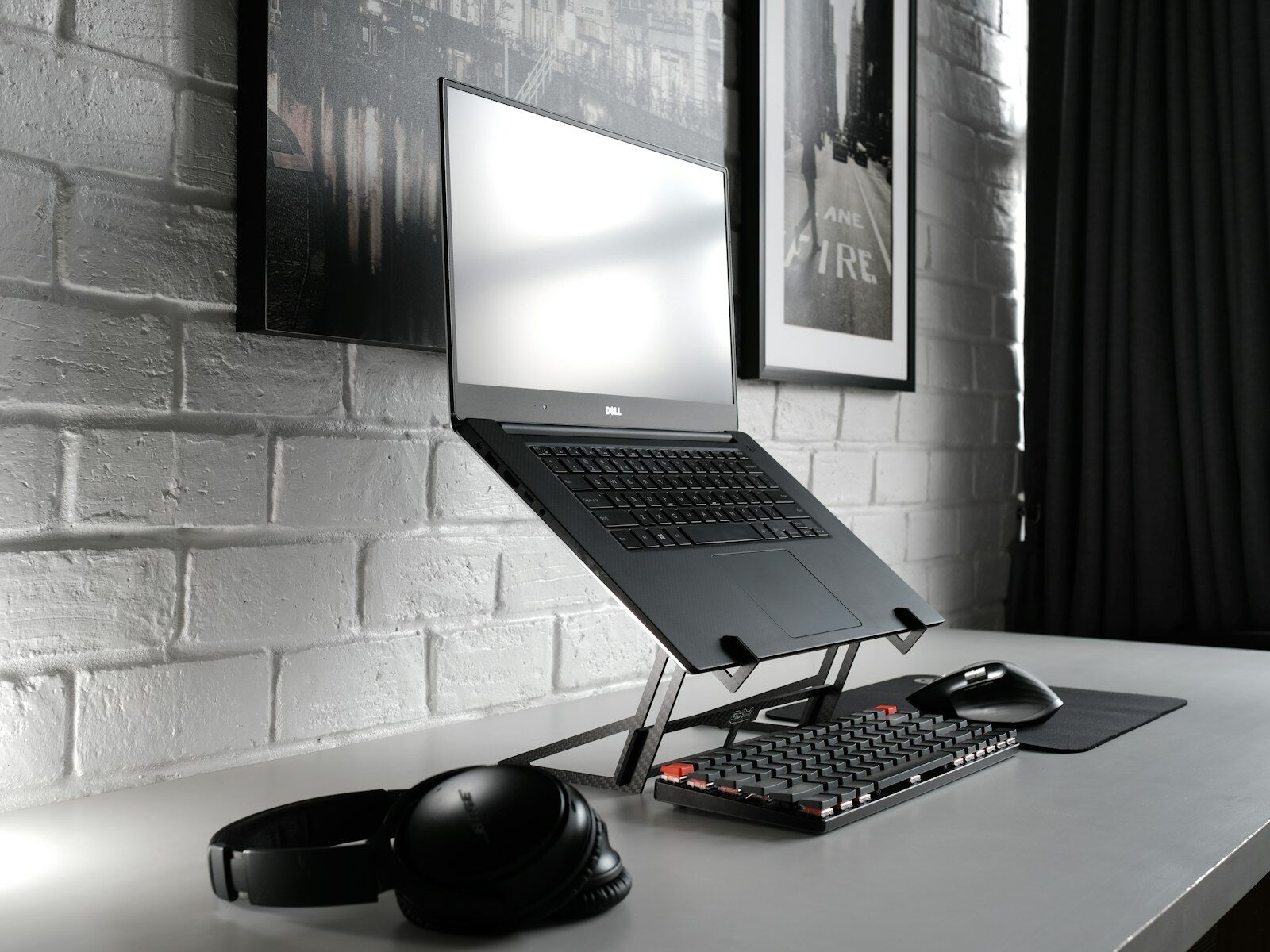
- Set up your laptop properly. Use a stand or a stack of books to raise the screen to eye level, with a separate keyboard and mouse at elbow height.
- Take micro-breaks. Every 20 to 30 minutes, look up, roll your shoulders, and gently move your neck through a comfortable range.
- Practice chin tucks. Gently draw your chin straight back, as if making a double chin, and hold briefly. Repeat several times a day to retrain posture.
- Strengthen the upper back. Exercises like rows and shoulder blade squeezes help the muscles that hold your head in balance.
- Check your pillow. A pillow that keeps your neck roughly in line with your spine can reduce morning stiffness.
- Limit screen time before bed. Scrolling in bed, propped on one elbow, is one of the worst positions for your neck, and it disrupts sleep, which itself makes pain worse.
These steps are simple, but consistency is what makes them work. Many patients notice improvement within a few weeks when they commit to them.
A practical tip from our exam rooms: tie the new habits to things you already do. Do a set of chin tucks every time you wait for coffee to brew, raise your phone every time you answer a text, and stand up whenever you join a video call. For most people, this kind of at-home tech neck treatment works best when it becomes automatic rather than something you have to remember. If you work at a desk, take a photo of your setup from the side and look at it honestly; many patients are surprised by how far forward their head actually sits.
Neck pain that outlasts your posture fixes? Let our Scottsdale team take a closer look.
Pain Arizona – Scottsdale
2629 N Scottsdale Rd #200, Scottsdale, AZ 85257
Call 480-626-2552
When Home Fixes Are Not Enough
Sometimes neck pain persists despite good habits. That is not a personal failure; it often means something more than posture strain is involved. It is worth seeing a specialist for tech neck treatment if:
- Pain has lasted longer than a few weeks despite consistent self-care
- Pain radiates into the shoulder blade, arm, or hand
- You notice numbness, tingling, or weakness in an arm or hand
- Headaches are becoming more frequent or severe
- Neck pain is disrupting sleep, work, or the activities you enjoy
Seek urgent care for neck pain after a fall or accident, neck pain with fever and a stiff neck, sudden severe headache, trouble with balance or coordination, or weakness that is getting worse quickly. Those symptoms need immediate evaluation.
For everything short of an emergency, a specialist visit is about clarity. Posture strain, facet joint arthritis, a pinched nerve, and muscle-driven headaches can all feel like “tech neck,” yet each calls for a different approach. Sorting them out is the first and most important step of any tech neck treatment plan, and it keeps you from spending months on exercises aimed at the wrong problem.
Professional Tech Neck Treatment at Our Scottsdale Clinic
When you come in for an evaluation, we start with your story: when the pain started, where it goes, what your daily screen and work habits look like, and what you have already tried. We examine your posture, range of motion, strength, reflexes, and sensation, and we review imaging if it is truly needed.
From there, a staged plan might include:
- Physical therapy focused on posture retraining, deep neck flexor strengthening, upper back conditioning, and ergonomic coaching.
- Medication guidance for short-term flare control, used carefully and for a limited time.
- Trigger point injections for persistent, tight muscle knots that do not respond to therapy alone.
- Cervical facet joint injections or medial branch blocks when arthritic facet joints appear to be the main pain source.
- Radiofrequency ablation for selected patients with confirmed facet-related neck pain, which can provide longer-lasting relief.
- Cervical epidural steroid injections when a nerve root is irritated and pain travels into the arm.
Most patients with tech neck never need a procedure. But for the subset whose pain is driven by facet joints or nerve irritation, targeted image-guided care can make a real difference, and it often creates the relief window needed to make physical therapy succeed. You can see our broader range of options on the treatments page.
The Bigger Picture: Pain Is Not Just Physical
Neck pain is rarely only about the neck. Persistent pain can affect concentration, sleep, mood, and patience with the people around you. Many tech neck patients also carry stress in their shoulders, and stress and pain feed each other. That is why good tech neck treatment looks at habits, sleep, stress, and workload alongside the spine itself.
Our mission at Pain Arizona is to save one million lives, and that mission includes the quieter, everyday kinds of suffering, like the professional who dreads the afternoon headache or the grandparent who cannot comfortably turn to back out of the driveway. Small, consistent changes, combined with expert care when needed, can give those parts of life back.
If you are considering a specialist, you can learn about our team on our practitioners page and verify any physician’s credentials through the American Board of Medical Specialties.
Get a tech neck plan that fits your work, your hobbies, and your spine.
Pain Arizona – Scottsdale
2629 N Scottsdale Rd #200, Scottsdale, AZ 85257
Call 480-626-2552
Frequently Asked Questions
Can tech neck cause permanent damage?
Tech neck itself is usually a strain pattern that responds to posture changes, exercise, and therapy. However, years of sustained strain may make existing disc or joint wear more symptomatic. The earlier you address habits and get persistent pain evaluated, the better your chances of keeping it manageable.
How long does tech neck take to improve?
Many people notice improvement within a few weeks of consistent ergonomic changes, micro-breaks, and exercises. Pain that involves arthritic joints or nerve irritation may take longer and may benefit from physical therapy or targeted treatment. Results vary from person to person.
Are neck injections safe?
Cervical injections are performed under live X-ray guidance by trained physicians, which helps with precision and safety. Like any procedure, they carry some risks, which your physician should explain clearly before treatment. For many patients they are a useful option when conservative care has not been enough.
What is the best sleeping position for tech neck?
Sleeping on your back or side with a pillow that keeps your neck roughly in line with your spine is usually best. Stomach sleeping forces the neck into rotation for hours and often worsens symptoms. Avoid propping yourself up on one elbow to scroll in bed.
The Bottom Line for Scottsdale Screen Users
Our phones and laptops are not going away, but neck pain does not have to be the price of using them. Start with the simple fixes: raise your screens, take breaks, strengthen your upper back, and protect your sleep. If the pain lingers, radiates, or starts to shape your days, a proper evaluation can uncover what is really driving it. Effective tech neck treatment combines conservative habits with targeted care for the few who need it, and after 17 years in pain medicine, I can tell you that most necks respond well when you give them the right support.
— Dr. Paul Lynch is a double board-certified pain physician and anesthesiologist and CEO of Pain Arizona. Connect with him on LinkedIn.
This article is for educational purposes only and is not medical advice. It does not replace an evaluation by a licensed medical professional. Candidacy, risks, benefits, costs, and results vary from patient to patient; please consult a qualified physician about your specific situation. Seek emergency care for neck pain after trauma, with fever and stiffness, or with sudden weakness or severe headache.
Ready to look up from the pain? Book a neck evaluation in Scottsdale.
Pain Arizona – Scottsdale
2629 N Scottsdale Rd #200, Scottsdale, AZ 85257
Call 480-626-2552