
Every fall, as Medicare open enrollment rolls around, our Mesa/Gilbert offices on Baseline Road field a wave of the same questions from East Valley seniors: “Does Medicare cover pain management? Will it pay for injections? What happens if I switch to an Advantage plan?” Those are smart questions, because Medicare pain management coverage is genuinely confusing, and misunderstandings can lead people to skip care they are entitled to or get surprised by a bill they did not expect. I am Dr. Paul Lynch, CEO of Pain Arizona and a double board-certified pain care physician and anesthesiologist with 17 years of experience caring for patients across the Valley, including a great many retirees in Mesa, Gilbert, Sun Lakes, and the surrounding communities. In this article I will walk through what Medicare typically covers, where the fine print usually lives, and how to approach your options with confidence.
The Basics: How Medicare Is Organized
Before we talk about pain care specifically, it helps to understand the building blocks. Medicare is divided into parts, and each part covers different things:
- Part A is hospital insurance. It generally covers inpatient hospital stays and some related care.
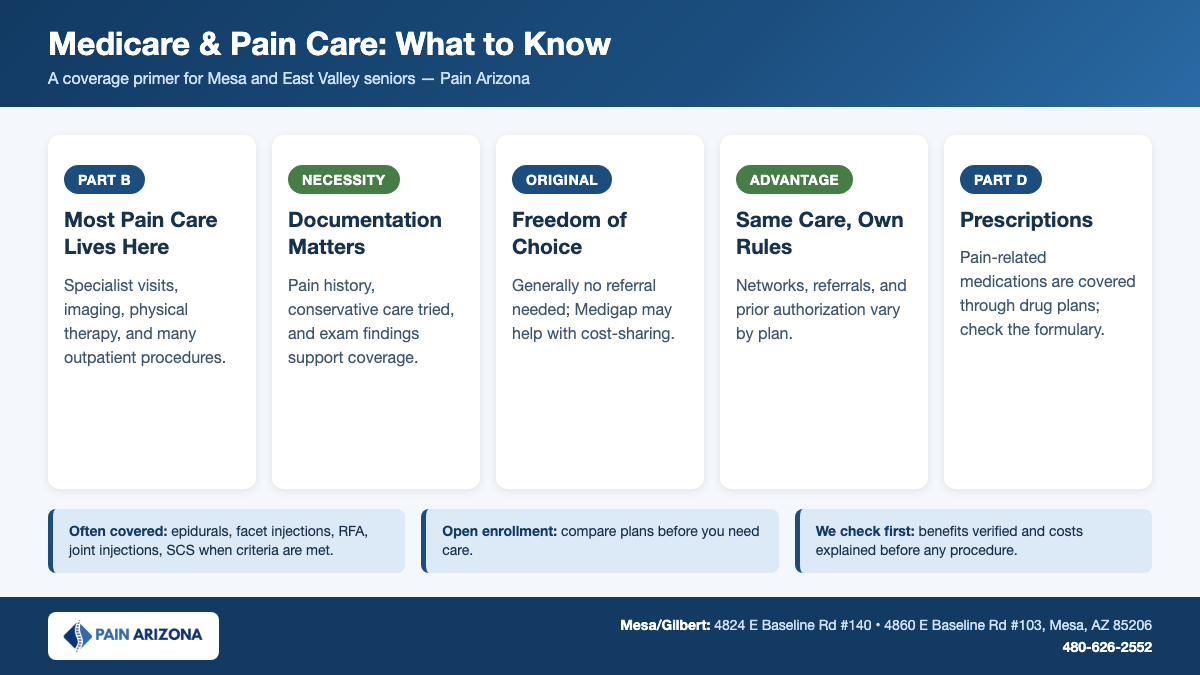
- Part B is medical insurance. It generally covers outpatient care, including physician visits, many outpatient procedures, diagnostic imaging, and physical therapy when medically necessary. Most pain management care falls under Part B.
- Part C, or Medicare Advantage, is an alternative way to receive your Medicare benefits through a private plan approved by Medicare. These plans must cover what Original Medicare covers, but they can have their own networks, referral rules, prior authorization requirements, and cost-sharing.
- Part D covers prescription drugs, including many pain-related medications, through private plans.
Many people with Original Medicare also carry a Medicare Supplement plan, often called Medigap, which can help pay for some of the out-of-pocket costs Original Medicare leaves behind. If you want a neutral, government-maintained overview of these programs, the National Library of Medicine’s MedlinePlus Medicare page links to reliable resources.
What Medicare Pain Management Coverage Typically Includes
Here is the reassuring part: Medicare generally covers a broad range of evidence-based pain care when it is medically necessary and properly documented. That often includes:
- Office visits and evaluations with a pain specialist, including follow-up visits.
- Diagnostic imaging such as X-rays and MRIs when clinically justified.
- Physical therapy when ordered as part of a treatment plan.
- Epidural steroid injections for nerve root pain from conditions like herniated discs or spinal stenosis.
- Facet joint injections and medial branch blocks for arthritic back or neck pain, often with specific documentation requirements.
- Radiofrequency ablation for facet-related pain, generally after positive diagnostic blocks.
- Joint steroid injections for knees, hips, shoulders, and other joints affected by arthritis.
- Spinal cord stimulation for selected patients with persistent nerve pain, typically after a successful trial and other required steps.
Coverage for any specific service depends on your diagnosis, your documentation, and the rules that apply to your plan. That is why the details below matter so much. Medicare pain management coverage is broad, but it is not automatic; it rewards a clear diagnosis and a well-documented plan.
On Medicare and hurting? Our Mesa/Gilbert team will check your coverage before your visit.
Pain Arizona – Mesa/Gilbert
4824 E Baseline Rd #140, Mesa, AZ 85206
4860 E Baseline Rd #103, Mesa, AZ 85206
Call 480-626-2552
The Fine Print: Medical Necessity and Documentation
The phrase you will hear over and over with Medicare pain management coverage is “medically necessary.” In practical terms, Medicare wants to see that a treatment is appropriate for your diagnosis and that the clinical story supports it. For many interventional procedures, that often means documentation of:
- How long the pain has lasted and how it affects daily function
- Conservative treatments you have already tried, such as physical therapy, home exercise, or medications
- Exam findings and, when relevant, imaging that support the diagnosis
- For some procedures, the results of diagnostic blocks or prior injections
- Limits on how frequently certain procedures can be repeated
This is one of the reasons I believe so strongly in a conservative-first approach. It is good medicine, and it also builds the documented history that Medicare and other insurers frequently require. When our team recommends a procedure, we make sure the record clearly explains why, so your coverage is not derailed by missing paperwork.
Original Medicare vs. Medicare Advantage for East Valley Seniors
This is the question I hear most during open enrollment, and it is a big one for Medicare pain management coverage. Both paths cover medically necessary pain care, but the experience can differ.
With Original Medicare, you can generally see any physician who accepts Medicare without a referral, and procedures usually follow Medicare’s national and regional coverage rules. Your costs typically include the Part B deductible and coinsurance, and a Medigap plan may cover some or all of that cost-sharing.
With Medicare Advantage, your plan may use a provider network, may require referrals for specialist visits, and frequently requires prior authorization for procedures such as spinal injections or radiofrequency ablation. Copays and out-of-pocket maximums vary by plan. Many East Valley seniors are very happy with their Advantage plans; the key is understanding the rules before you need care, not after. Open enrollment runs each fall, and it is the natural time for East Valley seniors to compare Medicare pain management coverage across plans rather than discovering the differences mid-treatment.
If you are in a chronic pain treatment plan and considering a switch during open enrollment, a few questions are worth asking before you sign:
- Is my current pain physician in the new plan’s network?
- Will I need a referral to keep seeing my specialist?
- Which procedures require prior authorization, and how long does approval usually take?
- What are the copays for specialist visits, outpatient procedures, and physical therapy?
- Are my current pain-related medications on the plan’s drug list?
How Medicare Pain Management Coverage Works at Our Mesa Clinic
At our Mesa/Gilbert offices, we try to take the guesswork out of the process. Before your first visit, our team verifies your Medicare or Medicare Advantage benefits. If a procedure is recommended, we handle prior authorization where your plan requires it and explain your estimated responsibility before anything is scheduled. Our insurance and financing page has more detail, and one call to 480-626-2552 starts the conversation.
Your first visit will feel familiar if you have read other posts on this blog: a detailed history, a careful exam, a review of any imaging, and a staged plan in plain language. For many seniors, that plan starts with physical therapy and adjustments to medication, then moves to targeted injections only if needed. You are always welcome to verify any physician’s credentials through the American Board of Medical Specialties.
Questions about Medicare and pain care? Get straight answers from our Mesa team.
Pain Arizona – Mesa/Gilbert
4824 E Baseline Rd #140, Mesa, AZ 85206
4860 E Baseline Rd #103, Mesa, AZ 85206
Call 480-626-2552
Why Seniors Should Not Accept Pain as “Just Getting Older”
I meet a lot of East Valley retirees who have quietly decided that pain is the price of age. They stopped golfing, gave up the morning walk, or skip visits with the grandkids because the car ride hurts. Some assume treatment will be too expensive; others assume Medicare will not pay for anything beyond pills.
Pain is common with age, but it is not something you simply have to accept. Arthritis, spinal stenosis, and degenerative disc changes are among the most treatable sources of pain we see, and Medicare pain management coverage often extends to the very treatments that help them. Pain is not just physical, either. In older adults it can affect balance, sleep, mood, independence, and the risk of falls. Treating it well is about protecting the life you worked hard to enjoy.
Our mission at Pain Arizona is to save one million lives, and for many seniors that means helping them stay active, independent, and engaged for years longer than they thought possible. Sometimes that starts with simply learning that the care they need is covered.
A Few Practical Tips Before Your Appointment
- Bring every card. Bring your red, white, and blue Medicare card or your Advantage plan card, plus any supplement or Part D cards.
- Bring a full medication list. Include over-the-counter pain relievers and supplements, which matter for both safety and documentation.
- Bring your history. Note when the pain started, what you have tried, and how long each treatment lasted. This often speeds up coverage decisions.
- Ask about costs up front. A reputable clinic should be willing to tell you what your estimated responsibility will be before a procedure.
- Bring a companion if you like. A second set of ears is helpful when discussing insurance and treatment options.

Frequently Asked Questions
Does Medicare cover pain management injections?
In many cases, yes. Medicare Part B often covers medically necessary injections such as epidural steroid injections, facet joint injections, and joint injections when documentation supports them. Specific rules, such as required prior treatments and limits on frequency, apply. Our team verifies your coverage before any procedure.
Do I need a referral to see a pain specialist on Medicare?
With Original Medicare, you generally do not need a referral to see a specialist who accepts Medicare. Some Medicare Advantage plans do require referrals, especially HMO-style plans. Call 480-626-2552 and our staff can check your specific plan.
Does Medicare Advantage cover the same pain treatments as Original Medicare?
Medicare Advantage plans must cover the services Original Medicare covers, but they can apply their own networks, referral requirements, prior authorization rules, and cost-sharing. The treatments are generally available; the process to access them can differ.
What will I pay out of pocket for pain care on Medicare?
It depends on your plan. With Original Medicare, you typically pay the Part B deductible and coinsurance, which a Medigap plan may help cover. With Medicare Advantage, you pay the copays or coinsurance your plan sets, up to its out-of-pocket maximum. We explain your estimated costs before any procedure is scheduled.
The Bottom Line for East Valley Seniors
Medicare is not a barrier to good pain care. For many seniors in Mesa, Gilbert, and across the East Valley, it opens the door to the same evidence-based treatments younger patients receive, from physical therapy to precise, image-guided procedures. Understanding Medicare pain management coverage, especially the differences between Original Medicare and Advantage plans, helps you choose wisely during open enrollment and get care without surprises. After 17 years of caring for patients in the Valley, my advice is simple: do not let insurance confusion keep you in pain. Let us check your benefits, and let us help you get back to the life you planned for your retirement.
— Dr. Paul Lynch is a double board-certified pain physician and anesthesiologist and CEO of Pain Arizona. Connect with him on LinkedIn.
This article is for educational purposes only and is not medical, insurance, or financial advice. Medicare rules, plan benefits, and costs vary and change over time; confirm coverage details with Medicare or your plan. This article does not replace an evaluation by a licensed medical professional. Candidacy, risks, benefits, costs, and results vary from patient to patient.
Make the most of your Medicare benefits. Schedule a pain evaluation in Mesa.
Pain Arizona – Mesa/Gilbert
4824 E Baseline Rd #140, Mesa, AZ 85206
4860 E Baseline Rd #103, Mesa, AZ 85206
Call 480-626-2552