
ICD-10 Code for L1 Compression Fracture: A Complete Guide for Coders
Why Getting the ICD-10 Code for L1 Compression Fracture Right Matters
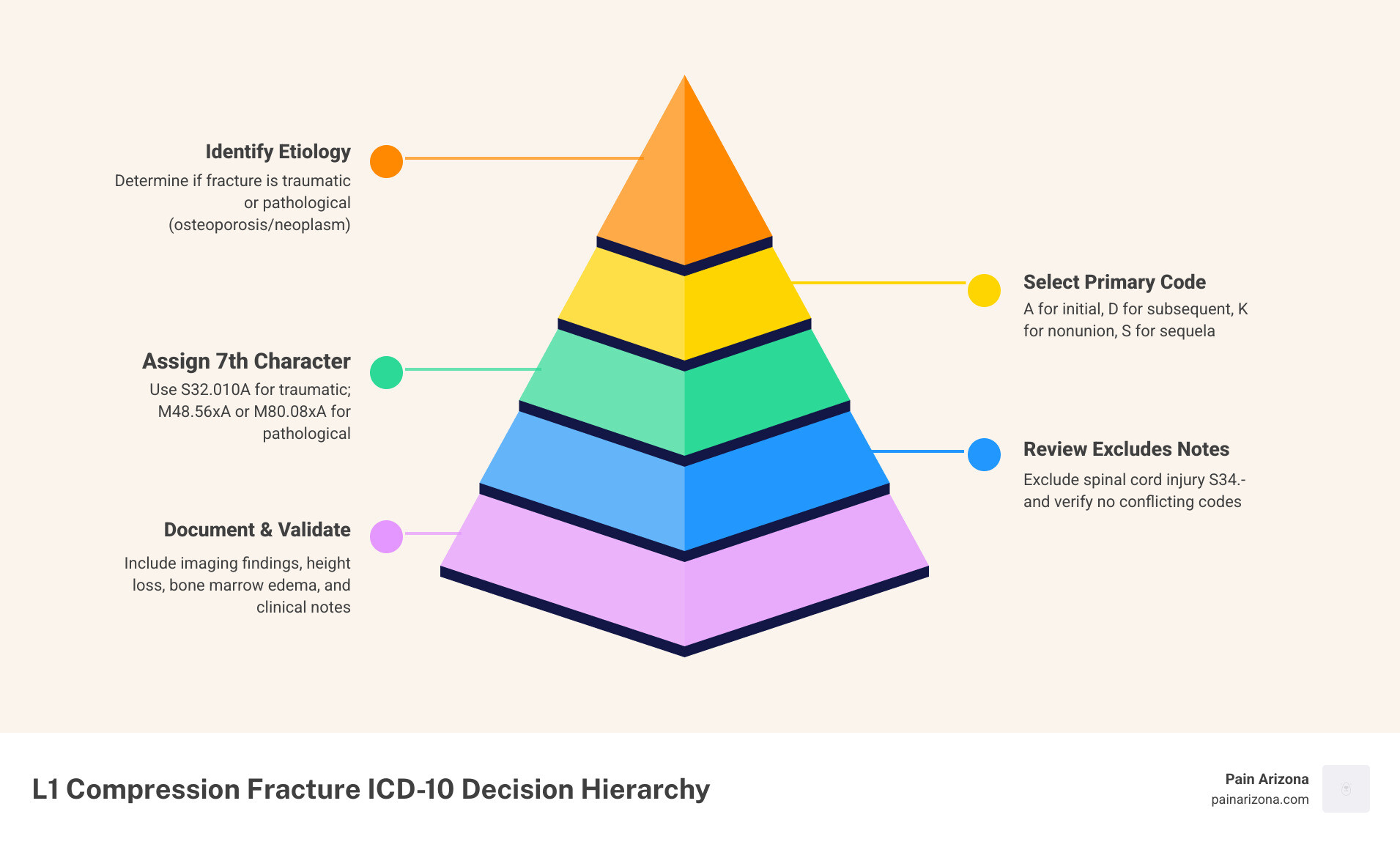
The ICD-10 code for L1 compression fracture depends on one critical question: was the fracture caused by trauma or by an underlying condition like osteoporosis?
Here’s the quick answer:
| Fracture Type | Primary ICD-10 Code | Description |
|---|---|---|
| Traumatic (closed) | S32.010A | Wedge compression fracture, L1, initial encounter |
| Pathological (osteoporosis/neoplasm) | M48.56xA | Collapsed vertebra, lumbar region, initial encounter |
| Age-related osteoporosis with fracture | M80.08xA | Osteoporosis with current pathological fracture, vertebra |
Getting this distinction wrong creates real problems — denied claims, audit flags, and inaccurate patient records.
Vertebral compression fractures are far more common than most people realize. Around 700,000 occur in the U.S. every year, making them the most common osteoporotic fracture — nearly twice as frequent as hip or wrist fractures. Yet only about one-third are ever clinically diagnosed, which means documentation and coding gaps are widespread.
Whether you’re a coder, a clinician, or a biller, this guide walks you through every code, every 7th character, and every documentation requirement you need for accurate L1 fracture coding.
I’m Dr. Nasser, a double board-certified PM&R and pain medicine physician with extensive experience evaluating and treating vertebral compression fractures across the Greater Phoenix area — conditions where precise clinical documentation directly shapes the ICD-10 code for L1 compression fracture assigned and the care patients ultimately receive. In the sections below, I’ll break down exactly how to code these fractures correctly, from first encounter to sequela.
Traumatic vs. Pathological: Finding the Right ICD-10 Code for L1 Compression Fracture
To select the correct icd-10 code for l1 compression fracture, the first order of business is identifying the etiology. In the medical coding world, fractures are broadly divided into two main camps: traumatic and pathological.
Traumatic Fractures (S32.010A)
A traumatic fracture occurs when a healthy bone is subjected to a force greater than it can bear. Think of a car accident, a fall from a ladder, or a hard slip on a wet surface. If a patient with otherwise healthy bones sustains a fracture due to an external force, we look to the “S” category of codes.
The baseline code for an acute traumatic compression fracture of the first lumbar vertebra is S32.010A. This specific code represents a wedge compression fracture of first lumbar vertebra, initial encounter for closed fracture.
For more details on the traumatic coding pathways, you can explore the ICD-10-CM Diagnosis Code S32.010A database.
Pathological Fractures (M48.56xA and M80.08xA)
Pathological fractures happen when the bone is structurally weakened by an underlying disease process. The bone becomes so fragile that normal, everyday activities — such as coughing, sneezing, reaching for a coffee mug, or taking a minor stumble — can cause it to collapse.
- M48.56xA (Collapsed vertebra, not elsewhere classified, lumbar region, initial encounter) is utilized when a lumbar vertebra collapses due to unspecified pathologically weakened bone, or when the collapse is not directly classified under a specific disease like age-related osteoporosis.
- M80.08xA (Age-related osteoporosis with current pathological fracture, vertebra, initial encounter) is the gold standard code when a patient has documented osteoporosis and suffers a vertebral compression fracture without a distinct traumatic event.
To understand how these chronic conditions relate to spinal structural integrity, you can read our comprehensive Vertebral Compression Fracture Guide.
The Clinical Comparison
To make things easier, we have put together a breakdown of the three primary codes you will encounter when coding an L1 compression fracture:
| Feature | S32.010A | M48.56xA | M80.08xA |
|---|---|---|---|
| Etiology | Traumatic injury (e.g., car accident, fall) | Pathological collapse (disease, neoplasm, unspecified) | Pathological collapse due directly to osteoporosis |
| Bone Health | Typically healthy bone before trauma | Weakened by disease or tumor | Weakened by age-related or secondary osteoporosis |
| Triggering Event | High-impact or moderate-impact trauma | Minimal to no trauma | Minor everyday movement, sneeze, or minor stumble |
| Key Documentation | Clear history of physical trauma | History of bone disease or localized bone destruction | DEXA T-score $\le$ -2.5, history of osteoporosis |
For a deeper dive into the documentation nuances between these codes, the resource ICD-10 Coding for L1 Compression Fracture ( S32.010A, M48.56XA ) provides exceptional technical clarity.
Clinical Documentation Requirements for L1 Vertebral Fractures
A major pitfall in medical billing is “unspecified” coding. If a medical record simply states “L1 compression fracture,” a coder is forced to use an unspecified code, which acts as a giant red flag for insurance audits and potential claims denials. To support a highly specific code, clinical documentation must be robust.
What Clinicians Must Document
To validate the assignment of a specific icd-10 code for l1 compression fracture, the clinical chart should clearly outline:
- The Mechanism of Injury: Did the patient fall from a height, or did they experience sudden back pain while lifting groceries? Clear documentation of trauma (or lack thereof) is the primary fork in the road for coding.
- Imaging Findings: X-rays, CT scans, or MRIs must explicitly confirm the L1 location. The report should specify the fracture type (e.g., wedge, crush, or burst) and note the severity, such as “25% anterior height loss.”
- Acuity and Activity: Is there evidence of bone marrow edema on the MRI? Bone marrow edema indicates an active, acute healing phase, whereas its absence suggests an old, healed fracture.
- Underlying Bone Density: If osteoporosis is suspected, clinicians should reference bone density testing (DEXA scans) and document T-scores to validate pathological coding.
For clinicians looking to optimize their clinical charts, the L1 Vertebral Compression Fracture – AI-Powered ICD-10 Documentation guide offers excellent templates to streamline this process.
Translating Symptoms to Code Validation
Patients presenting with an L1 compression fracture typically experience sudden, localized mid-to-lower back pain that worsens when standing or walking and improves when lying down. Understanding these clinical presentations helps coders spot discrepancies. If a chart notes “chronic dull back pain for three years” without acute imaging changes, coding for an acute traumatic fracture (S32.010A) is highly inappropriate.
To explore the wider clinical context of spinal pain, you can review our guide on Back Pain Causes.
How to Apply the 7th Character for an L1 Fracture Code
The seventh character in ICD-10-CM coding is where many mistakes happen. For vertebral fractures, this final character is not optional; it is required to explain the exact phase of treatment the patient is receiving.
Understanding the 7th Character Extensions for the Traumatic ICD-10 Code for L1 Compression Fracture
For traumatic codes like S32.010, the seventh character specifies the encounter type and the healing status. The most common seventh characters for these fractures in 2026 include:
- A – Initial encounter for closed fracture: Used when the patient is receiving active treatment for the fracture. This includes surgical evaluation, emergency department visits, or the initial casting/bracing phase.
- B – Initial encounter for open fracture: Used if the fracture communicates with an open wound. You can reference the 2026 ICD-10-CM Diagnosis Code S32.010B for specific open fracture guidelines.
- D – Subsequent encounter for fracture with routine healing: Used for follow-up visits after the active treatment phase is complete (e.g., routine x-rays to monitor healing progress).
- G – Subsequent encounter for fracture with delayed healing: Used when the bone is taking longer than expected to mend.
- K – Subsequent encounter for fracture with nonunion: Used when the bone ends fail to heal together. For detailed rules on nonunion coding, refer to the 2026 ICD-10-CM Diagnosis Code S32.010K.
- S – Sequela: Used for complications or chronic conditions that arise as a direct result of the fracture after the fracture itself has healed (e.g., chronic post-traumatic kyphosis).
Coding Pathological and Osteoporotic Fractures at the L1 Level
Pathological codes also require a seventh character, but their options are slightly different. For example, when coding M80.08x (Age-related osteoporosis with current pathological fracture, vertebra), you must still append a seventh character to indicate the encounter type:
- A is used for the initial encounter while the patient is receiving active treatment.
- D represents subsequent encounters for routine recovery.
- G is for delayed healing.
- K is for nonunion.
- P is for malunion (healing in an abnormal position).
- S is for sequela.
When managing these complex, chronic pain cases, treating the underlying fracture and managing the resulting pain is essential. If you are looking for clinical pathways, check out our Back Pain Treatment Complete Guide or read about targeted Lower Back Pain Treatments available at our clinics.
Coding Pitfalls, Excludes Notes, and Audit Risks

Failing to understand the structural rules of the ICD-10 manual can result in immediate claim denials. Here are the primary pitfalls and guidelines to keep in mind when coding an L1 compression fracture.
1. Code First Instructions
If the patient has sustained a spinal cord injury alongside their L1 fracture, ICD-10-CM guidelines dictate that you must code first any associated spinal cord and spinal nerve injuries (S34.-). The fracture code itself becomes the secondary diagnosis.
2. Excludes1 vs. Excludes2 Notes
Pay close attention to coding exclusions. For instance, category S32 contains:
- Excludes1: Transection of abdomen (S38.3). This means these two codes can never be billed together because they are mutually exclusive.
- Excludes2: Fracture of hip NOS (S72.0-). This indicates that a hip fracture is not part of an L1 fracture, but a patient could theoretically have both at the same time. If documented, you can bill both codes together.
To review these detailed code exclusions and structural notes, the AAPC S32.010A Code Details page is an invaluable resource.
3. MS-DRG Mapping and Audit Risks
Insurance companies and government auditors keep a close eye on vertebral fracture claims because they heavily impact Medicare Severity Diagnosis-Related Group (MS-DRG) classifications.
- MS-DRG 551: Medical back problems with major complications or comorbidities (MCC).
- MS-DRG 552: Medical back problems without MCC.
If a hospital or clinic routinely bills acute traumatic codes (S32.010A) without documented high-impact trauma, or fails to provide radiological proof of an acute fracture, they run a high risk of audits. Unspecified codes or incorrect seventh characters can result in downcoding, delaying reimbursement, or triggering a retroactive clawback of funds.
Frequently Asked Questions About L1 Compression Fracture Coding
What is the specific icd-10 code for l1 compression fracture due to trauma?
The specific, billable code for an acute traumatic compression fracture of the first lumbar vertebra is S32.010A. This code specifically represents a wedge compression fracture of first lumbar vertebra, initial encounter for closed fracture. If the documentation does not specify whether the fracture is open or closed, guidelines state it should be coded as closed. If it does not specify whether it is displaced or nondisplaced, it defaults to displaced.
How do you code a subsequent encounter for an L1 fracture with nonunion?
To code a subsequent encounter where a traumatic L1 wedge compression fracture has failed to heal properly, you would use the code S32.010K. The seventh character K explicitly indicates a “subsequent encounter for fracture with nonunion.”
When should you use M80.08xA instead of S32.010A?
You should use M80.08xA instead of S32.010A when the L1 compression fracture is pathological and caused by age-related osteoporosis. If the patient has osteoporosis and sustains a fracture from a minor, non-traumatic event (like coughing or stepping off a low curb), M80.08xA is the correct code. Conversely, if a patient with osteoporosis is involved in a major car crash and fractures their spine, the fracture is considered traumatic and coded under the S32 series.
Conclusion and Next Steps for Patient Care
Accurate coding is the bridge that connects high-quality clinical care with seamless healthcare operations. When clinicians document thoroughly, coders can assign the exact icd-10 code for l1 compression fracture, ensuring compliance, reducing audit risks, and securing timely insurance approvals.
At Pain Arizona, we understand that behind every clinical code is a real person seeking relief from debilitating back pain. Led by our double board-certified pain management physicians, we provide compassionate, evidence-based care across the Greater Phoenix Area — including our state-of-the-art clinics in Phoenix, Mesa, Gilbert, Scottsdale, and Glendale.
For patients suffering from the sharp, limiting pain of an L1 compression fracture, conservative therapies are not always enough. We specialize in cutting-edge, minimally invasive procedures designed to restore spinal stability and eliminate pain at its source. This includes kyphoplasty and vertebroplasty — procedures where a medical-grade bone cement is carefully injected into the collapsed L1 vertebra to restore its height and structurally stabilize the fracture.
To learn more about our advanced surgical and non-surgical options, explore our guide to Minimally Invasive Spine Surgery or visit our dedicated Vertebral Compression Fracture Treatment page.
If you or a patient are dealing with spinal pain, we make accessing top-tier care simple. We accept most insurance plans. Check with our office manager to see if your plan is accepted, and schedule an evaluation with us today to start your journey back to pain-free living.